What Led To US-Israeli Strikes On Iran?

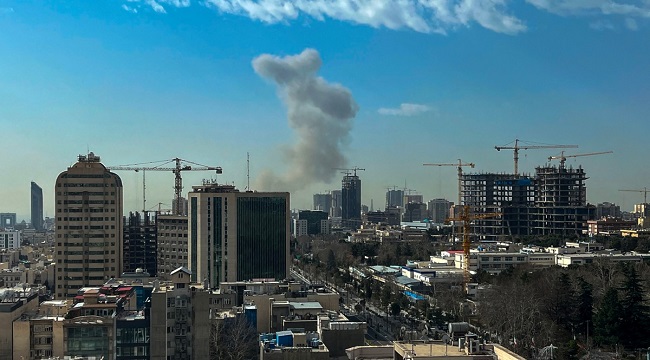
The US and Israeli strikes on Iran follow the Islamic Republic’s violent repression of mass protests and stalled negotiations between Tehran and Washington over existential issues for Iran: its nuclear program, ballistic missiles, and regional proxies.

Here is a blow-by-blow account:

Protest crackdown

Protests over economic hardship erupted in Tehran in late December before spreading nationwide as a broad anti-government movement, peaking on January 8 and 9.

The unrest prompted a violent crackdown by Iranian authorities, with the US-based Human Rights Activists News Agency (HRANA) recording more than 7,000 deaths, mostly protesters, while warning the full toll was likely far higher.

In addition, more than 53,000 people have been arrested since January.

US President Donald Trump has cited 32,000 deaths, echoing figures reported by Persian-language media based outside of Iran.

For their part, Iranian authorities acknowledge more than 3,000 deaths but blame the violence on “terrorist acts” they alleged were orchestrated by the United States and Israel.

As the crackdown was waged, Trump initially pledged to the Iranian people on January 13 that “help is on its way” and ordered the biggest military build-up in decades in the Middle East.

Nuclear Programme

While Trump initially focused on the protest crackdown, he soon pivoted to Iran’s nuclear programme — a long-standing point of contention. Western powers have accused Tehran of seeking nuclear weapons, allegations Iran denies.

The United States has pushed for a total ban on all uranium enrichment, even for civilian purposes, while Tehran maintains its nuclear programme is strictly peaceful, despite enriching uranium to 60 per cent — a level exceeding civilian requirements.

Washington and Tehran opened indirect talks in Geneva this week in an attempt to revive a deal on Iran’s nuclear programme.

United Nations peacekeepers stand near the wreckage of an Iranian rocket that was reportedly intercepted by Israeli forces in the southern Syrian countryside of Quneitra, near the Golan Heights, close to the town of Ghadir al-Bustan. Photo by BAKR ALKASEM / AFP

On Tuesday, in his State of the Union address to Congress, Trump spoke of Iran’s “sinister nuclear ambitions” and accused Tehran of seeking to develop weapons that could hit the United States.

The latest round of negotiations concluded on Thursday without an agreement as Washington reportedly sought to have negotiations include Tehran’s ballistic missile program and regional network of proxy militias.

Iran’s Foreign Minister Abbas Araghchi warned Friday that Washington must abandon its “excessive demands” if it hopes to secure an agreement, without specifying which terms he was referring to.

Ballistic Missiles

The US president expressed frustration after Tehran refused to address its ballistic missile program during the latest negotiations.

Israel has also pushed for the issue to be addressed, warning that Iran’s short- and medium-range missile arsenals pose a direct threat to its security.

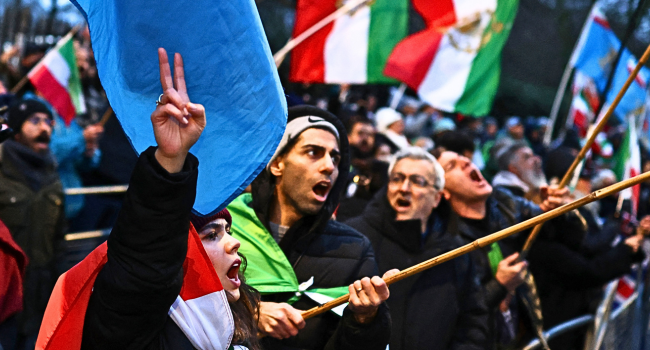
Protesters gather with Iranian national flags during a demonstration in support of the government and against US and Israeli strikes outside a mosque in Tehran on February 28, 2026. Photo by ATTA KENARE / AFP

Trump said Wednesday that Tehran has developed missiles capable of threatening Europe and US military bases overseas, warning that the regime is also developing weapons that “will soon reach” the United States.

But the Islamic Republic said it refuses to negotiate on its ballistic missiles, asserting its right to self-defence.

Iranian-Backed Proxies

Beyond seeking regime change, the US and Israel have vowed to dismantle Iran’s so-called “axis of resistance” — a network of armed and funded regional proxies that includes Hezbollah in Lebanon, Palestinian militant group Hamas, the Houthis in Yemen, and various militias in Iraq.

“We’re going to ensure that the region’s terrorist proxies can no longer destabilize the region or the world and attack our forces,” Trump said in a message posted to his Truth Social platform on Saturday.

“It’s been mass terror, and we’re not going to put up with it any longer. From Lebanon to Yemen and Syria to Iraq, the regime has armed, trained, and funded terrorist militias that have soaked the earth with blood and guts,” he said.

US-Iran combo

He further condemned the “monstrous October 7th attacks on Israel” by Hamas.

Hezbollah and the Houthis have also targeted Israel in recent months.

Trump also cited “countless attacks” against US forces in the Middle East, alongside strikes targeting US naval and commercial vessels and international shipping lanes.
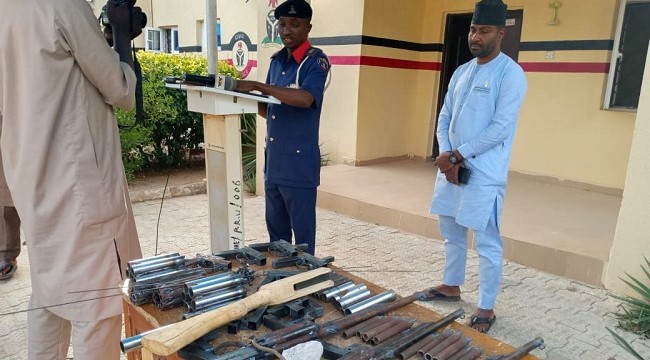
Four Suspects Arrested As NSCDC Busts Illegal Arms Fabricating Factory In Katsina

The Katsina State Command of the Nigeria Security and Civil Defence Corps (NSCDC) has announced the successful uncovering and dismantling of a suspected illegal arms fabricating factory in Kore Village along Batsari Road in Batagarawa Local Government Area of the state.

The operation was carried out on Thursday, 26th February, 2026, at about 1000 hours by the command’s Special Rapid Response Squad, acting on credible intelligence.

In a statement issued on Friday, the Public Relations Officer of the Command, Buhari Hamisu, stated that upon receiving the information, State Commandant Abbas Dan-ile Moriki directed the squad to respond immediately while maintaining professionalism.

He explained that the team promptly acted, uncovered and dismantled the factory, seized weapons and fabricating equipment, and arrested four suspects.

READ ALSO: Police Confirm Killing Of Five Persons In Plateau Attack

The suspects—Haruna Lawal (male, 28), Badamasi Kabiru (male, 50), Hamza Lawal (male, 30), and Sagir Abba (male, 25)—were apprehended inside the factory while allegedly perpetrating the crime.

He added that the suspects are currently under investigation to identify other members of the syndicate and potential buyers, and that due diligence would be observed in their prosecution.

The Commandant assured the public of adequate security and reiterated the command’s commitment to combating illicit arms proliferation, uncovering activities of vandals and economic saboteurs, and tackling crime in the state.

“Commandant Moriki thanks the general public for their continued cooperation and urges more support for security agencies by providing actionable and timely intelligence to help expose the activities of miscreants in the state.

“The Commandant remains committed to promoting safety, security, and protecting critical national assets and infrastructure in Katsina State and Nigeria as a whole.

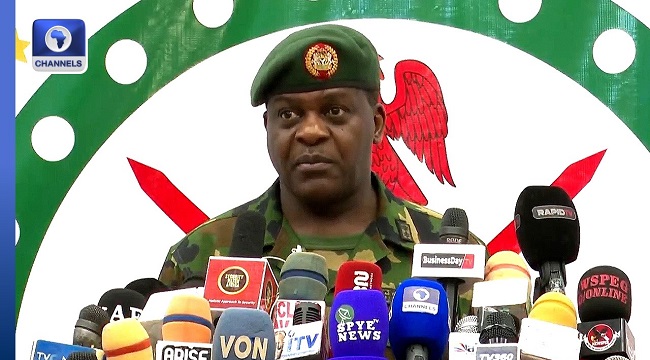
VIDEO: DHQ Defends US Military Support, Says Nigeria’s Sovereignty Not Threatened

The Defence Headquarters (DHQ) has clarified that military assistance from the United States to Nigeria does not undermine the nation’s sovereignty, insisting that the partnership is legitimate and beneficial to ongoing security efforts.

Speaking on Friday, military authorities said the support from the U.S. government is strictly advisory and capacity-building in nature, with no financial burden on the Federal Government.

According to the DHQ, the collaboration is primarily aimed at training Nigerian troops and enhancing counter-terrorism operations across the country.

The clarification comes days after the DHQ announced the arrival of about 100 U.S. military personnel and related equipment on February 17. In an earlier statement, the Director of Defence Information, Maj. Gen. Samaila Uba, explained that the deployment was the outcome of discussions held during a working group meeting between Nigerian officials and their U.S. counterparts.

Providing further details at a press briefing in Abuja on Friday, the Director of Defence Media Operations, Maj. Gen. Micheal Onoja, said the partnership should not be misconstrued, describing it as a routine military-to-military engagement consistent with international cooperation in combating terrorism.

He maintained that such collaboration is common practice among nations facing security challenges and is designed to strengthen Nigeria’s operational capacity rather than compromise its independence.

Watch the video below:

US In ‘Major Combat’ To Destroy Iran Missiles, Navy, Says Trump

US President Donald Trump announced Saturday that “major combat” is underway to destroy Iran’s missile forces and “annihilate” the country’s navy.

“The United States’ military began major combat operations in Iran,” Trump said in a video message posted on his social media site while he spent the weekend at his Florida golf club. “Our objective is to defend the American people by eliminating imminent threats from the Iranian regime.”

“We are going to destroy their missiles and raze their missile industry to the ground. It will be totally — again — obliterated. We’re going to annihilate their navy,” Trump said.

20 Killed In Cash-Packed Military Plane Crash In Bolivia

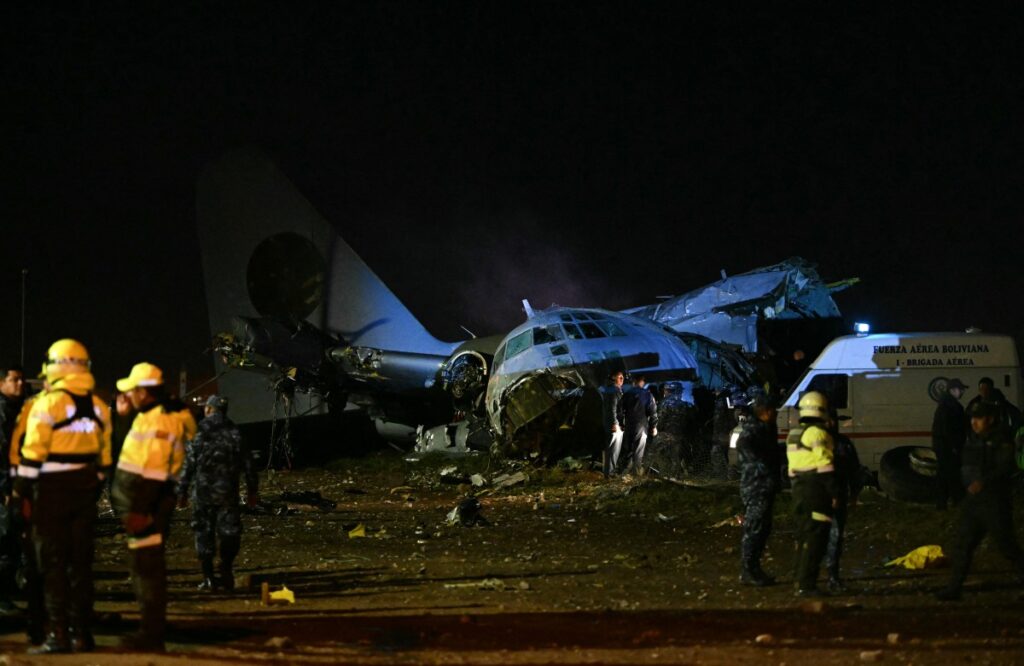
At least 20 people were killed when a Bolivian military cargo plane carrying banknotes crashed while landing near the capital city La Paz, police said Friday, as crowds attempted to loot the site.

The aircraft, a C-130 Hercules transport plane — manufactured by Lockheed Martin — veered off the runway at El Alto International Airport and crashed into an avenue, destroying multiple cars and damaging trucks, local media footage showed.

Mangled parts of the aircraft were seen on the road where the plane came down and bystanders could be seen rushing to grab the scattered cash prompting police to deploy tear gas to repel the hordes.

Authorities were later seen setting the money alight in a bonfire at the scene of the crash.

It was not immediately known what caused the crash but witnesses told AFP that the weather had been treacherous.

“A heavy hailstorm” was falling and “there was lightning” when the plane went down said Cristina Choque, a 60-year-old vendor whose car was struck by aircraft wreckage.

“The tire is what fell on top of us… my daughter is injured, she has a head wound,” she said.

The Ministry of Defense said it would launch an investigation into the crash.

Military personnel stand next to pieces of a military plane that crashed in el Alto, near La Paz on February 27, 2026. (Photo by AIZAR RALDES / AFP)

Colonel Rene Tambo, head of the police homicide division in El Alto, told reporters late Friday that “there are about 20, maybe a few more,” casualties.

Colonel Pavel Tovar of the National Fire Department gave an earlier toll of “between 15 and 16 people” dead in the disaster.

“We are recovering the bodies of these people who have sadly suffered in the accident,” he said.

Bolivia’s health ministry reported that at least 28 people were injured.

 Money grab ‘a crime’

Fatalities were recorded both at the airport and on the busy avenue where the plane crashed and struck several vehicles.

The Bolivian Air Navigation and Airports authority NAABOL said in a statement that the C-130 Hercules had departed from the eastern city of Santa Cruz and crashed while landing at El Alto international airport, which has since suspended operations.

The defense ministry in a statement said that “the money transported in the crashed aircraft has no official serial number… therefore it has no legal or purchasing power.”

A destroyed car is pictured near the site where a military plane crashed in el Alto, near La Paz on February 27, 2026.  (Photo by AIZAR RALDES / AFP)

It said that “its collection, possession, or use constitutes a crime.”

Choque and her family remained inside their mangled vehicle for fear of the heaving crowd at the crash site.

The La Paz Prosecutor’s Office received reports of businesses that were also targeted by criminals taking advantage of the chaos.

“Twelve people have been arrested” for questioning, prosecutor Luis Carlos Torres told reporters.

Hospitals in El Alto also launched a blood donation campaign to treat the injured.

La Paz, at an altitude of 3,650 meters (11,975 feet) and surrounded by Andean peaks, is the highest administrative capital in the world.

Court Affirms Ibadan PDP Convention, Recognises Turaki-Led Leadership

An Oyo State High Court sitting in Ibadan has affirmed the validity of the Peoples Democratic Party (PDP) national convention held in the Oyo State capital in November 2025, which produced Kabiru Tanimu Turaki as the party’s substantive national chairman.

Delivering judgement on Friday, Justice Ladiran Akintola upheld the amended originating summons filed by Musibau Adetunmbi (SAN) on behalf of the claimant, Folahan Malomo Adelabi.

The court granted all 13 reliefs sought, holding that the convention complied with the provisions of the 1999 Constitution, the Electoral Act 2022 (as amended), and other relevant electoral laws.

Justice Akintola also dismissed motions seeking a stay of proceedings and suspension of the judgment filed by Sunday Ibrahim (SAN) on behalf of Austin Nwachukwu and two others.

The court had earlier rejected their application for joinder, describing it as lacking merit.

In addition, the ruling directed the Independent National Electoral Commission (INEC) to recognise and give full effect to the outcomes of the convention, including the leadership of the National Working Committee (NWC) led by Turaki.

READ ALSO: 2027: INEC Commissioner Defends Timetable, Says Party Digital Membership Deadline Feasible

The decision is the latest development in a protracted legal tussle over the PDP’s leadership following the November 15, 2025, elective convention in Ibadan.

On January 30, 2026, the Federal High Court, Ibadan, presided over by Justice Uche Agomoh, nullified the convention, ruling that it was conducted in defiance of existing court orders.

That judgment barred Turaki and other officers from parading themselves as national officials of the party.

The conflicting rulings have deepened uncertainty within the opposition party’s hierarchy.

Despite the latest validation by the Oyo State High Court, the PDP remains divided between the Turaki-led leadership and a different bloc aligned with Nyesom Wike, minister of the Federal Capital Territory, which has reportedly dismissed the judgement as inconsequential.