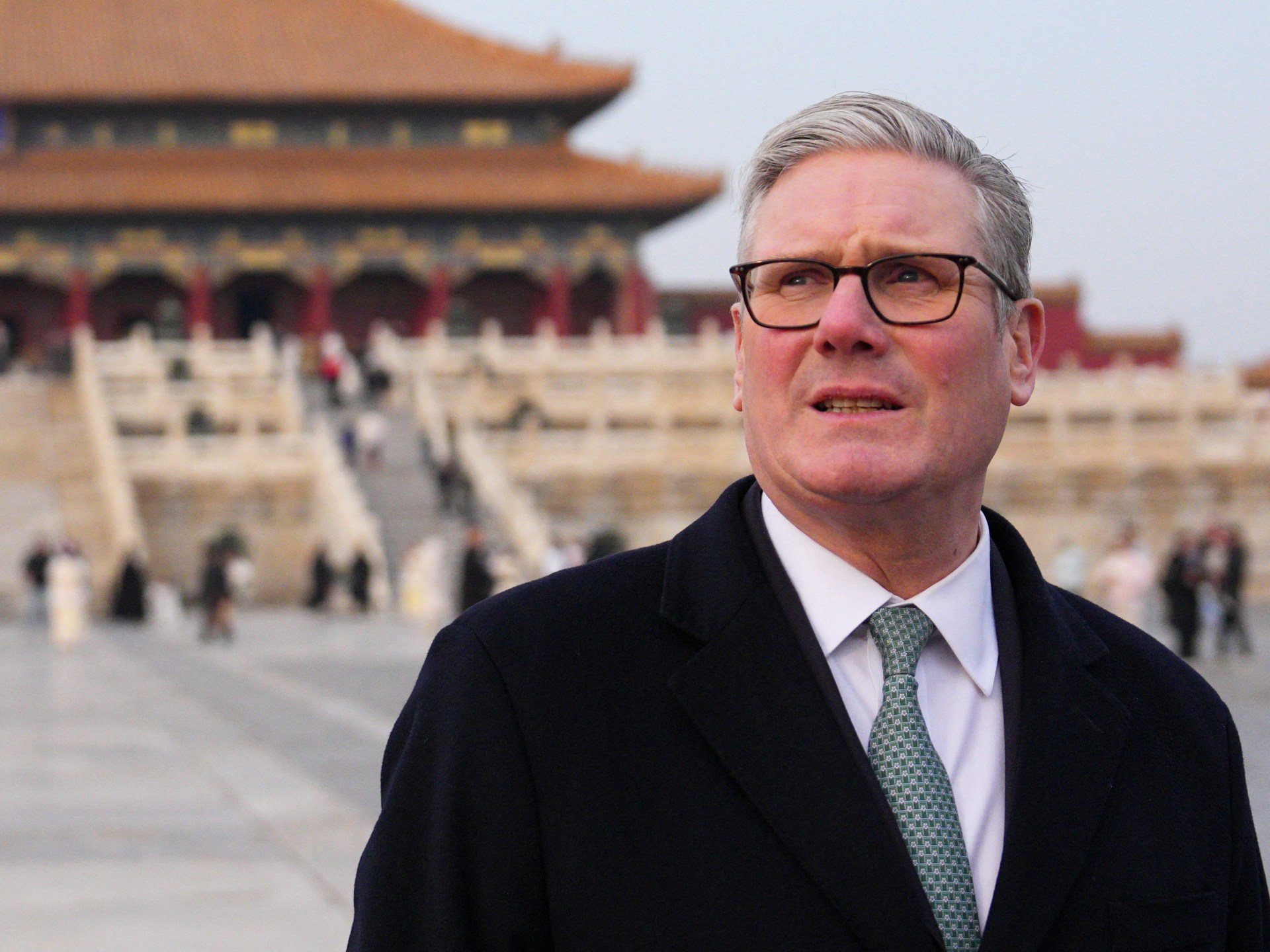
A parade of Western leaders to Beijing, including French President Emmanuel Macron in December, and more recently, Canadian Prime Minister Mark Carney and the United Kingdom’s Keir Starmer, with German Chancellor Friedrich Merz planning a visit later this month, might suggest a great geopolitical realignment in the making. But to interpret these visits as a strategic defection from the United States is to mistake tactical adaptation for fundamental realignment. What we are witnessing is the pursuit of economic pragmatism alongside enduring security alliances, a balancing act that China’s charm offensive has not fundamentally disrupted.
The initial phase of President Donald Trump’s second term saw US allies pursuing a delicate balancing act, engaging in strategic hedging by maintaining economic ties with China while aligning strategically with Washington against perceived threats from Beijing and Moscow. However, Trump’s prolonged trade wars, rough treatment of European and North American partners, and coercive threats shattered illusions of a united Western front. This disorientation soon found its voice in Canadian PM Carney’s Davos speech.
He declared the end of the US-led, rules-based international order, framing the situation not as a transition but a “rupture”, where “the strong can do what they can, and the weak must suffer what they must”. This crystallised the disillusionment, creating political and diplomatic cracks that Beijing was swift to explore and, if possible, exploit.
Against this backdrop, the diplomatic pivot to Beijing reveals its true meaning: Western leaders are not embracing China but pursuing what Carney termed a “third path” for middle powers, a quest for “strategic autonomy” in energy, critical minerals, and supply chains to avoid becoming collateral in great power coercion. These visits focus on economic diversification and risk mitigation, not replacing one patron with another. The evidence from these visits reveals the severe limits of Beijing’s courtship. Joint statements emphasise practical cooperation but avoid any fundamental strategic shift, underscoring their transactional, not transformational, nature.
This pattern highlights a critical reality: economic pragmatism confronts an immovable priority, foundational security. A stark demonstration of this priority came when Australia moved to reclaim the Port of Darwin from its Chinese lessee, despite the port’s profitability and official reviews finding no security threat. That the formal assessments found no immediate security risk only reinforces the point: in moments of strategic uncertainty, perception and alliance alignment can outweigh technocratic evaluations, signalling where ultimate loyalties lie.
In alliance politics, signalling often matters as much as assessment. Even with deep and structurally significant European Union-China trade, European allies safeguard US intelligence sharing and defence commitments. Despite rhetorical tensions with Washington, European states have increased defence spending towards NATO’s 2 percent benchmark and deepened military coordination over Ukraine, reinforcing the institutional bedrock of transatlantic security. Their discontent fuels appeals for restraint, not support for China-led confrontation, revealing a gap rooted in deeper issues than trade.
Beneath the transactional politics lies a civilisational schism, a chasm that neither diplomatic niceties nor economic pragmatism can bridge. For Europe, Canada and Australia, a legacy of shared Western identity permeates elite consciousness, fostering assumptions of cultural affinity amplified by visceral fears that China’s state-driven capitalist model poses a systemic threat to the liberal-democratic order. This identity is not merely cultural but institutional, embedded in NATO interoperability, Five Eyes intelligence integration and decades of joint operational planning. This unease transcends protectionism, representing an existential struggle to preserve institutional and ideological hegemony. The double standard is revealing: the US’s predatory behaviour is framed as a regrettable aberration, while China’s trade practices are cast as an inherent systemic challenge. Consequently, trade disputes with Washington fade against this deeper dissonance.
For key Asian allies like Japan and South Korea, the US alliance is foundational to their sovereignty. Their post-war identities were forged under US security patronage, with integrated defence systems and political cultures creating deep bonds. To Tokyo and Seoul, China’s rise stirs historical anxieties about falling into a new sphere of influence. Thus, even as South Korea’s chip giants lobbied against decoupling from China, they reinforced joint research with the US, viewing the cost of ties with Washington as trivial against the risk of Chinese regional dominance.
This loyalty is most evident in intelligence sharing. For Canada, Australia, and New Zealand, the Five Eyes network, rooted in Allied World War II code-breaking, represents a strategic DNA common with Washington. Real-time intelligence sharing builds trust beyond mere profits. Australia knows China could disrupt its iron ore exports, yet it still bans Huawei from 5G networks. This reflects a civilisational kinship, a bond no Chinese trade deal can replace, as defiance would risk strategic suicide.
This deep-seated allegiance sets the non-negotiable boundaries within which economic hedging occurs. German automakers may oppose US tech bans, Australian universities may host Confucius Institutes, and Japan may route exports through Chinese factories. They may even lend rhetorical support to China’s WTO appeals against US tariffs. Yet, when asked to side with Beijing against Washington on upholding the rules-based order, these allies hesitate, consistently choosing alliance management over systemic defence. The calculus remains clear: trade with China aids prosperity, but an alliance with the US ensures survival.
Thus persists an unbroken chain of allegiance, a case of what might be called “calculated hypocrisy”. By this, I mean a pattern in which allies publicly criticise Washington’s coercive tactics while privately reinforcing the security architecture that depends upon them. Allies openly critique Washington’s coercive tactics while quietly sheltering under its security umbrella, invoking a rules-based order they expect China to obey, yet hesitate to enforce when the US bends the rules. Despite US economic uncertainty and Chinese clean-tech dominance, Washington’s alliance network remains its key advantage. Decades of military drills, academic exchanges, and shared values create resilience that Chinese chequebook diplomacy cannot crack. For all its dominance in rare earth refining and its growing strength across AI supply chains and ecosystems, China still lacks the trust to turn partners into strategic allies.
Ultimately, the visits to Beijing signal a broader ailment: the failure of coercive US policy to maintain alliance unity. Yet engagement with China is no cure. The “third path” remains an uncertain experiment, constrained by a hard truth: while allies seek autonomy, they lack a realistic alternative to US security protection. The emerging order will be defined by this tense balance, assertive hedging, not decisive realignment. They may distance themselves from US unilateralism, but they are not entering Beijing’s orbit. Their cautious, pragmatic course reveals the great illusion: this is a story of resilience, not realignment.
The success of this manoeuvring depends on resolving a core contradiction: pursuing strategic autonomy while relying on a security protectorate that often undermines it. Coercion may undermine cohesion, but structural integration preserves it. Hence, the “third path” is less a stable course than a perpetual, perilous balancing act over the abyss of great-power rivalry.

Leave a Reply