To play this video you need to enable JavaScript in your browser.
“If a women’s football team does not have their own stadium in 10 years’ time, they will be at a disadvantage.”
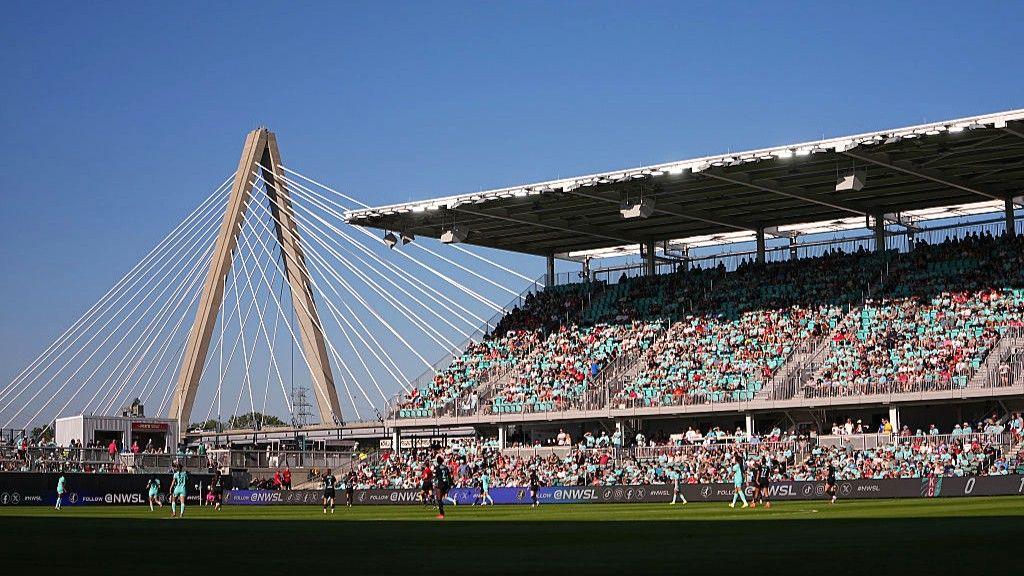
So says Chris Long, co-owner of Kansas City Current, who have played at the CPKC Stadium for the past two seasons.
It is the world’s first purpose-built ground for women’s football.
New US franchise Denver Summit are also building their own stadium, with a planned opening for the 2028 season.
Is this the direction of travel for women’s football, including in the UK?
Why have American teams taken this route?
And how do the new venues differ from existing stadiums?
Why are these stadiums being built?
Kansas City has a strong relationship with football, which is of course commonly known as soccer in the US.
FC Kansas City were a founding member of the NWSL in 2012 but folded after the 2017 season.
KC Current were born in 2021 thanks to the investment of local business executives Angie and Chris Long, plus Brittany Mahomes, wife of Kansas City Chiefs quarterback Patrick Mahomes.
They wasted no time in plotting an ambitious course for the new franchise, including the opening of CPKC Stadium in March 2024.
With a capacity of 11,500, it ranks middle of the road for average attendance. But a crowd at that level would place them behind only Arsenal’s average in the Women’s Super League (WSL) and, unlike with most stadiums in the UK, games in Kansas are always sell-outs.
“Our job is to create the best home advantage and make sure every seat is filled,” explains KC Current president Raven Jemison. “That is so our opponents feel it’s going to be very hard to play here.”
But how does a bespoke stadium help Kansas achieve that?
“For so long, we talked about women’s sports as nice to have, but now we want to talk about these amazing athletes,” says Jemison.
Like with WSL clubs, most US teams share another franchise’s premises, be it a men’s team’s ground or a venue usually reserved for other sports, such as NFL stadium Lumen Field for Seattle Reign.
Kansas City buck this trend, and Denver Summit president Jen Millet believes it makes financial sense to follow suit.
“A big part of a sustainable business model is controlling revenue streams,” Millet says. “Women have been tenants and missed out on those things – food, beverage, parking, rentals, retail.
“It’s massively important to operate your own stadium.”
Having their own venue has also enhanced KC Current’s marketing strategy – something Kirsten Ross, president of official supporters’ club The Blue Crew, says has greatly raised the team’s profile.
“[The club] do a really good job of ramping up when the team is playing,” she says.
“Previously, people had no idea FC Kansas City existed. Now you can’t walk anywhere without knowing there’s a game for KC Current.”
Chris Long argues a bespoke stadium brings the best out of players – after all, Kansas City dominated the 2025 regular season and won the NWSL Shield by 21 points, even if they lost in the play-offs.
“It’s the feeling of belonging,” he says. “If you’re a tenant, the schedule isn’t based on you… you put your stuff in the locker room but have to take it out because it’s temporary.”
How are these stadiums distinctive?
 Populous
Designing a stadium for women’s sports offers opportunity to be different.
The 14,500-seat venue in Denver will have an intentionally open end to help create what architectural firm Populous describe as a “blend of architecture, green space and community”.
Senior principal at Populous, Sherri Privitera, says inclusion was key to the design.
She points to a number of distinctive elements.
Kansas City president Jemison echoes Privitera’s comments, saying integration and ownership are central to CPKC Stadium.
“We want female athletes and fans in a facility that feels like it is their own, where all feel welcome,” she says. “It is a community asset.”
Not that this aspect blunts the atmosphere.
What challenges arise?
 Getty Images
For WSL clubs offering admiring glances, challenges are abundant.
Eleven out of 12 top-flight teams are attached to men’s operations, with only London City Lionesses fully independent.
That has led to playing games at huge stadiums such as Anfield and Villa Park, but most WSL games are hosted by small shared grounds such as Leigh Sports Village for Manchester United or Brighton at Crawley Town’s Broadfield Stadium.
Filling those is difficult.
Brighton had proposals for a purpose-built stadium approved in October 2023, but owner Tony Bloom could not “put a time on it” in autumn last year.
Even Chelsea’s ground Kingsmeadow, while owned by the club, was originally built for men’s team Kingstonian before the Blues took control in 2017.
In America, the 16 NWSL teams are independent of men’s franchises, although that has been an evolution.
“When the league started, the successful teams were those tied to men’s clubs as the infrastructure was there,” The Blue Crew’s Russell explains.
“But by putting resources behind standalone teams, it has been proved you can be successful.”
Kansas City’s Jemison agrees, saying: “There’s a misconception that sport is a men’s thing, but there’s a whole subset of fans who love and have a real affinity for women’s sport.
- 19 January
- 14 October 2025
For WSL sides, investment is a big issue. Striking out alone requires significant finances and, for clubs propped up by revenue streams from the men’s side of the business, separation is a leap.
In January, the 2025 Deloitte Rich List showed WSL sides are in a healthy place in terms of revenue – with eight in the top 15 for women’s clubs.
That list did not include US data, and analysis from American publication Forbes last summer suggested Kansas City were leaders for revenue generated with $36m (£26.6m).
That is not a large amount higher than European leaders Arsenal (£21.5m) and Chelsea (£21.3m) but is comfortably above the other six WSL clubs featured on Deloitte’s list.
On top of that, in recent accounts detailing 2024-25 finances, Arsenal, Liverpool and Manchester City all mention “reliance” on their parent companies for funds.
Long is not blind to this financial barrier.
“It is very expensive – and when we started up, we approached 40 banks and got 39 noes,” he says. “You need them to believe.
What does the future hold?
Circling back to the beginning, Kansas City’s Chris Long is convinced about where the women’s game is heading: new homes for all.
“I truly believe in 10 years’ time, this will be commonplace,” he says. “It’ll be absolutely critical to getting players, retaining them and being financially successful.”
It may seem a long way off for the WSL, but architect Privitera believes the visible benefits of teams having their own stadiums cannot be ignored.
Related topics
- Football
- Women’s Super League
- Women’s Football

Leave a Reply