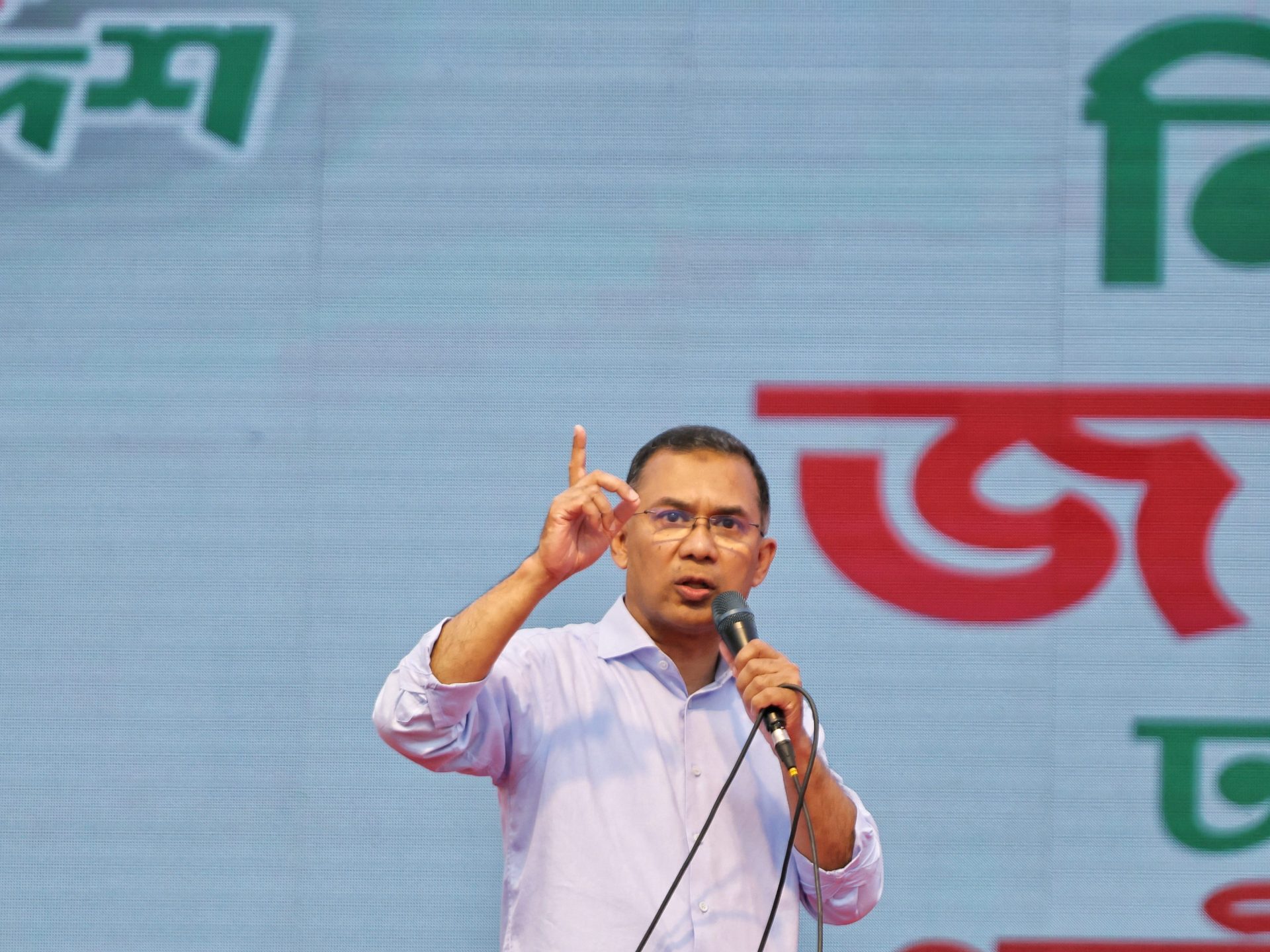
The Bangladesh Nationalist Party (BNP) led by Tarique Rahman has won two-thirds majority in the South Asian country’s historic elections – the first since the 2024 student-led uprising that ousted the previous Prime Minister Sheikh Hasina.
The Election Commission (EC) on Friday released the latest results from the elections, showing that the BNP had won 209 seats out of the 297 announced.
Recommended Stories
list of 4 itemsend of list
Jamaat-e-Islami, which was banned by the Hasina government, has registered its best performance, winning 68 seats and emerging as the main opposition party in the 350-member parliament, the Jatiya Sangsad. Fifty are nominated members.
The National Citizen Party (NCP), a political party born out of the protests, is in the third place with six seats. The party leader, Nahid Islam, has managed to win his seat, becoming one of the youngest MPs in the new parliament. The NCP fought the election in alliance with Jamaat.
Hasina’s Awami League was barred from participating in the elections, and she fled to India after 15 years of authoritarian rule.
The general elections were also accompanied by a national referendum on “the July Charter”, aimed at reforming state institutions.
The EC on Friday said voter turnout was 59.88 percent, in one of the most peaceful and credible elections in decades.
Who won the election in Bangladesh?
According to the latest results released by the EC: the BNP won 209 seats; Jamaat won with 68 seats; and the NCP won six seats.
Other parties won seven seats and independent candidates won the other seven seats that remained.
Elections were held for 299 seats instead of 300 due to the death of a candidate. A court has barred the publication of results for the Chattogram‑3 and Chattogram‑8 constituencies. This is why the latest results show the outcome of voting for 297 seats in total.
The BNP claimed victory in an X post on Friday, with its media page writing in a post: “The Bangladesh Nationalist Party is set to form the government after winning the majority of seats.”
The party wrote in a statement that it will not hold any rallies or meetings to celebrate its victory, but will instead hold prayers at noon at mosques nationwide.
Rahman, the son of the late former Prime Minister Khaleda Zia, will likely be the next prime minister after the results are officially confirmed. The 60-year-old leader returned to Bangladesh from self-imposed exile in the United Kingdom weeks before the elections. He had fled the country in 2008 after what he deemed politically motivated persecution.
Reuters reported, citing the EC, that the BNP won 181 seats, Jamaat-e-Islami won 61 and others won seven seats.
The electoral body has yet to announce the official results.
Are there concerns about result tampering?
Both the NCP and the BNP have alleged irregularities and result tampering, suggesting that some parties are benefiting from “election engineering”, though they have so far provided limited specific evidence.
Jamaat has also voiced its concern in a statement about the unofficial results, posted on its Facebook page.
“We are not satisfied with the process surrounding the election results. From candidates of the 11-party alliance narrowly and suspiciously losing in various constituencies, to repeated inconsistencies and fabrications in unofficial result announcements, the Election Commission’s reluctance to publish voter turnout percentages, and indications that a section of the administration leaned towards a major party – all of this undoubtedly raises serious questions about the integrity of the results process,” the statement said.
Jamaat has urged its supporters to wait for the official results.
Who won, who lost?
The BNP chairman, Rahman, has been declared elected in two constituencies – the Dhaka-17 and Bogura-6, according to Bangladesh’s The Daily Star newspaper, though official results are yet to be announced.
Jamaat leader Shafiqur Rahman won the Dhaka‑15 constituency, local media reported.
BNP Secretary-General Mirza Fakhrul Islam Alamgir has won the Thakurgaon-1 constituency in northwestern Bangladesh, according to multiple media outlets. His nearest rival, Jamaat-e-Islami candidate Delwar Hossain, trailed behind him.
“Bangladesh Jamaat-e-Islami is expected to serve as the opposition party, with an eye on winning the next election. It is reasonable to expect that they will play a responsible and constructive role in parliamentary politics,” Asif Nazrul, a law professor at Dhaka University, told Al Jazeera.
Rumeen Farhana, an independent candidate and a former BNP lawmaker, has won the Brahmanbaria-2 constituency in eastern Bangladesh, according to local media.
The BNP has won 13 of the 20 seats in Dhaka, according to multiple local outlets. Jamaat has won four seats while its ally, the National Citizen Party (NCP), won one.
Local media is also reporting wins for prominent BNP candidates, including Salahuddin Ahmed, Amir Khasru Mahmud Chowdhury, Lutfozzaman Babar, Mirza Abbas, Fazlur Rahman, Reza Kibria and Bobby Hajjaj.
The NCP was formed by students who led the protests against Hasina in 2024. Local media reports that NCP founder Nahid Islam has won the Dhaka-11 seat.
“Although the NCP did not secure major electoral success, for a party formed only months before the election, its performance was not insignificant given its limited experience in electoral politics,” Nazrul said.
“While expectations were higher in some quarters, if the NCP positions itself as a constructive and principled political alternative, it may gradually strengthen its position in future elections.”
Was the BNP win expected?
Experts say the BNP’s win was widely expected.
Months before the election, the BNP had been drawing huge support in rallies organised to highlight unemployment and rising prices, among other issues. The party helped organise and ride the wave of mass protests that followed the student‑led uprising against Hasina’s government.
By May 2025, the BNP was also staging rallies against the interim government led by Muhammad Yunus, demanding early elections and other concessions.
“Unlike other participating parties, the BNP has a strong support base across every part of the country, a winning political culture and past experience in governance,” Nazrul said.
“Its leader, Tarique Rahman, created a positive impact following his return to Bangladesh, which further strengthened the party’s momentum.”
Bangladesh also held a referendum on the July Charter. Was it approved?
Voters in Bangladesh cast their votes on two ballots on Thursday: a white parliamentary voting ballot and a pink ballot for a referendum on the July National Charter.
According to the latest results released by the EC, 60.26 percent of voters cast their ballot in favour of the July Charter.
The charter was drafted by the caretaker government led by Nobel laureate Mohammad Yunus, following the student protests, and outlines a roadmap for constitutional amendments, legal changes and the enactment of new laws.
It contains more than 80 proposals to overhaul Bangladesh’s system of governance, with key reforms being “increasing women’s political representation, imposing prime ministerial term limits, enhancing presidential powers, expanding fundamental rights, and protecting judicial independence”, according to the International Institute for Democracy and Electoral Assistance (IDEA).
The charter recommends creating a 100-member upper chamber alongside Bangladesh’s current single parliamentary body, the 350-member parliament.
Local newspaper The Daily Star says that, so far, 72.9 percent of votes counted are in favour of adopting the charter, as opposed to 27.1 percent opposed.
The BNP says it will back the implementation of the charter.
“Major parties appear to agree on almost all the core referendum issues. However, disagreements remain regarding specific details, particularly in regard to the formation of the proposed Upper House,” Nazrul explained.
“The BNP favours forming it in proportion to parliamentary seats, while Jamaat and the NCP prefer a system of proportional representation. Resolving this dispute remains a key challenge.”
What’s next?
Rezaul Karim Rony, a Dhaka-based political analyst, told Al Jazeera that the BNP win means a “victory of a democratic force”.
“The challenge now is to ensure good governance, law and order, and public safety, and to establish a rights-based state, which was at the heart of the aspirations of the 2024 mass uprising,” Rony told Al Jazeera.
Nazrul, the professor from Dhaka University, expressed optimism for the future of Bangladesh without the Awami League.
“Awami League governed through a one-party parliament following fake elections for nearly 16 years. The present parliament will function without that one party. It’s poetic justice, in my view,” he said.
“The new parliament includes much more diverse voices and competitive political engagement. As a result, parliamentary functioning is expected to improve. The Awami League should engage in reflection, express remorse and learn from past experiences.”

Leave a Reply