Inspired by Wrexham, Merthyr dream of more glory

  • 1 Comments

“Can we do a Wrexham?”

An increasingly common question that football fans and club owners are asking themselves when they see what two Hollywood superstars have done in north Wales.

Transform a struggling non-league side into a globally-recognized brand with back-to-back-to-back promotions. Why can’t that be us?

Those who run – or follow – Merthyr Town are no exception.

“At the moment we’re on a fabulous run and everyone’s taking notice. They want to be a part of it,” says chairman Les Barlow.

“We’re speaking to people weekly [about potential investment]. Some have got money, while others…”

The Martyrs might be four tiers below Championship side Wrexham but they are one third of the way towards replicating the triple promotion winners at the Stok Cae Ras.

Promoted as champions of the Southern League Premier South in 2024-25, Town are third in National League North, seven points off the leaders but with the luxury of a 15-point cushion inside the play-off zone. They have won 18 of their 29 matches so far.

Back-to-back promotions, then, a very real possibility at Penydarren Park.

In some ways, you might think pure survival is all that really matters given fan-owned Merthyr Town are a phoenix club that rose from the ashes of the old Merthyr Tydfil FC, which went into liquidation in 2010.

But who wants pure survival?

Not Merthyr. They’re aiming to get back into the fifth tier of the English game for the first time since 1995, when a gradual decline in fortunes saw them relegated from the old Vauxhall Conference and spiral down through the backwaters of the Southern League.

Ultimately, the dream is to join the four other Welsh sides who play in the English Football League (EFL) – Wrexham, Swansea City, Cardiff City and Newport County – a level Merthyr have not graced since before World War Two.

But how realistic is that? And are there any potential investors – or Hollywood film stars – with deep enough pockets to potentially bankroll a Wrexham-type rise?

Moving Merthyr forward

Chairman Les Barlow at Merthyr's National League North game against TelfordBBC Sport

Merthyr are not short of star names who have dipped into their own wallets to help. Line of Duty star Vicky McClure and her filmmaker husband Jonny Owen, who is from Merthyr, are among the club’s 150-plus owners, along with former Wales international Joe Morrell.

But any major takeover – by a company or individuals who could potentially propel Merthyr up the divisions at speed, like Ryan Reynolds and Rob Mac have done at Wrexham – would likely lead to a big change in its ownership structure.

“Unfortunately we’re a fan-owned club,” said Barlow, who has seen more ups and downs than most during his 65-year involvement with Merthyr, from player to kitman, physio to boardroom leader.

But fan-owned is what Wrexham were before Rob and Ryan breezed into the Stok Cae Ras and changed the world as Red Dragons’ fans knew it back in 2021.

“Yes, and those guys [Rob and Ryan] came in and put their hands in their pockets,” said Barlow.

“We haven’t come across anybody like that at the moment, but we have had some good sponsors and, as I say, we’re talking to people weekly.

“We’re starting now for next year. Irrespective of where we end up, we still want to be in a better position financially and stadium-wise than where we are now.

“One side of the ground is perfect, but we’ve got another area which I think the Romans built when they had a fort in the corner!”

Keep moving, keep looking for new forms of investment. A responsibility to do that comes from a need to keep supporting the man leading Merthyr’s charge for a second successive promotion, manager Paul Michael.

“We’re working as hard as we can because we want to support this guy, and we want the best team we can afford,” said Barlow.

“The better the results we can get with this guy in charge…it helps a long way.”

Appointed after leaving Yate Town in April 2022, Michael has transformed Merthyr from relegation candidates in Southern League Premier South to National League hopefuls.

“It’s been a real step into the unknown, but we’ve grown and grown and got better and better,” said Michael, who has managed to overcome the loss of 23-goal top scorer and Penydarren cult hero Ricardo Rees, who signed for National League promotion chasers Forest Green Rovers in December.

“Over the past few weeks we’ve probably been the most in-form team in the league, yet we’re competing against full-time teams. We’ve got no right to stay up there, really.

“If we were fortunate enough to get to the National League we would try to take it all in our stride. It would be an unbelievable achievement for a part-time team, though we’ve still got a long way to go.

Glory days again?

Merthyr fans at their match against TelfordBBC Sport

Needless to say, Merthyr fans are loving life at the Park right now. The Martyrs are enjoying their best spell since the late 1980s – headlined by their famous European Cup Winners’ Cup win over Italian side Atalanta in 1987 – and the early 1990s, when they finished as high as fourth in the Conference.

And plenty of supporters share the dream that the Martyrs can indeed do a Wrexham and copy the north Wales club’s eye-catching journey up the pyramid.

“Having been a fan-owned club themselves, I’d say Wrexham are an inspiration for clubs like ours,” said Gavin Burns, a blogger and writer for the ‘Banking on the Martyrs’ fanzine. He used to be a Cardiff City season ticket holder but fell in love with Merthyr Town when he moved to the area in 2011.

“Looking at Wrexham as a blueprint, I think Merthyr are the up and coming team in Welsh football at the moment.

“With the fantastic job the team is doing, the attendances going through the roof, the stadium we’ve got and the potential catchment area around the valleys, there’s no reason why we can’t do back-to-back-to-back promotions.”

Bethan Hurley, a lifelong Merthyr fan, also hopes the club can attract a rich benefactor or two to help them follow Wrexham into the EFL.

“We’re one division below where Wrexham’s fairytale story started so if there are any Hollywood investors out there, please get in touch,” said Hurley.

“I’d love to see us get promoted again. I’m born and bred in Merthyr, and I’ve stuck around through all the suffering – good, bad and ugly. Never known anything else.

“I was born in 1988 – a year after the win over Atalanta, but my mother was pregnant with me at the time. So I was there at the game!”

Just like those European glory days, fans are cramming into Penydarren again to help spur Merthyr on, with almost 4,000 there for a 2-2 draw with Hereford on 30 December.

Having suffered rare back-to-back defeats over the past week against Southport and AFC Telford United, Michael’s side are preparing for a long 330-mile round trip to former Football League stalwarts Darlington on Saturday, 31 January.

But this time, the rare luxury of a hotel stay the night before the game.

Related topics

  • Welsh Football
  • Wales Sport
  • Football

Aoun’s tightrope: Daily Israeli attacks and Hezbollah’s refusal to disarm

Beirut – Lebanon’s President Joseph Aoun could be facing the most critical period of his one-year tenure in the coming weeks and months.

In February, Lebanese Armed Forces (LAF) chief of staff Rodolphe Haykal is set to visit Washington, DC. Also in February, the LAF will present a plan for phase two of Hezbollah’s disarmament. Then in March, an international conference will be held in Paris in support of the Lebanese army.

Recommended Stories

list of 3 itemsend of list

These events come amid increasing United States and Israeli pressure on Lebanon and on Aoun, a former armed forces chief himself, to continue the effort to disarm Hezbollah. They also come as Israeli attacks in south Lebanon and the Bekaa Valley intensify, and as Hezbollah leader Naim Qassem states that his group will not accept disarmament north of the Litani River, which flows across south Lebanon, unless Israel starts to abide by the ceasefire agreed in November 2024.

Israel has been violating the truce with bombardments on a near-daily basis, and continues to occupy parts of the south.

This leaves Aoun caught between a rock and a hard place, facing the difficult task of disarming Hezbollah without pushing Lebanon into renewed civil conflict, which no one in a scarred nation wants.

He is also being relied on to get Israel, which has violated the November 2024 ceasefire more than 11,000 times, to stop attacking the country at a time when the LAF is currently undermanned, underfunded and underequipped to deploy across south Lebanon, let alone militarily confront the Israelis.

That has left him navigating diplomatic corridors with international actors to back the Lebanese army and pressure Israel to abide by the ceasefire: two crucial steps that would facilitate an easier disarmament of Hezbollah.

“Joseph Aoun finds himself in an extremely sensitive position, caught between escalating American and Israeli pressure on one hand, and domestic rejection of any discussion of weapons under fire on the other,” Souhaib Jawhar, a nonresident fellow at the Beirut-based Badil, the Alternative Policy Institute, told Al Jazeera. “What he is doing today is managing a highly fragile transitional phase, aimed more at preventing a comprehensive collapse than at imposing a final settlement.”

A new agreement?

On November 27, 2024, a ceasefire between Israel and Hezbollah went into effect. The two parties had exchanged cross-border attacks since October 8, 2023, the day after a Hamas-led operation into southern Israel launched the Israel-Palestine war.

In September 2024, Israel unilaterally intensified attacks on Lebanon. In October, Israeli troops invaded south Lebanon and engaged Hezbollah in battles. By the time the ceasefire was agreed, Israel had killed nearly 4,000 people in Lebanon, including hundreds of civilians.

Hezbollah had also been badly weakened as a military and political force in Lebanon, suffering the assassination of its charismatic, longtime leader Hassan Nasrallah.

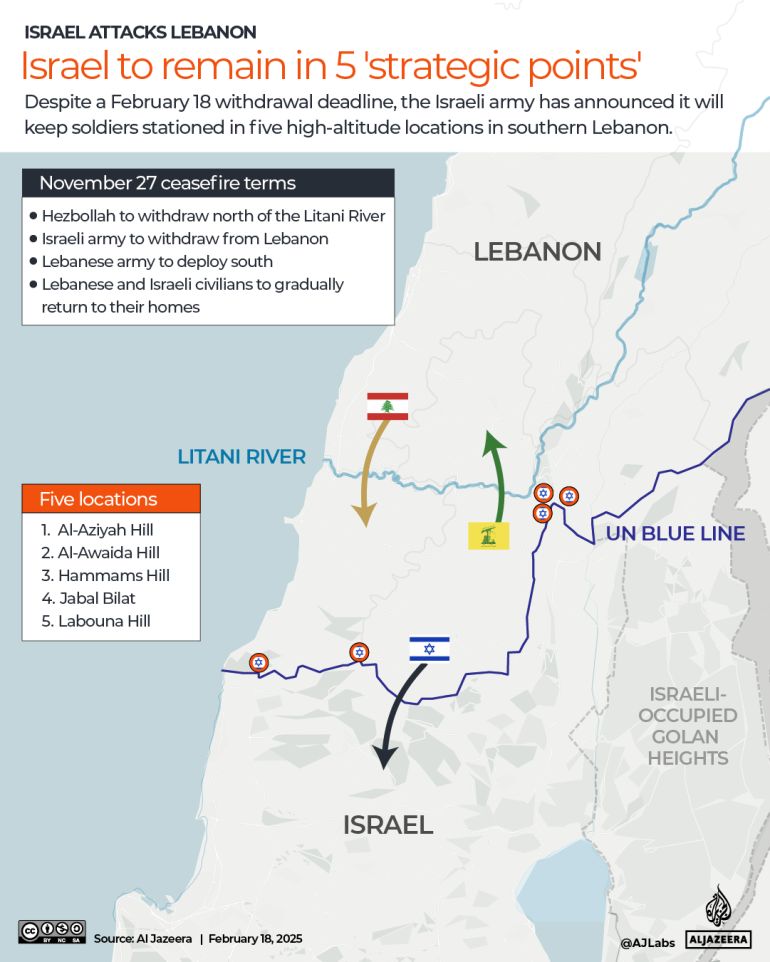
Under the agreement, both sides were to cease their attacks, Hezbollah would withdraw to north of the Litani River, and Israel would pull its troops out of Lebanon. But since then, Israel hasn’t stopped attacking Lebanon, and it still maintains troops in five points on Lebanese territory.

INTERACTIVE - Israel-Hezbollah Lebanon remain in 5 locations-1739885189
(Al Jazeera)

Israeli drones are ever-present in south Lebanon and occasionally hover over Beirut, despite the fact that Hezbollah has not fired a shot across the border since December 2024.

Despite a one-sided ceasefire, the administration of US President Donald Trump has still pushed hard for Hezbollah’s disarmament. The issue is a contentious one in Lebanon, where the group enjoys widespread support among the Shia Muslim community but strong opposition among other communities.

A source close to Aoun, who requested anonymity, told Al Jazeera that Lebanon had stuck to its side of the agreement but that no one was holding Israel accountable.

“Only the Americans have leverage over Israel,” the source said. “The problem we have now is [we don’t know] if Israel really wants to take the diplomatic road and wants to implement the November 27, 2024 agreement, or if they are trying to have a renegotiated agreement.”

Imad Salamey, a political scientist at the Lebanese American University in Beirut, noted that “the broader issue is that Lebanon is being asked to deliver security outcomes without reciprocal guarantees”.

“As long as Israeli military pressure continues unchecked and international mechanisms fail to enforce balance, any Lebanese president will face the same constraints,” Salamey told Al Jazeera.

The fear, of course, is that the US will sustain pressure on the LAF to disarm Hezbollah without reigning in Israel. This has some in Lebanon worried that the LAF and Hezbollah could come into direct conflict – possibly splitting the army, as happened during the early years of the 1975-1990 Lebanese Civil War.

But analysts and other sources predict the LAF will do all it can to avoid civil strife.

“The army will avoid anything that would degenerate into civil conflict,” Michael Young, a Lebanon expert at the Carnegie Middle East Center, told Al Jazeera. “But if support for the Lebanese Army gives them better equipment and support, they might be more aggressive in securing arms caches.”

Risk of LAF-Hezbollah confrontation?

LAF Commander Haykal is set to visit Washington from February 3 to 5. He was scheduled to visit the US in November, but the visit was cancelled after US officials were unhappy with Haykal for comments he made criticising Israel.

Haykal’s visit is one of a few key events in February and March that Lebanon and Aoun hope will shift the pendulum in their favour. Haykal will also propose phase two of Hezbollah’s disarmament by the LAF to the Lebanese Cabinet in February.

In phase two, Hezbollah is set to be disarmed from the Litani River to the Awali River, which runs across Lebanon starting south of Beirut.

Then, on March 5, Paris will host an international conference aimed at supporting the LAF. There, Lebanon hopes to meet with regional and international allies who have been backing the government in their efforts to rein in Israel and Hezbollah, such as the Saudis, French, Qataris, and the Egyptians.

While Lebanon is working with the US, it has also tried to rely on its other allies to help it convince the Americans to rein in Israel.

“These countries can help to pressure Israel to stop killing and attacking Lebanon and implement the ceasefire,” the source close to Aoun said.

Convincing the US’s officials to pressure its staunch ally Israel to give in to some of Lebanon’s demands, such as stopping attacks, releasing Lebanese prisoners in Israeli custody, and withdrawing from Lebanese territory, is the key.

Hezbollah has also called for reconstruction to begin in south Lebanon, which Israel has prevented. Human Rights Watch said Israel has systematically targeted reconstruction equipment across southern Lebanon.

Without the US support, however, analysts said they don’t see Israel being open to negotiations. And without that, analysts fear an impasse in the current situation.

Limits of diplomacy

As for Hezbollah, the group has held firm that it doesn’t plan to make any more concessions as long as Israel continues attacking and occupying Lebanon.

Supporters of Hezbollah have been critical of Aoun and the Lebanese government, accusing them of ineffectiveness in getting any concessions out of the Israelis.

“Diplomatic methods may have prevented the war from escalating, but they have not achieved any objective in confronting the Israeli occupation,” Qassem Kassir, a journalist close to Hezbollah, told Al Jazeera.

In a speech on January 26, Hezbollah leader Naim Qassem said the group is under serious military and political pressure.

But while Hezbollah has been critical of Aoun, the group also continues to keep a direct line open to him.

“The connection never ended,” the source close to Aoun said. “There have always been talks with a representative of Hezbollah and someone close to the president, with [Parliament Speaker and Hezbollah ally] Nabih Berri also engaged in these talks.”

“Hezbollah doesn’t have many options,” Young said. “They are sitting on a community that is traumatised and whose villages have been destroyed.”

Salamey noted, “Diplomacy alone has clear limits when Israel calculates that the costs of continued strikes are low.”

Jawhar added that Aoun should try “a firmer approach” that still focuses on negotiations without capitulating, an approach “regionally supported rather than left to distorted balances of power”.

But the embattled Lebanese leader also knows diplomacy is his only shot.

‘Even the dead were not spared’: Israeli’s Gaza desecration compounds grief

Gaza City – Fatima Abdullah cannot erase the painful images from al-Batsh cemetery, which was excavated and desecrated this week by the Israeli military in the Tuffah neighbourhood east of Gaza City, as the army recovered the last captive’s body.

The cemetery contains the grave of her husband, who was killed during Israel’s genocidal war on Gaza, alongside thousands of other graves belonging to families across the devastated territory.

Recommended Stories

list of 4 itemsend of list

Fatima, a mother of three, has told Al Jazeera of the unbearable tension she felt knowing that the Israeli military’s search operations were focused on that cemetery.

“We were all on edge… we knew the operation was at al-Batsh cemetery, and everyone was scared it would be their loved one’s grave next. I imagined the machinery approaching my husband’s grave, and I said, ‘No, God.’”

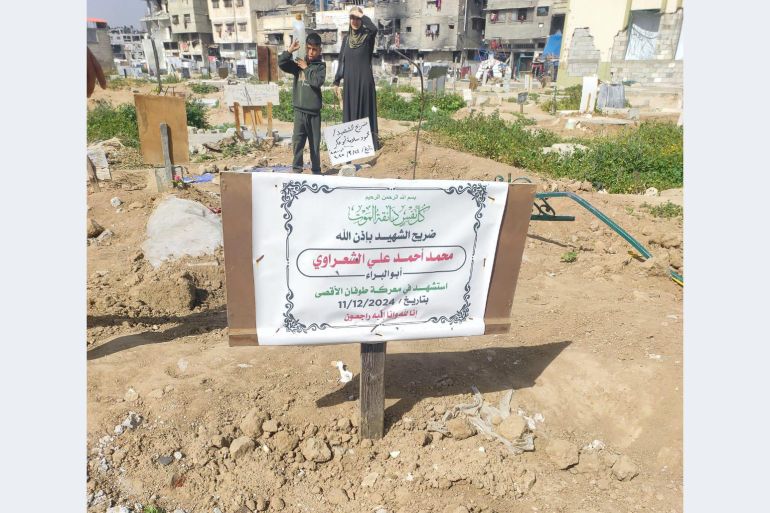
Fatima’s husband, Mohammad al-Shaarawi, was killed in an Israeli drone strike on December 11, 2024. The attack targeted him with a group of friends in Tuffah. At the time, Fatima and her children were displaced in southern Gaza.

“Even the dead were not spared,” Fatima says, describing a violation of the last remnants of their right to mourn and preserve dignity.

“Corpses scattered, bones, bags thrown … they were bulldozing graves, dumping the remains as if they were nothing.”

During the search and recovery of captive Israeli policeman Ran Gvili, about 250 graves were examined in a short period using heavy military machinery and bulldozers.

The operation led to the exhumation of both old and recent graves, the destruction of many tombstones, and a significant alteration of the cemetery’s landscape, according to aerial images of the site.

“I used to always visit him. On holidays, on his birthday, with the kids. The strange thing is that my children didn’t feel they were going to a sad place; they felt they were really going to visit their father,” Fatima says.

After the forced mass evacuation of tens of thousands from Shujayea in Gaza City amid intensive Israeli attacks in June 2024, Fatima could no longer reach the cemetery, surrounded by rubble, debris and military machinery.

The risk persisted after the ceasefire was declared in October 2025 because the cemetery lies near the so-called “yellow line” under Israeli military control.

“No one knows what they took, what remains were returned … if anything at all,” Fatima says, hoping that phase two of the ceasefire will allow her to visit the cemetery to check on her husband’s grave.

“We, the people of Gaza, didn’t even have the luxury of mourning properly, and now they’ve taken away the graves of our loved ones after death,” she adds.

Gaza Cemetery
The grave of Mohammed Al-Shaarawi, Fatima Abdullah’a husband, at al-Batch cemetery in the Tuffah neighbourhood, east of Gaza City [Courtesy of Fatma Abdullah]

Israel’s history of desecrating cemeteries

The Israeli military has wantonly bombed, bulldozed and desecrated Palestinian graves in Gaza multiple times over the years, drawing condemnation from human rights organisations as a flagrant violation of international humanitarian law.

The Euro-Med Human Rights Monitor documented that the Israeli army has destroyed or severely damaged approximately 21 out of 60 cemeteries in Gaza, exhuming remains, mixing them or causing them to be lost, leaving thousands of Palestinian families with crushing uncertainty about the fate of their relatives’ bodies.

Among instances of Israeli destruction are:

  • Beit Hanoon cemetery in northern Gaza
  • Al-Faluja cemetery in Jabalia, northern Gaza
  • Ali Ibn Marwan cemetery, Gaza City
  • Sheikh Radwan cemetery, Gaza City
  • Al Shuhadaa Eastern cemetery, Gaza City
  • Tunisian cemetery, Gaza City
  • Cemetery of Church of St Porphyrius, Gaza City
  • Khan Younis cemetery in the Austrian neighbourhood

The Gaza War Cemetery, in Tuffah, housing fallen soldiers during World Wars I and II from the United Kingdom and several Commonwealth nations, has suffered significant damage from Israeli bombardment but is not yet completely destroyed, according to local assessments. Damage has also been reported to the Deir el-Balah War Cemetery.

Additionally, earlier this month, Euro-Med called for urgent international intervention “to halt the crimes of widespread destruction and land levelling being carried out by the Israeli army in Rafah, in the southern Gaza Strip, until specialised teams and the necessary equipment are allowed to recover the bodies of victims, identify them, and ensure their dignified burial”.

Hamas also condemned the exhumation of hundreds of graves and described the act as “unethical and illegal, reflecting the international system’s failure to hold the occupation accountable for its unprecedented crimes in modern times”.

Gaza Cemetery
Madeline Shuqayleh stands at her sister’s grave in al-Batch cemetery for the first time, months after her burial [Courtesy of Madeline Shuqayleh]

Buried without farewell

For Madeline Shuqayleh, the exhumation of al-Batsh cemetery ripped open the wound of where her sister and niece were buried.

On October 28, 2023, her sister, Maram, and her four-month-old daughter, Yumna, were killed in an Israeli strike in central Gaza. The family did not immediately know of their deaths, as they were displaced in Deir el-Balah, while her sister stayed in the north with her husband’s family.

“Imagine knowing your sister was killed and buried without knowing how, where, or what happened to her. It was a crushing shock in every way.”

Maram and her daughter were buried in al-Batsh cemetery. “After a lot of effort, we found the place. When we visited, the grave was there, the tombstone intact … the pain was immense,” she added. “But now, to this moment, they’ve deprived us … as if they killed her again.”

The family still does not know what happened to the bodies of Maram and her daughter, or whether the exhumed graves were restored.

The UN and international human rights organisations have documented multiple cases of missing bodies and the deterioration of burial sites after cemeteries were bulldozed or destroyed during Israeli military operations.

In April 2024, UN High Commissioner for Human Rights Volker Turk noted the discovery of mass graves at al-Shifa and Nasser hospitals, containing hundreds of corpses, including women, the elderly, and wounded. Some were found bound and naked, raising “serious concerns” over possible grave violations of international humanitarian law.

‘My father has no grave today’

Rola Abu Seedo experienced compounded grief with her family after the bulldozing of her father’s grave by the Israeli army in a temporary cemetery at al-Shifa.

Rola had been displaced to the south with her mother and four siblings, while her father refused to leave and remained in their northern home until his death.

Her father remained in Gaza City under a severe blockade and a collapsed health system, suffering from diabetes, high blood pressure and a previous stroke, relying on medications that were no longer available.

“At that time, there was famine and no medicines,” Rola told Al Jazeera. “The medical report noted respiratory problems, and his condition worsened.”

On April 28, 2024, her father died, and the family did not learn of his death immediately. “Communications were nearly cut off; my father couldn’t charge his phone to reach us.”

A relative performed a burial and preserved the grave location, placing a simple marker sent to the family, who planned to move it later to an official cemetery once conditions stabilised.

But after another major Israeli incursion around al-Shifa in March 2024, bulldozers levelled the cemetery, leaving no grave markers.

“Our relatives went back to find the grave after the operation, but they said they couldn’t locate it and the area where he was buried had been bulldozed,” Rola said.

About a year ago, with news of potential grave transfers from al-Shifa to Beit Lahiya in northern Gaza, a committee of forensic authorities and the Red Crescent participated in digging operations based on residents’ testimonies.

Rola’s family searched for her father’s remains again, but to no avail.

“They dug in the spot we were sure was his grave … but they didn’t find a body.” To this day, the family does not know the whereabouts of her father’s remains.

“We still don’t know if they took the bodies, mixed them, or moved them,” she says. “My father has no grave today.”

“It’s as if they not only deprived us of our loved ones while they were alive, but also denied us the farewell after death.”

Gaza Cemetery
Fahmi Abu Seedo, 65, Rola’s father, who died in northern Gaza during the war after suffering from health complications [Courtesy of Rola Abu Seedo]

Palestinian journalist Bisan Owda with 1.4m followers reports TikTok ban

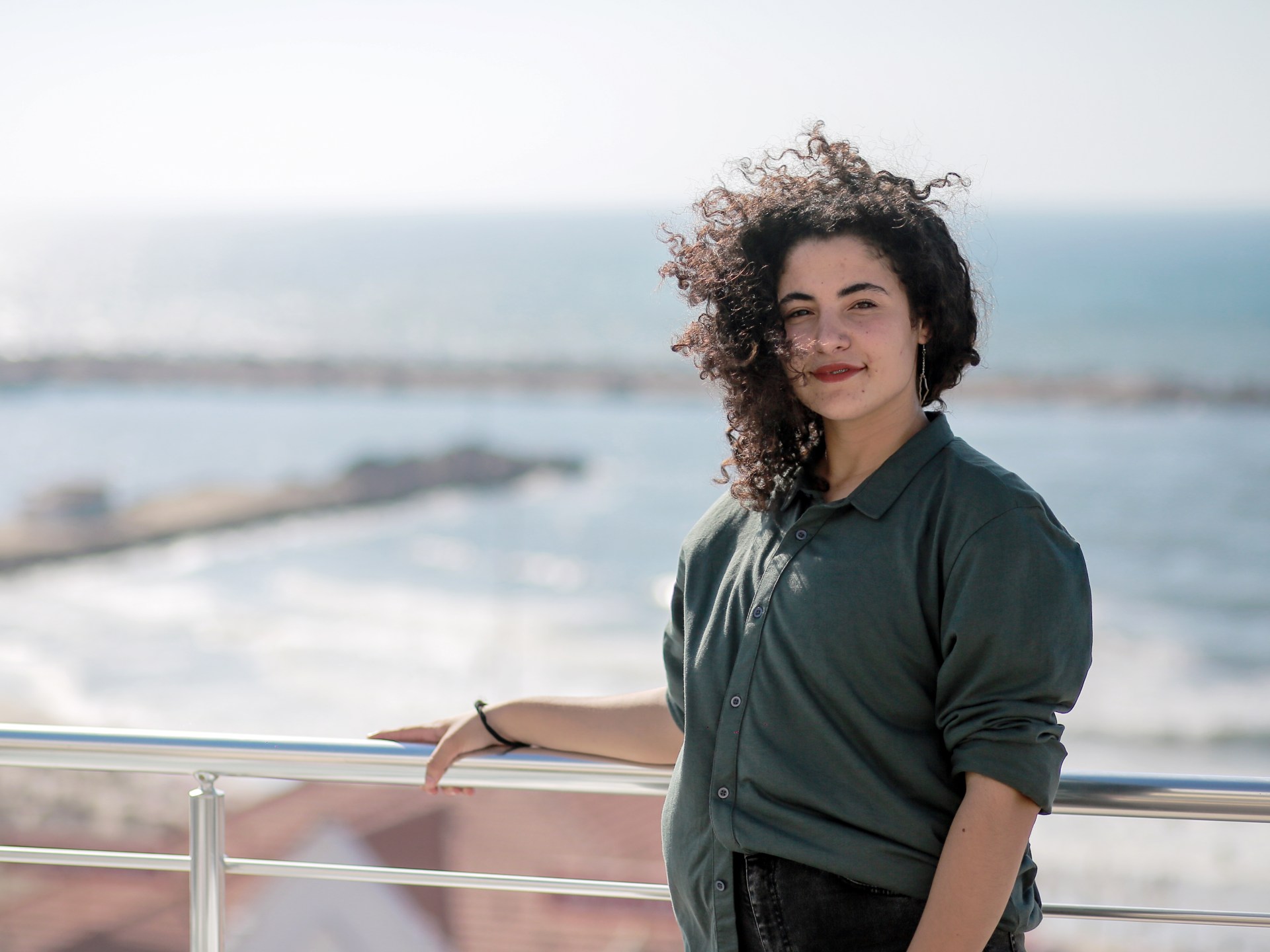
Award-winning Palestinian journalist Bisan Owda has said she has been permanently banned from TikTok, days after the social media platform was acquired by new investors in the United States.

Owda, an Emmy Award-winning journalist and contributor to Al Jazeera’s AJ+ from Gaza, shared a video on her Instagram and X accounts on Wednesday, telling her followers that her TikTok account had been banned.

Recommended Stories

list of 4 itemsend of list

“TikTok deleted my account. I had 1.4 million followers there, and I have been building that platform for four years,” Owda said in the video filmed from Gaza.

“I expected that it will be restricted, like every time, not banned forever,” she added.

Al Jazeera sent a query to TikTok inquiring about Owda’s account and is waiting for a reply.

Hours after Owda shared her video, an account that appeared to have the same username was still visible on TikTok with a message that said: “Posts that some may find uncomfortable are unavailable.”

The last post visible on that account was from September 20, 2025, nearly three weeks before a ceasefire was reached in Israel’s genocidal war on the Gaza Strip.

In her video on Wednesday, Owda pointed to recent remarks from Israeli Prime Minister Benjamin Netanyahu as well as Adam Presser, the new CEO of TikTok’s US arm, as a possible explanation for the ban.

Netanyahu met with pro-Israel influencers in New York in September last year, telling them that he hoped the “purchase” of TikTok “goes through”.

“We have to fight with the weapons that apply to the battlefield in which we engage, and the most important ones are social media,” Netanyahu, who is a war crimes suspect, said at the time.

“The most important purchase that is going on right now is … TikTok,” Netanyahu added. “TikTok, number one, number one, and I hope it goes through, because it can be consequential,” he said.

TikTok announced last week that a deal to establish a separate version of the platform in the US had been completed, with the new entity controlled by investment firms, many of which are American companies, including several linked to US President Donald Trump.

Owda also shared an undated video of Adam Presser, the new CEO of TikTok’s US arm.

In the video, Presser speaks about changes made at TikTok, where he previously worked as head of operations in the US, saying that “the use of the term Zionist as a proxy for a protected attribute” had been designated “as hate speech”.

“There’s no finish line to moderating hate speech, identifying hateful trends, trying to keep the platform safe,” Presser said.

Zionism is a nationalist ideology that emerged in the late 1800s in Europe, calling for the creation of a Jewish state.

Owda’s social media presence grew from posting daily videos in which she greeted her audience, saying, “It’s Bisan From Gaza – and I’m still alive.”

She made a documentary of the same name with Al Jazeera’s AJ+, which was awarded an Emmy in the Outstanding Hard News Feature Story category in 2024.

Her video on Wednesday came as Israel’s top court again postponed making a decision on whether foreign journalists should be allowed to enter and report on Gaza independently of the Israeli military.

Despite the ongoing ceasefire, an Israeli attack last week killed three Palestinian journalists in Gaza.

US agents involved in Alex Pretti’s killing in Minneapolis placed on leave

Two United States federal agents involved in the fatal shooting of intensive care nurse Alex Pretti during an immigration raid in Minneapolis have been placed on administrative leave, as fallout from the most recent killing of a US citizen continues to cause outrage.

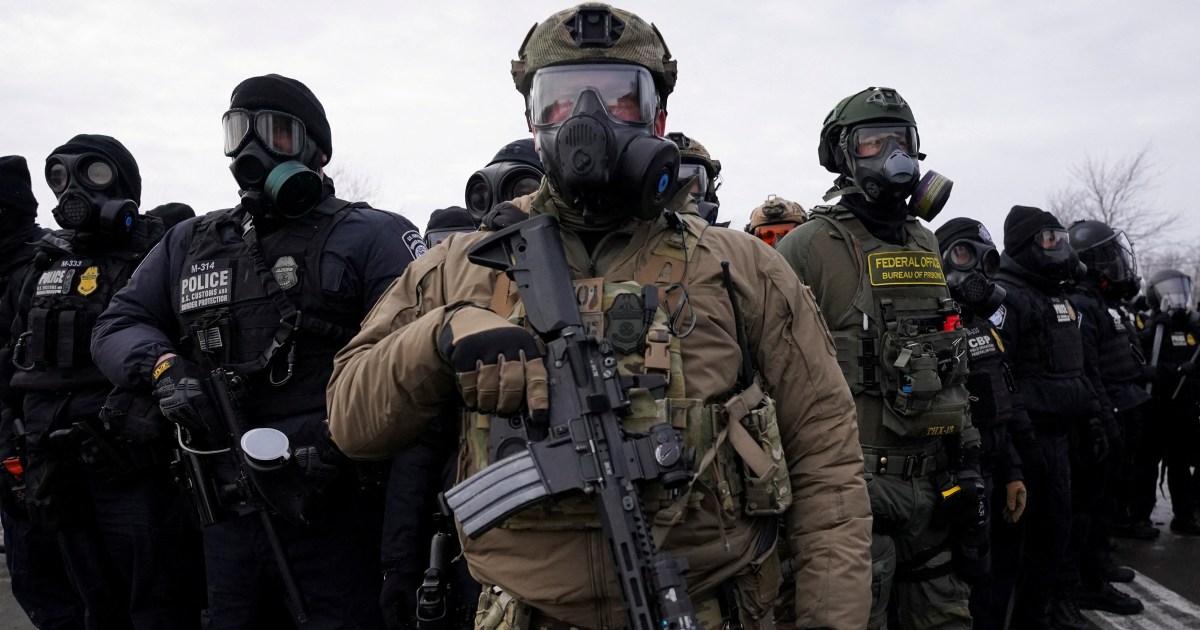
The two officers have been on leave since Saturday, in what US officials said on Wednesday was “standard protocol”, when Pretti was shot multiple times after being forced to the ground by masked immigration officers in an altercation that quickly turned deadly and was captured on video.

Recommended Stories

list of 4 itemsend of list

“The two officers involved are on administrative leave and have been since Saturday,” Al Jazeera’s Manuel Rapalo said, reading from a statement from a Customs and Border Patrol (CBP) spokesperson on Wednesday.

Rapalo, reporting from Minneapolis, said that it was “unclear whether or not the Department of Homeland Security has taken any sort of additional actions against the other officers who were involved in that fatal shooting”, referring to agents “seen in multiple videos helping to restrain Alex Pretti in the moments before that fatal shooting took place”.

US media, citing a preliminary investigation sent to members of the US Congress, report that a US Border Patrol agent initially opened fire on Pretti while he was on the ground, followed by a CBP officer, who also fired.

The killing of Pretti has been widely condemned across the political aisle despite initial efforts by officials from the administration of President Donald Trump to justify the killing and paint the victim as being to blame.

Pretti’s shooting followed the January 7 killing of Minneapolis resident Renee Good, a mother of three who was shot by an Immigration and Customs Enforcement (ICE) officer.

In a bid to stem the political and public backlash over the violence by federal officers in Minnesota, President Trump has shuffled the leadership of immigration agents deployed in Minneapolis.

He replaced Greg Bovino, the Border Patrol official whose aggressive tactics in Minnesota have drawn widespread criticism, with his policy-focused border immigration chief Tom Homan.

But Trump’s signals have been mixed regarding the ongoing immigration raids in Minneapolis.

After stating on Tuesday that he wanted to “de-escalate” the spiralling crisis in the state, Trump on Wednesday warned Minneapolis Mayor Jacob Frey that he was “playing with fire” after Frey reiterated that his city would not help federal agents enforce immigration law.

Trump wrote on his social media platform Truth Social: “Could somebody in his inner sanctum please explain that this statement is a very serious violation of the Law, and that ‌he is PLAYING WITH FIRE!”

Responding to the president, Frey wrote on social media, “The job of our police is to keep people safe, not enforce [federal] immigration laws.”

Amid the mixed messaging from Trump, tensions remain high on the streets of Minneapolis, where observers said immigration raids had not slowed but appeared to be more targeted.

Attorney General Pam Bondi, a high-ranking member of Trump’s administration, was in Minneapolis on Wednesday, where she announced the arrests of 16 Minnesota “rioters” for allegedly assaulting federal law enforcement.

Trump has sent thousands of federal officers to the city of Minneapolis and the surrounding state of Minnesota as part of the president’s aggressive deportation policy.

“Community members are afraid to go out as a result of the occupation in our city by ICE,” US Congresswoman for Minnesota Ilhan Omar said.

“Not only is the federal occupation hurting businesses, the president’s reprehensible rhetoric has led right-wing grifters to show up here to terrorise our community. It is indefensible,” she said, warning that “constitutional rights are being crumpled” as “fear is being weaponised”.

The parents of Pretti have retained a former federal prosecutor who helped Minnesota’s attorney general convict a police officer of murder for kneeling on the neck of African American man George Floyd, and whose killing by white officer Derek Chauvin in 2020 ignited the global Black Lives Matter protests.

Steve Schleicher is representing Michael and Susan Pretti pro bono, according to a family spokesman.