‘A nice way to sign off in yellow’ – Australia’s Healy hits 158 in last ODI

Maisie Gallen

BBC Sport journalist
  • 15 Comments

Third women’s one-day international, Hobart

Australia 409-7 (50 overs): Healy 158 (98) Mooney 106 (84); Rana 2-66

India 224 (45.1 overs): Rana 44 (74) Rodrigues 42 (29); King 4-33

Australia won by 185 runs

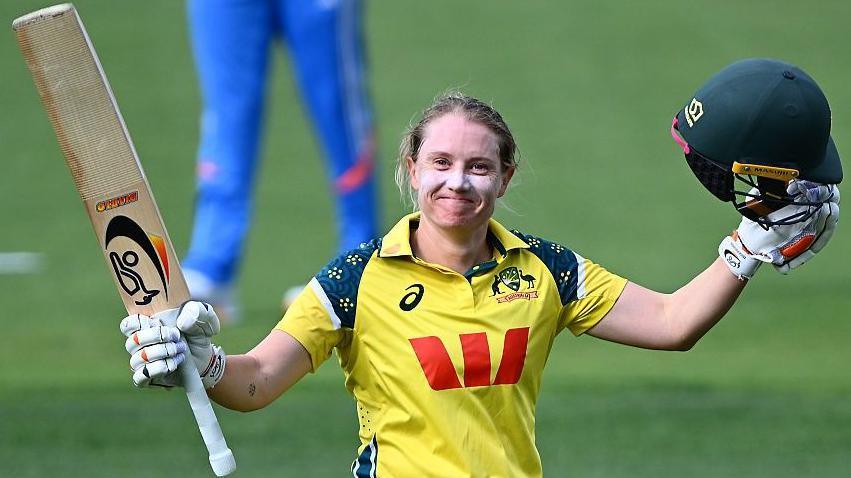
Alyssa Healy ended her one-day international career with a stunning 158 as Australia completed a clean sweep of the 50-over series against India with a 185-run win in Hobart.

The Australia captain, who is set to retire from all formats after this series, reached her century in 79 balls, before moving to 150 just 16 balls later.

She hit 27 fours and two sixes before being bowled by Sneh Rana for 158 off 98 deliveries.

It was Healy’s second highest ODI score behind her 170 from 138 balls against England in the 50-over World Cup final in 2022.

Healy, 35, was aided by team-mate Beth Mooney’s 106 off 84 as Australia posted 409-7 – their highest score in Australia and eighth highest in women’s ODI history.

“What a ridiculous sport we play that it can kick you down so many times and then give you opportunities like it has today,” said Healy after the match.

“I’ve hated every milestone match so today was just an opportunity to go out and enjoy it and it was one of the most enjoyable experiences I have had.

“I was fine this morning and then seeing Lucy Hamilton make her debut made me realise how special and lucky I have been over the last 15 years, to have done it as many times as I have.

“It’s a nice way to sign off in yellow.”

In reply, India were bowled out for 224 in 45.1 overs, with Rana making 44 off 74 balls, while leg-spinner Alana King was the pick of Australia’s bowlers with 4-33.

Australia lead the points-based multi-format series 8-4 having won all three ODIs, after India’s 2-1 win in the three-match T20 series.

The series concludes with a Test match worth four points at Perth’s WACA ground, meaning Australia can at worst draw the series.

On the Test match, Healy said: “To put ourselves in a position where we don’t have to win is a great sign for the series, but we are going [to the Test match] to win.

“Any time this group gets to wear the baggy green is extra special so we are looking forward to that.”

Related topics

  • Cricket

More on this story

    • 16 August 2025
    BBC Sport microphone and phone

Insecurity: Over 1,000 Nigerians Killed This Year — Peter Obi

The 2023 Labour Party presidential candidate, Peter Obi, has claimed that more than 1,000 Nigerians were killed and thousands more abducted between January and February of 2026.

In a post via X on Sunday, Obi said the scale of violence across the country is worse than that of nations officially at war.

He criticised what he described as the “politics of zero humanity” in the country, accusing political leaders of prioritising 2027 election calculations over the safety of Nigerians.

“It is profoundly disturbing that while we, the politicians, continue to obsess over the 2027 elections—spending our energy scheming about how to capture, grab, and run the next election—the first two months of 2026 have reportedly seen the killing of over 1,000 Nigerians and the abduction of several thousand others.

“This is the painful reality confronting our nation. From Zamfara State to Kwara, Ondo, Kebbi, Edo, Benue, Adamawa, Plateau, and many other states, families have buried loved ones, and communities have been emptied by gunshots and fear.”

READ ALSO: 10 Killed In Fresh Attacks On Two Plateau Communities

The former Anambra State governor alleged that more than 25 states across the country had been affected by attacks carried out by bandits and other terrorist groups, lamenting that the crisis had yet to receive the necessary attention from the relevant authorities.

“In over 25 states across all geopolitical zones this year alone, there have been major violent attacks on innocent citizens, kidnappings by armed bandits, mass shootings, village invasions, and brazen assaults on worshippers and travellers.

“The scale of bloodshed and the number of deaths in just two months in Nigeria are even worse than what we see in countries officially at war. Yet the urgency with which we discuss these tragedies does not match the urgency of our discussions surrounding zoning formulas, party structures, and campaign strategies,” he stated.

The African Democratic Congress (ADC) chieftain noted with dismay that while leaders were engrossed in debates about power sharing, Nigerians were busy sharing funeral programmes.

Obi stressed the need for authorities to elevate human life to what he described as “sacred status in our national priorities”, cautioning that leadership is not about winning elections but saving lives.

“We debate power sharing while citizens are sharing funeral programs. I watched in tears yesterday as families in the Doruwa Babuje community in Plateau State buried their dead after attacks by armed terrorists, but our media and leaders were focused on discussions about party issues and the 2027 elections.”

”When we aren’t even sure we will be alive to see it, given all the deaths happening in our country today. We strategise about 2027 while Nigerians struggle to survive 2026. This is inhumane.”

“We must elevate human life to a sacred status in our national priorities. Leadership is not about winning elections; it is about saving lives. We can, and we must, aspire to a Nigeria devoid of bloodshed—a Nigeria where governance is measured not by political dominance but by the safety and dignity of its people.

Who could succeed Ayatollah Ali Khamenei to lead Iran?

The killing of Ayatollah Ali Khamenei in US-Israeli air attacks has thrust Tehran to a pivotal crossroads as the ruling establishment looks to pick the late supreme leader’s successor.

Several senior leaders close to Khamenei were also killed in the attack, including his top security adviser Ali Shamkhani and Islamic Revolutionary Guard Corps (IRGC) commander-in-chief Mohammad Pakpour.

Tehran on Sunday targeted more sites in Gulf countries in retaliation as it vowed to avenge the killing of Khamenei. Meanwhile, United States President Donald Trump has warned against the retaliatory attacks and suggested that the strikes on Iran would continue.

The US-Israeli attacks were launched on Saturday despite several rounds of diplomatic engagement with Tehran that raised hopes of a deal on its nuclear programme.

The assassination of Khamenei, who took power in 1989, has left Iran’s top leadership to prepare for the transfer of power at a time when the US, the world’s strongest military power, has pledged to dismantle the ruling structure established following Iran’s 1979 revolution.

So, who will be the next supreme leader of Iran? And how will he be chosen?

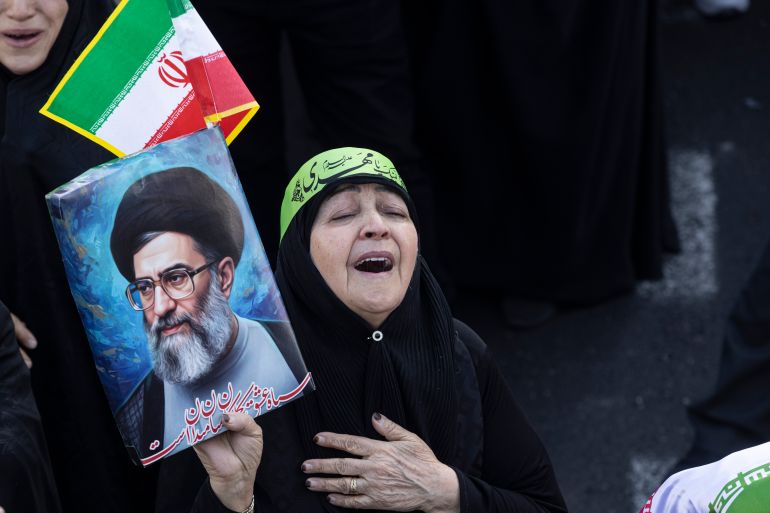
TEHRAN, IRAN - MARCH 1: A woman wails and holds a poster as thousands of people gather in Enghelab Square for a pro-government demonstration after Iranian state media confirmed the death of Ayatollah Ali Khamenei on March 1, 2026 in Tehran, Iran. Iran's Supreme Leader, Ayatollah Ali Khamenei, was confirmed killed after the United States and Israel launched a joint attack on Iran on February 28. Iran retaliated by firing waves of missiles and drones at Israel, and targeting U.S. allies in the region. (Photo by Majid Saeedi/Getty Images)
A woman wails and holds a poster as thousands of people gather in Enghelab Square for a pro-government demonstration after Iranian state media confirmed the death of Ayatollah Ali Khamenei on March 1, 2026 in Tehran, Iran [Majid Saeedi/Getty Images]

How is the supreme leader selected?

Iran’s supreme leader is selected by the Assembly of Experts, an 88-member clerical body elected by the public every eight years.

Candidates who run for the Assembly must first be vetted and approved by the Guardian Council, a powerful oversight body whose members are partly appointed by the supreme leader himself.

When the position becomes vacant, due to death or resignation, the Assembly of Experts convenes to choose a successor. A simple majority is sufficient to appoint the new supreme leader.

As per Iran’s constitution, the candidate must be a senior jurist with deep knowledge of jurisprudence in Shia Islam, as well as qualities such as political judgement, courage, and administrative capability.

Earlier, there had been only one other transfer of power in the office of the supreme leader of Iran, when Grand Ayatollah Ruhollah Khomeini, the leader of the Islamic Revolution, died at age 86 in 1989.

Iran
Emergency personnel stand at the site of an Iranian missile strike on a residential building, after Iran launched missile barrages following attacks by the United States and Israel on Saturday, in Tel Aviv, Israel, March 1, 2026 [Ronen Zvulun/Reuters]

What happens in Iran during a leadership vacuum?

Article 111 of Iran’s constitution mandates that a temporary council handle duties until a new supreme leader is elected.

That council will include President Masoud Pezeshkian, Supreme Court Chief Justice Gholam-Hossein Mohseni-Ejei, and a cleric from the Guardian Council, according to Iranian media. Ayatollah Alireza Arafi from the Guardian Council, 67, was on Sunday appointed to the three-member temporary council.

They will lead the country until the assembly formally picks the new supreme leader.

Iran’s security chief and a close confidante of the late Khamenei, Ali Larijani, said on Sunday that the transition process is under way.

Luciano Zaccara, a research associate professor in Gulf politics at Qatar University, told Al Jazeera that Iran’s political system has been prepared for the current situation, knowing that Khamenei’s assassination was a real possibility.

“Trump wants to get the best deal possible, but the method he’s using to get that deal is to annihilate or destroy as much as he can,” Zaccara said. “This is the way to impose conditions, not to negotiate anything. Trump wants a surrender of the regime, not a change.”

To avoid a vacuum of power, the late Khamenei kept replacements for all the officials eliminated in the last few months ready, and made sure to put in a structure, Zaccara told Al Jazeera.

“The structures remain, the line of power [and] the line of command remain in place,” he said.

INTERACTIVE-Iran’s government structure-jan 12, 2026 2-EDIT-1768237547
(Al Jazeera)

Who is the supreme leader of Iran?

The supreme leader is the top position in the Islamic Republic’s political and religious hierarchy under the velayat-e faqih system – the principle of the guardianship of the Islamic jurist.

He is essentially the commander-in-chief of the armed forces and the final word in the country – and appoints key judicial, military, and media officials. He also leads the mighty IRGC.

Here are the contenders for the top job in Tehran

iran
Mojtaba Khamenei (left), the second son of Iran’s Supreme Leader Ayatollah Ali Khamenei, visits Hezbollah’s office in Tehran, Iran, October 1, 2024 [Handout/Office of the Iranian Supreme Leader/West Asia News Agency via Reuters]

Mojtaba Khamenei

Khamenei’s second son, Mojtaba Khamenei, is among the top contenders to succeed his father as the next supreme leader.

He is known to wield significant influence among the administrators and the IRGC, the most powerful military body.

However, Khamenei’s lineage is also among the biggest barriers he faces. He was reportedly opposed to the father-to-son succession. It is frowned upon in Iran, particularly after the US-backed monarchy of Shah Mohammad Reza Pahlavi was toppled in 1979.

Iran
Pope Francis is shown a gift as he receives Ayatollah Alireza Arafi (centre), president of the Islamic Seminaries of Iran, and his entourage in a private audience at the Vatican, May 30, 2022 [Handout/Vatican Media via Reuters]

Alireza Arafi

Arafi, a 67-year-old cleric, is an influential figure in the Islamic Republic’s religious establishment, but not a widely accepted political actor.

He serves as the deputy chairman of the Assembly of Experts, the body responsible for overseeing the selection of the supreme leader, and has been a member of the Guardian Council, which vets election candidates and laws passed by parliament.

Arafi was appointed as ⁠the jurist member of ⁠Iran’s Leadership Council, the body tasked with fulfilling the ‌supreme leader’s role until the Assembly of Experts elects a new leader, Iran’s state media reported on Sunday.

He is also the Friday prayer leader of Qom – Iran’s most important religious centre – and heads the country’s seminary system, overseeing clerical education nationwide.

Mohammad Mehdi Mirbagheri

Mirbagheri is an ultra-hardline clerical voice in the establishment and a member of the Assembly of Experts.

He is widely known for his world view critical of the West – and currently heads the Islamic Sciences Academy in the northern city of Qom.

Gholam-Hossein Mohseni-Ejei

Mohseni-Ejei is a senior Iranian cleric and currently heads the judiciary of the Islamic Republic, appointed to the role in July 2021 by the late Khamenei.

He previously served as minister of intelligence from 2005 to 2009 and later as prosecutor-general and first deputy chief justice. He is regarded as a hardline figure aligned with the conservative wing of the regime.

Iran
Ayatollah Ruhollah Khomeini’s grandson, Hassan Khomeini (right), stands next to Iran’s Supreme Leader Ayatollah Ali Khamenei during the 36th anniversary of the death of the leader of Iran’s 1979 Islamic Revolution, Ayatollah Ruhollah Khomeini, at Khomeini’s shrine in southern Tehran, Iran, June 4, 2025 [Handout/Office of the Iranian Supreme Leader/WANA via Reuters]

Hassan Khomeini

Khomeini, 54, is among the most discussed names in succession talks for the next supreme leader.

He is the grandson of Ayatollah Ruhollah Khomeini, the founder of the Islamic Republic, and also the custodian of his grandfather’s mausoleum in Tehran.

How US-Israel attacks on Iran threaten the Strait of Hormuz, oil markets

The US-Israeli attacks on Iran have triggered swift retaliatory attacks from Tehran, targeting their assets in multiple Middle East countries, including Israel, Qatar, the United Arab Emirates, Kuwait, Bahrain, Jordan, Saudi Arabia, Iraq and Oman.

Analysts are warning of a spike in global oil prices after Iranian officials hinted at shutting down the Strait of Hormuz, one of the most important maritime routes in the world.

Recommended Stories

list of 3 itemsend of list

On Saturday, an official from the European Union told the Reuters news agency that vessels crossing the strait have been receiving very high frequency (VHF) transmissions from Iran’s elite Islamic Revolutionary Guard Corps (IRGC), saying “no ship is allowed to pass the Strait of Hormuz”.

However, the EU official added, Iran has not officially closed the strait. Instead, several tanker owners have suspended oil and gas shipments through the strait amid the ongoing conflict in the region.

“Our ships will stay put for several days,” a top executive at a major trading desk told Reuters on condition of anonymity. Countries like Greece have also advised their vessels to avoid transiting through the waterway.

Any instability in this important maritime route could rattle economic stability worldwide.

So what is the Strait of Hormuz, and how will its closure impact oil prices?

Where is the Strait of Hormuz?

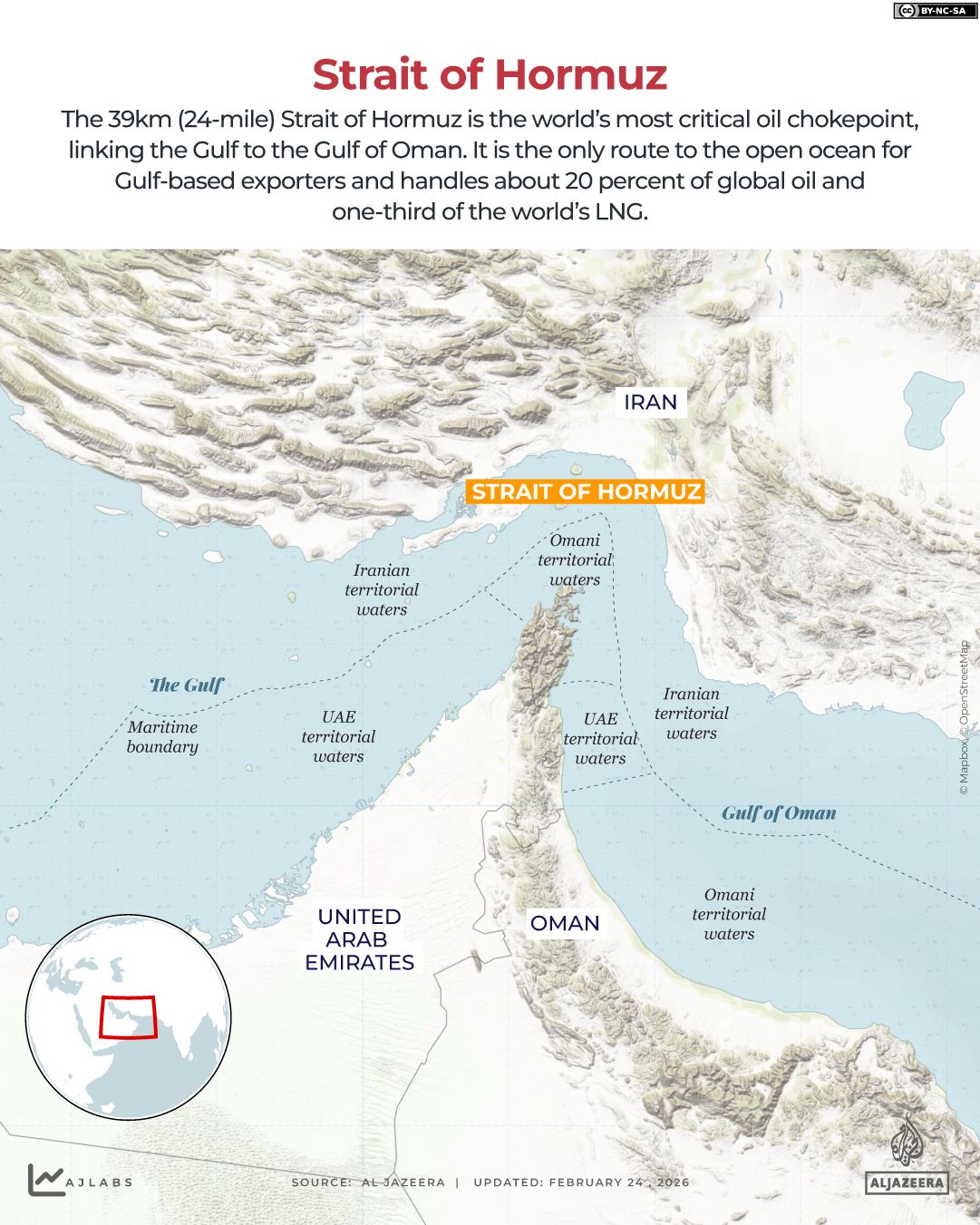
The Strait of Hormuz is located between Oman and the UAE on one side and Iran on the other. It links the Arabian/Persian Gulf, or just the Gulf, with the Gulf of Oman and the Arabian Sea beyond.

It is 33km (21 miles) wide at its narrowest point, with the shipping lane just 3km (2 miles) wide in either direction, making it vulnerable to attack.

Despite its narrow width, the channel accommodates the world’s largest crude carriers. Major oil and gas exporters in the Middle East rely on it to move supplies to international markets, while importing nations depend on its uninterrupted operation.

How much oil and gas pass through the strait?

According to the US Energy Information Administration (EIA), about 20 million barrels of oil, worth about $500bn in annual global energy trade, transited through the Strait of Hormuz each day in 2024.

The crude oil passing through the strait originates from Iran, Iraq, Kuwait, Qatar, Saudi Arabia and the UAE.

The strait also plays a critical role in the liquefied natural gas (LNG) trade. According to the EIA, in 2024, roughly a fifth of global LNG shipments moved through the corridor, with Qatar accounting for the vast majority of those volumes.

Where does it all go?

The strait handles both oil and gas exports and imports.

Kuwait and the UAE import supplies sourced outside the Gulf, including shipments from the United States and West Africa.

The EIA estimated that in 2024, 84 percent of crude oil and condensate shipments transiting the strait headed to Asian markets. A similar pattern appears in the gas trade, with 83 percent of LNG volumes moving through the Strait of Hormuz destined for Asian destinations.

China, India, Japan and South Korea accounted for a combined 69 percent intake of all crude oil and condensate flows through the strait last year. Their factories, transport networks and power grids depend on uninterrupted Gulf energy.

A spike in oil prices will impact countries such as China, India and several Southeast Asian nations.

How would the Strait’s closure impact oil prices?

According to Iranian state media, the country’s Supreme National Security Council must make the final decision to close the strait, and it has to be ratified by the government.

But energy traders have been on high alert in recent weeks amid escalating tensions in the region – home to one of the largest reserves of oil and gas in the world. Muyu Xu, senior crude oil analyst at Kpler, told Al Jazeera that since the war began on Saturday, there has been a sharp drop in vessel traffic through the strait.

“At the same time, the number of vessels idling on either side – in the Gulf of Oman and the Gulf – has surged, as shipowners grow increasingly concerned about maritime security risks following Tehran’s warning of a potential navigation closure,” he said.

“The Strait of Hormuz is critical to the global energy market, as roughly 30 percent of the world’s seaborne crude oil transits the waterway. In addition, nearly 20 percent of global jet fuel and about 16 percent of gasoline and naphtha flows also pass through the Strait,” Muyu said.

“On Sunday, an oil tanker was struck off the coast of Oman just hours ago, signalling a clear escalation of the conflict and a shift in targets from purely military facilities to energy assets.”

Shipping data showed that at least 150 tankers, including crude oil and liquefied natural gas vessels, have dropped anchor in open Gulf waters beyond the Strait of Hormuz.

The tankers were clustered in open waters off the coasts of major Gulf oil producers, including Iraq and Saudi Arabia, as well as LNG giant Qatar, according to the Reuters news agency estimates based on ship-tracking data from the MarineTraffic platform.

Moreover, on Sunday, the United Kingdom Maritime Trade Operations (UKMTO) said it is aware of “significant military activity” in the Strait and said it has ⁠received a report of an ⁠incident two nautical miles north of Oman’s Kumzar, located in the ‌Strait of Hormuz.

Muyu from Kpler said a broad range of energy infrastructure is now under threat. “This is expected to sharply intensify the oil price rally and could keep prices elevated for a sustained period, potentially longer than during last June’s conflict.”

Ali Vaez, director of the Iran project at the International Crisis Group, told Al Jazeera, “Closure of the Strait of Hormuz would disrupt roughly a fifth of globally traded oil overnight – and prices wouldn’t just spike, they would gap violently upward on fear alone.”

“The shock would reverberate far beyond energy markets, tightening financial conditions, fuelling inflation, and pushing fragile economies closer to recession in a matter of weeks,” he added.

When the US and Israel bombed Iran last June, there was no direct disruption to maritime activity in the region.

What does it mean for the global economy?

Any disruption to energy flows through Hormuz will also impact the global economy, driving up fuel and factory costs.

Hamad Hussain, a climate and commodities economist at the United Kingdom-based firm Capital Economics, said that for the global economy, a sustained rise in oil prices would add upward pressure to inflation.

“If crude oil prices were to rise to $100 per barrel and remain at those levels for a while, that could add 0.6-0.7 percent to global inflation,” he said, noting that this would also lead to an increase in natural gas prices.
Green wins LPGA title with husband as caddie

Paul Battison

BBC Sport Journalist

HSBC Women’s World Championship – final round leaderboard

-14 H Green (Aus); -13 A Kim (US); -11 P Bouchard (Fra), A Yin (US), M Lee (Aus); -10 H Ryu (Kor); -8 L Duncan (US); -7 A Iwai (Jpn), R Takeda (Jpn)

Selected others: -6 L Woad (Eng), C Hull (Eng), M Rhodes (Eng)

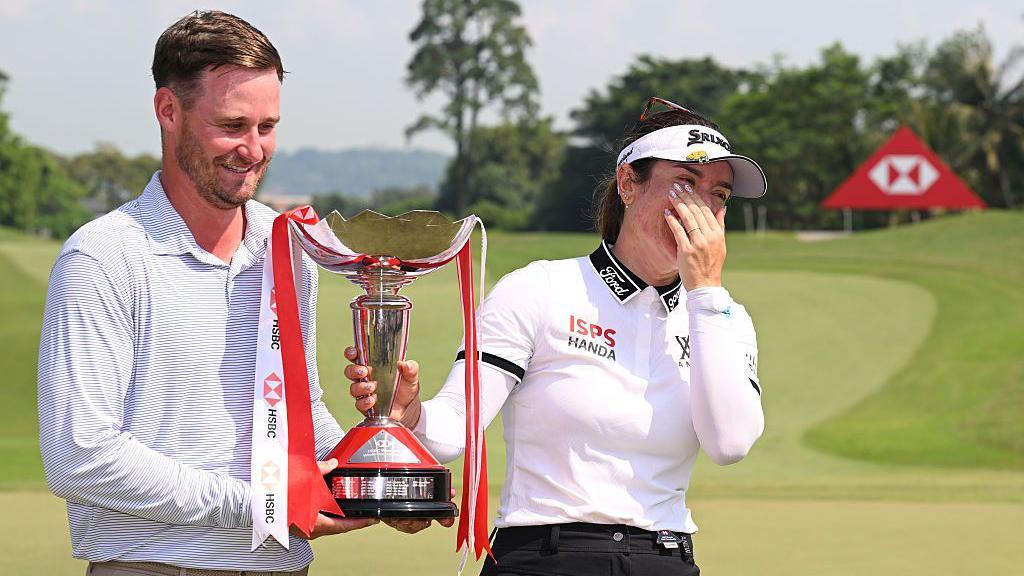
Australia’s Hannah Green won the LPGA’s Women’s World Championship in Singapore after her husband stepped in as her caddie.

With Green’s usual caddie unable to leave the USA while he applies for a green card, her husband Jarryd Felton – who is a professional golfer – filled the role for the second time this year.

Green, 29, carded a three-under-par 69 on Sunday to finish one shot clear of American Auston Kim and win this title for a second time.

She married Felton in 2024 and has also caddied for her husband in the past.

“It was absolutely a team effort over the last two weeks, and it’s very special to share my seventh win, which is also my favourite number, with him,” said Green.

“My usual caddie is applying for a green card and couldn’t leave the US, so it wasn’t part of the plan for the season. Luckily, my husband was able to pick up the bag for me.”

Green started the day tied for the lead with three-time major champion Minjee Lee, but took control with an early birdie followed by an eagle on the eighth hole.

Green sank three more birdies on the final nine, and – despite a nervous finish after bogeying her final two holes – ended on 14 under overall to win this tournament for the second time in three years, having triumphed in 2024.

“I was feeling nervous and told Jarryd a couple of times that I wasn’t comfortable. He reminded me to take a deep breath, have a snack or even sip some water,” she said.

“I haven’t played with this kind of adrenaline in a long time, and we handled it really well.”

Related topics

  • Golf