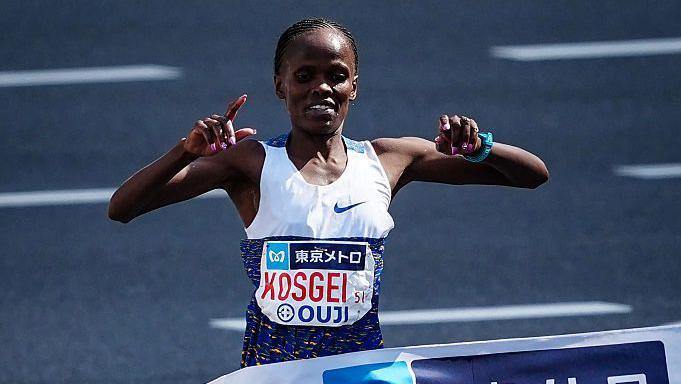
Kenya’s Brigid Kosgei set a new course record with a commanding victory at the Tokyo Marathon.
The 32-year-old finished in 2:14:29 – more than two minutes ahead of Ethiopia’s Bertukan Welde, who was second in 2:16:36.
Welde’s Ethiopian compatriot Hawi Feysa came third in 2:17:39.
The previous course record was 2:15:55 – set by two-time Tokyo winner Sutume Asefa Kebede in 2024.
Kosgei, who won marathon silver for Kenya at the Tokyo Olympics in 2021, is planning to represent Turkey at the 2028 Los Angeles Games.
“We have a lot of athletes in Kenya,” said Kosgei. “I want some young generation to follow my step to join me in Turkey.”
In the men’s race, Ethiopia’s Tadese Takele defended his title in a thrilling sprint finish with Kenyan duo Geoffrey Toroitich and Alexander Mutiso Munyao.
Takele clocked 2:03:37, which was the same official time as second-placed Toroitich, with Munyao finishing just one second further back in third.
“I knew that the final stage would be decisive,” said 23-year-old Takele.
More explosions have been heard across the Gulf states as Iran carries out attacks in retaliation for attacks by the United States and Israel that killed its Supreme Leader Ayatollah Ali Khamenei and other top officials.
The explosions were heard for a second day on Sunday morning in Dubai, the United Arab Emirates; Bahrain’s capital, Manama; and Qatar’s capital, Doha, raising fears of a wider conflict in a region long seen as a haven of peace and security in an otherwise turbulent Middle East.
Recommended Stories
list of 4 itemsend of list
Witnesses in Doha reported hearing several loud bangs and seeing thick black smoke rising on the clear morning horizon in the south of the city.
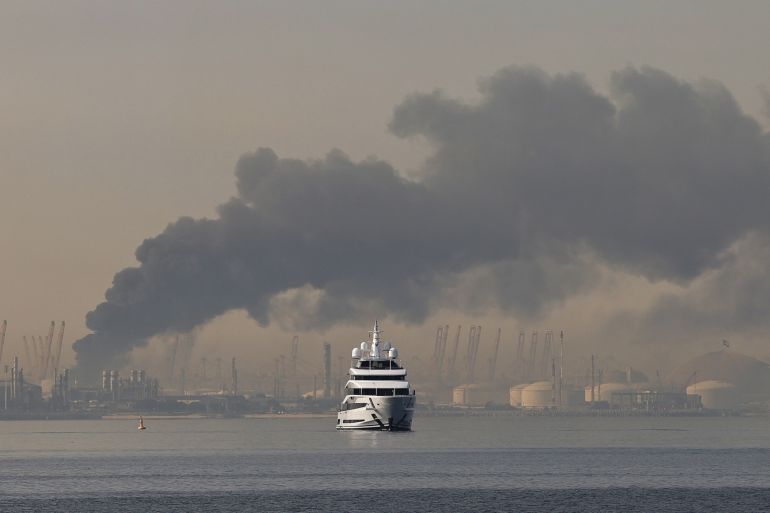
Shortly after, another wave of explosions reverberated through Dubai, a regional business hub. Puffs of white smoke from missile interceptions were seen in the city’s skies, while billows of dark smoke rose over its port of Jebel Ali, one of the busiest in the Middle East.
Explosions were also reported in Manama, with witnesses reporting at least four loud explosions. There was no immediate report of any damage or injuries from Sunday’s blasts.
The explosions came after a day of similar Iranian strikes on US military bases and other assets across the Gulf – except for Oman, which was mediating the nuclear talks between the US and Iran.
The oil-and-gas-rich Arab states, lying just across the Gulf from Iran, collectively host thousands of US troops.
On Saturday, Iran fired 137 missiles and 209 drones across the UAE, the country’s Ministry of Defence said, with fires and smoke reaching the Dubai landmarks of Palm Jumeirah and Burj al-Arab.
At Abu Dhabi’s airport, at least one person was killed and seven others wounded during what the facility’s authority called an “incident”. Dubai airport, the world’s busiest for international traffic, and Kuwait’s airport were also hit.
A yacht sails past a plume of smoke rising from the port of Jebel Ali following a reported Iranian attack on Dubai on March 1, 2026 [AFP]
Meanwhile, Qatari officials said Iran launched 65 missiles and 12 drones towards the Gulf state on Saturday, most of which were intercepted, but 16 people were injured in the attacks.
Elsewhere in the region, the Jordanian defence systems intercepted missiles that entered the capital Amman’s airspace, as well as the country’s northern areas, according to Al Jazeera Arabic. Sirens were also heard in Kuwait, the network reported.
In northern Iraq, a drone crashed near Erbil international airport, according to local media reports, with a large plume of smoke rising. The US is reported to still have troops in Iraq’s autonomous Kurdish region as part of an international coalition against ISIL (ISIS).
‘A great crime’
Iranian President Masoud Pezeshkian has denounced Khamenei’s killing “as a great crime”. Iran’s armed forces’ chief of staff, Abdul Rahim Mousavi, has also been killed in the joint US-Israeli attacks.
Iran’s parliamentary speaker, Mohammad Bagher Qalibaf, said in a televised address on Sunday that “you [US and Israel] have crossed our red line and must pay the price”. “We will deliver such devastating blows that you yourselves will be driven to beg,” he said.
Trump said the US will hit Iran “with a force that has never been seen before” if the Middle East nation hits back over the killing of Khamenei, who ruled over the country for 37 years.
“Iran just stated that they are going to hit very hard today, harder than they have ever been hit before,” Trump said in a post on Truth Social. “THEY BETTER NOT DO THAT, HOWEVER, BECAUSE IF THEY DO, WE WILL HIT THEM WITH A FORCE THAT HAS NEVER BEEN SEEN BEFORE!”
More than 200 killed in Iran
Israel’s military early on Sunday said it had struck more than 30 targets in attacks on western and central Iran, announcing that strikes would continue on Iranian air defence installations, missile sites, military headquarters and other “regime targets”.
Since Saturday, at least 201 people have been killed in Iran, including at least 148 people in an attack on an elementary girls’ school in the southern city of Minab.
Iran’s Islamic Revolutionary Guard Corps (IRGC) said it was carrying out retaliatory attacks at 27 US bases, the Israeli Tel Nof airbase, the Israeli army’s command headquarters at HaKirya in Tel Aviv, and a large defence industrial complex in the city.
People look at a building damaged in a reported overnight Iranian attack in Tel Aviv on March 1, 2026 [AFP]
Shortly after 6am local time (03:00 GMT), air raid sirens were repeatedly sounded across Israel, including in Tel Aviv, after a series of explosions were heard.
The Iranian government has announced the formation of a three-person interim council to oversee the transition following the death of their supreme leader, as his supporters take to the streets in Tehran and other cities in mourning.
Iran has begun 40 days of mourning after Supreme Leader Ayatollah Ali Khamenei was killed in ongoing attacks by the United States and Israel, according to Iranian state media.
Top security officials were also killed in Saturday’s strikes, along with Khamenei’s daughter, son-in-law and grandson. The killings mark one of the most significant blows to Iran’s leadership since the 1979 Islamic revolution.
Recommended Stories
list of 4 itemsend of list
President Masoud Pezeshkian condemned the killing as “a great crime”, according to a statement from his office. He also declared seven days of public holidays in addition to the 40-day mourning period.
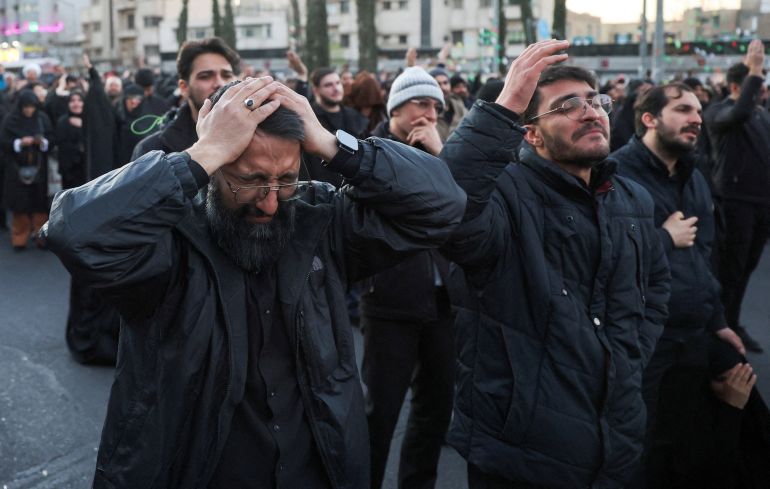
Reporting from Tehran, Al Jazeera’s Tohid Asadi said people were pouring into the streets of the capital following the news of Khamenei’s killing.
“There will be expected ceremonies,” he said, noting they would likely take place amid continuing bombardment across the country.
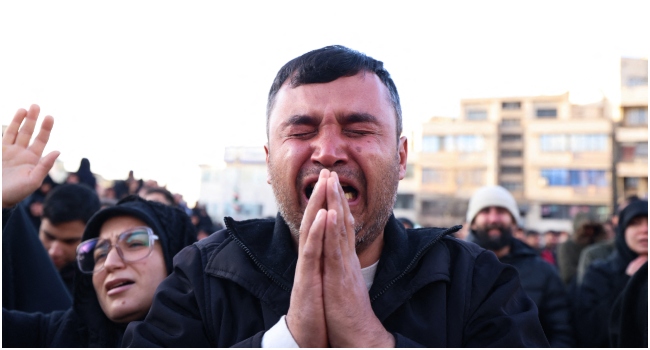
People mourn at the Enghelab Square in Tehran [Majid Asgaripour/West Asia News Agency via Reuters]
Protests denouncing Khamenei’s killing were also reported elsewhere, including Shiraz, Yasuj and Lorestan.
“There will be expected ceremonies,” he said, noting they would likely take place amid continuing bombardment across the country.
Footage aired by Iranian state media showed supporters mourning at the shrine of Imam Reza in Mashhad, with several people seen crying and collapsing in grief.
The killing also led to protests in neighbouring Iraq, which declared three days of public mourning. In Baghdad, protesters confronted security forces in the heavily fortified Green Zone, which houses Iraqi government buildings and foreign embassies.
Videos verified by Al Jazeera showed demonstrators waving flags and shouting slogans, with witnesses saying some were attempting to mobilise towards the US Embassy. Footage also showed protesters blocking vehicles at a roundabout near one of the entrances to the area.
Protesters demonstrate near the entrance of the Green Zone after the killing of Iran’s Supreme Leader Ayatollah Ali Khamenei, in Baghdad, Iraq, March 1, 2026 [Thaier Al-Sudani/Reuters]
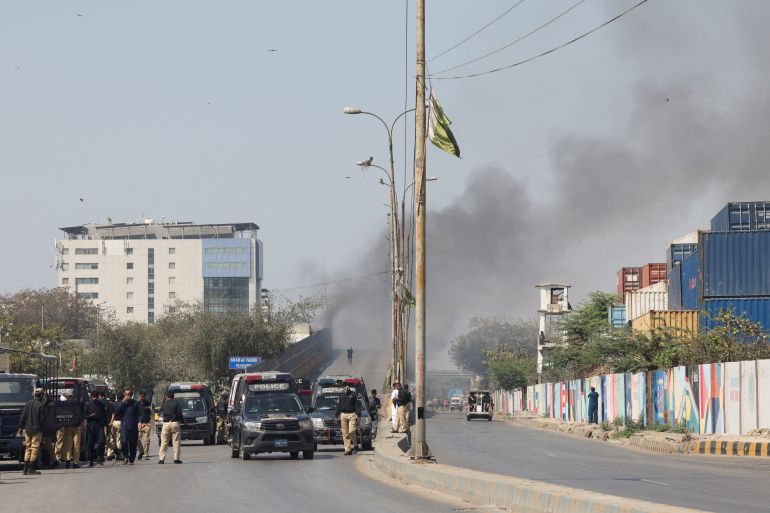
There was also a protest in the Pakistani city of Karachi, where footage, verified by Al Jazeera, showed people setting fire to and smashing the windows of the US consulate.
However, there have also been reports of celebrations in Iran, with the Reuters news agency quoting witnesses as saying some people had taken to the streets in Tehran, the nearby city of Karaj and the central city of Isfahan.
Meanwhile, the official IRNA news agency reported that a three-person council, consisting of the country’s president, the chief of the judiciary, and one of the jurists of the Guardian Council, will temporarily assume all leadership duties in the country. The body will temporarily oversee the country until a new supreme leader is elected.
Ali Larijani, the head of Iran’s Supreme National Security Council, accused the US and Israel of trying to plunder Iran, in an interview aired on state TV.
He also called on Iranians to unite. “Groups seeking to divide Iran should know that we will not tolerate it,” he added.
Khamenei assumed leadership of Iran in 1989 following the death of Ayatollah Ruhollah Khomeini, who had led the Islamic revolution a decade earlier.
While Khomeini was regarded as the ideological force behind the revolution that ended the Pahlavi monarchy, Khamenei went on to shape Iran’s military and paramilitary apparatus, strengthening both its domestic control and its regional influence.
Attacks across the region
Meanwhile, the Islamic Revolutionary Guard Corps (IRGC) pledged revenge and said it had launched strikes on 27 bases hosting US troops in the region, as well as Israeli military facilities in Tel Aviv.
Explosions have continued to be reported in Qatar and the United Arab Emirates, while security alerts are in place in several countries across the region.
US President Donald Trump, in a social media post on Sunday, warned Iran that it would be hit “with a force that has never been seen before” if it retaliated.
Iran’s retaliatory attacks since Saturday have targeted Israel and US assets across multiple Middle East countries, including Qatar, the UAE, Kuwait, Bahrain, Jordan, Saudi Arabia and Iraq.
Harlan Ullman, chairman of the strategic advisory firm Killowen Group and an adviser to the Atlantic Council in Washington, DC, said the US may have made a “big mistake” by killing Khamenei.
“Decapitation only works when you get all the leaders, and I don’t think that we got all the leaders,” Ullman said, adding that the US should not expect Iran’s leadership to enter negotiations in the immediate aftermath.
At least nine people have been killed near a United States consulate in the Pakistani city of Karachi after protests broke out following the killing of Iranian Supreme Leader Ayatollah Ali Khamenei, an official has told Al Jazeera.
Several others were injured as security forces opened fire to scatter hundreds of pro-Iranian protesters trying to storm the consulate early on Sunday morning.
Recommended Stories
list of 4 itemsend of list
Police surgeon Dr Summaiya Syed told Al Jazeera at least nine bodies were brought to Karachi’s civil hospital.
Video footage shared online and verified by Al Jazeera showed a wounded person being transported by bystanders. Other images showed protesters attempting to storm the US consulate building located on the city’s Mai Kolachi Road.
Large protests also broke out in other parts of Pakistan.
Protesters set fire to a United Nations office building in Pakistan’s northern city of Skardu, in the Shia-majority Gilgit Baltistan (GB) region, known for its Himalayan peaks popular with tourists.
“A large number of protesters have gathered outside the UN office in GB and burned down the building,” local government spokesperson Shabbir Mir told Reuters news agency, adding no casualties had been reported.
Police gather after a protest outside the US consulate in Karachi, March 1, 2026 [Akhtar Soomro/Reuters]
In the central city of Lahore, hundreds of protesters gathered outside the US consulate, but there were no reports of violence.
“Some of the protesters tried to damage the security gate, hundreds of yards away from the consulate. However, police stopped them without using force,” Aqeel Raza, a witness, told Reuters.
A demonstration is also expected near the diplomatic enclave housing the US embassy in the capital, Islamabad, on Sunday afternoon.
Protests over Khamenei’s killing have also broken out elsewhere in the world, including Iraq, Morocco, and Indian-administered Kashmir.
Iraq announced on Sunday a three-day mourning period after the death of Iran’s supreme leader, Ayatollah Ali Khamenei.
Government spokesman Bassem al-Awadi said in a statement that “with deep sorrow, we extend our condolences to the noble people of Iran and the entire Muslim world” after Khamenei was killed in “a blatant act of aggression”.
READ ALSO: Iran Strikes US Bases In Iraq, Gulf After Khamenei’s Death
He said the government had announced three days of mourning, while urging an immediate cessation of military operations that “are driving the region to unprecedented levels of violence”.
Iran wields a significant influence in Iraqi politics and also backs armed groups, whose power has grown both politically and financially.
Iraq has for decades been a proxy battleground between the US and Iran.
The Coordination Framework, a ruling coalition of Shiite groups with varying degrees of links to Iran, said “with deep sorrow and profound grief, we mourn the passing of the martyred leader, Ayatollah Ali Khamenei”.
His “blood will remain a guiding light for all generations” and “the curse will continue to haunt the murderous Zionists for all time”, the coalition added.
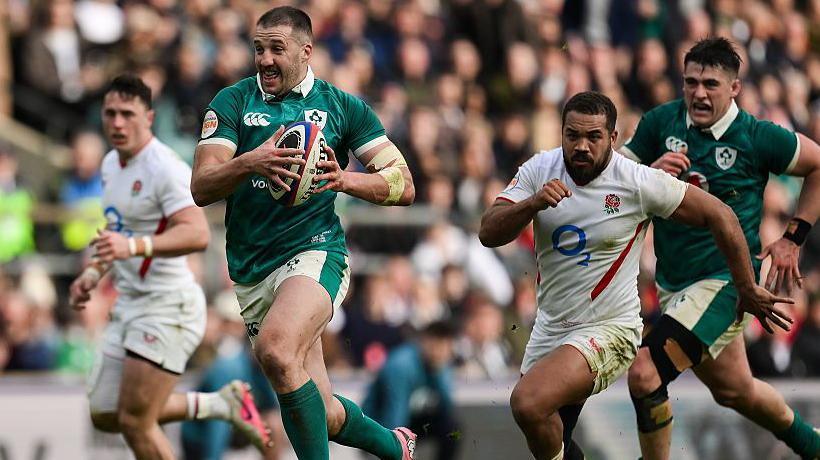
If perseverance and desire fuelled Stuart McCloskey when chasing down Marcus Smith in the closing stages of Ireland’s 42-21 Six Nations win over England last week, it was perhaps a microcosm of his international career.
The 33-year-old centre made his Test debut at Twickenham during the 2016 edition as England claimed a 21-10 win on their way to a Grand Slam, but appearances during Joe Schmidt’s reign as Ireland coach proved few and far between.
With Bundee Aki and Robbie Henshaw the preferred midfield partnership at that time, McCloskey found himself out of favour, while Schmidt did not seem keen on the Ulster man who earned just two further caps during his tenure.
Performances for Ulster were catching the eye and McCloskey was beginning to play his way in, despite filling the dreaded 24th man role more times than he would have preferred.
A run in the team during the 2022 autumn wins over South Africa, Fiji and Australia seemed to solidify a partnership with Garry Ringrose and that carried into the following year’s Six Nations with McCloskey starting against Wales, France and Italy.
However, misfortune would be the culprit this time as injury ruled him out of the remaining games against Scotland and England as Ireland won the Grand Slam as Aki seized his opportunity.
“It wasn’t hard mentally as I thought I did pretty well,” McCloskey reflected.
“Unfortunately I had the calf tear and Bundee came in. That was a straight swap and we saw what he did for those last two games which led into the World Cup.
“Back then it wasn’t the done thing to put a 12 on the bench and Bundee was unbelievable during that World Cup cycle and was nominated for World Player of the Year.
Getty Images
It’s been a reversal this time, with Aki suspended for the opening three games of Ireland’s Six Nations campaign, opening the door for McCloskey to stake his claim once again.
While Ireland’s campaign got off to a slow start with an emphatic defeat by France before surviving a scare against Italy, it all came together against England.
McCloskey was a key figure in that game, making line breaks, creating opportunities, putting in the tackles which culminated with that last-ditch tackle on Smith, who seemed to be in the clear to salvage a four-try bonus point as a form of consolation for Steve Borthwick’s team.
Racing back to make that challenge turned McCloskey into something of a viral sensation afterwards, giving him “a few laughs as there are some funny memes going about”.
However, it was an incident during training on the Tuesday before the game when Farrell challenged him for not making the same effort which reminded him of the effort required at Test level.
“It wasn’t like Andy went through us, but just pointed it out and a couple of us were still struggling with soreness from the weekend, but he was right.
‘This is vindication for the years of slogging it out’
Aki is back with the Ireland squad as they prepare for Friday’s game against Wales in Dublin (20:10 GMT), but will he return to the starting line-up?
On current form, many will feel McCloskey deserves to retain his place and he is certainly hopeful that he can continue to make the most of his chances in the green jersey.
“I’ve always said you have to enjoy the environment and even being the 24th man I enjoyed, but you always want the opportunity (to play) and over the last seven or eight months, I’ve had a good run at it,” he said.
“I suppose it’s (praise) vindication for the years of slogging it out and not getting too much love. You’ve got to enjoy to as these things don’t last forever.