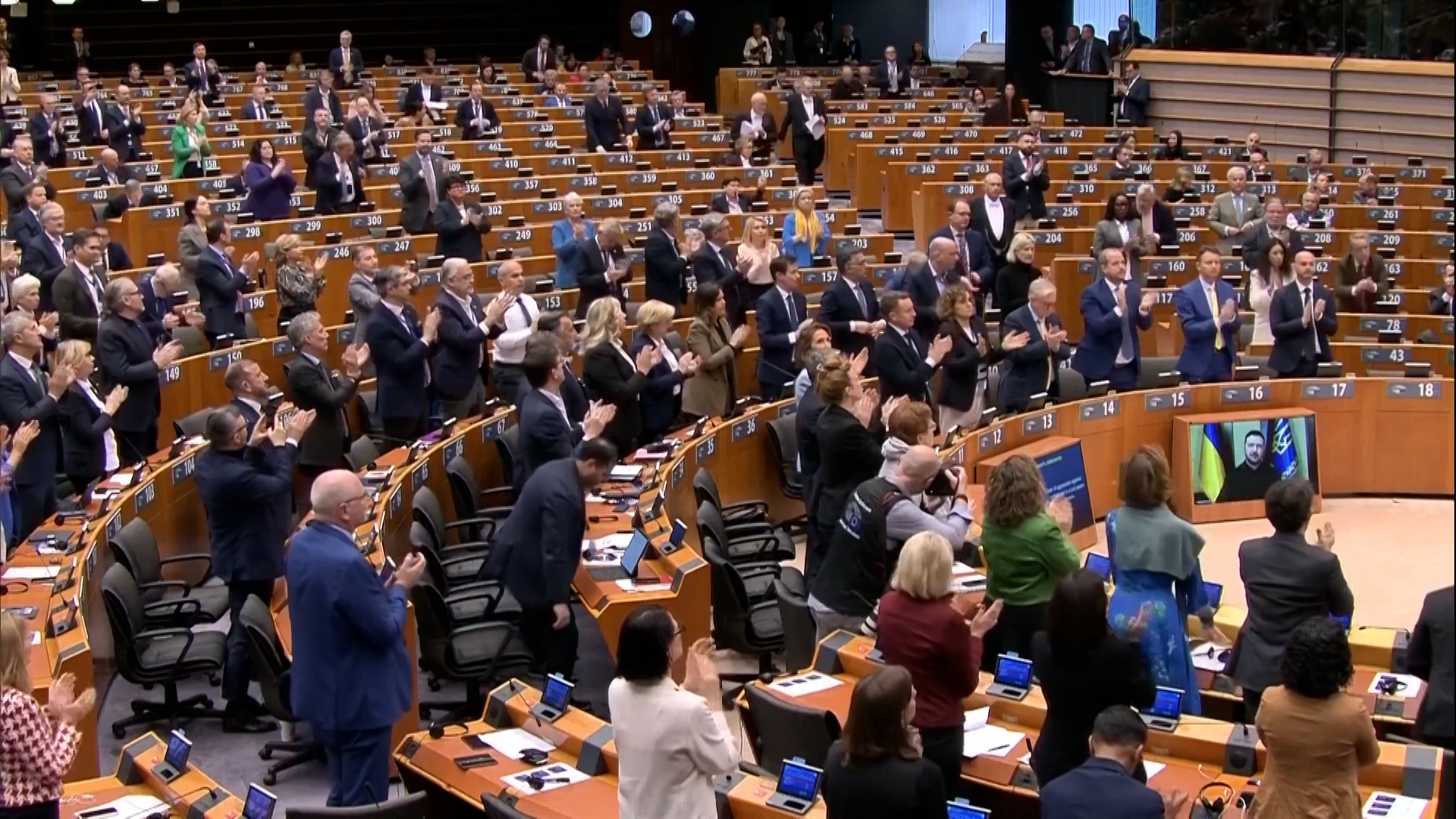
Politicians at the European Parliament gave Ukrainian president Volodymyr Zelenskyy a standing ovation after a speech marking the fourth anniversary of Russia’s full-scale invasion of Ukraine.
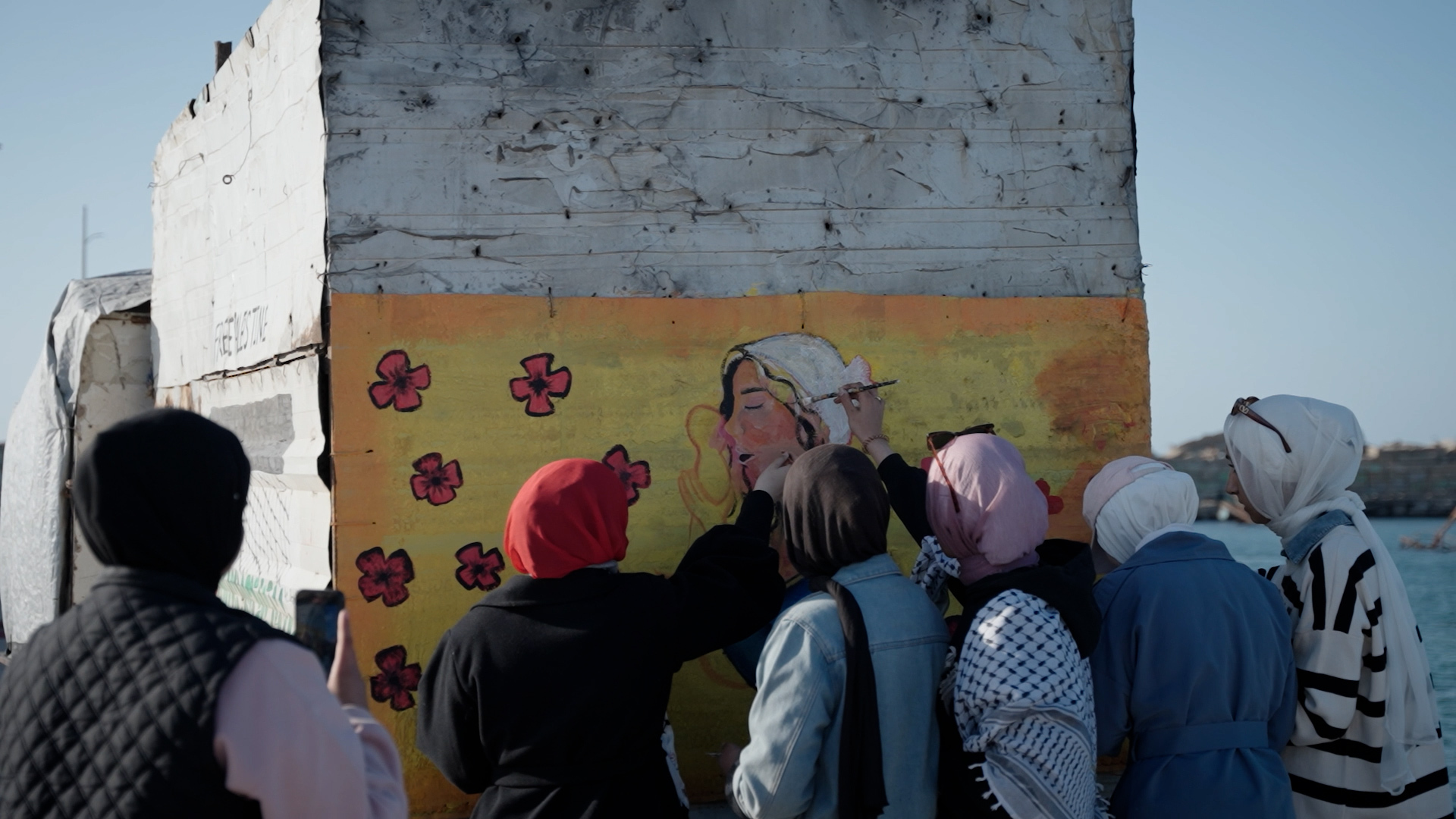
Young Palestinian artists in Gaza are turning the city’s ruins into a canvas through ‘Breathe and Paint’, an initiative founded by local artist and activist Farah Ajjour. They transform the trauma of war into art that speaks of survival, resistance, and hope.
Israeli soldiers fired more than 900 bullets at a convoy of clearly marked Palestinian emergency vehicles in Gaza before advancing to kill the surviving aid workers, some of whom were shot “execution-style” at close range, last March, a new joint investigation has revealed.
The report released on Monday by independent research agency Forensic Architecture and audio investigation group Earshot offers the most detailed reconstruction to date of the massacre in Tal as-Sultan, a neighbourhood west of Rafah in the southern Gaza Strip, on March 23, 2025.
Recommended Stories
list of 4 itemsend of list
Fifteen aid workers were killed in the attack, including paramedics from the Palestine Red Crescent Society (PRCS), firefighters from the Palestinian Civil Defence (PCD) and a staff member of the United Nations agency for Palestinian refugees (UNRWA). The slain aid workers were then buried along with their vehicles.
The Israeli military initially claimed the vehicles were “uncoordinated” and later admitted a “professional error”. But the forensic analysis paints a different picture: a coordinated ambush, an absence of return fire and a calculated move to eliminate survivors.
The science of the massacre
The investigation relies heavily on a “situated testimony” technique and advanced audio ballistics to analyse the sound of gunfire to determine the shooter’s distance, weapon type and direction.
Investigators analysed footage recovered from the phone of slain paramedic Rifaat Radwan, a PRCS paramedic who began recording at 5:09am, when the ambush began. In a video lasting five and a half minutes, at least 844 gunshots were recorded. Combined with other recordings, the total documented count reached at least 910 gunshots.
In the video, filmed from inside one of the last two ambulances, Radwan can be heard asking his mother for forgiveness and reciting the Islamic declaration of faith, the shahada, before he dies.
According to Earshot’s analysis, 93 percent of these shots featured a specific acoustic signature: a “supersonic shockwave”, followed by a muzzle blast. This combination confirms that the camera – and the aid workers huddled around it – were directly in the line of fire.
“The density of gunfire … frequently exceeds 900 rounds per minute,” the report states, noting that, at one point, five shots were fired in just 67 milliseconds. This rate of fire confirms that at least five shooters, likely many more, were firing simultaneously from an elevated sandbank approximately 40 metres away.
“Israeli soldiers ambushed and subjected Palestinian aid workers to continuous assault by gunfire for over two hours”, between 5:09am and 7:13am, the report says.
From ambush to execution
The report challenges the Israeli narrative of a chaotic “combat zone”. Instead, it describes a methodical massacre of Palestinian aid workers on their way to help people injured in Israeli strikes.
“There was no exchange of fire in the area, and no tangible threat to the safety of those soldiers. These attacks did not happen in ‘a hostile and dangerous combat zone’, as was claimed by Israeli spokespersons,” the report says.
By analysing the time delay between the sound of the gunshots and their echoes bouncing off a nearby concrete wall, investigators tracked the movement of the soldiers.
For the first four minutes, the soldiers held a fixed position on a sandbank. Then, the audio data shows the echo interval increasing, indicating the soldiers were moving down the hill, advancing roughly 50 metres towards the convoy while continuing to fire.
This corroborates the testimony of survivor Assaad al-Nassasra, a PRCS worker, who told investigators: “They were walking between [the aid workers] and shooting.”
The most chilling findings concern the final moments of the attack. Analysis of a subsequent phone call made by paramedic Ashraf Abu Libda to dispatchers captures the soldiers arriving at the vehicles.
The audio analysis identifies specific gunshots where the distinct “supersonic crack” of the bullet disappears, leaving only the muzzle blast. Ballistically, this indicates the shooter was within 1 to 4 metres (3 feet to 13 feet) of the victim.
These shots coincide with the final sounds of movement from Abu Libda, suggesting he was shot while lying on the ground. A doctor who later examined the bodies confirmed the wounds were consistent with “execution-style” killings.
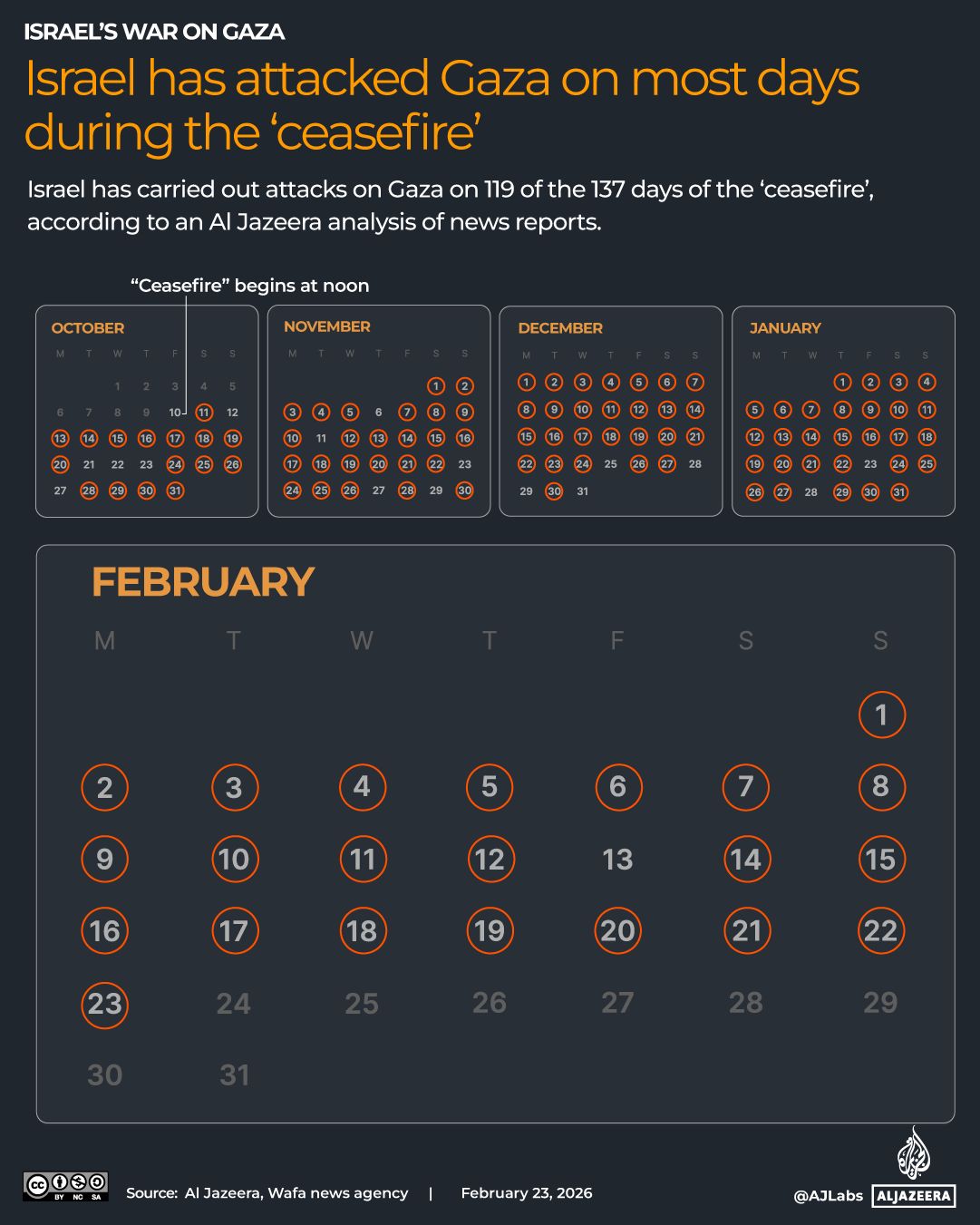
Israeli forces have repeatedly been accused of crimes against humanity and war crimes during their genocidal war in Gaza that killed more than 72,000 Palestinians. A recent report by the medical journal The Lancet says the death toll in the first 16 months was much higher than the official figures. Despite a “ceasefire” in place since October, Israel has killed more than 600 Palestinians.
Rights groups and scholars have said the Israeli military offensive that turned Gaza into ruins is genocide. The International Court of Justice (ICJ) is hearing a case of genocide against Israel, while the International Criminal Court (ICC) has issued an arrest warrant for war crimes against Prime Minister Benjamin Netanyahu.
The brutal killing of the 15 aid workers in March 2025 caused outrage, but Israel faced no legal or political consequences as it continued to receive backing from its Western allies, including the United States.
Hiding the evidence
The report details a systematic attempt by Israeli forces to conceal the massacre in the hours that followed.
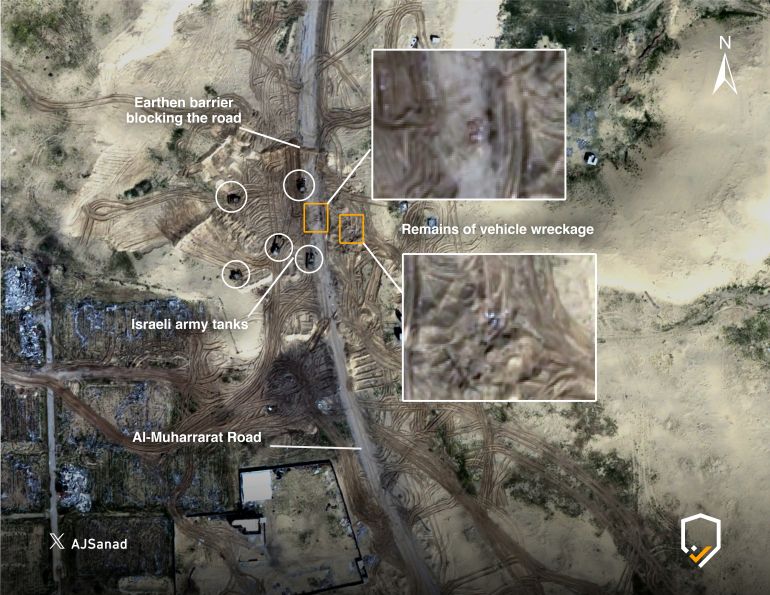
Satellite imagery from that morning revealed that bulldozers were deployed to the site. The emergency vehicles were crushed and buried, and earth berms were constructed over the scene to block visibility.
These forensic findings align with exclusive satellite imagery obtained by Al Jazeera’s Sanad fact-checking agency last year. In a report published on March 30, 2025, Sanad revealed imagery taken on March 25 showing that at least five rescue vehicles had been “completely destroyed” and buried in sand by Israeli forces on al-Muharrarat Street – the site of the massacre.
Exclusive satellite imagery obtained by the Sanad agency reveals the destruction and burial of Palestine Red Crescent Society and Civil Defence vehicles in Rafah [Sanad/Al Jazeera]
At the time, the Palestinian Civil Defence condemned the act as a “crime of extermination”, stating that Israeli forces deliberately “altered the landmarks of the place” and used heavy machinery to hide the bodies of the victims.
“Israeli military personnel acted intentionally to conceal and disrupt evidence … by burying the bodies of the victims [and] burying the mobile phones,” the Forensic Architecture report says.
Survivor al-Nassasra was detained, taken to Israel’s notorious Sde Teiman detention camp, and tortured for 37 days. He testified that soldiers confiscated and buried his phone, likely to hide evidence.
One of the two PRCS survivors of the attack was later used as a “human tool” at an Israeli military checkpoint near the incident site, the report says.
Lalas, Yotam and Amatzia
In a rare instance of identification, the audio analysis was able to isolate and enhance the voices of the Israeli soldiers speaking Hebrew during the attack.
The investigation identifies three soldiers by name – Elias (referred to as Lalas), Yotam, and Amatzia – based on their conversations as they moved among the bodies.
In one recording, a soldier is heard asking, “Lalas, did you finish?” before receiving an order to “put the guns on them”.
Paris Saint-Germain footballer Achraf Hakimi is to face a rape trial, a social media post from him has said.
In his post on X on Tuesday, however, the Morocco national team player denied the allegations.
Recommended Stories
list of 4 itemsend of list
“Today, a rape accusation is enough to justify a trial, even though I deny it and everything proves it’s false,” Hakimi said.
“This is as unjust to the innocent as it is to the genuine victims. I calmly await this trial, which will allow the truth to come out publicly.”
The Nanterre prosecutor’s office in the French capital of Paris had opened an investigation in 2023 after a woman accused him of rape.
The prosecutor confirmed on Tuesday that Hakimi’s case had been sent to trial.
Hakimi’s lawyer, Fanny Colin, also confirmed the trial order in a statement to the AFP news agency.
“A trial has been ordered on the basis of an accusation that rests solely on the word of a woman who obstructed all investigations, refused all medical examinations and DNA tests, refused to allow her mobile phone to be examined, and refused to give the name of a key witness,” Colin said.
The plaintiff’s lawyer, Rachel-Flore Pardo, said her client was relieved to hear the case was going to court.
She said the judiciary had been exemplary in handling the case.
But its treatment in general showed “there are still areas where the #MeToo movement has not yet breached the sound barrier, chiefly in men’s football”, AFP quoted Pardo as saying.
PSG will face Monaco in Wednesday’s return leg of their Champions League knockout round playoff tie.
Hakimi was in the initial squad list published last Tuesday.
Palestinians across Gaza have woken up to heavy rains that flooded their makeshift tents as they brave the winter with little to no protection.
The enclave was hit by a winter storm late Monday through Tuesday – the first since the start of the holy month of Ramadan – with Gaza’s civil defence units reporting multiple distress calls overnight.
Recommended Stories
list of 4 itemsend of list
Rescue teams provided emergency assistance to several families whose tents were flooded in the al-Mawasi camp west of Khan Younis in southern Gaza.
Areas west of Gaza City, particularly the Remal neighbourhood and the port area, were also hit hard.
Videos circulating on social media showed flooded tents in Remal, as residents struggled to find solutions to prevent further damage.
Meanwhile, Israeli forces continued to kill Palestinians in Gaza in violation of a “ceasefire” reached with Hamas in October.
As the enclave battled the aftermath of the rains, the Israeli military killed two people, including a boy, in northern Gaza’s Beit Lahiya area. The details of those killings are awaited.
“It’s not only the fact that aid is not entering, but also [that] Israel continues violating the ‘ceasefire’, continues to kill Palestinians,” said Al Jazeera’s Hind Khoudary, reporting from Gaza City.
More than 600 Palestinians have been killed in Israeli attacks since the United States-brokered “ceasefire” came into effect, according to the Ministry of Health in Gaza.
Israel launched its genocidal offensive in Gaza in October 2023, killing more than 72,000 Palestinians and wounding 171,000 others as it turned the enclave to rubble.
‘Catastrophic’ conditions
Tens of thousands of Palestinian families are living in makeshift tents, unable to withstand heavy rains and exposed to waterborne illnesses and the risk of hypothermia.
United Nations rights chief Volker Turk said the situation remains “catastrophic”.
Since December, a series of winter storms have flooded or blown away tens of thousands of tents and caused already damaged buildings, previously hit by Israeli attacks, to collapse, killing and injuring dozens of Palestinians.
Some have died from extreme cold in their flimsy tents as Israel continues to block the entry of aid shipments and shelter materials, including tents and mobile homes.
Despite the harsh weather, Israel is maintaining its restrictions on the entry of critically needed humanitarian aid.
Australia 217-4 (38.2 overs): Mooney 76 (79), Healy 50 (70)
Australia won by six wickets
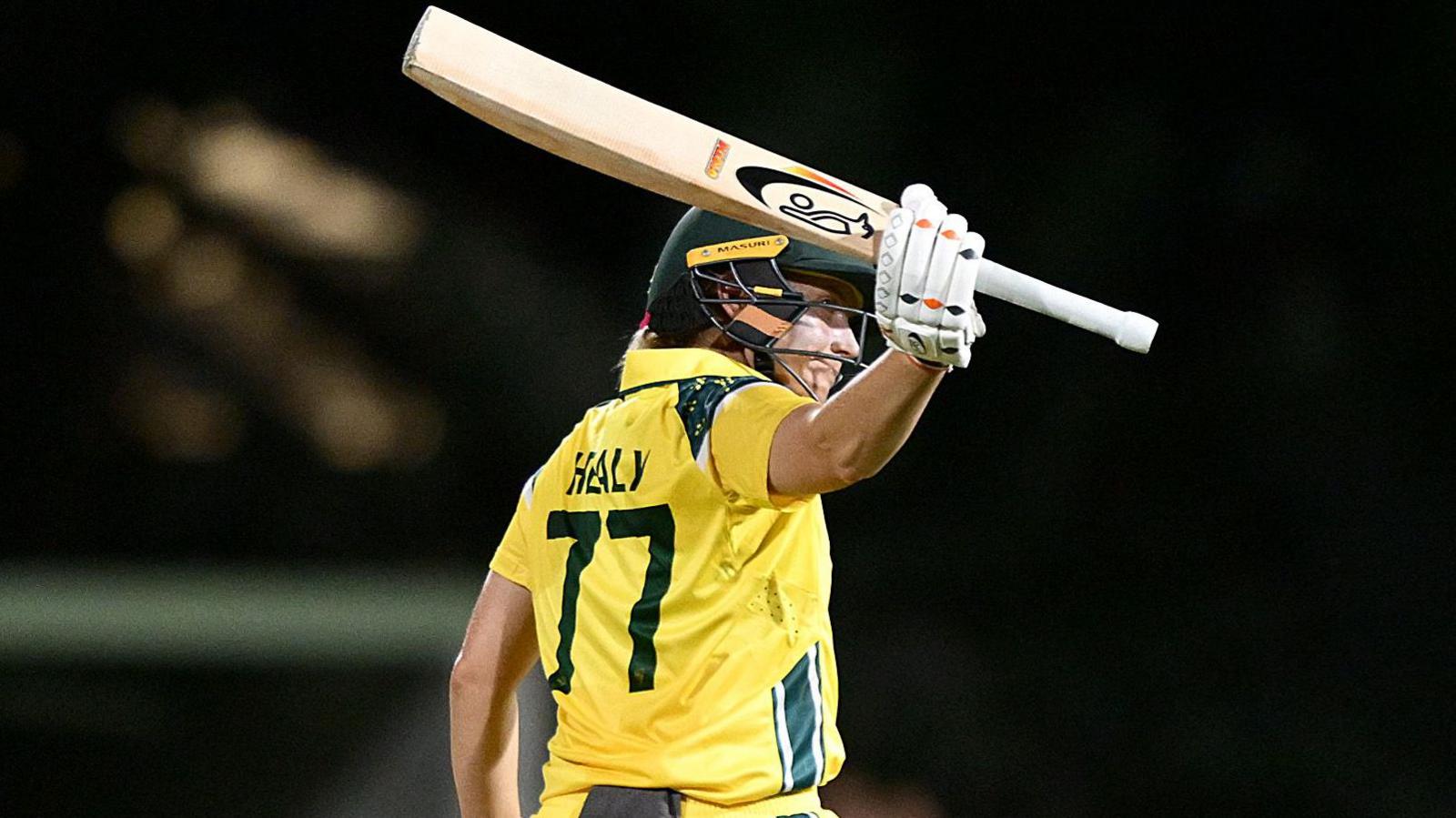
Alyssa Healy began her final series before retirement with a half-century as Australia eased to a six-wicket victory over India in the opening one-day international.
She scored 50 off 70 balls opening the batting as Australia chased down a target of 215 with 11.4 overs to spare in the day-night match at Allan Border Field in Brisbane.
Beth Mooney made a fluent 76 off 79 balls before all-rounder Annabel Sutherland hit an unbeaten 48, sealing victory with a six off Deepti Sharma.
Australia’s defeat by India in the T20 series this month was their first at home in nine years.
“A little bit was put on us about how we were going to bounce back,” said Healy.
“To come out and play the way we did today was clinical. I’m proud of the group.”
Captain Harmanpreet Kaur and Smriti Mandhana made gritty half-centuries in India’s 214 all out, while Kashvee Gautam contributed 43 from number eight.
![Exclusive satellite imagery obtained by Al Jazeera’s Sanad agency reveals the destruction and burial of Palestinian Red Crescent and Civil Defence vehicles in Rafah. [Sanad/Al Jazeera]](https://i0.wp.com/www.aljazeera.com/wp-content/uploads/2026/02/1_25-03-2025-west-rafah-illustration-en-copy-1771927180.jpg?w=696&ssl=1)