The killing of Mexican drug lord El Mencho: How it unfolded

Mexican forces killed Nemesio Oseguera Cervantes, known as “El Mencho”, the leader of the Jalisco New Generation Cartel (JNGC), in a high-risk operation in the western state of Jalisco on Sunday.

Security forces tracked El Mencho, one of the United States’s most wanted fugitives, to a property in the mountain town of Tapalpa, central-western Mexico, after receiving intelligence linked to a close associate.

Recommended Stories

list of 3 itemsend of list

Troops launched a predawn raid on Sunday, triggering hours of gun battles and a wave of violence across several states.

The killing marks the most significant blow against organised crime since Mexican and US authorities recaptured Joaquin Guzman, known as “El Chapo”, nearly a decade ago.

Here is what we know about how the operation to capture El Mencho unfolded on Sunday.

Who was El Mencho?

El Mencho, 59, was believed to be a former police officer. He was from Michoacan, western Mexico, and built a vast criminal enterprise over more than 30 years.

US authorities convicted him of heroin trafficking in the mid-1990s, and he served a prison sentence in the US before returning to Mexico, where he rose rapidly within the drug underworld.

Around 2009, he founded the JNGC, which expanded rapidly to become one of Mexico’s most powerful and violent cartels.

The group trafficked cocaine, methamphetamine and fentanyl to the United States and smuggled migrants northwards.

It also earned notoriety for deploying military-style tactics, including armed drones and improvised explosive devices, and for launching direct assaults on security forces.

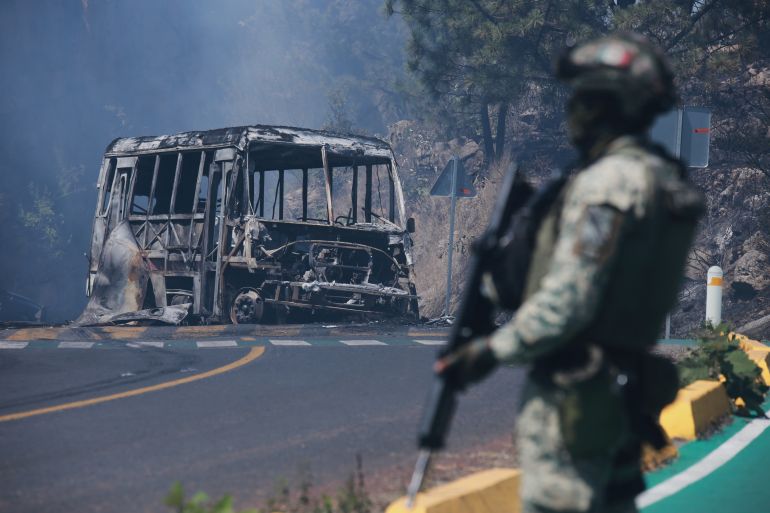
A soldier stands guard by a charred vehicle after it was set on fire, in Cointzio, Michoacán state, Mexico, Sunday, Feb. 22, 2026, following the death of the leader of the Jalisco New Generation Cartel, Nemesio Oseguera, known as "El Mencho." (AP Photo/Armando Solis)
A soldier stands guard by a charred vehicle after it was set on fire, in Cointzio, Michoacán state, Mexico, Sunday, February 22, 2026, following the death of the leader of Nemesio Oseguera, known as ‘El Mencho’ [AP Photo/Armando Solis]

How did the operation unfold?

On February 20, acting on new intelligence from an associate of one of El Mencho’s romantic partners, Mexican authorities began surrounding the site in Tapalpa where El Mencho was believed to be hiding.

Special forces, backed by the National Guard, military aircraft and helicopters, sealed off the area before dawn on February 22.

Cartel gunmen opened fire as soldiers advanced. Security forces returned fire, killing several suspected CJNG members. El Mencho and members of his inner circle fled to a nearby wooded cabin complex, where a second firefight erupted.

Soldiers eventually found a wounded El Mencho alongside two bodyguards. The authorities airlifted him to a medical facility, but he died during the flight.

A US defence official told Reuters that a US military-led intelligence task force focusing on drug cartels had supported the operation.

National Guard members patrol the area outside the General Prosecutor's headquarters in Mexico City
National Guards patrol the area outside of the General Prosecutor’s headquarters in Mexico City, Sunday, February 22, 2026 [Ginette Riquelme/AP]

What happened in the aftermath of the operation?

The raid set off an immediate response from cartel bosses. The defence ministry identified a senior JNGC figure known as “El Tuli”, El Mencho’s right-hand man and a top financial operator within the cartel, as the organiser of coordinated attacks in Jalisco.

Mexican authorities said he orchestrated roadblocks, arson attacks and assaults on government facilities, and offered a bounty of 20,000 pesos ($1,100) for the killing of each member of the military, following the February 22 operation.

Later the same day, security forces tracked him to El Grullo, a small town about 180km (112 miles) southwest of Guadalajara. He attempted to flee, firing on officers who killed him in the ensuing clash.

Violence spread across Mexico rapidly. Cartel members torched vehicles and blocked highways in several states.

Airlines cancelled flights to Puerto Vallarta, a Pacific resort city in the western state of Jalisco, as plumes of smoke rising over parts of southern Mexico grabbed international headlines.

Schools and universities suspended classes, and local authorities urged residents to remain indoors.

By Monday, authorities reported that at least 30 suspected gang members, 25 National Guard troops and one civilian had been killed in the unrest following the operation.

Security forces arrested more than 70 people across seven states and recorded at least 85 cartel-related roadblocks on Sunday alone.

The killing of El Mencho removes one of Mexico’s most feared crime bosses.

Abidjan Signals Readiness To Host 10th AFRIMA

Abidjan has declared its ambition to host a future edition of the All Africa Music Awards (AFRIMA), as Francophone stakeholders gathered for the Road to the 10th Edition Media and Stakeholders’ Parley on Tuesday.

The event, held in Côte d’Ivoire, marked the second stop in the global build-up to AFRIMA’s milestone 10th edition, following an earlier engagement in Dar es Salaam, Tanzania.

It brought together government officials, cultural industry leaders, artistes and media practitioners, underscoring the city’s growing profile as a creative hub in Francophone Africa.

Serge Akpatou, Deputy Director-General of the Ivorian Bureau of Copyright (BURIDA), said the awards platform continues to strengthen the continent’s creative ecosystem.

“AFRIMA adds real value to Africa’s creative ecosystem. It promotes our artistes, strengthens intellectual property awareness and connects us to the rest of the world. Abidjan has the capacity and the cultural depth to host a future edition, and we sincerely hope that opportunity will come,” Akpatou said.

READ ALSO: Rema, Burna Boy, Jux, Wendy Shay, Others Emerge Winners At AFRIMA Awards (FULL LIST)

Representing the Minister of Culture and Francophonie, Hein Sie described AFRIMA as a driver of cultural diplomacy and economic growth.

“Events like AFRIMA are important for our continental visibility. They celebrate African excellence, create opportunities for our creatives, and reinforce our identity.

“Côte d’Ivoire is proud of its artistes who have done us proud on a massive platform like AFRIMA, and we are ready to support initiatives that position our country as a creative force,” he said.

Members of AFRIMA’s International Executive Committee, including Associate Producer Victoria Nkong and International Jury member Messie Mboukou, led discussions on the awards process and collaboration with Francophone stakeholders.

Mboukou emphasised the importance of transparency and partnership as preparations intensify for the landmark edition.

“This gathering is not only about celebration. It is about dialogue, transparency and building stronger bridges between artistes, the media, cultural institutions, policy makers and AFRIMA.

“As we approach the 10th edition, continuous collaboration with Francophone Africa is vital for us not to be left out in the AFRIMA movement,” Mboukou said.

Addressing questions on adjudication, he added that the process is supervised by the African Union and independently audited to ensure credibility.

The parley featured several winners from the ninth edition, including Ivorian stars Didi B, Morijah and the group Team Paiya, alongside DJ Moh Green and Axel Merryl.

Receiving her trophy for Best Female Artiste in African Inspirational, Morijah said, “This award represents years of sacrifice and dedication. I am grateful to AFRIMA and Africa for recognising my work on such a respected global African platform.”

Didi B described the awards as a networking platform that expands opportunities for collaboration across borders, while other winners highlighted the exposure and confidence gained from the recognition.

10th Edition

Although the official dates are yet to be announced, the International Committee noted that preparations are underway for the 10th edition in partnership with the African Union Commission and host city Lagos.

Meanwhile, celebrations continue following the successful ninth edition held from January 7 to 11, 2026, at the Eko Convention Centre.

At that ceremony, top honours went to Rema, who emerged Artiste of the Year, while Burna Boy won Album of the Year. Other major winners included Shallipopi, Qing Madi, Juma Jux, Wendy Shay and Element Eléeeeh.

Qing Madi 9th AFRIMA Awards for Most Promising Artiste of the Year. Credit: afrimaofficial/X

The ceremony, hosted by Falz and French-Senegalese presenter Liliane Maroune, featured performances by Stonebwoy, Mr P, Seyi Vibez and Adewale Ayuba.

Founded in 2010 by the AFRIMA International Committee in partnership with the African Union, the awards remain Africa’s longest-running continental music platform, dedicated to celebrating and promoting African music globally.

‘It bothers me that Vinicius’ celebration is being used against him’

Bobbie Jackson

BBC Sport journalist

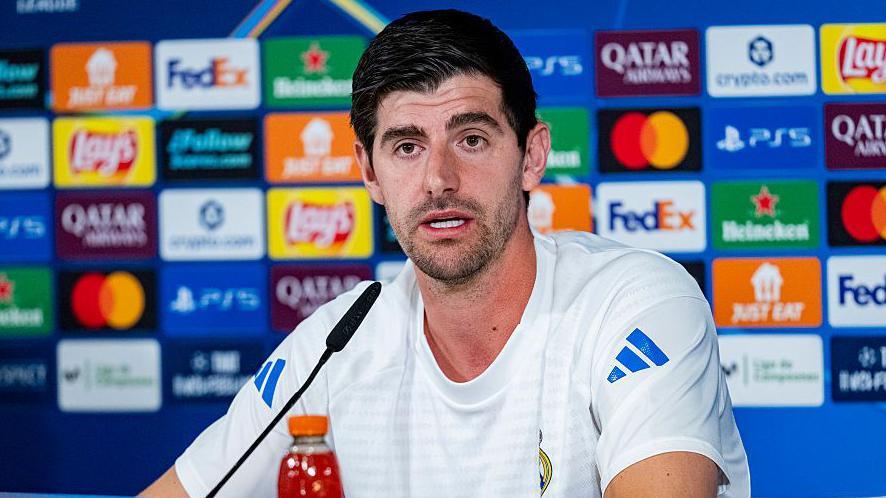
Real Madrid goalkeeper Thibaut Courtois says Vinicius Jr’s celebration against Benfica in last week’s Champions League tie in Portugal “does not justify a suspected act of racism”.

Vinicius alleged he was racially abused by Benfica’s Gianluca Prestianni shortly after scoring a stunning goal that earned the Spanish side a 1-0 win in the knockout round first-leg encounter.

Argentine winger Prestianni denied racially abusing Vinicius but has been handed a one-game provisional ban by Uefa and will miss Wednesday’s return in Madrid.

Vinicius was shown a yellow card for celebrating in front of the Benfica supporters after his strike.

Speaking after the game, Benfica boss Jose Mourinho said he believed the Brazilian forward had acted disrespectfully and incited the crowd.

“Unfortunately [he was] not just happy to score that astonishing goal. When you score a goal like that, you celebrate in a respectful way,” added Mourinho.

Asked about the comments from his former Chelsea manager, Courtois said: “Mourinho is Mourinho and, as a coach, you’ll always defend your club.

“But it bothers me that Vinicius’ celebration is being used against him.

“Vini didn’t do anything bad. He celebrated the same way many rivals have celebrated against us.

“It happened, and we can’t justify a suspected act of racism because of a celebration. I think we have to be less stupid as a society.”

    • 5 days ago
    • 5 days ago
    • 23 hours ago

Courtois refused to be drawn on comments from Benfica president Rui Costa, who said Prestianni “is not racist” and deserves the club’s trust after “being crucified”, but reiterated his support for his own team-mate.

“Vini has never said anything like that, so I’m 100% sure he heard it,” said the Belgian.

“I believe him completely. Since he’s keeping quiet, we’ll never know for sure, but there’s not much more we can do.”

The tie was halted for 10 minutes after Vinicius alerted referee Francois Letexier to the incident, before his team-mates temporarily left the pitch.

Courtois said Real were prepared to “stand their ground”, but agreed to complete the game after Vinicius said he wanted to continue.

There were also reports of racist gestures in the stands at Estadio da Luz.

“The other things that happened in the stands, in my opinion, warrant stopping the match and kicking those people out,” added Courtois.

“As footballers, we don’t see everything, but it happens when we’re focused on the game. There have to be people in charge who see that.

“There’s a Benfica security guard who’s two metres away and he has to act. We can keep improving in these areas… and stop being so foolish.”

Uefa has subsequently sanctioned Prestianni, 20, on a provisional basis, pending the result of a full investigation by an ethics and disciplinary inspector.

The European governing body said further punishment could be handed out once that investigation is completed.

Real manager Alvaro Arbeloa urged Uefa to use this incident as a chance to make a statement.

“We have a great opportunity to mark a turning point in the fight against racism,” he said.

Related topics

  • European Football
  • Real Madrid
  • UEFA Champions League
  • Football

More on this story

UN delegates walk out during Russian ambassador’s speech

NewsFeed

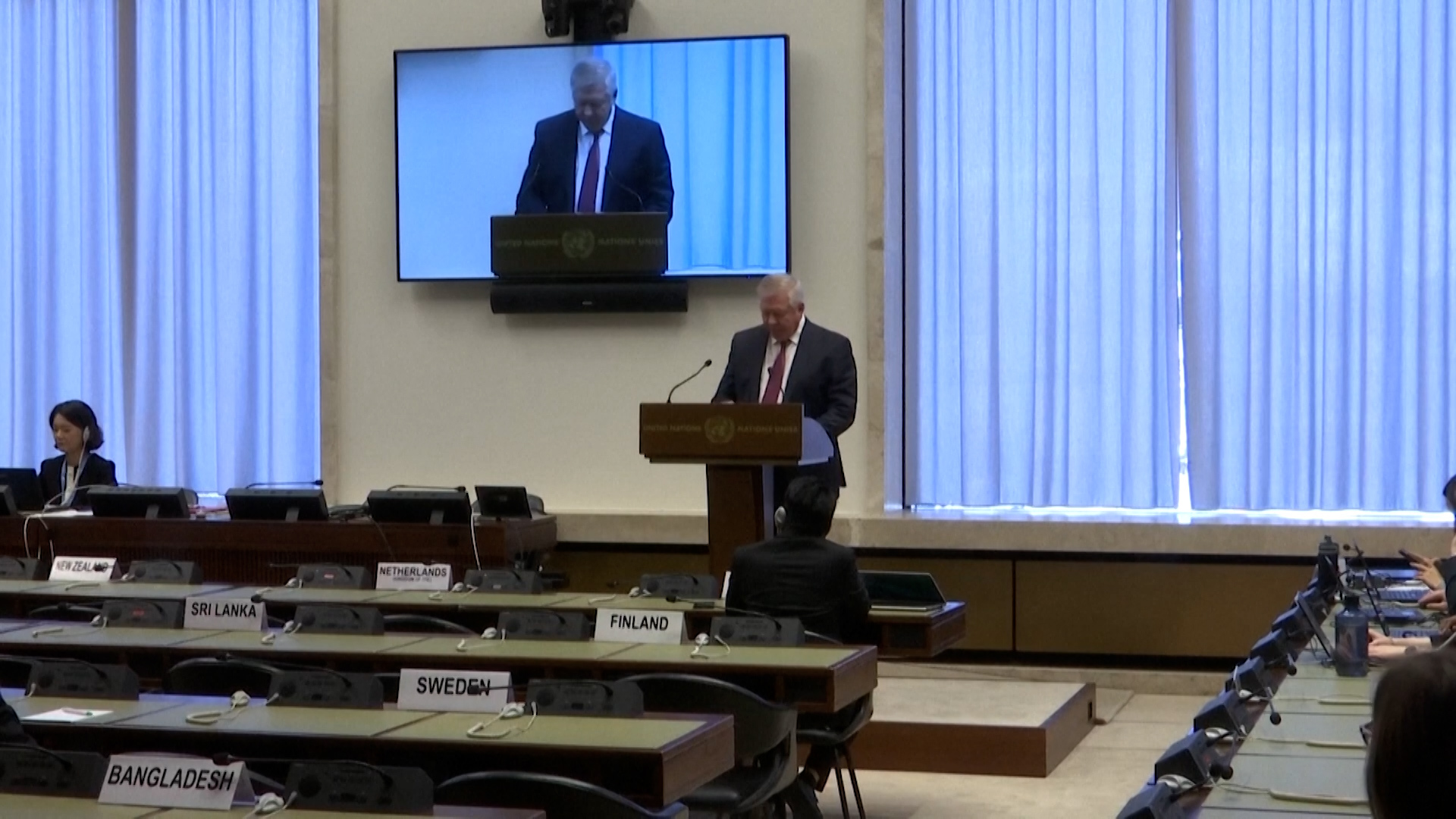
Dozens of delegates walked out of Russian ambassador Gennady Gatilov’s speech to the UN conference on disarmament in Geneva, Switzerland. They gathered outside the room holding the Ukrainian flag, returning once the ambassador had finished speaking.

New stadium curse – are Everton showing how clubs struggle after move?

Paul Birch

BBC Sport journalist
  • 125 Comments

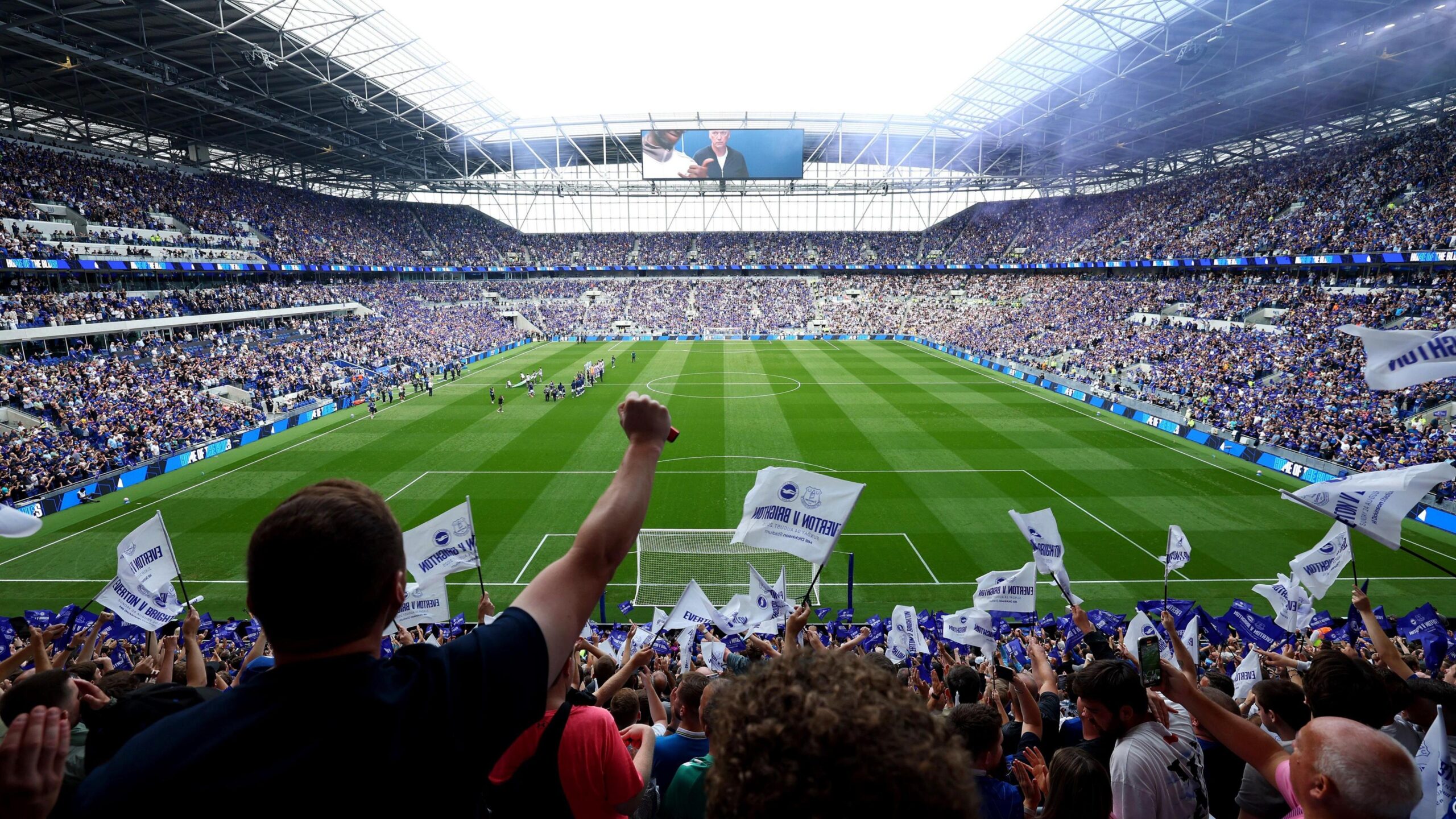
When Everton said a tearful farewell to their atmospheric Goodison Park home after 133 years in the summer, hopes were high that Hill Dickinson Stadium could become the fortress fans dreamed of.

An unbeaten five-match start at their new ground, inspired by new signing Jack Grealish, raised expectations further.

But defeat against Manchester United on Monday cemented Everton’s status as the latest Premier League team to find the transition to a new stadium tough going.

The Toffees have failed to win any of their past seven matches at their gleaming 52,769-capacity arena, following in the footsteps of other top-flight sides who have struggled after moving grounds.

Eight clubs – only counting teams who were in the top flight for both their last season at their old ground and first at their new, and excluding temporary homes – have moved stadiums since 1992-93, but only one finished the next season with an improved record.

Derby County went from an average of 1.6 points per game in their last year at the Baseball Ground to an impressive 2.1 as they adapted brilliantly to a debut campaign at Pride Park in 1997-98.

Middlesbrough had an identical record between Ayresome Park and the Riverside, but the other teams all suffered a drop-off.

Tottenham were always unlikely to match their stunning White Hart Lane finale of 17 wins and two draws when they moved to Tottenham Hotspur Stadium after a spell at Wembley.

But seven years on they are still to establish their arena as a place teams fear to come, with some pundits claiming it is too welcoming for opposition players. Only Wolves have lost more home games in Europe’s big five leagues this season than Spurs, with eight.

West Ham had an immediate drop-off in their first season at London Stadium, dropping half a point per game on average. Their plight at the hugely unpopular and vast former athletics track is well documented, with fans pining for Upton Park’s intimidating atmosphere.

It was a similar story for Southampton after they left the tight confines of the Dell for St Mary’s.

Why are Everton struggling?

Monday’s loss to United was Everton’s sixth at home this season in the league, surpassing their total from the whole of their final campaign at Goodison.

They are sixth in the away form table, having secured six wins and 21 points on the road, but languish in 14th for home results with only four wins from 14 games.

Since their bright start they have shipped four goals at home to both Newcastle and Brentford and three to Spurs, while a statement win over a big club is yet to materialise.

Goals have also been at a premium in front of their own supporters, with only five scored in their past seven matches in all competitions.

Manager David Moyes has increasingly found himself fielding questions as to why his side are finding the transition so tough.

“There is probably a change – other teams come here and enjoy it,” he said after the United game.

“You think of Goodison – narrow tunnel; the players can touch you. It feels a bigger space than Goodison.

“Tonight we lost a goal when we were a bit wide open. There are things about it which are different and we have to get used to.

BBC Sport’s Everton Fan’s Voice writer Briony Bragg has noted that the increased pitch size – 100x68m at Goodison compared to 105x68m at Hill Dickinson – has made a difference.

“The pitch is five metres longer than Goodison Park, and David Moyes has persisted with James Tarkowski and Michael Keane at centre-half this season,” she said.

“They don’t have the pace Jarrad Branthwaite and Jake O’Brien do, and statistics prove Everton perform better when either is not being shoehorned in at left- or right-back.”

Related topics

  • Premier League
  • Everton
  • Football

More on this story

  • Everton's Hill Dickinson Stadium
  • Ask Me Anything logo