Bolivia revives anti-drug alliance after nearly 18-year break with US

In a significant foreign policy shift, Bolivia has reopened its doors to the United States Drug Enforcement Administration (DEA).

The move, confirmed on Monday, ends a nearly two-decade hiatus in bilateral efforts to stem drug trafficking.

Recommended Stories

list of 3 itemsend of list

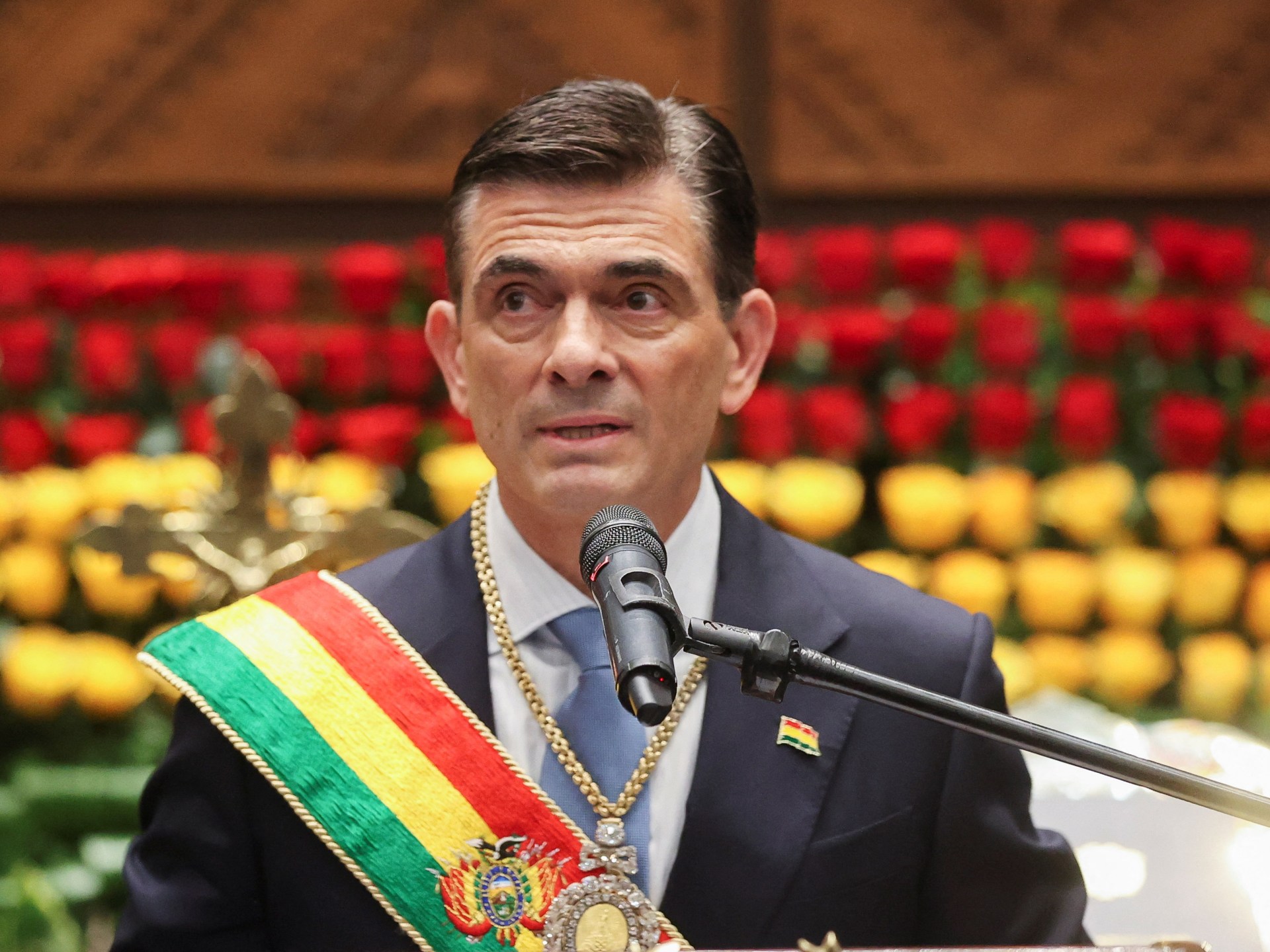
Bolivian Minister of Government Marco Oviedo told local media this week that DEA agents were already operating in the country.

“The DEA is in Bolivia,” he said. “Just as the DEA is now present, we also have cooperation from European intelligence and police bodies.”

Oviedo explained that the initial focus of the law enforcement efforts would be to tighten border surveillance and dismantle trafficking networks.

He added that the cooperation with the DEA and European agencies was only the start of Bolivia’s expanded international efforts.

“We want neighbouring countries’ anti-narcotics agencies on board as well,” Oviedo said.

End to Morales order

The announcement marks an end to an order issued under former left-wing President Evo Morales in 2008, effectively expelling all DEA agents from the country.

Morales, the leader at the time for Bolivia’s Movement for Socialism (MAS), had accused the US of using drug enforcement efforts to pressure countries in Latin America to bend to its political and economic agenda.

Under Morales, all drug enforcement cooperation with the US came to a halt, and he refused to let DEA officers into the country, accusing them of destabilising his government. Diplomatic relations were likewise suspended.

In turn, MAS received strong support from rural parts of Bolivia, where the cultivation of coca, the raw ingredient in cocaine, is a key economic driver.

Bolivia, along with other Andean countries like Colombia and Peru, is a key producer of coca, which has traditional uses, including as a remedy for altitude sickness. Morales himself led a union of coca growers, or cocaleros, before taking office.

Advocates have accused the US’s militaristic “war on drugs” of harming impoverished rural farmers through the forced eradication of coca crops. Such campaigns, they argue, can leave farmers without a means of supporting themselves and their families.

MAS remained in power from the start of Morales’s term in 2006 until 2025, when its coalition fractured amid economic instability and internal fighting.

New political direction

In October 2025, two right-wing candidates proceeded to a run-off for the presidency: centrist Rodrigo Paz of the Christian Democratic Party and a former right-wing president, Jorge Quiroga.

It was the first presidential run-off in modern times for Bolivia, and it marked a sharp turn away from two decades of socialist government.

Both candidates made improving the relationship with the US a central pillar of their campaigns, viewing it as essential to solving Bolivia’s severe economic crisis.

Paz, who was educated in Washington, DC, argued that normalising ties would attract the international investment needed to modernise the energy and lithium sectors.

Meanwhile, Quiroga, a conservative who studied at Texas A&M University, campaigned on a more aggressive platform, including fiscal austerity and security partnerships with the US.

His vice presidential candidate, Juan Pablo Velasco, is credited with popularising the tagline “Make Bolivia Sexy Again”, a twist on US President Donald Trump’s slogan, “Make America Great Again”.

Paz ultimately emerged as the victor in the race, with nearly 54.9 percent of the vote. After his inauguration in November, Paz moved quickly to fulfil his promises by restoring diplomatic ties with the US.

The US, meanwhile, called Paz’s presidency a “transformative opportunity” for the region.

Earlier this month, both Bolivia and the US agreed to appoint ambassadors to one another’s countries for the first time in nearly 18 years.

Uncertainty remains

But it is unclear to what extent the DEA will be operating in Bolivia. Left-wing leaders like Morales continue to have strong pockets of support, particularly in highland and rural areas.

Bolivian Foreign Minister Fernando Aramayo has said negotiations are still under way to finalise the specific areas of cooperation between his country and the DEA, as well as operational limits for the US agency.

A full agreement outlining the scope of the agency’s activities is expected in the coming months.

Since returning to office on January 20, 2025, Trump has intensified the US campaign against drug trafficking in Latin America, including by designating several major cartels as “foreign terrorist organizations”.

Trump has also pressured Latin American governments to take more aggressive actions against the illicit drug trade, using economic sanctions and military threats as leverage.

Already, in late December and early January, Trump has authorised two strikes on Venezuela on the premise of combating drug trafficking.

One, on December 29, targeted a port that the Trump administration said was used for drug smuggling. The second, on January 3, resulted in multiple explosions, dozens dead and the abduction of Venezuelan President Nicolas Maduro. He remains in custody in the US, where he faces drug trafficking and weapons possession charges.

Critics have argued that Trump’s anti-drug campaign has blurred the line between law enforcement and military activities.

The increasing use of military force against criminal suspects has raised concerns that human rights are being violated and legal processes circumvented, including through the use of extrajudicial killings.

One example has come as part of a military campaign called Operation Southern Spear.

On September 2, the US announced the first of nearly 44 “lethal kinetic strikes” against suspected drug-smuggling vessels in the Caribbean and Eastern Pacific.

FPL Podcast from BBC Sport

Available for over a year

Alistair Bruce-Ball, Chris Sutton and Statman Dave are joined by The Athletic writer and podcaster Carl Anka.

Are Manchester United players fun to use in FPL? Should Bournemouth feature in your team? How should Premier League players take their penalties?

Chris Sutton reveals his pre-match warm up routine whilst Carl and Dave face-off in Sutton Death.

Programme Website

Italian clubs on brink of historic Champions League embarrassment

Alex Bysouth

BBC Sport Senior Journalist
  • 37 Comments

Italian football stands on the brink of a Champions League “debacle” – with the prospect of no Serie A clubs competing in this season’s last 16.

Since the reintroduction of the last-16 knockout round to Europe’s showpiece competition in 2003-04, there has always been at least one Italian representative – on 12 occasions in the past 22 years, there have been three.

In fact, there has been at least one Italian side in the last 16 of the competition – or first knockout round when it took other formats – every year since 1987-88, when Napoli went out in the first round of the European Cup to Real Madrid.

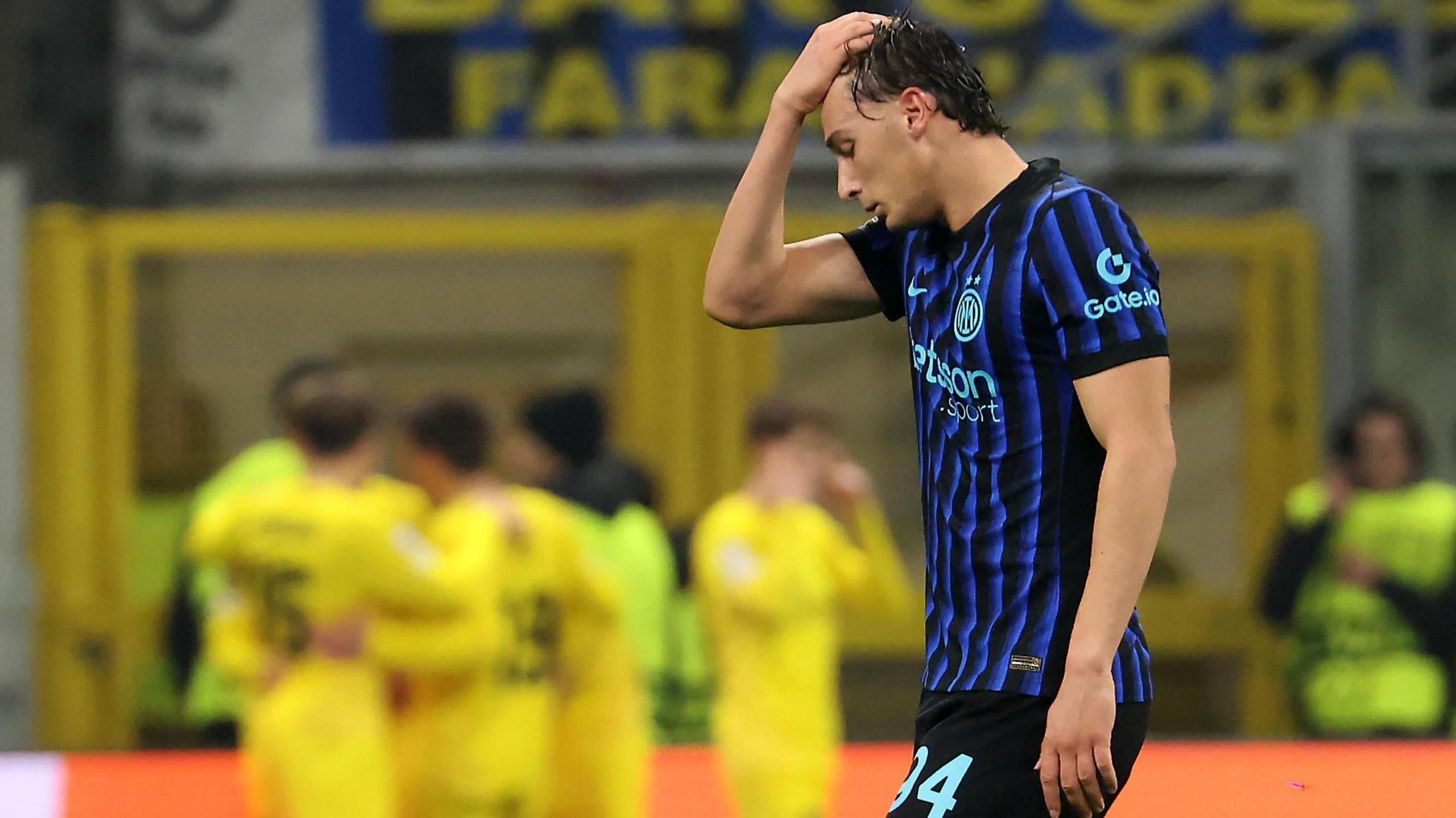
But Inter Milan’s shock play-off exit to Norwegian debutants Bodo/Glimt on Tuesday means either Juventus or Atalanta will have to overcome first-leg deficits to keep that run going.

Juventus trail Galatasaray 5-2 heading into a return meeting in Turin, while Atalanta are 2-0 down on aggregate before Wednesday’s home leg with Borussia Dortmund.

Inter – finalists last season – lost 2-1 at San Siro against Bodo, having suffered a 3-1 defeat in the first leg.

It is the first time the Milan giants have been knocked out of the Champions League by a team from outside Europe’s top five leagues, those from England, Spain, Germany, Italy and France.

“This is a big wake up for Italian football,” said Italian football journalist Daniele Verri.

“Juventus will need to win 4-0 and Atalanta need to win 3-0. [For them all to go out] would be a complete debacle, a disaster for our clubs.

Ronaldo and Christian Vieri presented with gifts at San SiroGetty Images

Inter signed Ronaldo and Vieri for world-record fees in the late 1990s, when Serie A was the envy of world football, blessed with the game’s most talented stars.

AC Milan then beat Juventus to win the Champions League in 2003, losing to Liverpool on penalties in the final two years later, before defeating the Reds to become European champions again in 2007.

While there have been more recent successes in Europe’s other competitions – Atalanta won the Europa League in 2024, Roma won the Conference League in 2021 – Jose Mourinho’s Inter were the last Italian side to win the Champions League in 2010.

Inter’s European exit comes despite being 10 points clear of rivals AC Milan in Serie A and a further four ahead of defending champions Napoli, who failed to make it out of the Champions League’s league phase.

“It is a piece of history,” said journalist Vincenzo Credendino. “Speaking about Italy and Inter, this is one of the worst pieces.

“Inter are the best in Italy, but maybe it is time to think not about what can happen in one or two years, but about 10 or 15 years – and on that side we can see generally Italian football is not on the same level of top European leagues.”

The national team must also win through a play-off in March to avoid missing out on a third successive World Cup this summer, having last lifted the trophy in 2006.

“It is a difficult time for Italian football and this shows it,” added European football expert Julien Laurens on BBC Radio 5 Live.

“Today, Inter Milan put pressure on but it was not enough from them. They have been the best team in Italy for the last few years. And Napoli as well, they haven’t even come close.

“It’s terrible for Italian football at the moment.”

Inter won five of their opening eight league phase games in Europe to finish 10th, with Juventus 13th and Atalanta 15th.

Yet in the play-offs, all have come unstuck against sides who finished lower in the table but play a more intense brand of football.

“What does it say about Italian football? That something needs to be changed,” added Verri.

“The level of Italian football is poor. It is a structural issue. We play very slow football. You can ask any manager in Italy and they will all say the same.

“I was talking to Claudio Ranieri the other day and he said: ‘Look, when I was in England at Leicester… people don’t train more than in Italy. They just do it with another intensity, and then they keep up that intensity during the games.’

    • 17 February

While Inter boast a much more expensively assembled squad on far bigger wages than Bodo, who had nine Norwegians in their starting XI at San Siro, Verri says Italian clubs are seeing their best players move abroad.

Last season’s Serie A top goalscorer Mateo Retegui left for Al-Qadsiah in Saudi Arabia, for example, while former team-mate Ademola Lookman joined Atletico Madrid and Tijjani Reijnders left AC Milan for Manchester City.

While the majority of Italy’s national squad still play in the country, stars such as Gianluigi Donnarumma, Riccardo Calafiori, Sandro Tonali and Retegui are elsewhere.

Meanwhile, Laurens believes Serie A clubs are no longer producing good enough youngsters.

“Sporting CP, Club Brugge and Bodo have similarities in their success this season. Their scouting is great and their academies perform well,” he explained.

Related topics

  • European Football
  • Football

More on this story

‘Bring it on’ – Newcastle’s message to Chelsea and Barcelona

Ciaran Kelly

Newcastle United reporter at St James’ Park
  • 35 Comments

Jacob Murphy did not think twice.

The Newcastle United winger had just been asked whether he wanted Barcelona or Chelsea in the last 16 of the Champions League.

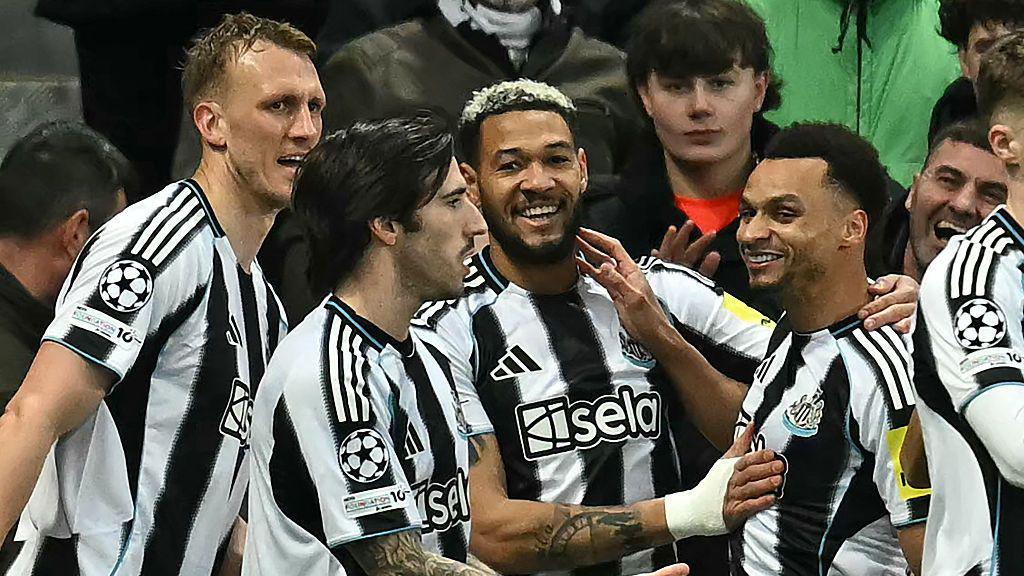
“Anyone,” he immediately responded on Amazon Prime after his side beat Qarabag 3-2 to secure a dominant 9-3 win on aggregate.

“Honestly, with this group of players, we will take anyone on. Especially with knockout football, we back ourselves. Bring on whoever’s to come.”

It was a mindset shared by his manager.

Newcastle have achieved their initial target of reaching the next round, but head coach Eddie Howe does not want his side’s journey to end yet.

He believes his team can “raise our game and compete with anybody”.

“We have to believe in ourselves,” he said. “We have seen the best of ourselves when we have gone into cup games and one-off games, where we have been able to rise to whatever challenge we have had in front of us.

To play this video you need to enable JavaScript in your browser.

Relishing the new format

Newcastle are certainly enjoying life back at Europe’s top table.

Howe’s side are the top scorers in the Champions League with 26 goals, and have won six games in a single campaign in the competition for the first time.

It has been quite a turnaround in the last two-and-a-half weeks.

Howe was the first to admit he was not doing his job “well enough” after his side were booed off by a section of supporters following a 3-2 defeat against Brentford in the Premier League in their previous game at St James’ Park earlier this month.

The Newcastle head coach embarked on some soul searching in the aftermath of the loss, while his players set out to “fight for the manager”.

Newcastle have won four of their last five games in all competitions since, and secured a place in the knockout stage proper.

Given the revenue gap between the Premier League and a number of clubs on the continent, and the competitiveness of the top-flight, outsiders may question whether that should necessarily come as a huge surprise.

Even beleaguered Tottenham Hotspur, who are hovering above the relegation zone in the Premier League, finished in the top eight of the league phase.

Yet the manner of Newcastle’s six Champions League victories against Qarabag, Benfica, PSV Eindhoven, Athletic Club and Union Saint-Gilloise were far from foregone conclusions.

Qarabag, for instance, had drawn against Chelsea and defeated Benfica, Eintracht Frankfurt and Copenhagen. Newcastle hammered the Azerbaijan Premier League champions.

Although Howe wanted more from his much-changed side in the 3-2 second-leg win on Tuesday night, Newcastle have shown they can battle the continent’s elite on their day.

Newcastle drew 1-1 against holders Paris St-Germain in the French capital last month and suffered a narrow 2-1 defeat at the hands of Barcelona in their opening game of the competition.

No wonder, then, defender Dan Burn feels Newcastle can “compete with anybody” at their best.

“We’ve shown that, especially against Paris St-Germain, how good we can be,” he wrote in his programme notes.

‘They will buzz off someone like Barcelona’

Newcastle have a lot of work to do in the Premier League, where they currently lie in 11th place.

But they are no longer stargazed by life in the Champions League.

Even playing in the opening round of the competition was a new experience for the majority of those at the club last time around.

This was a stage these players dreamed of playing on – nothing said that quite like Murphy’s wide-eyed wonder as he lined up for the Champions League anthem for the first time at the San Siro in 2023 – but they now feel like they belong.

Not only are the squad able to draw on the experiences of their last campaign, when they faced Paris St-Germain, Borussia Dortmund and AC Milan in the group of death, they have also accumulated big-game experiences in the interim. This includes, of course, ending a 70-year wait to win a major domestic trophy by beating Liverpool in the Carabao Cup final last March.

That is why Friday’s last 16 draw will bring eager anticipation rather than trepidation as former Newcastle striker Dwight Gayle knows better than most.

“Knowing all of the boys in the dressing room, they will be excited about who they get in the next round,” he told BBC Radio 5 Live.

Related topics

  • Premier League
  • UEFA Champions League
  • Newcastle United
  • Football

More on this story

  • St James' Park
  • Ask Me Anything logo

US Department of Justice sues UCLA over anti-Semitism allegations

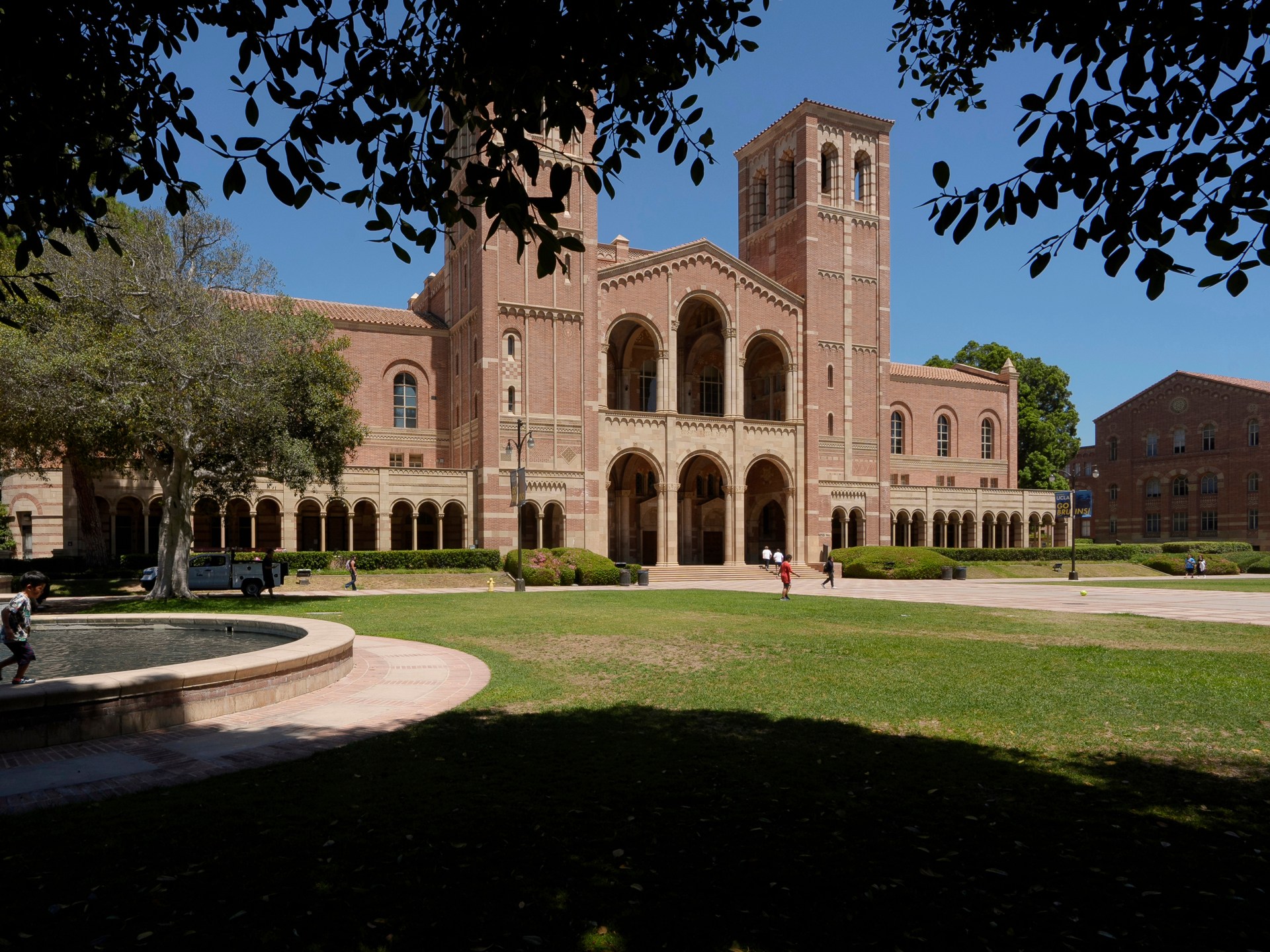
The United States Department of Justice has filed a lawsuit against the University of California at Los Angeles (UCLA), alleging that its “administration turned a blind eye to – and at times facilitated – grossly antisemitic acts”.

Tuesday’s lawsuit marks the latest example of a campaign under President Donald Trump to crack down on campuses that hosted large pro-Palestinian protests.

Recommended Stories

list of 3 itemsend of list

Critics, however, have accused the Trump administration of seeking to dampen the free speech of activists it disagrees with.

In a statement, the Department of Justice said that the university had created a “hostile work environment” for Jewish and Israeli workers amid protests against Israel’s genocidal war on Gaza.

“According to today’s complaint, after the Hamas-led massacre in Israel on October 7, 2023, antisemitic acts pervaded UCLA,” the department wrote.

The lawsuit accuses UCLA of violating Title VII of the 1964 Civil Rights Act, which prohibits employment discrimination based on a number of factors, including religion.

The “general atmosphere of antisemitism” was “so severe and so pervasive” at UCLA that it constituted a “hostile work environment” under the law, according to the Justice Department’s complaint.

The lawsuit cites the Palestinian solidarity protests that unfolded on UCLA’s campus after the start of Israel’s war on Gaza.

“Based on our investigation, UCLA administrators allegedly allowed virulent anti-Semitism to flourish on campus, harming students and staff alike,” said Attorney General Pamela Bondi.

But critics consider the lawsuit the latest chapter in an ongoing pressure campaign to force top universities to align with the Trump administration’s priorities.

Inside the student protest movement

Israel’s war on Gaza has killed more than 75,000 people, according to Gaza’s Ministry of Health and other sources. Israel launched its genocidal military campaign against Gaza in 2023, after a Hamas-led attack left nearly 1,200 people dead in southern Israel.

Amid reports of widespread human rights abuses, including torture and starvation, student protesters held demonstrations on college campuses across the US in 2023 and 2024.

Trump campaigned for re-election in 2024, during the height of the movement to erect solidarity encampments on school grounds. His campaign platform called for dismantling the protests as one of 20 national goals.

“Deport pro-Hamas radicals and make our college campuses safe and patriotic again,” one of the platform’s bullet points reads.

Trump has long accused the pro-Palestinian movement of creating an unsafe learning environment.

But many protest organisers, some of whom were Jewish, have refuted allegations of anti-Semitism. Instead, they said their mission was to highlight the grave human rights abuses perpetuated by the Israeli government in Gaza.

Still, the student encampments faced crackdowns from university authorities and law enforcement. Thousands of students were taken into custody in 2024, though many were ultimately released without charge.

One encampment at UCLA that year was attacked by a group of right-wing supporters of Israel, wielding pipes and spraying mace at pro-Palestine protesters. Activists argued that the police allowed the violence to happen, before forcibly clearing the encampment the next day.

UCLA agreed to pay a $6m settlement to three Jewish students and a professor last year, after they alleged harms during the protest movement.

The school has maintained it has taken multiple measures to address anti-Semitism on campus.

Tensions with universities

Since taking office for a second term in January 2025, Trump has sought to punish certain schools where protests were prominent, including Columbia University in New York City.

In March, the Trump administration froze federal funding to Columbia, starting a wave of uncertainty in the education sector, as other schools also saw their contracts and grants suspended.

Trump also deployed Immigration and Customs Enforcement (ICE) to arrest Columbia student leader Mahmoud Khalil, a permanent US resident, on the basis that his protests threatened US foreign policy.

Khalil and other foreign-born student protesters continue to fight deportation in the US court system.

In July, the Trump administration arrived at a $220m settlement with Columbia, which saw the prestigious university accede to a list of demands in exchange for its federal funding being restored. Other schools, including Brown University and Cornell University, have likewise struck deals.

But schools, including Harvard, have so far refused to accept demands and costly settlements. They face ongoing investigations and penalties.

Last year, for instance, the Trump administration pressured UCLA, a public university, to pay more than $1bn in settlement fees in a letter that also demanded changes to its hiring and admissions processes.

At stake are more than $500m in frozen federal research grants to the school. The school has so far not agreed to pay the sum.

In July, the Justice Department also issued a notice of violation against UCLA, saying that its investigation had found violations of the Constitution’s Equal Protection Clause as well as the Civil Rights Act.

‘Historical moment’ as Bodo/Glimt succeed against all odds

Gary Rose

BBC Sport journalist
  • 87 Comments

Bodo/Glimt just keep on defying the odds.

The Norwegian team, based around 70 miles into the Arctic Circle, have forged a reputation for upsets, but on Tuesday night in Milan they produced one of the biggest in Champions League history.

Facing three-time winners Inter Milan – beaten by Paris St-Germain in the final of this competition just over nine months ago – Bodo had a daunting task, even if they held a 3-1 lead from the first leg.

Yet they rose to the occasion once more – just like they had done in beating Manchester City and Atletico Madrid in the group phase.

It was another resolute and determined display in Italy to complete a home and away double over Cristian Chivu’s men, first to repel the numerous first-half Inter attacks before scoring twice to ultimately leave the Serie A leaders with too much to do.

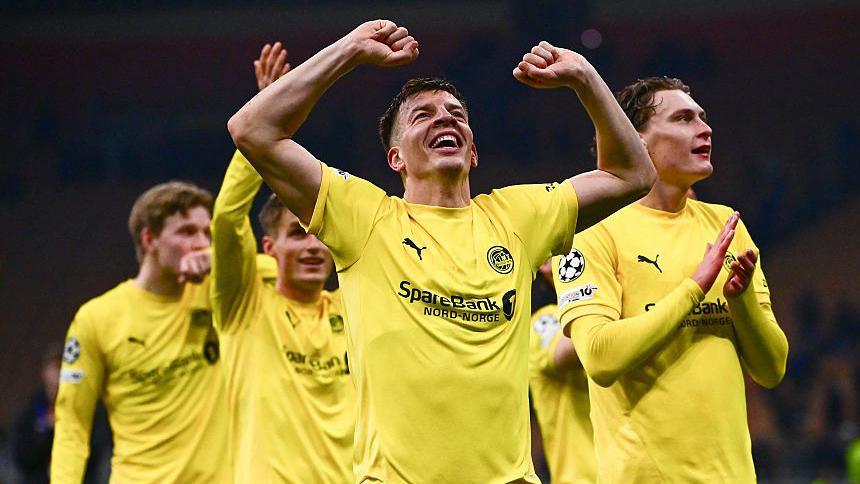
Winners 2-1 on the night, Bodo’s 5-2 aggregate success secured their place in the Champions League last 16 for the first time, where they will face either Manchester City or Sporting.

“It is a historical moment for Bodo and I think also for Norwegian football,” said boss Kjetil Knutsen.

Jens Petter Hauge was again inspirational, scoring his sixth goal in the competition this season for the opener, before setting up Hakon Evjen’s lovely finish for the second.

“It sounds not true, but we are there, among the last teams in the competition,” added the forward, who was back in the San Siro where he had a two-year spell at AC Milan.

To play this video you need to enable JavaScript in your browser.

The statistics behind brilliant Bodo

From the Arctic Circle to San Siro success

Picture of Bodo/Glimt's groundAFP via Getty Images

This fairytale run to the knockouts will have felt unlikely for Bodo after failing to win their first six league phase games, meaning they were left needing results against Manchester City and Atletico Madrid to qualify for the play-offs.

And, against the odds, they provided them.

A 3-1 victory over Pep Guardiola’s men brought deserved attention and acclaim, but it was no one-off as Bodo overcame Atleti 2-1 in Madrid to claim a play-off spot.

Knutsen’s side lost to Spurs in the Europa League semi-finals last season, having become the first Norwegian side to reach the last four of a major European competition.

Key to their success has often been their ability to make their home games as tough as possible.

In the north of Norway, Bodo can often be bitterly cold, snowy and windy during the long winter months, with temperatures deep into minus figures.

The difficult weather conditions mean the team play on an artificial pitch made of plastic, something many sides used to playing on grass find difficult to deal with.

Those aspects, coupled with the players’ determination and strong belief in their ability, means many have left Bodo defeated.

They famously thrashed Jose Mourinho’s Roma 6-1 at home in the Europa Conference League five years ago, while Celtic, Besiktas, Porto and Lazio have also been victims in recent years.

Manchester City won’t relish another meeting in the last 16 if they are drawn together, with Bodo buoyant after proving they have nothing to fear against Europe’s top sides.

“It’s amazing,” captain Patrick Berg told Canal+.

“For the club and city it’s unbelievable. I don’t think people thought we could beat Manchester City, Atletico and now Inter two times.

‘If we can do it, then everyone can do it’

Bodo/Glimt fans celebrate against Inter MilanAFP via Getty Images

This is a step into the unknown for Bodo as they prepare to play in the knockout stage of the Champions League for the first time.

But their run to the Europa League semis in the previous campaign will give them belief – and provide hope to every small club of what can still be achieved in Uefa’s major competitions.

And, for however long this journey continues, they will be backed by the now familiar sight of their vocal fans, who were unmissable at the San Siro decked out all in yellow and with scarves held in the air.

“I am so proud, we are a team from a small town,” added Knutsen.

Related topics

  • European Football
  • Inter Milan
  • UEFA Champions League
  • Football