Air attacks on Kabul push Pakistan-Taliban crisis into uncharted territory

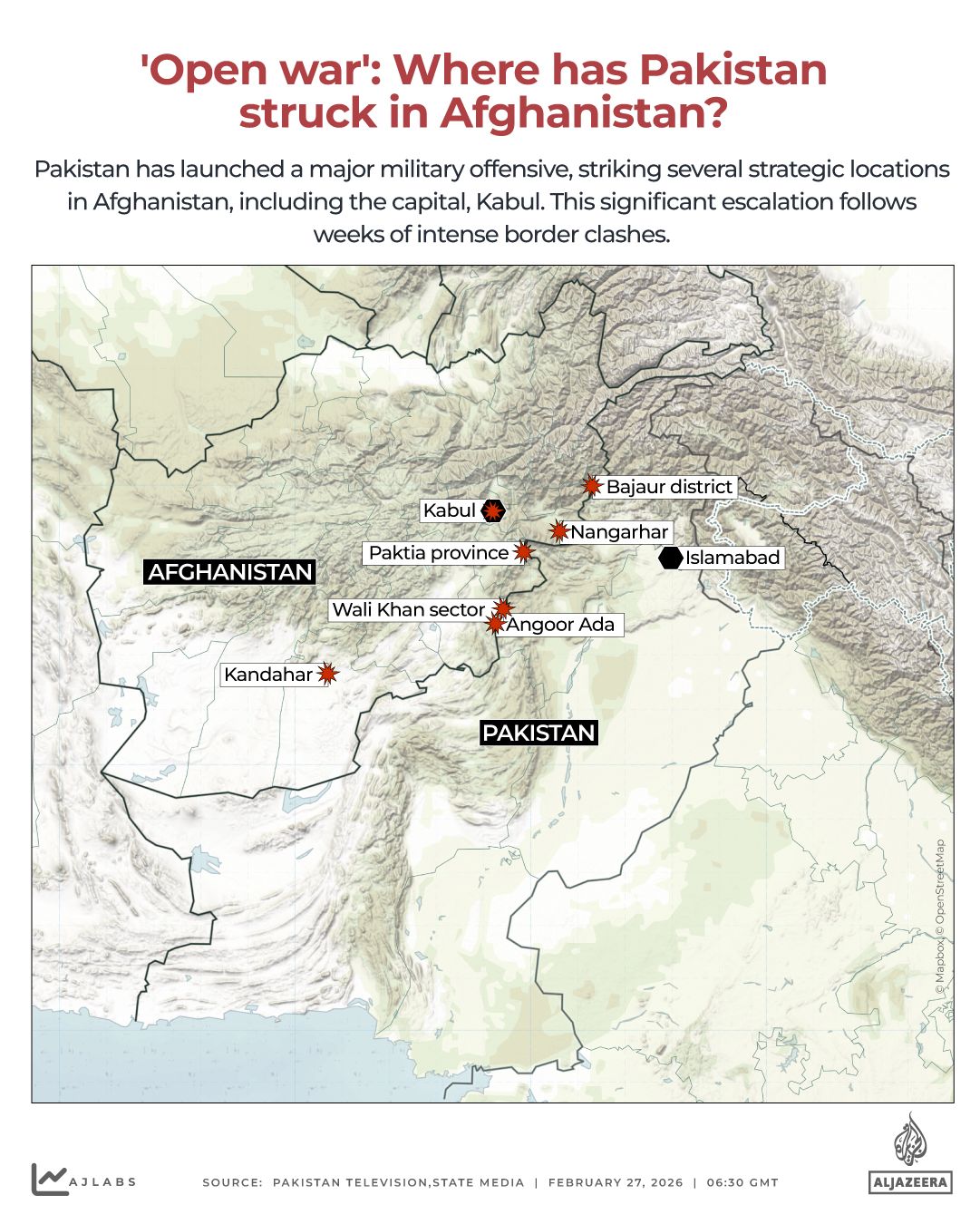
Islamabad, Pakistan – Pakistan launched air strikes on Afghanistan’s capital, Kabul, as well as on Kandahar and Paktia, early on Friday. The attacks targeted Taliban military installations as Islamabad declared “open war” on the group’s government, in the most serious military confrontation between the two neighbours in years.

The strikes came hours after Afghan forces launched coordinated cross-border attacks on Pakistani military positions in six border provinces late on Thursday. Kabul claimed 55 Pakistani soldiers were killed and 19 outposts captured.

Recommended Stories

list of 4 itemsend of list

Pakistan acknowledged two soldiers had been killed but dismissed the other claims as propaganda. It said Pakistan had eliminated at least 133 Afghan fighters in retaliation, while destroying at least 27 Afghan outposts.

Defence Minister Khawaja Asif declared Pakistan’s patience exhausted. “Our cup of patience has overflowed. Now it is open war between us and you,” he wrote on social media, as Prime Minister Shehbaz Sharif warned there would be “no leniency” in defending Pakistan’s homeland.

Taliban spokesman Zabihullah Mujahid confirmed the strikes on Kabul, Kandahar and Paktia but claimed there had been no casualties. He announced retaliatory operations had begun from Kandahar and Helmand.

The exchanges have shattered a ceasefire brokered by Turkiye and Qatar, which was reached after 10 days of deadly border fighting in October killed more than 70 people on both sides. Subsequent negotiations in Doha and Istanbul failed to produce a formal agreement.

What is unfolding now, analysts say, is categorically more dangerous, with no framework in place to contain it.

Why has Pakistan escalated now?

Pakistan’s rationale for Friday’s heavy attacks lies in a renewed wave of violence at home.

On February 6, a suicide bomber killed at least 36 people at a Shia mosque in Islamabad. This was followed, days later, by another incident in which an explosives-laden vehicle rammed a security post in Bajaur in Khyber Pakhtunkhwa, killing 11 soldiers and a child.

Pakistani authorities said the attacker was an Afghan national and issued a demarche to the Afghan deputy head of mission in Islamabad.

On February 21, another suicide bomber struck a security convoy in Bannu, also in Khyber Pakhtunkhwa, killing two soldiers.

Those attacks prompted Pakistan’s first round of strikes last weekend inside Afghanistan, targeting what it said were hideouts linked to armed groups, particularly the Pakistan Taliban, known by the acronym TTP.

The TTP, formed in 2007, fought alongside the Afghan Taliban against United States-led forces in Afghanistan and hosted Afghan fighters in Pakistan. It is organisationally distinct from the Afghan Taliban but shares deep ideological, social and linguistic ties. Pakistan accuses Kabul of providing sanctuary to the TTP, a charge the Taliban denies.

The TTP has been waging a rebellion against the state of Pakistan for more than a decade. The group demands the imposition of hardline Islamic law, release of key members arrested by the government and a reversal of the merger of Pakistan’s tribal areas with Khyber Pakhtunkhwa province, among other demands.

Another major armed group, which Pakistan alleges benefits from sanctuary in Afghanistan, is the Balochistan Liberation Army (BLA), an organisation officially designated “terrorist” by several countries and international bodies. The group has been fighting its own war against the Pakistani state, seeking independence for the Balochistan province, which is a natural mineral-rich province in southwest Pakistan, and also shares a border with Afghanistan.

Kabul said at least 18 people were killed in Pakistani strikes last Sunday and pledged retaliation, which culminated in Thursday night’s cross-border fire.

For analysts tracking Pakistan’s escalatory ladder over the past year, Friday’s strikes were not surprising, though their scope was unprecedented.

Tariq Khan, a retired three-star general who has served extensively in Khyber Pakhtunkhwa and led operations against the TTP, said this is only the beginning.

“We have not seen the peak, and there will be more to come,” he told Al Jazeera.

“Pakistan asked the Taliban to control TTP, held several talks along with Turkiye and Qatar, but it was not going to work because the Taliban refused to take responsibility,” he said.

Tameem Bahiss, a Kabul-based security analyst, said the crisis revolves around a single unresolved dispute.

“Tensions have been largely driven by Pakistan’s repeated accusations that Afghan authorities are allowing the TTP to operate from Afghan soil, which Kabul has denied,” he said.

“As long as this core issue remains unresolved, attacks will continue. From Islamabad’s perspective, these operations are framed as counterterrorism measures. From Kabul’s perspective, they are violations of sovereignty and territorial integrity,” Bahiss told Al Jazeera.

Striking military installations in Kabul and Kandahar marks a shift from peripheral border zones to the Taliban’s administrative and ideological centres. Yet dismantling decentralised and mobile TTP networks embedded along both sides of the porous frontier remains far from guaranteed.

Abdul Basit, a security researcher at Singapore’s S Rajaratnam School of International Studies, questioned the strategic payoff.

“Whatever has happened represents a dangerous escalation. While I understand the compulsion for Pakistan to retaliate, I do not understand the logic of how it will help address terrorism,” he said.

“It will lead to instability, and instability is precisely what terrorist networks crave, including TTP and other armed groups which have sought sanctuary in Afghanistan, and have all grown stronger as a result,” Basit told Al Jazeera. “The message is: We will not absorb hits. This is the new normal.”

Pakistani soldiers patrol near the Pakistan–Afghanistan border crossing in Chaman on February 27, 2026, following overnight cross-border fighting between the two countries. Pakistan bombed major cities in Afghanistan including the capital Kabul on February 27, with Islamabad's defence minister declaring the neighbours at "open war" following months of tit-for-tat clashes. AFP journalists in Kabul and Kandahar heard blasts and jets overhead, as Pakistan launched air strikes on the Afghan capital and southern power base of the Taliban authorities. (Photo by Abdul BASIT / AFP)
Pakistani soldiers patrol near the Pakistan-Afghanistan border crossing in Chaman in Balochistan province on February 27, 2026, following overnight cross-border fighting between the two countries [Abdul Basit/AFP]

The Taliban’s asymmetric options

The Taliban has no air force, and comparing the two militaries conventionally misses the point, Khan said.

“The Afghan system conducts kinetic operations through proxies, guerrilla warfare, and a war of attrition,” he said. “But if you get drawn into a war of attrition, you are on the losing side, no matter what nuclear capability or air power you possess, because you are fighting on their turf.”

Bahiss pointed to the most immediate lever available to Kabul: Pakistan’s thousands of fixed security posts along the long and porous border.

“The Taliban have repeatedly demonstrated that in moments of escalation, their preferred response is to target Pakistani military posts along the long and porous border,” he said.

Basit, though, warned of broader “unconventional options”.

“They have suicide bombers and the poor man’s air force, kamikaze drones. I think they will use both these options in large numbers, and it appears that Pakistani urban centres will see violence for the foreseeable future,” he said.

On Friday afternoon, Pakistan’s Information Minister Attaullah Tarar confirmed drone attacks in three Pakistani cities, blaming the Taliban government. He said “small drones in Abbotabad, Swabi and Nowshera” were brought down. “No damage to life,” he added in his message on social media platform X.

Another variable is the TTP itself. Kabul’s most potent asymmetric card may be its capacity to restrain or loosen tolerance for TTP operations inside Pakistan.

“So far, there has been no publicly verified evidence that Kabul is providing extensive, overt military support to the TTP in response to Pakistani strikes,” Bahiss said.

Iftikhar Firdous, a security analyst and cofounder of The Khorasan Diary, a journalism platform, argued that proxy leverage lies at the heart of this confrontation.

“Even a cursory sentiment analysis of Afghan social media linked to the Taliban clearly shows the alignment in agenda and, at times, a clear call for action by proxy groups. And while they don’t have an air force, the drone warfare is an indication of what the future of conflict looks like,” he told Al Jazeera.

A villager looks at damaged solar plates and a portion following overnight cross border fighting between Pakistan and Afghan forces, at a village in Bajaur, a district of Pakistan's Khyber Pakhtunkhwa province bordering with Afghanistan, Friday, Feb. 27, 2026
A villager looks at damaged solar plates and a portion following overnight cross-border fighting between Pakistan and Afghan forces, at a village in Bajaur, a district of Pakistan’s Khyber Pakhtunkhwa province bordering Afghanistan, on Friday, February 27, 2026 [AP Photo]

Is there an off-ramp?

Neither side appears to have an obvious exit from all this.

Pakistan’s operation received backing from the president, prime minister and across the political spectrum, with the government pledging to respond to any attack emanating from Afghan soil.

For the Taliban, absorbing strikes on Kabul and stepping back risks projecting weakness to fighters and the public it governs.

Basit said the threshold has already shifted.

“This has been a step-by-step escalation; not one step has been reversed, we have only moved forward. Tensions may come down temporarily, but in my calculation, there is no going back. Summer has arrived early in the Af-Pak region, and we are bracing for a bloody summer in both countries,” he said.

Bahiss said the trajectory will depend on two factors: Violence inside Pakistan and external diplomatic pressure.

“If attacks inside Pakistan continue and there is no meaningful diplomatic intervention, further rounds of escalation remain a real possibility. At this stage, there is little indication that either side is stepping back strategically,” he said.

Khan, the former general, outlined de-escalation only on Pakistan’s terms.

“One likely outcome is that the Afghan government concludes it has had enough, signals to its proxies that it is over, and eventually comes to the table. They agree to share intelligence and curtail all proxies, including TTP and others. The second option is that they do not agree and continue as they are, in which case Pakistan’s response will continue as well.”

Can diplomacy still work?

The international community reacted swiftly on Friday in the wake of these tit-for-tat attacks.

United Nations Secretary-General Antonio Guterres urged both countries to adhere to international humanitarian law and resolve differences through diplomacy.

Iran’s Foreign Minister Abbas Araghchi invoked the holy month of Ramadan, writing on X that Tehran stood “ready to provide any assistance necessary to facilitate dialogue”.

Saudi Foreign Minister Prince Faisal bin Farhan Al Saud held urgent discussions with his Pakistani counterpart, Ishaq Dar, who is in Riyadh on an official visit. Dar, also deputy prime minister, spoke by telephone with Turkish Foreign Minister Hakan Fidan.

But Bahiss said durable de-escalation requires more than just statements.

“A credible de-escalation process would likely involve Pakistan sharing actionable intelligence regarding alleged TTP presence inside Afghanistan, followed by verifiable steps taken by Kabul against any confirmed elements,” he said.

“The fundamental obstacle is denial and mistrust. Kabul rejects the claim that TTP operates from its territory, while Islamabad insists that it does. As long as one side frames the issue as external aggression and the other as counterterrorism necessity, bridging that gap becomes extremely difficult.”

Former military official Khan argued Pakistan’s diplomatic approach must widen beyond the Taliban to include Pashtun communities and anti-Taliban political forces.

“Islamabad should be simultaneously talking to Pashtun communities and anti-Taliban political forces and empowering the locals who stand against the Taliban,” he said.

Firdous, however, said any sustained de-escalation would require the same external mediators who previously facilitated talks.
Court Grants Ex-AGF Malami ₦200m Bail In Terrorism, Firearm Charges

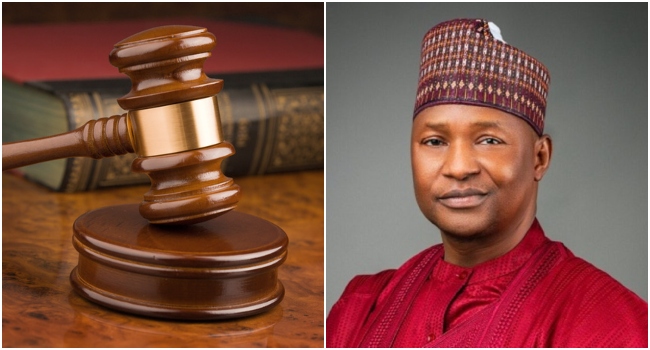
Justice Joyce Abdulmalik of the Federal High Court Abuja has admitted a former Attorney General of the Federation (AGF), Abubakar Malami, and his son, Abdulaziz, to ₦200 million bail in the charges bordering on alleged terrorism and illegal firearms possession brought against them by the Department of State Service (DSS).

Malami and his son were, however, ordered to be remanded at the Kuje Correctional Centre pending the perfection of the bail conditions imposed on them by the court.

Justice Abdulmalik granted them bail while ruling on their bail applications, which were argued by their lead counsel, Joseph Daudu, SAN.

The judge ordered the former AGF and his son to get two sureties each, one of whom must own landed property either in Maitama or Asokoro.

Justice Abdulmalik said that the title of the property must be deposited with the Deputy Chief Registrar of the court, along with valid international passports.

The sureties are also to depose to an affidavit of means and submit their two recent passport photographs to the court.

READ ALSO: Judge Withdraws From EFCC Cases Against Malami

Malami and his son were also ordered to submit their passports and recent passport photographs to the court.

The judge subsequently fixed March 4 for the commencement of the trial.

The DSS had arraigned Malami and his son, Abdulaziz, on a five-count charge bordering on terrorism and illegal firearms possession.

In the charge, Malami was accused of refusing to prosecute suspected terrorism financiers, whose case files were handed to him while he served as the AGF and Minister of Justice.

Malami and Abdulaziz are equally accused of warehousing firearms in their residence at Gesse Phase II Area, Birnin Kebbi, Kebbi LGA, Kebbi State, without lawful authority.

The DSS accused Malami in count one of the charge, with knowingly abetting terrorism financing.

Deadly journeys: Refugees, migrants risk everything to reach Europe

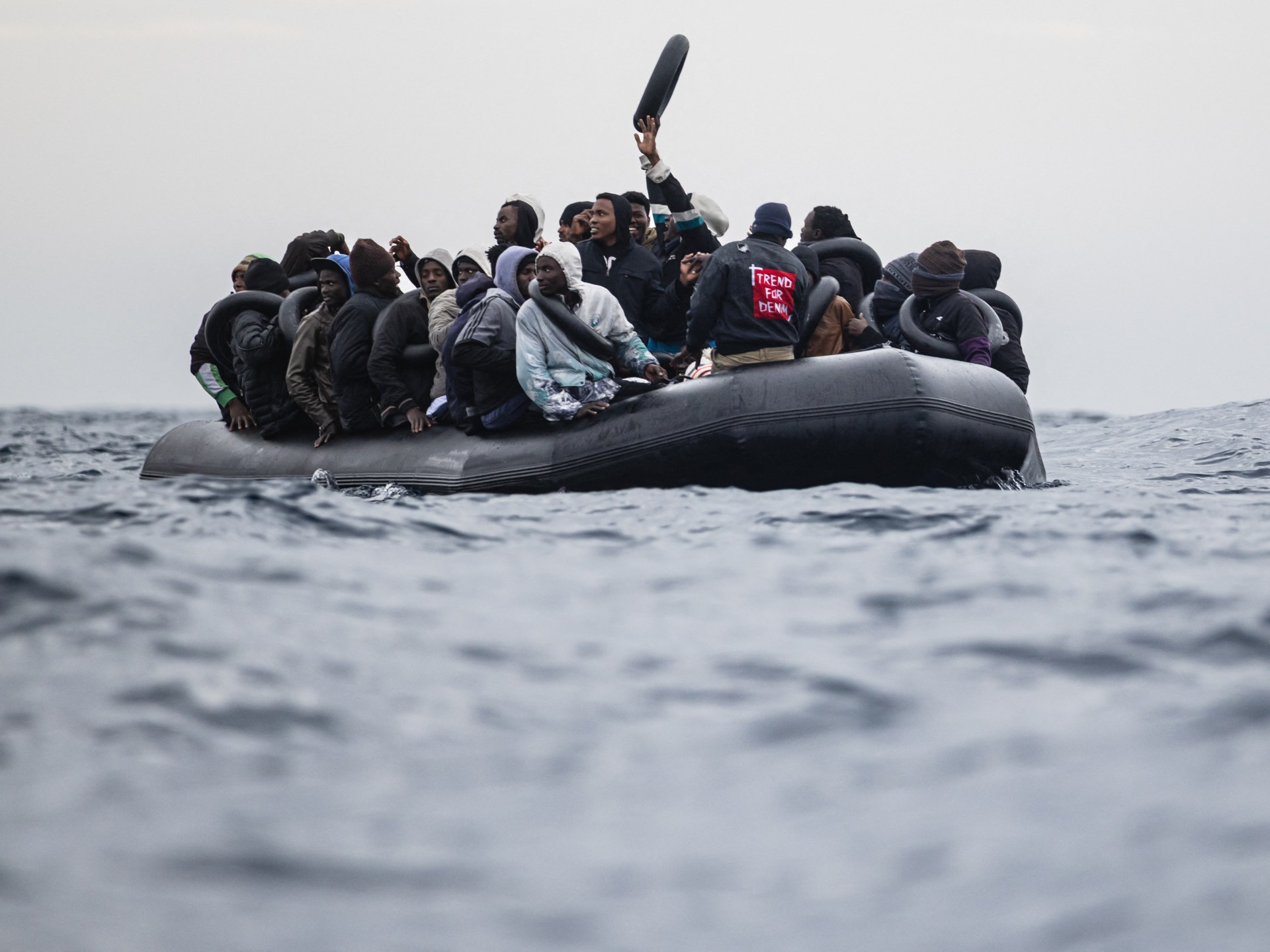
The new year is less than two months in, but already more than 560 people have gone missing in the Mediterranean Sea while trying to reach Europe, making it on course to be one of the deadliest years on record. At least 500 of those were lost crossing from Libya, Tunisia and Algeria to a Europe that continues to attempt to force them back.

The stories of those lost at sea, many of them travelling on boats that offer little protection from the waves, reveal the extent of their suffering.

Recommended Stories

list of 3 itemsend of list

Earlier in February, 53 people, two of them babies, were reported to be dead or missing after their boat capsized off the coast of the Libyan town of Zuwara. Only two women, both Nigerian, were rescued.

A few weeks earlier, as a freak cyclone tore across the Mediterranean Sea, hundreds, possibly up to a thousand people, desperately trying to reach Europe, were believed to have lost their lives.

Qualified risk

The risks of travelling to and through Libya are well known among migrants and refugees. Nevertheless, they come.

According to the United Nations’ International Organization for Migration (IOM), between August and October 2025, at least 928,000 migrants were identified in Libya, hoping to either stay in the North African country or, in the case of many, attempt to cross to Europe and the promise of a better life.

But, as they wait for the funds to pay for their passage, or the right opportunity to travel, they find themselves prey to the militias that have controlled much of Libya since a civil war robbed the country of a stable and unified government.

A report, issued by the UN Human Rights Office in February, painted a bleak picture of life for refugees and irregular migrants in Libya. In it, researchers described an environment where traffickers and armed groups could conduct widespread and systematic abuse against migrants with impunity. These “grave violations and abuses have evolved into deliberate, profit-driven practices that together form a ruthless and violent business model”.

Ola, a 25-year-old from Freetown in Sierra Leone, is one of the thousands to have fallen victim to Libya’s militias. Speaking from Libya’s capital Tripoli, Ola described being beaten and held prisoner by one of the militias in Zuwara, which is in western Libya.

Ola said that his hand had still not recovered after he was hit with an iron bar before he was detained in the summer of 2024. Ola remained in detention, enduring forced labour and regular beatings, for three months: the time it took his parents to borrow the $700 his captors demanded to free him.

“Conditions were very bad,” he said of his time in detention, as he rubbed his injured hand. “There was a lot of suffering. We would have bread to eat, and sometimes we had to drink the water they gave us to wash in. It was very bad; it had salt in it.”

“I did not have a [reputation for taking risks] in my country,” Ola said.

“I did not associate with bad people. I never did anything illegal,” he continued. “I know this is dangerous, but it’s better than where I come from”.

Mubarak, a 31-year-old from Sudan, is no different. He fled fighting around his village near Nyala in Darfur in 2023, crossing into Libya overland through Chad. Like Ola, Mubarak described being held prisoner, being beaten and forced to work by one of Libya’s militias, before being released.

Mubarak also knows the risks of continuing to Europe and is ready to accept them. He laughed bitterly, “I know the crossing [to Europe] is dangerous. [But] It’s just the money that’s stopping me. I know in my soul that Libya is just as dangerous as Sudan, but where will I go?”

No deterrence for the desperate

For those willing to stake their lives on surviving what the IOM says is the world’s most dangerous migration route, European deterrence means little.

Nevertheless, the European states most exposed to departures from Tunisia and Libya, principally Italy, have adopted increasingly punitive measures. Under a new Italian bill approved earlier this month, the country can indefinitely prohibit boats from entering its waters “in cases of grave threats to public order or national security”.

Moreover, the bill allows Italy to stop boats and send passengers to third-party countries it has outsourcing deals with, such as Albania, with no indication that authorities would check for protection needs, vulnerabilities, or physical or mental health concerns. The European Parliament has also signed off on changes to EU asylum rules that let member states transfer asylum seekers to “safe third countries”.

How effective all of that is at reducing migrant numbers remains to be seen. Despite an Italian government elected partly on the back of its anti-migrant platform in 2022, arrival numbers remain stubbornly high, with more than 63,000 people braving the odds in 2025, almost the identical number as those from the previous year.

“Why people take these extreme risks is one of the big questions,” said Ahlam Chemlali, a migration expert at Aalborg University in Denmark, who has conducted extensive field research among irregular migrants along Tunisia’s border with Libya,

Chemlali described speaking to the women in the border region, who knew and, in many cases, had experienced the danger inherent to migration firsthand.

“They told me they were already dead there [on the border], and they’re right. It’s a social death, where people have no future,” she said, “Everything is denied to them, so taking these risks is one way they can regain some control over their lives. They understand what they’re doing. The EU has poured millions into information campaigns, but the prospect of being stuck in limbo with no future feels worse. This is especially true for women with children. The presence of children can be a huge motivator, but of course, it also increases the risks.”

In Ola’s case, the drive to reach Europe is unwavering. He craves the rule of law – anything that would lead to consequences for those committing acts of violence against him.

“Life in Europe would be amazing,” he said, the tone of his voice lightening, “I would be safe. There is no violence there. If there is violence, it is punished by the law.

Man City play Real Madrid, PSG face Chelsea in Champions League last 16

Real Madrid will play Manchester City while defending champions Paris Saint-Germain will face Chelsea in the pick of the 2025/26 Champions League last 16 games after the draw was made by UEFA in Nyon, Switzerland.

The draw for European football’s biggest club competition on Friday determined that City will face Madrid for the fourth consecutive season in a knockout Champions League clash.

Recommended Stories

list of 4 itemsend of list

Meanwhile, PSG and Chelsea will repeat their FIFA 2025 Club World Cup final, which the Premier League side won 3-0.

Elsewhere, Barcelona will face Newcastle United, Tottenham Hotspur will play Atletico Madrid, and Arsenal will take on Bayer Leverkusen.

Liverpool will renew hostilities with Galatasaray in a rematch of their league phase game, which the Turkish giants won 1-0 in Istanbul.

Norwegian minnows will face Portugal’s Sporting Lisbon, while the only Italian side left in the competition face a daunting encounter with German champions Bayern Munich.

The first legs will be played on March 10-11 and the second legs will be played on March 17-18.

The eight seeded teams – who finished in the top eight spots in the league phase – will be at home for the second legs against the eight teams who qualified through the playoff round.

The last 16 draw in full:

  • Paris Saint-Germain vs Chelsea
  • Galatasaray vs Liverpool
  • Real Madrid vs Manchester City
  • Atalanta vs Bayern Munich
  • Newcastle vs Barcelona
  • Atletico Madrid vs Tottenham Hotspur
  • Bodo/Glimt vs Sporting
  • Bayer Leverkusen vs Arsenal

Familiar foes

Real Madrid knocked City out in the last 16 last season, as they did in the 2024 quarterfinals and 2022 semifinals.

City beat Madrid in the 2023 semifinal en route to lifting the Champions League trophy for the first time.

The two clubs have played each other on 15 occasions, with each team winning five games and the rest ending as draws.

City and Madrid have already faced each other in the league stage this season, with City coming from behind to win 2-1 in December.

PSG will be eager to take revenge on Chelsea after the Blues stunned the French champions to win the inaugural Club World Cup title in a bad-tempered game last year.

The clubs have previously faced each other in the Champions League, with Chelsea triumphing in a 2014 quarterfinal and PSG eliminating the Blues in the last 16 in 2015 and 2016.

FIFA Club World Cup - Final - Chelsea v Paris St Germain - MetLife Stadium, East Rutherford, New Jersey, U.S. - July 13, 2025 Chelsea's Cole Palmer celebrates scoring their first goal
Chelsea’s Cole Palmer celebrates scoring against PSG in the Club World Cup final with Joao Pedro [Hannah McKay/Reuters]

The draw on Friday also mapped out the potential route to the final, to be held in Budapest on May 30, as every team now knows their possible quarterfinal and semifinal opponents.

In the quarterfinals, City or Madrid will face the winner of Bayern Munich vs Atalanta, while PSG or Chelsea will take on either Liverpool or Galatasaray.

Quarterfinal draw

  • Paris Saint-Germain or Chelsea vs Liverpool or Galatasaray
  • Real Madrid or Manchester City vs Bayern Munich or Atalanta
  • Newcastle or Barcelona vs Tottenham or Atletico Madrid
  • Sporting Lisbon or Bodo/Glimt vs Arsenal or Bayer Leverkusen

Semifinal draw

  • Paris Saint-Germain, Chelsea, Liverpool or Galatasaray vs Real Madrid, Manchester City, Bayern Munich, or Atalanta
  • Newcastle, Barcelona, Tottenham or Atletico Madrid vs Sporting Lisbon, Bodo/Glimt, Arsenal or Bayer Leverkusen

Champions League knockout round schedule:

  • Last 16 : March 10-11 and March 17-18, 2026
  • Quarterfinals: April 7-8 and April 14-15, 2026
  • Semifinals: April 28-29 April and May 5-6, 2026
  • Final: May 30, 2026

Europa League last 16 draw

  • Ferencvaros vs Braga
  • Panathinaikos vs Real Betis
  • Genk vs Freiberg
  • Celta Vigo vs Lyon
  • Stuttgart vs Porto
  • Nottingham Forest vs Midtjylland
  • Bologna vs Roma
  • Lille vs Aston Villa

‘Scary’ and ‘ruthless’ Wigan out to regain crown

Adam Lanigan

BBC Sport England

It is a long and winding road towards Super League’s Grand Final at Old Trafford in October.

But even at this early stage of the 2026 campaign, Wigan Warriors look in determined mood to make sure they are there for a fourth straight season.

However, after relinquishing their crown last year to Hull KR, Matt Peet’s Warriors have begun in ominous form with three straight wins.

The latest was a 54-0 nine-try demolition of neighbours Leigh Leopards – not so much a “Battle of the Borough”, more a breeze.

By their own recent high standards, 2025 was a slight letdown for Wigan as they ended the year empty-handed having won an unprecedented quadruple the year before.

Instead it was the Robins on top of the perch as they won a fantastic treble to shake up the old established order.

Currently, Hull KR are basking in their new status as Super League winners and most recently World Club Champions, after an exciting victory over NRL Premiers Brisbane Broncos.

This week, the side from east Hull are taking in the sights of Las Vegas as they gear up for their game with Leeds Rhinos at Allegiant Stadium, home of NFL side Las Vegas Raiders.

‘Everyone being kept accountable’

“Matty challenged us to be ruthless and we got a pretty ruthless performance tonight,” full-back Jai Field told BBC Radio 5 Live.

After a solid win at Castleford Tigers in matchday one, Wigan have racked up 88 points in two home victories over Hull FC and then the Leopards in the space of five days.

And while Field and star half-backs Bevan French and Harry Smith have looked in the mood, the defence has given up just one try in 160 minutes of play.

“We bowed out in the Grand Final last year, but we wanted to fix up a few things that snuck into our game at the back end of last season,” said Field.

“Matty has challenged us this year. Training has been a little more intense, not getting away with things we probably brushed over last year.

Jai Field, on one knee, about to touch down for a try with Leigh's Josh Charnley and Wigan team-mate Patrick Mago running behind himSWPix

For captain Liam Farrell, this is a 17th Super League campaign with the Cherry-and-Whites.

He has a cupboard full of silverware but it does not stop the 35-year-old from wiping the slate clean every year and going again.

Farrell has stepped into the centres after an early injury to Jake Wardle and he has noticed how quickly his side has come out of the traps.

“I am hoping it’s only the start,” he said. “It’s not usually a good sign if you’re playing so well at the beginning of the year.

“I’m hoping we’re going to improve from this. That’s a scary thought if we’re going to improve from here.

“Hopefully we do. We’ll take on the year and see where we end up.”

Related topics

  • Rugby League
  • Wigan Warriors

VAR to be used for first time in Northern Ireland

Richard Petrie

BBC Sport NI Journalist
  • 19 Comments

The Northern Ireland Football League has confirmed that the upcoming BetMcLean Cup final between Linfield and Glentoran will see Video Assistant Referee (VAR) technology used for the first time in Northern Ireland domestic football.

The decider between Belfast rivals Linfield and Glentoran will be played at Windsor Park on Sunday, 15 March at 15:00 GMT.

“This milestone represents a significant step forward for domestic football, aligning the league more closely with European competition standards,” read a statement released by NIFL on Friday.

“While VAR will not replace the authority or judgment of the on-field referee, it will serve as a technological support mechanism aimed at enhancing decision-making accuracy, fairness, and transparency in key match incidents.

“The fixture will be officiated by Irish FA match officials on the field of play. However, VAR operations for this match will be managed by experienced referees from outside Northern Ireland using the Hawk-Eye system, as used in Fifa and Uefa competitions, ensuring technical proficiency during this introductory phase.”

The statement explained that the cup final would “provide an ideal controlled environment to evaluate operational procedures, communication protocols, and overall integration of VAR into the domestic matchday framework”.

The experience gained is set to inform any future decisions the governing body will make regarding potential broader implementation of VAR across NIFL competitions.

NIFL chief executive Gerard Lawlor acknowledged that the decision would not attract support from all quarters but highlighted the benefits of using the technology.

“The introduction of VAR for this game represents an important step forward for our league, strengthening decision-making and supporting our match officials,” he said.

“We recognise, however, that this will not be a universally popular decision and that the implementation of any new technology brings scrutiny and adjustment.

“This game represents a valuable opportunity for us to assess and become familiar with the technology in a controlled environment, while providing practical benefits to both the Referee Team and our clubs, particularly those participating in European competitions where its use may be required.”

Irish FA Head of Refereeing Andrew Davey added: “The use of VAR in the BetMcLean Cup Final is an exciting step forward for both the league and refereeing in Northern Ireland.

Related topics

  • Football
  • Irish Football