Players flee court in UAE after sirens warn of drone debris causing nearby fire

Jonathan Jurejko

BBC Sport tennis news reporter

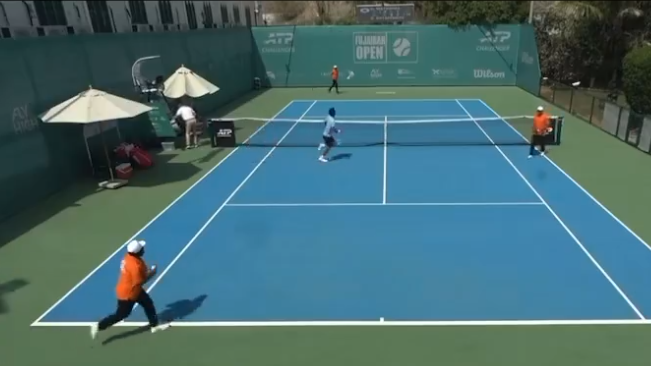
Players and officials ran from the court at an ATP Challenger event in the United Arab Emirates when an Iranian drone attack led to a fire breaking out at an oil terminal located about 10km away.

Two matches were stopped in Fujairah – which is about 90 miles south-east of Dubai – shortly after the city’s port was targeted on Tuesday morning. The ATP later confirmed play was cancelled for the rest of the day.

A live feed on the ATP website showed Japan’s Hayato Matsuoka and Russia’s Daniil Ostapenkov, along with the umpire and line judges, dash off court early in the third set.

Tournament officials could be heard shouting instructions to leave the court.

“Relevant authorities responded to a fire that broke out in the Fujairah Oil Industry Zone, resulting from falling debris following the successful interception of a drone by air defence systems,” the Government of Fujairah media office said in a statement.

Iranian drone and missile attacks have been fired towards the UAE over the past three days, in response to US and Israeli strikes on Iran.

Defence teams were still “working to contain the incident”, the statement added. No injuries were reported.

“The health, safety and wellbeing of our players, staff and tournament personnel is our priority,” the ATP told BBC Sport.

“Following consultation with local authorities and security advisers, play has been cancelled for the remainder of the day as a precautionary measure.

    • 20 hours ago
    • 6 hours ago

On Monday, the ATP confirmed the Fujairah tournament was going ahead as planned after holding discussions with the local government about its viability.

The men’s governing body had been told it was safe to proceed, with extra security measures put in place and the event being held behind closed doors.

British players Max Basing and Zach Stephens are among the players in the draw.

Around 40 players, team members, officials and media remain stranded in Dubai.

Former world number one Daniil Medvedev and British doubles player Henry Patten were among those unable to leave after the Dubai Tennis Championships when airspace was closed in the region at the weekend.

All scheduled flights remain suspended, with only a limited number of planes – prioritising passengers with earlier bookings and those in transit through Dubai – taking off.

The possibility of the players driving out of Dubai and hiring private jets from neighbouring Oman has been explored over the past few days.

Related topics

  • Tennis

More on this story

  • Some tennis balls
    • 16 August 2025
    BBC Sport microphone and phone

South Africa vs New Zealand – T20 World Cup semifinal: Teams, form, stream

Who: South Africa vs New Zealand
What: ICC Men’s T20 World Cup semifinal
When: Wednesday, March 4 at 7pm (13:30 GMT)
Where: Eden Gardens, Kolkata, India
How to follow: Al Jazeera’s live coverage begins at 10:00 GMT.

South Africa’s red-hot form and mental strength in the face of a knockout challenge will be put to the test in the first semifinal of the T20 World Cup when they meet a threatening New Zealand side on Wednesday.

Recommended Stories

list of 3 itemsend of list

Aiden Markram’s team, the only unbeaten side in the tournament, will look to bury the ghosts of their previously failed attempts to win knockout matches and lift a men’s World Cup trophy.

In their way stand Mitchell Santner’s allround XI of explosive batters, fierce fast bowlers and the most eye-catching fielding team of the tournament.

The famous Eden Gardens, known as India’s home of cricket, will host the showdown between two teams from the Southern Hemisphere.

What are South Africa’s strengths and weaknesses?

Batting

South Africa boast a power-packed batting lineup, which is led at the top by Markram. The captain has amassed 268 runs in seven matches, while Ryan Rickelton has 228.

David Miller’s heroics in the middle order have navigated the team out of trouble, while Quinton de Kock often provides blistering starts as an opener.

Dewald Brevis, Tristan Stubbs and their pace bowlers are all able to clear the boundary lower down the order.

Bowling

Quick bowler Lungi Ngidi has taken 12 wickets and has bamboozled some of the best with his deceptively slow off-cutter while squeezing the runs.

Keshav Maharaj can tie batsmen down with his left-arm spin but also pick up key wickets – as he did against India.

Nightmares of previous failures

On the field, South Africa are the strongest team, but they do carry scars of previously failed attempts at lifting the trophy.

Whether the recent one, from Barbados in 2024, or the 50-over World Cup semifinal failure in 2023, the Proteas have notoriously failed at the last hurdle.

What are New Zealand’s strengths and weaknesses?

Allround talent

New Zealand are truly a sum of all their parts, and most of those parts are vital cogs in the all-round machine.

From skipper and leading spinner Mitchell Santner to batting all-rounders Glenn Phillips and Rachin Ravindra, they thrive on the talents of their multiskilled team members.

Lockie Ferguson, Matt Henry and Jacob Duffy offer plenty of pace options while Ish Sodhi’s leg spin helps keep things tight.

Fielding

The Blackcaps are arguably the best fielding side in the tournament, and their acrobatic efforts often make the highlights reel of the match. Phillips has made a reputation for pulling off the most difficult catches.

Lower-order slip-ups

Despite packing all-rounders in their XI, New Zealand have failed to finish their innings with a big flourish on a few occasions. They are the only team in the last four to have lost two matches in the tournament.

New Zealand's Jacob Duffy (C) attends a training session on the eve of their 2026 ICC Men's T20 Cricket World Cup semi - final match against South Africa at the Eden Gardens in Kolkata on March 3, 2026. (Photo by Arun SANKAR / AFP)
New Zealand’s Jacob Duffy could return to the playing XI for the semifinal [Arun Sankar/AFP]

How have South Africa fared at the T20 World Cup?

South Africa opened their tournament with a 57-run win against Canada, but needed two super overs to confirm their win against Afghanistan in their second match.

Next, they thumped their semifinal opponents, New Zealand, in a seven-wicket win to confirm their passage to the Super Eights with a game to spare, before completing the group with a six-wicket win against the UAE.

Markram’s team stunned defending champions India at the biggest cricket stadium in the world by handing them a 76-run defeat in Ahmedabad. They then eased to a stunning nine-wicket win over West Indies, before finishing their Super Eights run by handing a five-wicket defeat to Zimbabwe.

How have New Zealand fared at the T20 World Cup?

New Zealand began their campaign with a comfortable five-wicket win over Afghanistan, who failed to contain the Kiwis’ batting prowess. Their second match was the Finn Allen and Tim Seifert show as they crushed the United Arab Emirates by 10 wickets in their chase of 175.

Santner’s side were handed their first defeat by South Africa as they failed to contain the Proteas in pursuit of 176 and ended up losing by seven wickets. They wrapped up their group stage with a comfortable eight-wicket win over Canada.

Their first Super Eights game against Pakistan ended in a washout. The second one, against co-hosts Sri Lanka, was where New Zealand collected crucial two points and a healthy net run-rate to ensure they remained on course for the semis.

England made a late comeback to beat New Zealand in their final Super Eights match, but Pakistan’s failure to hand Sri Lanka a big defeat sealed the Blackcaps’ passage into the knockouts.

What’s South Africa’s best result at the T20 World Cup?

Runners-up: 2024

What’s New Zealand’s best result at the T20 World Cup?

Runners-up: 2021

INTERACTIVE -STADIUMS- T20 MEN'S CRICKET WORLD CUP - 2026 - FEB3, 2026-1770220847
(Al Jazeera)

Form guide: South Africa

The Proteas are the team to beat in the tournament, having won all their games. Their last defeat in T20 matches came in the bilateral series win (2-1) against the West Indies in January.

Last five games (most recent result first): W W W W W

Form guide: New Zealand

New Zealand’s form has been mixed, with a string of wins followed by a defeat in both stages of the World Cup. They also suffered a 4-1 series loss against India before the tournament.

Last five games (most recent result first): L W NR W W

South Africa vs New Zealand: Head-to-head

South Africa hold the edge in their T20 meetings with New Zealand, having won 12 of the 19 encounters. New Zealand have won the remaining seven.

Team news: South Africa

The Proteas tinkered with their playing XI in the last Super Eights match against Zimbabwe, giving a rest to pace bowlers Marco Jansen and Kagiso Rabada. Both should return to the side for the knockout game.

Predicted XI: Aiden Markram (captain), Quinton de Kock (wicketkeeper), Ryan Rickelton, Dewald Brevis, David Miller, Dewald Brevis, Tristan Stubbs, Marco Jansen, Corbin Bosch, Kagiso Rabada, Keshav Maharaj, Lungi Ngidi

Team news: New Zealand

The Blackcaps are likely to make one change to the XI that lost their last Super Eights game against England. Jacob Duffy could return to the side in place of Cole McConchie.

Predicted XI: Tim Seifert (wicketkeeper), Finn Allen, Rachin Ravindra, Glenn Phillips, Daryl Mitchell, Mark Chapman, Mitchell Santner (captain), Matt Henry, Ish Sodhi, Lockie Ferguson, Jacob Duffy

How can I follow and stream the South Africa vs New Zealand semifinal?

Trump admin offers scant evidence on Iranian threat in ‘America First’ war

Washington, DC – As the US and Israeli militaries expand their strikes on Iran, the administration of US President Donald Trump has alternated its justification for the war between preventing immediate attacks and countering the long-term existential threat of a nuclear Tehran.

This was on full display on Monday, with Trump and Pentagon chief Pete Hegseth appearing to make the case that the culmination of Iran’s regional policies in the 47 years since the Islamic revolution, coupled with the future of its ballistic and nuclear programmes, represented an immediate threat to the US.

Recommended Stories

list of 3 itemsend of list

US Secretary of State Marco Rubio, meanwhile, argued that Washington’s close ally Israel was planning to attack Iran. In which event, the administration expected Iran to strike US assets, therefore justifying launching a preemptive attack, he said.

To date, the administration has offered little clear evidence to support any of its claims, according to advocates and analysts, as well as Democratic lawmakers who have recently attended classified briefings.

“The reality is, they’ve put forth very little evidence, and that’s a huge problem,” Emma Belcher, the president of Ploughshares, a group that advocates for denuclearisation, told Al Jazeera.

“It says, one: They don’t think they need to [make the case] for the war; that they won’t necessarily be held to account for it,” Belcher said. “But it also says to me that the evidence quite possibly isn’t there, and that they want to avoid particular scrutiny.”

Republicans have largely coalesced around the administration’s messaging, even as Democrats have pledged to force votes on war powers legislation to assert constitutional authority over the president’s military action.

Still, the administration remains in a tenuous political position as Trump’s Republican Party stares down midterm elections in November. Early public polling indicates little outright support from the US public, even as Trump’s Make America Great Again (MAGA) base has been staid in its response.

But the more days that pass, and the more US service members are killed, the more likely that Trump will be confronted with the contradictions to his past anti-interventionist promises.

“The longer it goes on and the more costly it is in terms of lives… the more the lack of evidence becomes an albatross around the neck of the administration – one that it will have to account for come November,” according to Benjamin Radd, a senior fellow at the UCLA Burkle Center’s international relations department.

A kaleidoscope of claims

Speaking from the White House on Monday, Trump praised the “obliteration of Iran’s nuclear programme” in US strikes last June. But moments later, he claimed that efforts to rebuild that programme, coupled with Iran’s ballistic missile programme, represented a menace to the US.

“An Iranian regime armed with long-range missiles and nuclear weapons would be an intolerable threat to the Middle East, but also to the American people,” Trump said. “Our country itself would be under threat, and it was very nearly under threat.”

Trump also said that, if not for US and Israeli attacks, Iran “would soon have had missiles capable of reaching our beautiful America”.

Daryl Kimball, the executive director of the Washington, DC-based Arms Control Association (ACA) said any claims of immediate or middle-term threats posed by Iran in terms of their ballistic and nuclear power are not supported by available evidence.

That is significant, as such “imminent threats” are required for a president justify attacks on foreign countries under both US domestic law and international law, save for approval from Congress.

“Iran did not possess, prior to this attack, the capability to quickly enrich its highest uranium to bomb grades, and then to convert that into metal for constructing a bomb,” Kimball told Al Jazeera.

“At the soonest, it might have taken many, many months to do that, but Iran does not have access to its 60 percent highly-enriched uranium. Its conversion facility is damaged and idle. Its major uranium enrichment facilities have been severely damaged by the US strikes in 2025.”

He explained that despite having “significant conventional short and medium range ballistic missile capabilities”, Iran has said it has imposed 2,000km (1,200-mile) limits on its ballistic missile range, and is not near having an intercontinental ballistic missile capability.

The “latest [US intelligence] assessment is that Iran could, if a decision is made, have an ICBM capability by 2035. So Iran is nowhere close to having an ICBM threat that could be called imminent,” he said, referring to intercontinental ballistic missiles, which have a range of at least 5,000km (3,400 miles).

Democrats say no new intelligence

Secretary of State Rubio on Monday said there “absolutely was an imminent threat” presented by Iran.

“We knew that there was going to be an Israeli action,” he said. “We knew that that would precipitate an attack against American forces, and we knew that if we didn’t preemptively go after them before they launched those attacks, we would suffer higher casualties.”

But top Democrats who received classified intelligence briefings in recent days said they had not been provided with evidence to justify the attack.

“I’m on two committees that give me access to a lot of classified information; there was no imminent threat from Iran to the United States that warrants sending our sons and daughters into yet another war in the Middle East,” Senator Tim Kaine, who sits on both the Armed Services Committee and the Foreign Relations Committee, told CNN on Saturday.

Senator Mark Warner, who was briefed on classified intelligence related to Iran last week as part of the “gang of eight”, a collection of the top lawmakers from both parties in Congress, told the network: “I saw no intelligence that Iran was on the verge of launching any kind of preemptive strike against the United States of America”.

Several sources speaking to both the Reuters news agency and the Associated Press, following a closed-door briefing of congressional staff on Sunday, said the administration presented no evidence that Iran was planning a preemptive strike, and had instead focused on a more generalised threat posed by Iran and its allies to US troops and assets in the region.

Trump looking for quick success

All told, the Trump administration appears to be arguing that “Iran has been a national security threat to the United States since 1979… that Iran was responsible for more American lives being killed than any other state or non-state actor; that Iran has never been held to account for this”, according to the Burkle Center’s Radd.

Trump, therefore, appears to be taking the position that given the totality of Iranian actions, including during recent indirect nuclear talks, the US “has no choice but to perceive Iran as an imminent threat”.

Oman’s foreign minister, who mediated the talks, had pushed back on the administration’s characterisation, maintaining that “significant progress” had been made before the US-Israeli attacks.

Radd noted that under the War Powers Act of 1973, a US president has between 60 and 90 days to withdraw forces deployed without congressional approval. Therefore, Trump appears to be saying, “We’re not obliged to prove to Congress any of that if we can conduct and execute this operation within the 60 to 90 day window,” he said.

Meanwhile, Ploughshare’s Belcher said that the administration’s own actions led to the current situation with Iran.

She pointed to Trump’s withdrawal of The Joint Comprehensive Plan of Action (JCPOA) in 2018, which had seen the US impose maximum sanctions on Iran, and Iran, in turn, begin enriching uranium beyond the levels laid out in the agreement. Trump also derailed nuclear talks last year by launching attacks on Iran.

“We’re in this situation precisely because President Trump gave up on an agreement that was negotiated by his predecessor,” Belcher said. “He gave up on diplomacy.”

‘America First’ war?

In his speech on Monday, Hegseth, in particular, appeared to try to frame the war within Trump’s political worldview, pledging to “finish this on America First conditions”.

He drew a contrast with the US invasion of Iraq, describing the attacks on Iran as a “clear, devastating, decisive mission”.

“Destroy the missile threat, destroy the navy – no nukes,” he said.

He also sought to draw a distinction between a “so-called regime-change war” and US attacks that happened to lead to regime change. As of Monday, US strikes had killed Iran’s supreme leader, Ayatollah Ali Khamenei, and several top officials, but the ruling government has remained intact.

Hegseth said that the US is unleashing attacks “all on our terms, with maximum authorities, no stupid rules of engagement, no nation-building quagmire, no democracy building exercise, no politically correct wars”.

It remains unclear how the message will resonate with the US public.

A Reuters-Ipsos poll released on Sunday suggested dismal approval for Trump’s strikes, but also indicated that large swaths of Americans were unsure about the conflict.

That could create opportunities for those challenging Trump’s actions and his justification for them.
NRC Increases Trips On Abuja–Kaduna Train Corridor

The Nigerian Railway Corporation (NRC) has announced a revision and expansion of train services on the Abuja‑Kaduna Train Service (AKTS) in response to rising passenger demand on the busy rail corridor between the Federal Capital Territory and Kaduna State.

In an official statement issued and signed by the corporation’s Chief Public Relations Officer, Callistus Unyimadu, the new timetable is scheduled to take effect from Friday, March 6, 2026.

According to the NRC, the expanded schedule will provide commuters with more travel options, bolster operational flexibility, and strengthen overall service delivery on one of Nigeria’s most patronised rail routes.

The revised schedule has been structured to cater to different travel patterns throughout the week.

It said on Tuesdays and Thursdays, two services will run daily, with departures from Idu at 8:45 a.m. and returns from Rigasa at 2:30 p.m.

READ ALSO: Nigeria’s Private Sector Growth Resumes After January Dip, PMI Hits 53.2

According to the NRC, on Fridays and Sundays, three trips will operate, departing Idu at 7:45 a.m. and 3:15 p.m., and leaving Rigasa at 11:30 a.m.

“Saturdays and Mondays: Three services are also scheduled, with trains departing Rigasa at 7:15 a.m. and 3:00 p.m., and from Idu at 11:00 a.m. All trains will make scheduled stops at Kubwa,” the agency said.

The NRC highlighted that the corridor had experienced operational disruptions in recent years due to events such as the March 28, 2022, bomb blast and the August 26, 2025, derailment, which temporarily reduced available rolling stock and led to slower speeds and a reduced number of daily trips.

With improved stability and coupled with sustained demand, the corporation said it is restoring and expanding service to better meet commuter needs.

Thousands flee to Syria over Israeli attacks in Lebanon

NewsFeed

Israel’s attacks in Lebanon have triggered a new wave of displacement to Syria. Tens of thousands of people have been fleeing to escape the bombardment with at least 11,000 crossing into Syria due to the ongoing regional escalation.

FIFA World Cup 2026 ticket frenzy unfolds amid global unrest

With 100 ⁠days to go until the tournament kicks off, appetite for tickets to the 2026 World Cup in the United States, Mexico and Canada is reaching fever pitch despite eye-watering prices that have fans crying foul amid global unrest after the US-Israeli attacks on Iran.

In addition ⁠to the war against Iran – a country scheduled to play its World Cup group stage games in the US – the heavy-handed immigration crackdowns in the US and the violence that erupted near host city Guadalajara after the death of Mexico’s most-wanted drug cartel leader are causing concern for fans.

Recommended Stories

list of 4 itemsend of list

“I’m afraid I might not ⁠be allowed into the country. I’ve decided to fly to Canada at most but not to the USA,” German football fan Tom Roeder told the Reuters news agency

“I hope that at least the issue of war with Iran does not reach North America, at least not in a way that affects us personally.”

FIFA, which did not immediately respond to a request from Reuters for comment, has said nearly 2 million tickets were sold in the first two sales phases and demand was so intense that World Cup tickets were oversubscribed more than 30 ‌times.

The most expensive tickets for the opening game are going for almost $900 and more than $8,000 for the final while tickets in general cost at least $200 for matches involving leading nations. The cheapest tickets for the final cost $2,000 and the best seats $8,680 – that is before taking into account FIFA’s official resale site, where one category three seat for the game in New Jersey on July 19 was being advertised for an eye-watering $143,750, more than 41 times its original face value of $3,450.

Political and social tensions surrounding host nations are nothing new for the World Cup.

Mexican President Claudia Sheinbaum said there was “no risk” for fans coming to the country, and Adrian Nunez Corte, leader of Unipes, a fan association in Spain, said the situation has not affected willingness to buy tickets.

“Obviously, it is causing concern, but some Spanish fans living in the area have helped to calm things down after the initial hours of alarm,” Corte said.

“There is no alarm regarding US immigration policy, but people are taking preparation of the necessary visas seriously to avoid problems, especially since some fans will be travelling between the US and Mexico due to the match schedule.”

The buzz around the tournament in North America is unprecedented.

“The demand for the 2026 World Cup ⁠in the USA, Canada and Mexico is the strongest I’ve ever experienced,” said Michael Edgley, director at Australia’s Green and ⁠Gold Army Travel.

“I think FIFA will make record amounts of money. There’s no question.

“This World Cup will be a massive financial success, and the beneficiaries will be the member federations.”

But such popularity comes with a price.

Geography adds another layer of complexity as the tournament spans 16 host cities across three countries, making it more challenging and expensive for fans wanting to follow their teams.

“The price of ⁠tickets has been a major drawback, particularly affecting the number of matches each fan will attend, as well as the distances between venues and the costs involved,” Corte said.

Secondary ticket market soars

The sticker shock is even more pronounced this year, especially with ⁠a huge resale market in which tickets are sold at above face value, which is legal in the ⁠US and Canada.

FIFA defended the ticketing model.

“Unlike the entities behind profit-driven third-party ticket marketplaces, FIFA is a not-for-profit organisation,” a spokesperson said.

“Revenue generated from the FIFA World Cup 2026 ticket sales model is reinvested into the global development of football. … FIFA expects to reinvest more than 90 percent of its budgeted investment for the 2023-2026 cycle back into the game.”

Mehdi Salem, vice president of the French football fans association Les ‌Baroudeurs du Sport, said its members are seeing more than a 200 percent increase on what they were told would be the prices in 2018 by the French federation and FIFA.

The pricing pain is so acute that Salem’s association, which boasts about 400 members, will have only 100 attend the tournament – a dramatic drop that he attributed to ticket prices ‌and ‌the political landscape in the US.