Amid Iran war, will Russia exploit Ukraine’s shortage of Patriot missiles?

Kyiv, Ukraine – As Washington’s Middle Eastern allies use US-made Patriot air defence systems to shoot down Iranian missiles and drones, Ukraine is about to face a dire shortage of ammunition for them.

Experts have told Al Jazeera that Russian President Vladimir Putin is sure to exploit the shortage of pricey guided missiles the truck-mounted Patriots launch at machinegun speed to down his pride and joy, Russia’s ballistic missiles that he once declared were “indestructible”.

Recommended Stories

list of 4 itemsend of list

The Patriots were developed in the 1970s to down Soviet missiles whose modifications Russia still rains on Ukraine.

Their supply to Ukraine began in 2023 and was initially limited to several batteries stationed in the capital, Kyiv. The location of the systems was constantly changed to protect them from Russian attacks.

The Patriots “have undoubtedly been the most important defence element, especially for cities with more than a million residents, Kyiv in particular, even though they couldn’t intercept all Russian missiles,” Nikolay Mitrokhin of Germany’s Bremen University told Al Jazeera.

But a shortage underscores a deeper problem – poor defence of Ukraine’s infrastructure, including power generation and transmission stations, against Russian strikes, he added.

With or without the guided missiles, Ukraine’s energy infrastructure is “doomed,” because even though Russia would not dare strike Ukrainian nuclear power stations, the Patriot systems cannot protect all key transmission lines, he said.

“The key question is how to stop Russia from manufacturing and using missiles, not about how many more guided missiles or Patriot systems Ukraine needs,” he concluded.

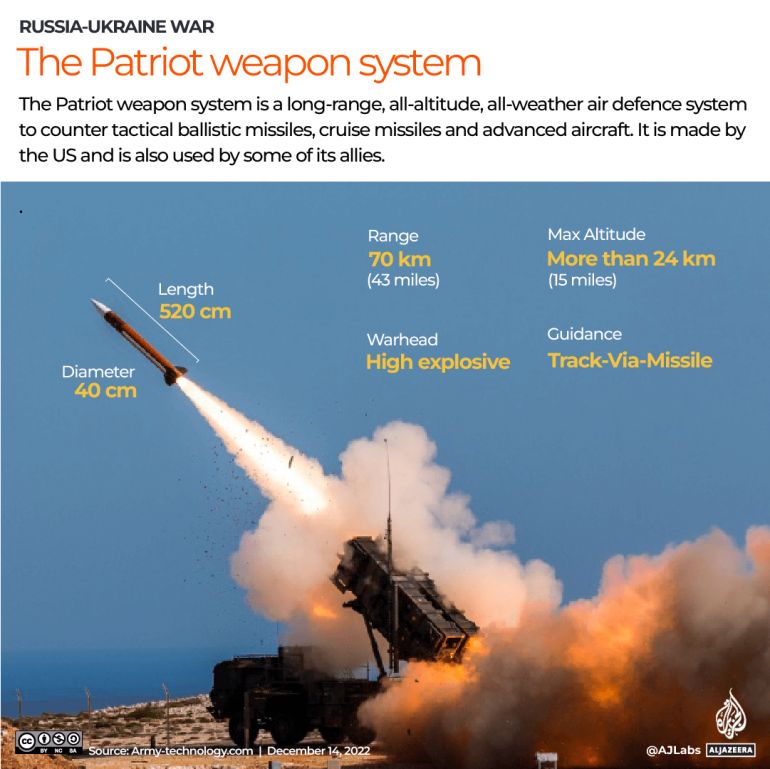
INTERACTIVE_PATRIOT_AIR_DEFENCE_SYSTEM_DEC14
(Al Jazeera)

The Patriots utilise advanced radars to detect targets flying at supersonic speeds and launch their guided missiles with the sound that resembles super-fast electronic beats – up to 32 missiles per minute.

But the noise – along with thunderous shockwaves that follow split-second, sun-bright explosions – made Ukrainians feel safe during harrowing, hours-long Russian assaults that have targeted civilian areas and involve hundreds of drones and dozens of missiles.

Within weeks after their deployment, the Patriots intercepted Russia’s Kinzhal (Dagger) intercontinental ballistic missiles that are launched by supersonic fighter jets and fly in the Earth’s stratosphere.

The interceptions disproved Putin’s earlier claims that the Kinzhals made any Western air defence systems “useless”.

The safety, however, came with a hefty price tag – each Patriot guided missile costs several million dollars, and their manufacturing never exceeded more than 900 units a year.

‘Tomorrow’s problem’

Some 800 guided missiles have been used to repel Iranian aerial attacks within just three days after Tehran began raining its missiles and drones on almost a dozen nations, Ukrainian President Volodymyr Zelenskyy said on Thursday.

“Ukraine has never had this many missiles to repel attacks,” Zelenskyy said, reiterating his readiness to dispatch Ukrainian experts and drone interceptors to help Gulf nations counter the attacks.

The shortage of guided missiles is, however, not immediate and may occur in several weeks.

“This is not today’s problem, this is tomorrow’s problem,” Volodymyr Fesenko, head of the Kyiv-based Center for Applied Political Studies (Penta) think tank, told Al Jazeera.

But the problem may become catastrophic.

In recent days, Moscow stopped attacking Ukraine with drones and missiles – a sign of amassing them for massive raids in the near future, Fesenko said.

“Russia’s most obvious actions would be to bleed Ukraine’s stock of Patriot missiles dry to inflict maximal damage on us through massive missile attacks,” he said.

Kyiv already faces a less critical problem with the shortage of missiles for Western-supplied F-16 fighter jets that proved effective in downing Russian missiles.

“The problem is less critical, but also vital for us,” Fesenko said.

Ukraine has experienced a shortage of Patriot missiles before.

Last summer, when the US and Israel struck Iranian nuclear sites, the Pentagon stopped the Patriot missiles’ supply as it was “auditing” its own stocks.

The suspension of Patriot interceptors and HIMARS multiple rocket launchers left Ukrainian civilian infrastructure, including thermal power stations and transport hubs, more vulnerable to Russian attacks.

Russia’s tactics of indiscriminate aerial strikes have been tried and tested over the past four years.

Moscow starts an air raid with drones and decoy drones to make Ukrainian air defence units use as many Patriot missiles as possible.

It then launches several more waves of attack drones and ballistic and cruise missiles.

As to upcoming attacks, “the question is that this time, it won’t be energy infrastructure, but whatever other targets the Kremlin will want to choose”, Kyiv-based analyst Igar Tyshkevych told Al Jazeera.

He referred to devastating attacks on energy and central heating facilities that left millions of Ukrainians without power and heat this winter, triggering health problems and deaths from hypothermia.

Russia already targets sites unprotected by Patriots: Military expert

Meanwhile, Israel and the European nations that pledged to transfer their stock of Patriot missiles to Ukraine are reluctant to do so now.

“Considering the general instability, I don’t think that many nations will open up their stock and pass it on to us,” Tyshkevich said.

Since the supplies of Patriots began, the US-Russian technological battle has kept raging on, according to the former deputy head of Ukraine’s general staff of armed forces, who for decades specialised in air defence.

“There is a confrontation in engineering,” Lieutenant-General Ihor Romanenko told Al Jazeera.

“Russians change something, Americans together with our experts change something else, because remaining on the old [technological] level means losing the battle before it begins.”

Russian engineers “modified software making the [Iskander-M] missiles able to manoeuvre mid-air, and the modernisation largely complicated the operation of the few Patriot systems that we have to destroy them,” Romanenko said.

The Patriots, however, have not become a Ukraine-wide aegis against the Russian strikes.

Ukraine has fewer than a dozen batteries, while Kyiv said it needed at least 25.

Russians “already know that we have but a few Patriot batteries against their ballistic missiles, so they were hitting the sites that had not been covered by the Patriots, or where they had not been deployed,” Romanenko said.

Luckily, Ukraine has an alternative.

A handful of French-Italian SAMP/T systems with solid-fuel anti-aircraft missiles have been deployed to Ukraine since 2023 and showed the advantages of their radars and “engagement logic” with high-speed targets.

While a Patriot battery requires up to 90 support servicemen and takes half an hour to deploy, SAMP/Ts require about a dozen.

But their ability to down modified Russian missiles will have to be battle-tested, Romanenko said.

Meanwhile, Ukraine’s increasingly daring drone and missile strikes deep inside Russia destroy or damage their arm depots and plants producing drones and missiles.
What is the PrSM missile that the US used for the first time in Iran?

The United States used Precision Strike Missiles (PrSMs) for the first time during its ongoing war with Iran, US Central Command (CENTCOM) said on Wednesday.

The war entered its seventh day on Friday, with attacks continuing across Iran and other countries in the Middle East.

CENTCOM stated in an X post that PrSMs provide an “unrivaled deep strike capability”.

“I just could not be prouder of our men and women in uniform leveraging innovation to create dilemmas for the enemy,” the post quoted Admiral Brad Cooper, head of CENTCOM.

It is unclear where these PrSMs were launched from, or which specific targets they hit in Iran.

So what is the PrSM, and why is it significant that it has been used by the US for the first time?

What are Precision Strike Missiles?

PrSMs are described as long-range precision strike missiles by their developer, the Maryland, US-headquartered defence firm Lockheed Martin, which delivered the first PrSMs to the US Army in December 2023.

PrSMs can hit targets ranging from 60km (37 miles) to more than 499km (310 miles) away, according to Lockheed Martin.

The company’s website adds that PrSMs are compatible with the MLRS M270 and HIMARS family of launchers, both also developed by Lockheed and used by both the United Kingdom and US armies.

MLRS stands for multiple-launch rocket systems, used to launch missiles. The UK sent a number to Ukraine in 2022. HIMARS stands for High Mobility Artillery Rocket System. In 2022, the US sent a number to Ukraine, as well.

M-142 HIMARS is a high-tech, lightweight rocket launcher that is wheel-mounted, giving it more agility and manoeuvrability on the battlefield. Each unit can carry six GPS-guided rockets, or larger missiles like Army Tactical Missile Systems (ATACMs) and PrSMs, which can be reloaded in about a minute with only a small crew.

Lockheed Martin adds that PrSMs can be rapidly developed. “We are ready to produce and deliver to meet the US Army’s accelerated timeline for this long-range precision fires priority,” the website says.

PrSMs feature “open systems architecture”, which means that it is easier to plug in new components, upgrade parts, or work with equipment from other companies. Similarly, they are “modular and easily adaptable”, enabling components to be switched around.

They also feature “IM energetic payload”, or Insensitive Munitions energetic payload, which makes explosions safer, the producer says. This means the warhead is made from explosives that are less likely to blow up accidentally if hit by fire, shrapnel or by accident, but still explode properly when triggered as intended.

What is different about the PrSMs?

PrSMs will ultimately replace the ATACMs currently being fired from the HIMARS launchers, significantly increasing their range from 300km (186 miles) to more than 499km (310 miles), without changing the vehicle carrying the missile.

PrSMs also offer double the “missile load” of ATACMs. While a HIMARS launcher is able to carry one ATACMS missile in its pod, it can carry two PrSMs per pod.

Does the PrSM give the US a strategic advantage?

CENTCOM confirmed that PrSMs have been used in the US and Israel’s attacks on Iran, codenamed Operation Epic Fury and launched on February 28.

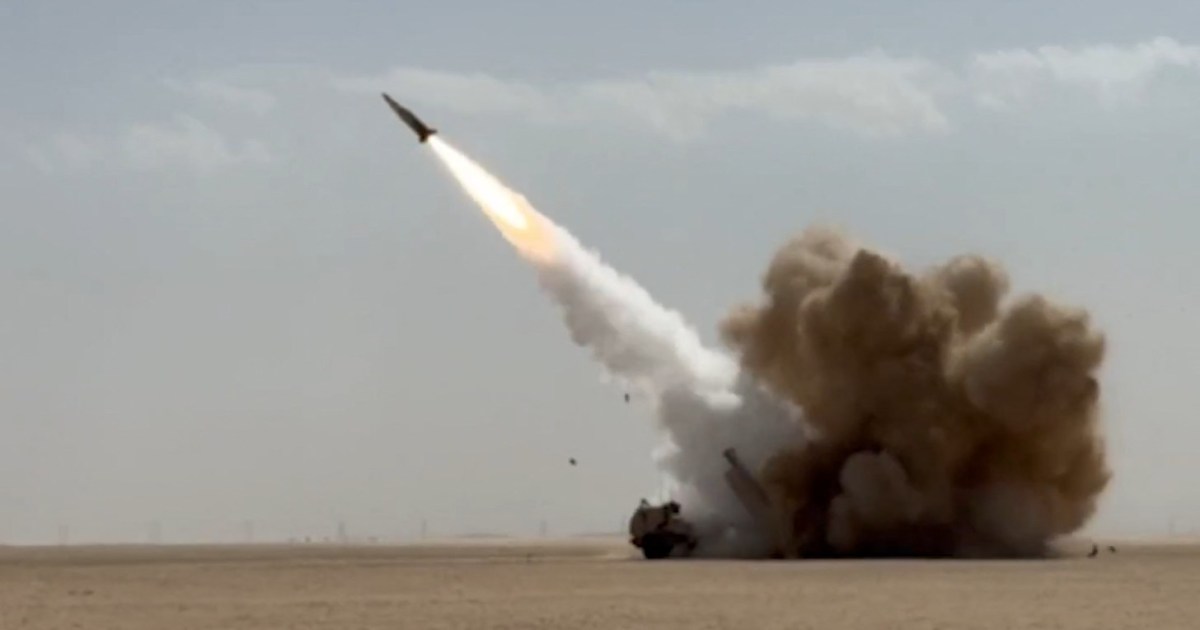
CENTCOM posted a video of the PrSMs being launched from M142 High Mobility Artillery Rocket Systems in an open desert terrain.

PrSMs do give the US military a boost for its pre-existing long-range capabilities.

Gulf countries such as Kuwait, Saudi Arabia, Bahrain, Qatar, the United Arab Emirates and Oman, specifically the Musandam Peninsula, which have military bases hosting US assets and troops, have at least some territory within 400km (250 miles) of Iran.

The US is using PrSMs in conjunction with other long-range missiles such as Low-Cost Unmanned Combat Attack System (LUCAS) one-way drones, MQ-9 Reaper drones, ATACMs and Tomahawk Cruise Missiles.

The range for LUCAS one-way drones is about 800km (500 miles), while the range for ATACMs is about 300km (186 miles) and the range for Tomahawk cruise missiles is about 1,600km (1,000 miles).

Why is the introduction of the PrSM significant?

The range of this missile is significant as it is likely that it would not have been permitted under the Intermediate-Range Nuclear Forces (INF) Treaty with Russia, which the Trump administration withdrew the US from in 2019. This is because it can exceed the maximum 500km (310-mile) range the treaty imposed on certain land-launched missiles.

The treaty was signed in 1987 by US and Soviet Union leaders Ronald Reagan and Mikhail Gorbachev. It sought to eliminate the presence of land-based nuclear missiles and medium-range arsenals between 500km and 5,500km (310 and 3500 miles) from Europe.

The US suspension of the treaty allowed Washington to resume development of its own medium-range, land-based arsenal.

Following the US suspension, Russia invited the US to reciprocate in a unilateral moratorium on the deployment of ground-launched intermediate-range missiles instead. While Washington initially rejected the offer, in 2022, it said it would be willing to discuss this.

In August last year, the Russian Ministry of Foreign Affairs announced Russia’s withdrawal from this moratorium, however, saying the US had “made significant progress” and “openly declared plans to deploy US ground-launched INF-range missiles in various regions”. INF stands for intermediate-range nuclear forces.

Iranians mourn Khamenei as they gather for first Friday prayers during war

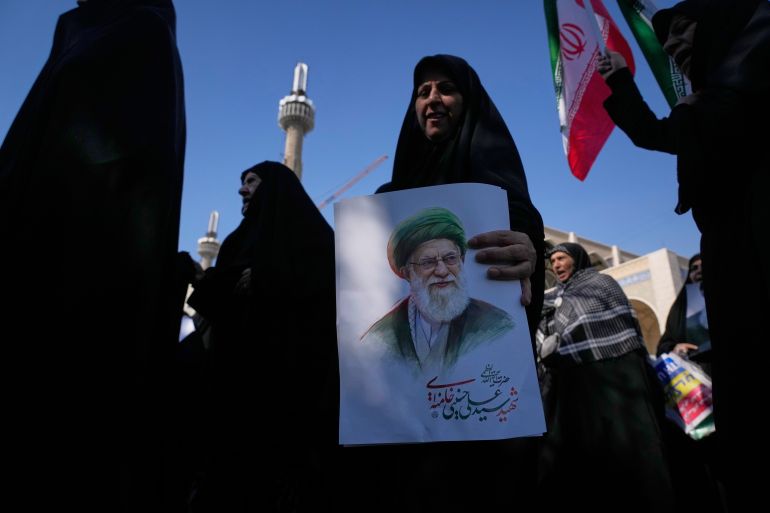
Iranian worshippers, many holding portraits of the assassinated Supreme Leader Ayatollah Ali Khamenei, have gathered in Tehran and other cities for the first Friday prayers since the United States-Israeli war on the country began seven days ago.

People chanted anti-US and anti-Israeli slogans as they gathered for midday prayers on Friday during the Muslim holy month of Ramadan, undeterred by a ferocious bombardment on the capital, an Al Jazeera team on the ground reported.

Recommended Stories

list of 4 itemsend of list

Iranian flags were also waved as people prepared to pray, in a sign of support for the Iranian government amid the ongoing strikes, including an attack in the early hours of the conflict that killed the supreme leader.

Footage shared by Iranian media showed crowds of men and women dressed in black streaming to an open space outside the Grand Mosque of Imam Khomeini in the capital.

In the background of one video, a man speaking through a loudspeaker mourned Khamenei, describing him as “the embodiment of piety and guardianship in our time,” while others, seated on prayer rugs, openly wept.

Photographs showed worshippers marching in a demonstration against the US-Israeli war following prayers.

A woman holds a picture of the late Iranian Supreme Leader Ayatollah Ali Khamenei as government supporters march against the ongoing U.S.-Israeli military campaign after Friday prayers at the Imam Khomeini Grand mosque
A woman holds a picture of the late Iranian Supreme Leader Ayatollah Ali Khamenei as government supporters march against the US-Israeli war after Friday prayers at the Imam Khomeini Grand Mosque [Vahid Salemi/AP]

Similar scenes were observed in footage from other cities across Iran, including Ilam and Borujerd in the west and Zahedan in the southeast, the AFP news agency reported.

The prayers were held as the US and Israeli waves of strikes on Tehran and other Iranian cities, following threats from United States Defense Secretary Pete Hegseth that the bombardment was “about to surge dramatically”.

The latest strikes on the capital hit a military academy and sites near a street housing key political offices, where Khamenei was killed on Saturday, as well as residential buildings, carparks and petrol stations, according to reports.

Prayers amid war

Worshippers in many countries across the Middle East observed the third Friday prayers of Ramadan amid unprecedented threats and disruption amid the ongoing war.

While US and Israeli strikes hit Iran, the Israeli military also continued its attacks in southern Lebanon and the southern suburbs of the capital, Beirut. Huge numbers of Lebanese have been displaced by the Israeli attacks, amid Israeli orders to issue threats of forced displacement in targeted areas.

Meanwhile, countries across the Gulf, including Saudi Arabia, Qatar, Bahrain, Kuwait and the United Arab Emirates, have been targeted by Iranian drones or missiles in retaliatory strikes, mainly because of a US or Israeli presence.

And in occupied East Jerusalem, Israel’s Civil Administration said it had cancelled Friday prayers at the Al-Aqsa Mosque, Islam’s third-holiest site, in the latest restrictions on activity at the complex.

Civil Administration Chief Brigadier General Hisham Ibrahim said on Thursday via the Israeli army’s Al Munasiq platform that the decision was taken in light of Iran launching retaliatory strikes at “Israel and the entire region”.

However, Israel regularly restricts access by Palestinians to Islam’s third-holiest site, including during Friday prayers in the current holy month of Ramadan.

Kildunne and Kabeya to miss games after getting stuck in Dubai

Red Roses stars Ellie Kildunne and Sadia Kabeya will miss this weekend’s Premiership Women’s Rugby fixtures after getting stranded in Dubai.

The England pair travelled together to the United Arab Emirates last week – before the conflict in the Middle East escalated last weekend – and have been unable to return to the UK due to travel disruption.

It means full-back Kildunne, 26, will miss Harlequins’ home fixture to Saracens on Saturday while flanker Kabeya will miss Loughborough Lightning’s trip to Sale Sharks.

It added: “Both Ellie and Sadia are in contact with the RFU, PWR and their clubs and continue to be supported throughout this period. They will return to England as soon as it is possible to do so.”

Airspace over the Middle East remains restricted, with flights completely or partially grounded over Saudi Arabia, Iran, Iraq, Qatar, Bahrain, Kuwait, Syria, the UAE and Israel.

More than 140,000 Britons in the region have registered their presence with the UK’s Foreign Office, after US-Israeli strikes on Iran prompted retaliatory strikes by Iran across the region.

Dubai has seen several direct strikes from Iran since Saturday, with damage reported at Dubai International Airport and several luxury hotels.

Kildunne, the 2024 world player of the year, starred in England’s World Cup-winning campaign in 2025 as the Red Roses lifted the title for a third time.

Related topics

  • Rugby Union

More on this story

The end of Iran’s strategic patience

Since October 7, 2023, the United States and Israel believed that sustained diplomatic and military pressure on Iran would deter and degrade its capacity to fight. In the process, they degraded something else entirely: Iran’s willingness to remain constrained. The missiles and drones now striking across the Gulf show that Iran is no longer holding back.

For years, Iran operated under a doctrine of “strategic patience”. This was a deliberate, calculated form of restraint that guided how Tehran and its network of allies delt with Washington and Tel Aviv.

Rather than confrontation, Iran built and leveraged a web of deterrence: Hezbollah in Lebanon, the Houthis in Yemen, Hamas in Gaza, and the Popular Mobilisation Forces in Iraq were its allies surrounding Israel, and helped to apply brakes on any major Israeli aggression.

The first serious fracture in Iran’s policy came in April 2024, when an Israeli strike destroyed the Iranian consulate in Damascus, killing senior Revolutionary Guard commanders. Tehran’s response was to launch Operation True Promise, a direct barrage of drones and ballistic missiles fired at Israeli territory.

Throughout 2024 and even into 2025, Iran attempted to maintain a form of managed restraint and carefully calibrated deterrence to avoid triggering all-out war. But the environment was shifting in ways that made this strategy untenable. Israel’s systematic targeting of Hamas and Hezbollah leadership disrupted key nodes of Iran’s deterrence architecture. The fall of the al-Assad government in Syria threatened critical supply lines through Iran’s primary land corridor to Hezbollah.

Following the 12-day-war in 2025, Iran formally declared a new doctrine in January 2026 of “active and unprecedented deterrence”.

When the US and Israel launched coordinated strikes on February 28, 2026, during ongoing negotiations, they confirmed to the Iranian leadership that restraint offered no protection and would likely offer none in the future.

In addition to striking Iran, Israel has struck Lebanon, Iraq, Yemen and Syria. The reaction from Iran has so far been a demonstration of its new doctrine: Kuwait, Qatar, UAE, Saudi Arabia, Iraq, Jordan, Israel and Cyprus have all been hit by Iran in a matter of days.

These countries have all played different roles in the region. Qatar, for example, has maintained its own strategy of mediation and has not only hosted a US base but also offices of Hamas; the most sophisticated display of balancing regional tensions. The fact that it has been drawn into the latest escalation is a direct indictment of the failure of governments with power and influence – particularly the US – to meaningfully resolve the crisis in Gaza over the past years.

Perhaps the most significant development in the current escalation is Iran’s heavy targeting of the United Arab Emirates. The UAE has pursued a foreign policy defined by a strategy of fragmentation. This has meant working with Israel and other partners to break down unified political and military opposition across the region into smaller, disconnected elements that can be more easily contained and managed.

That strategy was always premised on the assumption that the UAE’s own stability was insulated from its actions. As rockets rain down on Dubai and Abu Dhabi, the illusion of that separation is no longer possible.

Iran’s allies in the region have not fully mobilised, and despite their severe attrition, they and have retained an organisational depth that would likely allow them to sustain low-level armed resistance, similar to what wore down US forces in Iraq.

As the primary actors lock into a cycle of overt military confrontation, dormant domestic crises are rapidly being ignited across the Middle East. There are reports that the US administration  is encouraging Kurdish forces to form a ground offensive against Iran. In Bahrain, renewed protests against the monarchy have erupted, with Saudi forces being deployed to the island kingdom to crack down on the opposition. Protesters in Baghdad have tried to storm the Green Zone, the seat of parliament.

Palestine remains the clearest expression of the regional order that Israel and the US have sought to impose, with active support from the UAE: Isolated enclaves, subject to permanent low-grade military pressure in the West Bank and full-scale destruction in Gaza. The capacity for meaningful self-governance has been systematically dismantled while territorial expansion by Israel continues. This is the template.

The chapter of calibrated, managed conflict has been forcibly closed by the cumulative weight of Israeli choices. Each US and Israeli strike on Iran and Iranian-aligned leadership, each negotiation conducted before military operations, and each refusal to treat Palestinian political agency as a genuine variable in any regional settlement were choices made by governments that believed that security could be achieved through a combination of fragmentation and force.

When US Secretary of State Rubio addressed the Munich Security Conference, the nostalgia for an era of uncontested Western primacy was unmistakable. But that era is precisely what produced the conditions now exploding across the region. Israel’s settler-colonial expansion continues. The fragmentation model is being extended into Lebanon, Syria, and even the Horn of Africa,  with regime change unleashed on Iran to facilitate this project. And the accumulated resistance to it, whether from state or non-state actors, is no longer constrained by the patience that once made it manageable.

Stability for the region will be shaped by whether a global coalition can be built after a reckoning with a basic contradiction: A rules-based order cannot coexist indefinitely with territorial expansion, collective punishment, and selective accountability.

Prem clubs agree to limit contact in training

To play this video you need to enable JavaScript in your browser.

Chris Jones

Rugby Union Correspondent
  • 46 Comments

Prem clubs have agreed to significantly regulate contact training in a major breakthrough for the Rugby Players’ Association (RPA).

After years of lobbying from the players’ union, clubs will revolutionise how they record and share data around contact training, with detailed scrutiny of any concussion suffered.

There will be a staggered return to contact for international players following their five-week summer break, which will lessen the load on England’s top stars.

Players will also be required to wear Instrumented Mouthguards during contact sessions in the week rather than just during matches.

“The RPA has been working hard to produce the first change of this kind relating to the training environment globally,” the organisation’s general secretary Christian Day told BBC Sport.

“These changes will allow us to better identify when contact is occurring, understand what players are experiencing on the training field and to better protect all players as they return after their off-season break.”

England World Cup winner Steve Thompson, who has been diagnosed with early-onset dementia, which he attributes to the repeated brain trauma suffered during his rugby career, is among those to have called for drastic changes in the amount of contact in training.

‘89% wanted change to contact’

Changes to contact training has been an area of focus for professional players for a number of years. In 2023, 89% of players surveyed by the RPA said they wanted better regulation of contact in training.

While there won’t be a hard-and-fast limit on a week-to-week basis, senior figures in the process are confident that the introduction of oversight of how, when and where concussions and head impact exposures occur in training will shine a light on outliers.

As part of the new proposals, which have been ratified by the Professional Game Board:

‘The next step for elite rugby’

All players are currently given mandatory rest periods during the off-season. For example, England players who tour with the national side in the summer are then given five weeks mandatory rest before starting pre-season with their clubs, and then another five weeks before playing a match.

However when surveyed by the RPA, 36% of players said they were doing contact training in their first week of pre-season. This would mean an international player could conceivably be involved in contact training for as many as 47 weeks a year.

Under the new guidelines, which will be in place for the 2026/27 season, players will now experience a graduated return to contact, with no contact at all in week one and no full contact until the fourth week of their return. Clubs who fail to adhere to the new regulations could face a fine or a disciplinary case.

England’s most-capped men’s player Ben Youngs presented a BBC documentary exploring the issue of safety in rugby, and he believes regulation of training is a big move forward.

“Monitoring and limiting the amount of collisions and contact done within a training week is really, really important. That is the next step for elite rugby,” Youngs told the Rugby Union Weekly podcast.

Those involved in the agreement believe these changes to contact training will place the Prem at the forefront of player welfare as a league.

“Prem Rugby’s vision of becoming the best league in the world can only be achieved by ensuring our players are given world-leading support off the pitch,” said Phil Winstanley, rugby director at Prem Rugby.

“Working together with the RPA, RFU and our clubs, we will continue to raise standards off the pitch so our players can perform to the highest level on the field of play.”

Related topics

  • Rugby Union

More on this story