New Zealand’s Jimmy Neesham takes the wickets of Sanju Samson, Ishan Kishan and Suryakumar Yadav in the same over, as India slide to 204-4 in the ICC Men’s T20 World Cup final.
FOLLOW LIVE: ICC Men’s T20 World Cup final – India v New Zealand

New Zealand’s Jimmy Neesham takes the wickets of Sanju Samson, Ishan Kishan and Suryakumar Yadav in the same over, as India slide to 204-4 in the ICC Men’s T20 World Cup final.
FOLLOW LIVE: ICC Men’s T20 World Cup final – India v New Zealand

Sanju Samson makes 89 runs off 46 balls, including eight sixes, to put India in the commanding position of 203-2 with five overs to go in their ICC Men’s T20 World Cup final against New Zealand.
FOLLOW LIVE: ICC Men’s T20 World Cup final – India v New Zealand

The governor of Edo State, Monday Okpebholo, has paid the medical bills of a pregnant woman and her husband, who is receiving treatment for severe burns sustained in a fire incident.
In a statement signed by the chief press secretary to the governor, Patrick Ebojele, on Sunday, the governor intervened during a visit to the Irrua Specialist Teaching Hospital, where he also settled the medical expenses of several other patients admitted across various wards.
Speaking to journalists after the visit, Governor Okpebholo explained that the woman initially came seeking financial assistance for her husband.
“The woman came to seek help for her husband because they were looking for money to pay his bills. When my doctors saw her and observed she was due, they rushed her to the hospital immediately, where she later delivered safely through a caesarean section,” he said.
READ ALSO: IWD: Akpabio Celebrates Nigerian Women, Hails Their Resilience, Sacrifices
He added, “We have agreed with the hospital management to pay the bills of other patients we meet in the wards as well. They have no reason to worry about payments. By this, their treatment can continue, and, by the grace of God, we believe the man and others in the ICU will recover speedily.”
Beyond assisting the couple, the governor directed that the state government cover the medical expenses of several other patients receiving treatment in different wards.
Governor Okpebholo described the gesture as part of his administration’s commitment to supporting Edo residents, particularly those facing medical emergencies and financial difficulties.

Nigeria has a new Force Public Relations Officer: Anthony Okon Placid. He replaces Benjamin Hundeyin.
“The Inspector-General of Police, IGP Olatunji Rilwan Disu, psc(+), NPM, has approved the appointment of DCP Anthony Okon Placid, psc(+), mni as the new Force Public Relations Officer (FPRO),” outgoing Force spokesman Hundeyin said in a statement on Sunday.
Hundeyin was appointed as the Force Public Relations Officer (FPRO) in September 2015 by the immediate past IGP Kayode Egbetokun. Before then, Hundeyin served as the spokesperson of the Lagos State Police Command.
The new appointment comes weeks after Disu assumed office as Nigeria’s police chief and the subsequent reshuffle in the police hierarchy that came with it.
READ ALSO: IGP Disu Inaugurates Committee On State Police, Task Members On Professionalism
Placid, the police said, is a “seasoned officer” with vast experience in administration, intelligence, operations, training, and international peacekeeping.
The new Force spokesman, born on 2 December 1970 in Uyo, hails from Mbiokporo Nsit, Nsit Ibom Local Government Area, Akwa Ibom State.
Placid is a graduate of Geography and Regional Planning from the University of Uyo and has a Master of Arts in Law and Diplomacy (M.A.L.D.) from the University of Jos.
READ ALSO: Tinubu Swears Disu In As IGP
The Akwa Ibom-born officer also studied law at the National Open University of Nigeria (NOUN).
Nigeria’s new police spokesman began his career as a cadet assistant superintendent of police at the Police Academy, Kano, in 1996. He was commissioned in August 1998.
He has attended several professional and international courses, including the United Nations Peace Operations Specialised Training (POST), earning certifications as an expert in police studies, military studies, gender awareness, international humanitarian law, human rights, and civilian protection; the UNITAR Senior Leadership and Peacebuilding course in Kenya
DCP Placid has served in various strategic capacities within and outside the country.

Players on the Iranian women’s football team have sung and saluted during their national anthem before their final Women’s Asian Cup match at Gold Coast Stadium in Australia, six days after their decision to remain silent during the anthem saw them labelled “wartime traitors” on state TV back home.
The Iranians, whose situation has become a cause celebre among human rights campaigners in Australia, will play no further part in the tournament after a 2-0 loss on Sunday to the Philippines in Queensland.
list of 3 itemsend of list
Their campaign in the continental showpiece started last weekend, just as the United States and Israel launched air strikes on Iran on February 28, killing at least 1,332 people since then, including Supreme Leader Ali Khamenei.
Iran’s team and management, who have voiced fears and concerns for their families in Iran, wore a stoic look and chose not to sing their national anthem in the opening game against South Korea on Monday.
Their decision drew criticism in Iran with Islamic Republic of Iran Broadcasting presenter Mohammad Reza Shahbazi saying in a video that the players showed a lack of patriotism and their actions amounted to the “pinnacle of dishonour”.
The Iranian team sang along to Mehr-e Khavaran (Eastern Sun) before their second defeat against the host nation on Thursday, sparking fears among Australian human rights campaigners that they had been coerced by government minders.
No public reason was given for the players’ original stance over the pregame national anthem.

A petition launched on Friday on the Change.org website urging Australia to give refuge to the team had gathered more than 51,000 signatures by late on Sunday. The petition called on Home Affairs Minister Tony Burke to ensure the team did not depart Australia “while credible fears for their safety remain” but Burke’s office has not commented on the petition.
The petition asked local authorities to ensure any player seeking protection “can do so safely, privately, and without interference” and to “make clear that Australia will uphold its … humanitarian protection obligations in relation to any player at risk of persecution or serious harm”.
“Where credible evidence exists that visiting athletes may face persecution, imprisonment, coercion, or worse upon return, silence is not a neutral position,” it said. “The current wartime environment has intensified repression, fear, and the risks faced by anyone publicly perceived by the Islamic Republic as disloyal.”
Iranian Australian activist Tina Kordrostami, a member of local government in Sydney’s Ryde Council, told The Australian newspaper the Iranian players “need an opportunity, a safe space, a chance to actually speak up about what their needs are and what their requirements are”.
“We can’t give them that space without the government helping us,” she said.
Speaking to national broadcaster ABC before Sunday’s game, Foreign Minister Penny Wong was asked about the prospect of the team going home.
“I want to say about the Iranian women’s team that it has been really moving for Australians to see them in Australia,” she said.
Wong added that the sight of the Australian players swapping shirts with their Iranian opponents was “a very evocative moment”.
“It spoke to solidarity and the way in which sport can bring us together,” she said.
“We know this regime has brutally oppressed many Iranian women. Obviously, this is a regime that we know has brutally cracked down on its people.”
The US and Israel continued their large-scale strikes on Iran for a ninth day as the conflict has widened to include the Gulf region as well as Lebanon and Iraq.
The players union FIFPRO had previously called on the Asian Football Confederation and global football’s governing body, FIFA, to uphold their human rights obligations and undertake all necessary steps to ensure the safety of Iran’s squad in the wake of the broadcast.
Iran’s team ended their campaign winless, also losing 3-0 to South Korea and 4-0 to Australia to finish bottom of Group A with nine goals conceded and none scored.
Australia’s Alanna Kennedy scored her second goal deep into stoppage time to achieve a 3-3 draw against South Korea, but it was not enough to prevent their opponents from topping Group A.
The South Koreans, who sealed the top spot by virtue of their superior goal tally over the three group fixtures, will return to Stadium Australia in Sydney on Saturday for a quarterfinal against a third-placed team from one of the other opening-round groups.
The Matildas, meanwhile, will have to travel across Australia to play either North Korea or reigning champions China in the last eight at Perth Rectangular Stadium on Friday.

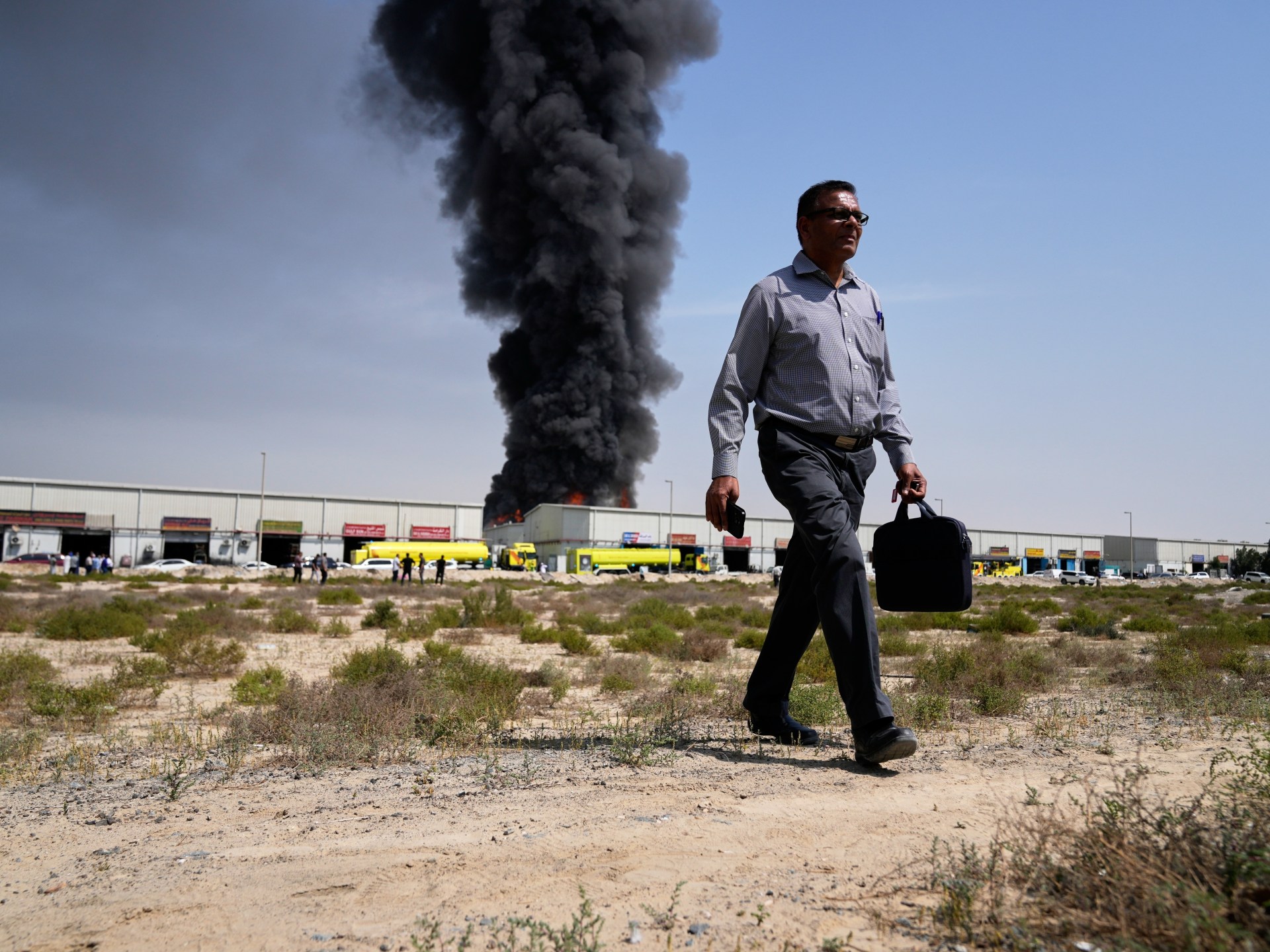
Bahrain has said an Iranian drone attack caused material damage to a water desalination plant in the country, marking the first time a Gulf nation has reported targeting any such facility during the eight days of the war between Iran and the US and Israel.
The attack on Sunday comes a day after Iranian Foreign Minister Abbas Araghchi said a freshwater desalination plant on Qeshm Island in southern Iran was attacked by the United States.
list of 3 itemsend of list
“Water supply in 30 villages has been impacted. Attacking Iran’s infrastructure is a dangerous move with grave consequences. The US set this precedent, not Iran,” he said on X on Saturday.
While Tehran has not yet commented on the Bahrain attack, it has raised questions about the vulnerability of the Gulf countries, which depend on desalination plants for the majority of their water supply.
How important are water desalination plants to the Gulf region? Can water security in the Gulf be guaranteed amid a widening of military targets to include energy and other civilian sites?
A desalination plant primarily converts seawater into water suitable for drinking purposes as well as for irrigation and industrial use.
The process of desalination involves removing salt, algae and other pollutants from seawater using a thermal process or membrane-based technologies.
According to the US Department of Energy, desalination systems “heat water so that it evaporates into steam, leaving behind impurities, and then condenses back into a liquid for human use”.
Meanwhile, membrane-based desalination involves “a class of technologies in which saline water passes through a semipermeable material that allows water through but holds back dissolved solids like salts”.
Reverse osmosis is the most popular membrane technology. Most countries in the Gulf Cooperation Council (GCC) use reverse osmosis since it is an energy-efficient technique.
Water is scarce in the Gulf region due to the arid climate and irregular rainfall. Countries in the Gulf also have very limited natural freshwater resources. Groundwater, together with desalinated water, accounts for about 90 percent of the region’s main water resources, according to a 2020 report by the Gulf Research Center.
But in recent years, as groundwater has also begun to deteriorate as a result of climate change, Gulf countries have begun relying heavily on energy-intensive seawater desalination to meet their water needs.
More than 400 desalination plants are located on the Arabian Gulf shores stretching from the United Arab Emirates (UAE) to Kuwait, providing water to one of the most water-scarce regions in the world.
According to a 2023 research paper published by the Arab Center Washington DC, GCC member states account for about 60 percent of global water desalination capacity, producing almost 40 percent of the total desalinated water in the world.
About 42 percent of the UAE’s drinking water comes from desalination plants, while that figure is 90 percent in Kuwait, 86 percent in Oman, and 70 percent in Saudi Arabia. Saudi Arabia also produces more desalinated water than any other country.
Desalination has also played a crucial role in enabling economic development in the region, according to Naser Alsayed, an environmental researcher specialising in the Gulf states.
He noted that after the discovery of oil in the late 1930s, Gulf states had very limited natural freshwater resources and could not meet the demands created by population growth and expanding economic activity.
“Desalination plants were therefore introduced,” he told Al Jazeera, adding that the importance of desalinated water in supporting the Gulf’s development is often overlooked.
“As a result, targeting or disrupting desalination facilities would place much of the region’s economic stability and growth at significant risk,” he said.
“Secondly, desalination is the main source of freshwater for most GCC states, especially smaller and highly water-scarce countries such as Bahrain, Kuwait and Qatar. Because this water is primarily used for human consumption, desalination carries a strong humanitarian dimension and is essential for sustaining daily life in the region, making any disruption to these facilities particularly significant for the population,” he added.
Iran also uses desalination plants, which have been installed in coastal areas such as Qeshm Island in the Gulf. But Iran also has many rivers and dams and is not as heavily reliant on desalination plants as other countries in the Gulf region.
The Gulf’s heavy reliance on desalination plants has made it vulnerable during times of conflict.
During the 1990-1991 Gulf War, Iraqi forces intentionally destroyed most of Kuwait’s desalination capacity, and the damage to its water supply was severe.
Raha Hakimdavar, a hydrologist, told Al Jazeera that in the long-term, attacking these plants can also impact domestic food production, which mostly uses groundwater.
“However, the pressures from competing needs can divert this water away from domestic production. This can be especially challenging because the region is also highly food import dependent and is facing potential food security challenges due to the compromising of the Strait of Hormuz,” said Hakimdavar, who is a Senior Advisor to the Deans at Georgetown University in Qatar and the Earth Commons.
A 2010 CIA report (PDF) also warned that while “national dependence on desalinated water varies substantially among Persian Gulf countries, disruption of desalination facilities in most of the Arab countries could have more consequences than the loss of any industry or commodity.”
According to Alsayed, the impact of a plant being attacked in the region, however, depends on the local scenario.
“For Saudi Arabia, which is the least dependent on desalination and has significant geographic space, facilities on the Red Sea provide resilience. The UAE has 45 days of water storage aligned with its 2036 water security strategy, so contingency plans are in place to manage potential disruptions,” he said.
“The effects are likely to be felt more acutely in smaller states that are highly dependent on desalination like Qatar, Bahrain, and Kuwait, which have minimal strategic reservoirs,” he noted.
“The most significant impact, in my view, is psychological,” Alsayed said. “Water is essential to human life, and the perception of risk can cause fear and panic, which is particularly challenging in the current environment in the region and where authorities are working to maintain calm.”
As attacks on Gulf countries continue, with energy and civilian infrastructure being targeted, Alsayed highlighted that it is important for GCC countries to view water security as a regional issue rather than an independent concern for each member state.
“The countries need to coordinate more closely and work together. The GCC has a strong platform to prepare for water challenges, but has not fully utilised it,” he said.
Alsayed noted that the GCC Unified Water Strategy 2035 called for all member states to have a national integrated energy and water plan by 2020, but this has not yet been achieved.
“Whether through unified desalination grids, shared regional strategic water reserves, or diversifying water resource goals, this is the way to usher a new era to strengthen Gulf water security,” he said.
Hakimdavar, the hydrologist, said there is no replacement for desalination in the GCC in the near-term.
But she added that the GCC countries can rely on strategic water storage reservoirs – many countries maintain large water reserves that can supply cities for several days or longer.