India triumphant again – do the rest have any hope of catching them?

To play this video you need to enable JavaScript in your browser.

Matthew Henry

BBC Sport journalist in Ahmedabad
  • 65 Comments

This time it was India. It had to be India.

Two years ago, at the last, they faltered on the biggest stage.

The weight of expectation, a final in front of 100,000 and a billion more at home, made them flinch.

They had broken their trophy drought since – first in Barbados in 2024 and then Dubai last year – but back in another home final, would that pressure stop them again?

The extra trains put on left Mumbai at 4am as thousands of fans rolled into Ahmedabad. Fans boarded with that same expectation.

There seemed a fear to talk about that night against Australia, when they lost the 50-over World Cup final. In press conferences, few questions asked. They were swatted away when they came.

“That’s over, sir,” captain Suryakumar Yadav said on Saturday. “It’s been three years, sir. Now T20 is here.”

    • 3 hours ago
    • 2 hours ago

To play this video you need to enable JavaScript in your browser.

In truth, India’s victory here is no surprise.

They wobbled in their opening match against the United States and were beaten by South Africa.

Since then have looked like the team that came in as overwhelming favourites to win in their home conditions, perhaps also one of the best T20 sides the international game has seen.

Since that defeat by the Proteas, Suryakumar’s men have effectively had four knockout matches.

Under the pump they hit more than 250 three times – against Zimbabwe, England and New Zealand – a feat that had only been achieved by anyone twice in previous T20 World Cups before.

In many ways this is a different India team.

They have Jasprit Bumrah, a modern-day phenomenon of a fast bowler.

Yet former captain Virat Kohli’s name is still the one worn on a thousand backs in the stands.

It is a team without the superstars of the past. One that instead is pushed by captain Suryakumar and coach Gautam Gambhir to focus on the collective.

Suryakumar is also a different breed of leader than those who have come before.

He is the international latecomer, who did not make his debut until his 30s and is not even captain of his Indian Premier League (IPL) side.

Kapil Dev, MC Dhoni and Rohit Sharma were the only men to have led India to World Cup glory – three icons of Indian sport who led by aura.

Suryakumar now stands alongside with a victory of his own.

Throughout the tournament contributions have come from all corners.

Ishan Kishan kept the campaign on track with two fifties in the beginning, before Sanju Samson, dropped on the eve of the tournament before regaining his place through a team-mates’ bereavement, provided the finale with three of his own.

Shivam Dube added gloss with late-order hitting and Axar Patel starred in the field. Even Abhishek Sharma, with a fifty in the final amid a difficult tournament, found form when it mattered most.

“They are a very good team,” said New Zealand captain Mitchell Santner. “They know how to play in these conditions. They play on a lot of flat wickets against quality sides.

To play this video you need to enable JavaScript in your browser.

The task for the rest of the world is to make up the sizeable gap India have built at the top of the T20 game.

One the face of it, the three-time champions, the first men’s side to defend the T20 crown and the first to win it on home soil, look to have everything going their way.

A young team, talent groomed in the IPL and the benefits of the funds that tournament provides, all while taking home a greater share of the international game’s revenue than anyone else.

The win in the T20 World Cup in 2024 ended a 13-year wait for a title and has provided unerring confidence.

India have only lost two of 34 matches at the past four global white-ball events. Catching them will be no easy task.

But, as good as they have been here over the past two weeks, the rest have to look to the tighter moments in this tournament.

West Indies dropped two catches in their defeat by India. Harry Brook put down Sansom in the semi-final. Things could have been different, or at least that has to be the hope.

The run of world events across the past three years has fallen kindly for India.

It began with the 2023 tournament on home soil, which they should have won, before more slow pitches in the Caribbean in 2024.

After that came the Champions Trophy where all of their matches were held in Dubai, and then this event hosted at home and Sri Lanka.

Cricket’s calendar now turns away from the subcontinent, with the next 50-over World Cup to be played in across Zimbabwe, Namibia and South Africa in 2027. Pitches there will offer pace and bounce.

After that, Australia and New Zealand host the 2028 T20 World Cup, where fast bowlers will again be key.

More depth behind Bumrah will have to be found, while recent struggles in Test cricket – India have lost at home to South Africa and New Zealand in the past two years – will require some focus.

In between those next two World Cups will be the Los Angeles Olympics in 2028, played in the T20 format. It is an event already on players’ minds.

“Definitely the next goal is Olympic gold and the next T20 World Cup,” said Suryakumar.

“Since 2024, the way we have played, we have won three ICC trophies in a row and we have not looked back.

“We want to continue doing that in 2027, 2028, 2029 and never stop.”

The rest of the world have been warned.

Related topics

  • India
  • Cricket
    • 3 hours ago

More on this story

    • 16 August 2025
    BBC Sport microphone and phone

Colombia elects Congress, chooses presidential candidates amid US tensions

Colombians have headed to the polls to elect a new Congress and choose new presidential candidates on Sunday as the country remains on high alert for political violence, with rural regions dominated by armed groups and with the nation facing ongoing pressure from the administration of United States President Donald Trump.

About 41.2 million eligible voters in Colombia will choose from more than 3,000 candidates vying for 102 Senate seats and 182 House seats.

Recommended Stories

list of 3 itemsend of list

Alongside the congressional vote, Colombians will be deciding on presidential candidates for the country’s three key political blocs: the left, centre-left, and the right.

The winners of the vote will go on to stand during the presidential election, whose first round is set for May 31. However, leading candidates, including leftist Ivan Cepeda, right-winger Abelarda de la Espriella and centrist Sergio Fajardo, will not be participating during the primary elections.

For Federico Rodriguez, a 32-year-old business administrator, after voting in the capital, Bogota said that it was “very important” to vote.

“The most important thing is for Colombia to decide its future and for the results to be respected,” Rodriguez told the Reuters news agency.

An Indigenous Misak woman waits for her ballot to vote at a polling station during legislative elections in Silvia, Cauca department, Colombia, on March 8, 2026.
An Indigenous Misak woman waits for her ballot to vote at a polling station during legislative elections in Silvia, Cauca department, Colombia [AFP]

Before the polls opened at 8am local time (13:00 GMT) and were expected to close at 4pm (21:00 GMT), Defence Minister Pedro Sanchez claimed that a group of at least 2,400 people “allegedly heading to vote” were detected trying to enter the country via an illegal border crossing with Venezuela, despite the announced border closures during the election process.

“They are doing so illegally,” said Sanchez, adding that “This is a clear case of a crime being committed.”

President Gustavo Petro also described the incident as “large-scale fraud” and an “avalanche of illegal voting”, as he called on the mayor of Cucuta to take action.

“Sixty buses have been detained, and the company responsible for bringing massive numbers of voters from across the border must be investigated immediately,” Petro wrote on X.

Moreover, more than 126,00 law enforcement officers are expected to be deployed across the country during election day.

But Petro, whose term as the country’s first left-leaning leader ends in August, has questioned the election software being used and pointed to the 2022 legislative elections when his party, Historic Pact, gained over 390,000 votes following a recount.

Still, Sunday’s vote is expected to lay the groundwork for the next president, as under Petro’s government, Congress’s decision did not align with the president’s policies, a marked change when the legislature tended to be more aligned.

Petro’s tribulations with Trump

After a vitriolic war of words between the two leaders, Trump invited Petro to the White House last month.

Both leaders hailed the meeting as productive, while acknowledging the lingering tensions that divide them.

Trump had previously called the Colombian leader a “sick man” and an “illegal drug leader”, as he blamed the country for funnelling drugs into the US.

The leaders began their feud by trading threats on social media over the fate of US deportation flights, a key part of Trump’s immigration crackdown.

Petro objected to the reported human rights violations facing the deportees. Trump, meanwhile, took Petro’s initial refusal to accept the flights as a threat to US “national security”. Petro ultimately backed down after Trump threatened steep sanctions on imported Colombian goods.

They continued to trade barbs thereafter. Petro condemned the deadly US attacks on boats in the Caribbean Sea and Pacific Ocean, comparing the strikes with murder.

He has also criticised Trump for carrying out a US military offensive in Venezuela to abduct then-President Nicolas Maduro. That attack, Petro said, was tantamount to “kidnapping”.

Thousands flee Akobo after South Sudan army issues forced evacuation order

Thousands of civilians have fled an opposition stronghold in eastern South Sudan after the army ordered evacuations to clear the way for a military offensive, the latest sign that the country’s fragile peace is unravelling, as fears of a return to all-out civil war haunt the world’s youngest nation.

The town of Akobo, near the Ethiopian border, was almost completely emptied by Sunday after the South Sudan People’s Defense Forces issued an ultimatum on Friday demanding that civilians, aid workers and United Nations peacekeepers leave ahead of a planned assault.

Recommended Stories

list of 2 itemsend of list

“The town is now almost empty,” said Nhial Lew, a local humanitarian official. “Women, children and the elderly have left and crossed into Ethiopia.” By Sunday evening, he could hear the conflict closing in. “We are hearing the sound of machine guns approaching,” he told the Associated Press news agency.

The army’s deadline was set to expire Monday afternoon.

The order extends a government counteroffensive, launched in January and dubbed Operation Enduring Peace, that has already displaced more than 280,000 people across Jonglei state since December, when opposition forces began seizing government positions.

The UN’s Commission on Human Rights in South Sudan warned of a possible “return to full-scale war” if the country’s leadership didn’t take the challenges it faces more seriously.

“Preventing further mass atrocity crimes, institutional collapse, and the destruction of South Sudan’s fragile transition requires urgent coordinated national, regional and international re-engagement,” the report said.

Akobo, which had been considered a relatively safe haven and sheltered more than 82,000 displaced people, is one of the last remaining strongholds of the Sudan People’s Liberation Movement-in-Opposition, or SPLM-IO, the armed movement loyal to South Sudan’s detained former vice president, Riek Machar.

Two UN flights evacuated most humanitarian staff on Sunday, though the International Committee of the Red Cross had not yet pulled its personnel from a surgical unit it runs at the local hospital, where wounded patients were still being treated.

“We are worried for our patients,” said Dual Diew, the county health director. “We tried to make a plan to take them to a safer location, but we don’t have enough fuel.”

The offensive comes amid a wider breakdown of the 2018 peace agreement that ended a civil war between forces loyal to President Salva Kiir and those backing Machar, a conflict that killed an estimated 400,000 people and forced millions from their homes.

Machar has been under house arrest in the capital, Juba, since March 2025, facing charges of treason and murder that his supporters say are politically motivated.

His detention coincided with a sharp rise in armed opposition activity, and a UN inquiry has since found that South Sudan’s leaders have been “systematically dismantling” the accord.

Conflicts have taken place across the country among groups associated with the two factions, said Jan Pospisil, a South Sudan researcher who spoke to Al Jazeera.

Dozens killed in the north

On Sunday, at least 169 people were killed, among them 90 civilians, including women and children, when armed men stormed a village in Abiemnom county in the country’s north.

The local administrator blamed the attack on elements of the White Army, a militia historically allied to Machar, alongside SPLM-IO-affiliated forces. The group denied any involvement. More than 1,000 people sought shelter at a UN base in the area.

“Such violence places civilians at grave risk and must stop immediately,” said Anita Kiki Gbeho of the UN mission in South Sudan.

Aid organisations operating in the conflict zone have also been targeted, with Doctors Without Borders, known by its French initials, MSF, saying on Monday that 26 of its staff remain unaccounted for, a month after a government air strike destroyed its hospital in the town of Lankien and a separate facility in Pieri was looted.

Staff who had been reached described “destruction, violence and extreme hardships”. It was the 10th attack on an MSF facility in 12 months.

“Medical workers must never be targets,” said Yashovardhan, the charity’s head of mission in South Sudan, who uses only one name.

Pospisil said the crisis had exposed the fragility of Kiir’s hold on power.

“The state is literally falling apart,” Pospisil said, referring to the convergence of conflict in the country and the elderly state of the president, whose condition has raised questions.

How do you track a war in real time?

US and Israel attack Iran: Information is power, and now everyone has it.

War is no longer just reported, it’s tracked in real time by journalists, analysts and anyone with internet access. Missile paths, military flights, troop movements, and border activity are monitored as events unfold, using open-source tools and public data. When this level of information is available to everyone, control of the narrative begins to shift. In an age of radical transparency, who holds the power, and who is held accountable?

Presenter: Stefanie Dekker

Guests:
Bilawal Sidhu – Tech creator and former senior product manager at Google

Yasir Atalan – Deputy director of CSIS Futures Lab

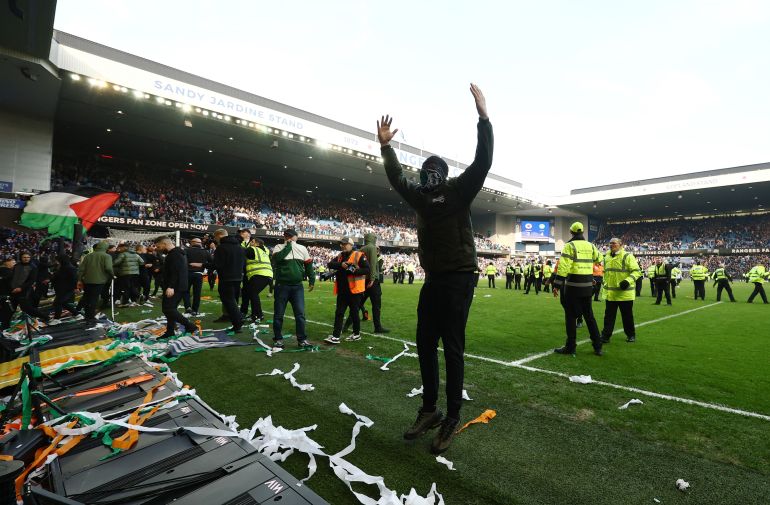
Rangers vs Celtic turns ugly as fans clash on pitch after Scottish Cup tie

The Scottish Football Association has launched an investigation after Celtic defender Julian Araujo and a member of his team’s backroom staff were attacked by Rangers fans in ugly clashes following the Scottish Cup quarterfinal in Glasgow.

Backed by 7,500 fans, Celtic beat their Old Firm rivals 4-2 on penalties on Sunday, following a 0-0 draw after extra time at Ibrox.

Fighting broke out when dozens of visiting Celtic supporters invaded the pitch to celebrate their victory, sparking an incursion from hundreds of Rangers fans, who attempted to attack their rivals.

The Glasgow derby – termed the Old Firm – is one of the oldest and most intense in world football, dating back to 1888. It has been fuelled by political and religious divisions.

Fans threw missiles and fireworks and continued to exchange blows after police and stewards finally formed a barrier across the pitch.

Police apprehended a man after Celtic players, including Tomas Cvancara, ran to the scene amid an incident involving a Celtic member of staff.

Cvancara was later interviewed on television with bloodstains on his kit, while Celtic right-back Araujo was pushed by a Rangers supporter.

“An investigation will be carried out immediately in line with the Judicial Panel Protocol,” the SFA said as they condemned the “behaviour from supporters entering the field of play”.

Celtic boss Martin O’Neill added: “As we were making our way back, I think there was some sort of fracas; somebody tried to get on the field.

“There is a natural euphoria about winning a game and about fans joining in. If this has gone too far, that would be disappointing.”

The ugly scenes came in the first Old Firm derby for almost a decade to feature a large allocation of tickets for away fans.

Soccer Football - Scottish League Cup - Quarter Final - Rangers v Celtic - Ibrox, Glasgow, Scotland, Britain - March 8, 2026 Rangers fans on the pitch after the match Action Images via REUTERS/Lee Smith
Rangers fans on the pitch after the match [Lee Smith/Action Images via Reuters]

‘Explosive games’

Following numerous hooligan clashes in previous meetings between the Glasgow rivals, away supporters were banned from the matches in 2023, before being allowed to return on a reduced basis last year.

The Scottish Cup tie was seen as a test for greater numbers of away fans.

O’Neill’s side moved into the semifinals despite failing to register a single shot on target in 120 minutes.

In the shootout, Rangers captain James Tavernier hit the bar with the first penalty before Djeidi Gassama blazed over.

Cvancara converted to seal Celtic’s victory before chaos erupted.

“There were a few tete-a-tetes. It’s unfortunate. Hopefully, it doesn’t dilute the performance,” O’Neill said.

“Old Firm games are explosive games; they always have been. That’s maybe one of the reasons why the derby is one of the best in the world.”

Rangers boss Danny Rohl added: “I was not on the pitch in this moment. I didn’t see it until now. I heard just that there was something on the pitch.

“I think we all know the emotional situation after a game. Nobody likes to see this.”

Despite amassing 24 shots and having a goal wiped out by VAR following a handball by Emmanuel Fernandez in extra time, Rangers once again stumbled against their hated neighbours.

The defeat was a bitter blow after Rangers blew a two-goal half-time lead in their 2-2 draw with Celtic in the Scottish Premiership at Ibrox last weekend.

Soccer Football - Scottish League Cup - Quarter Final - Rangers v Celtic - Ibrox, Glasgow, Scotland, Britain - March 8, 2026 Celtic fans celebrate after the match Action Images via REUTERS/Lee Smith
Celtic fans celebrate their team’s win [Lee Smith/Action Images via Reuters]

‘Sloppy’ England display against Italy shows ‘lack of confidence’

Rugby Special’s John Barclay and Sam Warburton believes there is a “lack of clarity” within the England squad after a “disjointed” performance against Italy, which saw Steve Borthwick’s side lose 23-18 in the Six Nations at the Stadio Olimpico in Rome.

WATCH HIGHLIGHTS: Six Nations 2026 – Italy 23 – 18 England