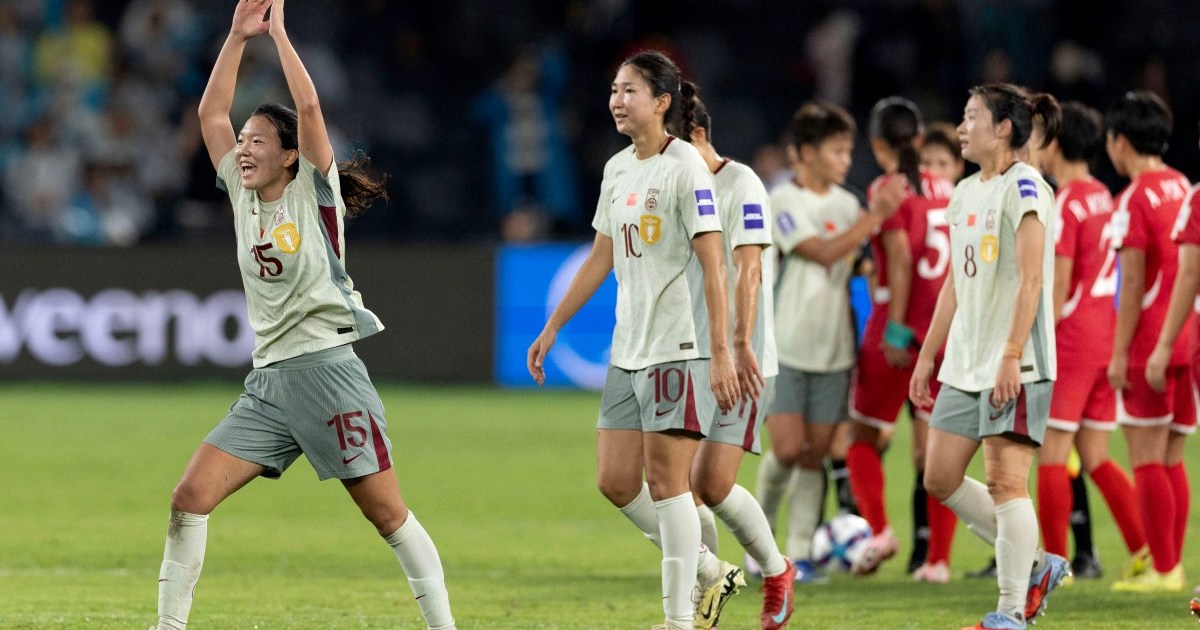
North Korea has pledged there will be no more sideline protests during their 2026 Women’s Asian Cup quarterfinal with Australia on Friday, after causing a stir against China.
An incensed North Korea refused to play for several minutes in their 2-1 loss to the Chinese during a group game on Monday.
Recommended Stories
list of 4 itemsend of list
They were left fuming when former Tottenham attacker Wang Shuang scored in first-half stoppage time, demanding the referee look at the pitchside monitor.
The three-time champions refused to resume the game for four minutes as boos rang out.
“If that kind of situation happens again in (Friday’s) match, we will follow the referees, the match official’s decision, and respect it,” coach Ri Song Ho told reporters in Perth through an interpreter on Thursday.
Ri was yellow-carded for his part in the fracas.
North Korea are set to face a partisan full house at Perth Rectangular Stadium against the hosts, who beat them on penalties in the 2010 final after it ended 1-1.
Australia’s Sam Kerr is the only player left from the match, with North Korea now boasting a young and physical side.
They are looking to build on defending their Women’s U17 World Cup title in Morocco last year, which came on the heels of winning the U20 World Cup in Colombia in 2024.
Talented striker Choe Il Son played in both those triumphs before transitioning to the full national side.
“We know Australia are a formidable team, so tomorrow we will give our best to support each other and perform at our highest level,” she said.
“We have talent on our side, and we’ve been preparing carefully for the match. We’re excited to show what our team can do on the pitch.”
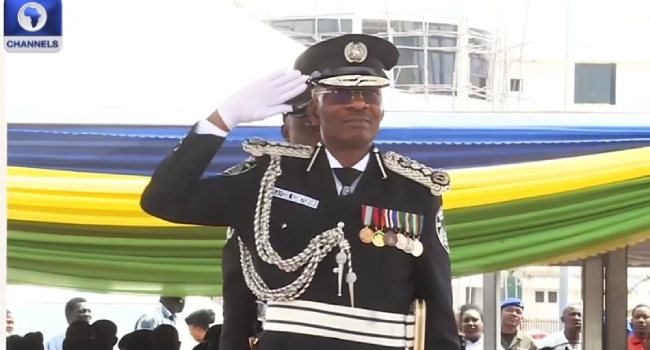
The Nigeria Police Force has begun the pull-out ceremony of the former Inspector General of Police, Kayode Egbetokun.
Egbetokun resigned as IGP in February and was replaced by Olatunji Disu, a former Assistant Inspector General of Police, who was appointed by President Bola Tinubu.
The management of the Nnamdi Azikiwe University Teaching Hospital (NAUTH) has suspended the implementation of the newly introduced ₦580,000 tuition fee for nursing students following protests by students of the institution.
The Chief Medical Director of the hospital, Prof. Joseph Ugboaja, announced the decision during an appearance on Channels Television’s The Morning Brief programme on Thursday.
The fee hike had sparked outrage in recent days after nursing students protested a 500 per cent increase in tuition fees from ₦90,000 to ₦580,000.
According to Prof. Ugboaja, the decision to suspend the new fee followed meetings with student leaders, the school management and the governing board after the protest.
READ ALSO: Pupils, Teachers Escape As School Building Collapses In Lagos
“What the students complained was that they were not carried along at the final decision making for the fees. They know that there was a review, their opinion was sorted, but at the level of taking decision they said there were not carried along.
“So, I had a meeting with them, I had a session with the school management, I also had a session with the board and we have decided that the management will suspend the implementation of the new policy.
“So, we have stopped it and then the committee is now going back to them to have a session with the students and all of them will come together and agree on the way forward,” he said.
He noted that the protest was not initiated by the student leaders but was largely driven by concerns that students were not properly involved in the final decision-making process regarding the fee review.
‘Fee Still Lowest In South-East’
Despite the suspension, Prof. Ugboaja defended the proposed fee, maintaining that the ₦580,000 tuition remains the lowest in the South-East region.
He explained that the review became necessary following the transition from the basic nursing programme to a National Diploma and Higher National Diploma structure.
“What we were running before is the RN/RM programme, that is the basic nursing programme but recently we moved to the ND programme articulated by the Nigerian Nursing and Midwifery Council. So, we are now running the ND/HND programme,” Prof. Ugboaja said.
“Now we have two sets of students, the basic nursing and basic midwifery students and then we have the ND and HND students. People that were paying the N90,000 are the basic nursing and midwifery students. But the ND and HND students, they have paid the fees, they don’t have issues, people that have issues are the people that have been paying the ₦90,000.
“The basic nursing and basic midwifery students have been paying the ₦90,000 since the school commenced, in fact we have not reviewed our fees since we started the school, that fee has been paid like that. Now what the board did was to adjust the fees to come up with current realities. Even with the ₦580,000, our fee remains the lowest in the region, you can find out, I can give you the comparative figures.”
Funding Challenges
The CMD also lamented that teaching hospitals do not benefit from intervention funds from the Tertiary Education Trust Fund (TETFund), which he said contributed to the need for an upward review of the fees.
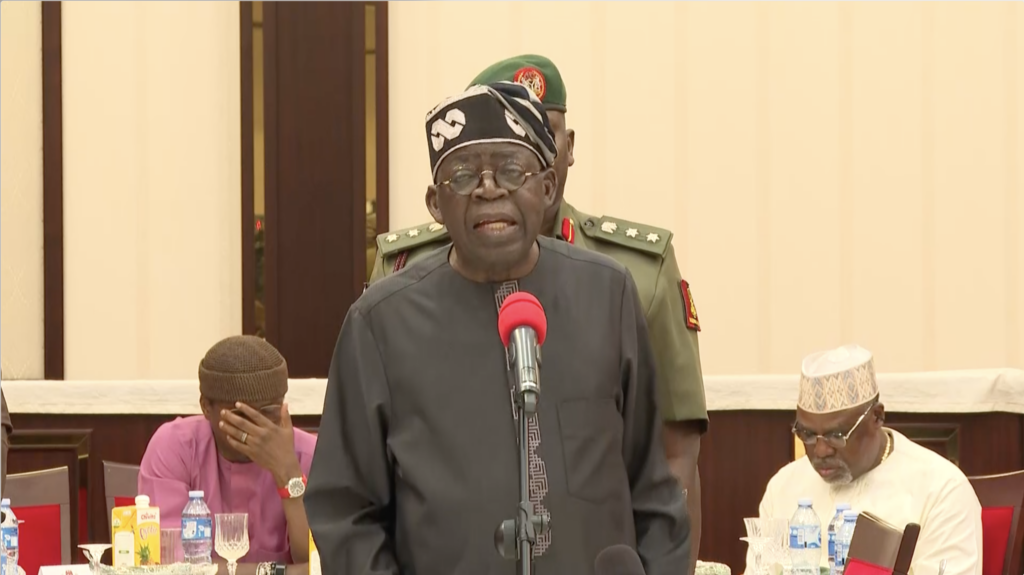
President Bola Tinubu has reiterated his commitment to sustaining democracy and the rule of law in Nigeria, saying that he is a “die-hard democrat”.
The President spoke at an inter-faith breaking of the fast with members of the National Working Committee of the All Progressives Congress (APC) and the leadership of the Inter-Party Advisory Council (IPAC) at the Presidential Villa, Abuja.
“The Chairman of IPAC, Yusuf Dantalle, provoked some questions. I am glad we are all democrats. And we all subscribe to this democracy voluntarily, willingly, and we’ve been at it selflessly in the last 26 years.
“Some of us had been bruised struggling for it. We were detained, we protested, we had street demonstrations, we went into exile, and all of that. We formed NADECO. I followed the leadership destiny that God has chosen for me. There’s no doubt about it. I am a die-hard democrat.
“I followed that belief wholeheartedly, committed to a united Nigeria, and that principle and the philosophy will live and die with me,” he stated.
He said that the unity and stability of the country rest on the pillars of good governance and assured that his administration would uphold these principles for posterity.
Tinubu also noted that strengthening internal democracy within political parties remained fundamental to building credible electoral institutions, processes, and systems.
The President further stated that direct primaries provide party members with better opportunities to participate and determine their representatives at various levels of governance.
According to him, there is no threat from any democrat under his watch.
He also said that the rule of law must prevail in any democracy.
“The majority will have their way, and the minority will have their say and their way. I must not stand in their way. That is the sweetness, the essence of democracy,” the President was quoted as saying in a statement by media aide, Bayo Onanuga.
President Tinubu also assured party leaders of his commitment to the APC.
“I am a registered voter. I am on the same platform as you. I’m going to stick to my platform.
When it was against me years ago, I toed the line. I was in opposition without a threat to any human being except the military junta.
“I want democracy, and since democracy is back here, there’s a fundamental voluntariness that is enshrined, and I am extremely glad to listen to you,” he added.
The Chairman of the APC, Nentawe Yilwatda, commended the President for providing strong leadership and ensuring the skilful management of human and material resources in a diverse and multi-ethnic society.
Yilwatda assured President Tinubu of the party’s support in realising his lofty vision for the country.
“We are grateful to God to have you as a leader of this country. We shall support you, and we will stand by you as a party,’’ he said.
The IPAC Chairman, according to the statement, appealed to the President to reconsider including the National Identity Number (NIN) as a requirement for voter registration.
Dantalle said many eligible voters might be disenfranchised by the requirement for NIN and the removal of the indirect mode for party nominations as enshrined in the newly signed 2026 Electoral Law.
He also appealed for the restoration of INEC’s financial support for political parties.
“Dantalle told the President that a movie had been produced on 26 years of democracy in Nigeria titled: ‘Unbroken Democracy’.
Beirut, Lebanon – In the early hours of March 11, Mohammad al-Ahmad was asleep at home with his wife and kids when he heard an explosion. It was about 5:20am.
“I woke up in a panic,” he told Al Jazeera, sitting in his tracksuit in a supermarket across the street from the blast site in Beirut’s Aicha Bakkar neighbourhood, his close-cropped brown hair specked with grey.
Recommended Stories
list of 3 itemsend of list
“I wanted to go see if my kids were all right and then a second explosion happened.”
The strike took out two whole floors in a residential building, leaving the street below covered in glass, concrete and dust. The Lebanese Ministry of Health said four people were injured in the attack. Israeli media said the apartment was used by the Jama’a Islamiye (the Islamic Group), though the group denied that any of its members or offices were targeted.
Al-Ahmad said his building was directly next to the one that was hit and his apartment was on the same level. “Glass is all over the floor, it’s all broken. The house has a lot of damage,” he said.
A third ordnance was found unexploded. “Thank God it didn’t explode,” he said. “If it exploded the damage would have been much worse.”
The site of Israel’s attack in Beirut’s Aicha Bakkar neighbourhood [Justin Salhani/Al Jazeera]
‘Israelis strike wherever they see fit’
Israel intensified its war on Lebanon again on Monday, March 2, after Hezbollah attacked Israel for the first time in more than a year.
Hezbollah said it was responding to the assassination of Iran’s Supreme Leader Ali Khamenei just two days earlier. A ceasefire had ostensibly been in effect since November 27, 2024, despite the United Nations and Lebanese government counting more than 15,000 Israeli ceasefire violations since then.
After Hezbollah’s reply, Israel intensified its attacks on the south and its troops have pushed further into Lebanese territory, engaging Hezbollah in battle in a couple of southern villages. Israel also issued evacuation orders for the entirety of south Lebanon, Beirut’s southern suburbs (known as Dahiyeh), and a few villages in the eastern Bekaa Valley, leading to a massive displacement crisis of at least 800,000 people, according to the Lebanese government.
Israel has since resumed attacking Dahiyeh multiple times a day, though before Wednesday’s strike, it had only attacked central Beirut once. The attack has shaken residents of the city, who were under the impression their areas were deemed safe.
In 2024, Israel struck multiple times in central Beirut and hit targets in every region of Lebanon, including those where Hezbollah or its supporters are not well represented or supported.
Nicholas Blanford, a nonresident fellow at the Atlantic Council, told Al Jazeera that the Israelis were following a similar pattern to 2024.
“They are finding their targets and hitting them wherever they may be,” Blanford said.
“The Israelis will strike targets where they see fit,” Blanford said. “I don’t think they are particularly bothered necessarily where the location is, if it’s in a Sunni area, a Christian area, or whatever.”
A woman looks on from her damaged apartment, across from the site of the attack in the Aicha Bakkar neighbourhood in Beirut [Justin Salhani/Al Jazeera]
We are afraid now
Residents in Aicha Bakkar said their sense of relative safety was completely shattered by Wednesday’s attack.
Ahmad Ballout, a 66-year-old retired English teacher, lives on the first floor of the building facing the building that was attacked. He said he left his home near Sidon, south Lebanon, in 2023 as Hezbollah and Israel started fighting and rented a furnished apartment in Beirut.
Just before the strike, Ballout was on the couch in his living room while his family slept inside. The force of the blast threw him onto the living room floor. It shattered much of the glass in his apartment and damaged his balcony.
“It took me a while to realise what was happening,” he said. “Now, I’m in pain. It was a big strike but God help all the others.”
The strike damaged many of the surrounding buildings. Two floors in the building where the attack took place were missing exterior walls. Inside, dust and debris covered a carpet that hung over the building’s exterior facade and a mattress that had ended up against an interior wall.
Cars below had their windshields broken by falling debris. Shocked neighbours looked on from their balconies, some having sustained damage to the steel or glass.
Ballout says the attack not only damaged his apartment but shattered the illusion of safety he had.
“We weren’t afraid before, but we are now,” he said.
That fear has led to frustration in the neighbourhood. A woman walking down the street by the site of the attack yelled out to whoever could hear: “We didn’t ask for this!”
On the corner of that street, Bilal Ahmad walked out of his brother’s building with his young daughter. “I don’t get it,” he told Al Jazeera. The target of the attack has yet to be named by Israel, Hezbollah or the Lebanese government. But Ahmad said that groups that know that they are Israeli targets should not put other residents in danger by staying there.
“The people here, where are they supposed to go [to be safe]? Go sit on the sand at the sea but don’t come between families and kids,” he said.
Damaged cars below the Israeli attack on Aicha Bakkar, Beirut [Justin Salhani/Al Jazeera]
Checking identities
The attack has also set in motion a larger set of demands driven by fear. A few locals have called for the Lebanese government to protect them by controlling who enters their neighbourhoods.
“In the last war this didn’t happen,” al-Ahmad said. “People in every area, not just this area, should know who is coming and going and following up on this. A lot of people were hurt without any fault of their own.”
Al-Ahmad said he worries about the impact on his two boys – the elder boy is four years old, and the younger one is just a year old. One of them has a speech impediment and sees a speech therapist to work on his pronunciation. Al-Ahmad worries the trauma of the incident will further impact his son’s speech.
“We didn’t ask for this and we can’t take this,” he said, his eyes tearing up. “Whoever wants to do this, get out of this area. People are fed up. It’s a crowded area and we’re sheltering people who are even more fed up.”
Still, al-Ahmad is not calling for a ban on hosting displaced people. “We’re not upset that displaced people are here, we accept everyone, Lebanese and even Syrians, Christian and Muslim. We accept anyone but we won’t accept danger.”
Al-Ahmad said he cannot leave the neighbourhood: His home is there, as are his businesses, including he electricity company he works at with his brother-in-law.

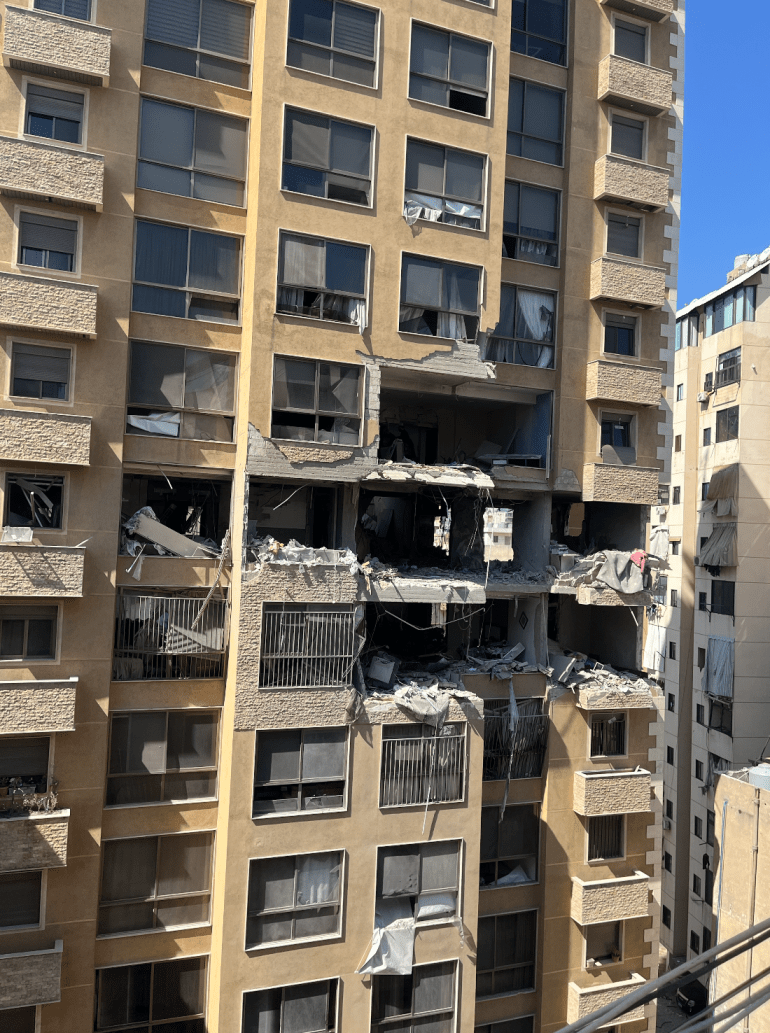
![The site of Israel's attack on Aisha Bakkar [Justin Salhani/Al Jazeera]](https://i0.wp.com/www.aljazeera.com/wp-content/uploads/2026/03/Screenshot-2026-03-11-at-22.59.26-1773262806.png?w=696&ssl=1)
![A woman looks on from her damaged apartment, across from the site of attack in the Aisha Bakkar neighbourhood in Beirut. [Justin Salhani/Al Jazeear]](https://i0.wp.com/www.aljazeera.com/wp-content/uploads/2026/03/Screenshot-2026-03-11-at-22.59.35-1773262801.png?w=696&ssl=1)
![Damaged cars below the Israeli attack on Aisha Bakkar, Beirut. [Justin Salhani/Al Jazeera]](https://i0.wp.com/www.aljazeera.com/wp-content/uploads/2026/03/Screenshot-2026-03-11-at-22.59.45-1773262797.png?w=696&ssl=1)