If Cuba falls, the Global South is to blame, too

On Tuesday, United States President Donald Trump had a good laugh with members of the press in the US state of Iowa as he issued a rather serious decree regarding the short-term future of Cuba: “Cuba will be failing pretty soon. Cuba is really a nation that’s very close to failing.”

To be sure, this is not the first time that Trump has predicted the downfall of the Caribbean island nation, which the US has effectively been trying to destroy for no fewer than 67 years – ever since the triumph in 1959 of Cuba’s communist revolution that overthrew the brutal right-wing dictator and US buddy Fulgencio Batista.

This time around, however, the threat carries a bit more weight in light of the Trump administration’s abduction earlier this month of Nicolas Maduro, the leftist president of Venezuela.

To date, the US has not been held accountable for this utterly illegal and patently batty act, which Trump on Tuesday invoked as alleged proof of Cuba’s impending demise: “You know, they got their money from Venezuela. They got the oil from Venezuela. They are not getting that any more.”

One would hope, then, that other countries – particularly the self-declared allies of Cuba – might step up to defend the island against US predations or at least credibly register their opposition to imperial impunity.

Instead, all Cuba has really gotten are some perfunctory professions of support – such as from Mexican President Claudia Sheinbaum, who, like her ostensibly leftist predecessor Andres Manuel Lopez Obrador, has perfected the art of pretending to counter US machinations while doing exactly what the gringos want.

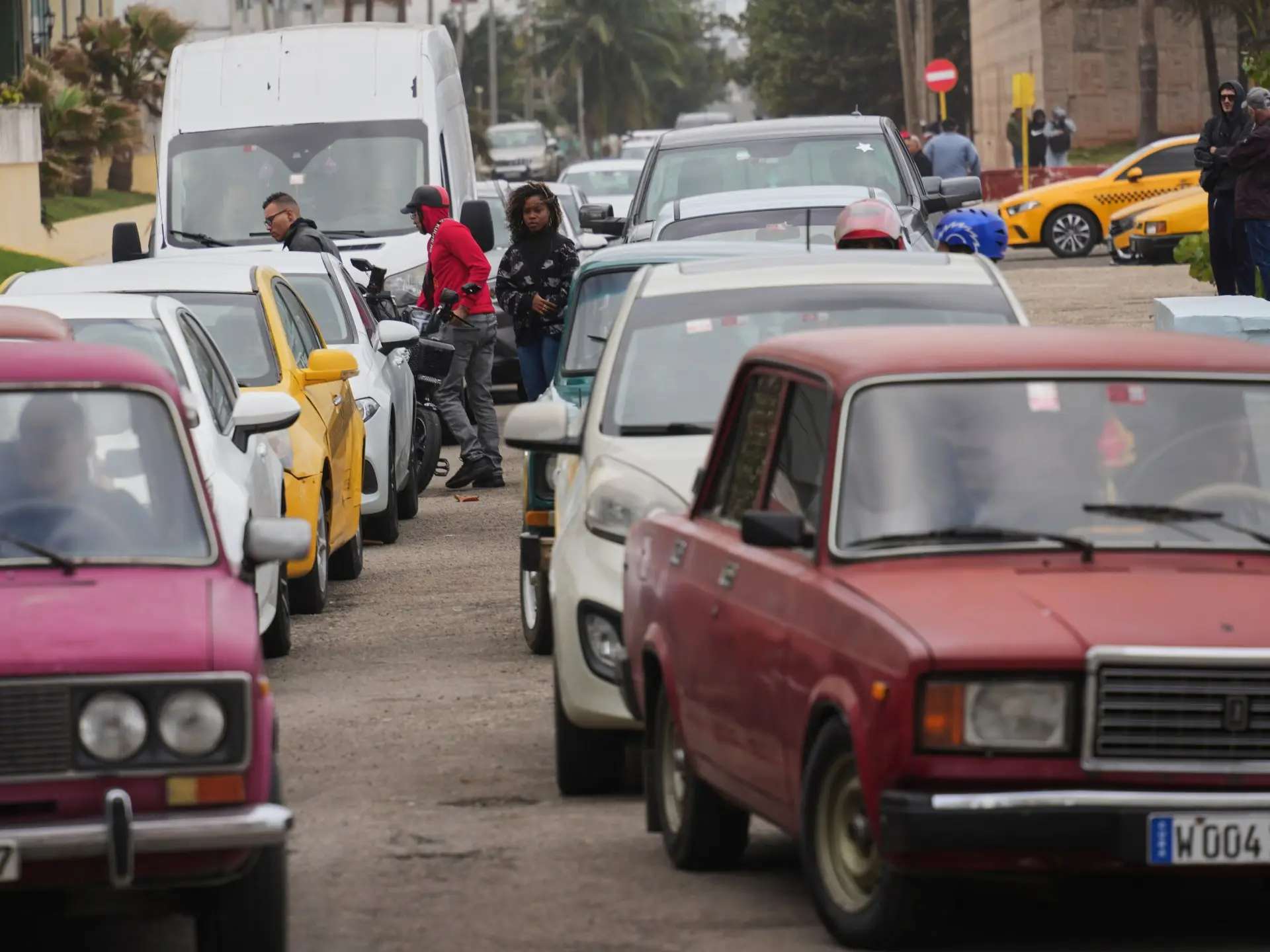
Following recent reports that Mexico had halted a scheduled oil shipment to Havana on account of US pressure, Sheinbaum has repeatedly insisted that the business of shipping oil is a “sovereign decision” and that Mexico remains “in solidarity” with Cuba.

Speaking evasively at a press conference, the Mexican leader reflected on her country’s history of providing oil to Cuba for “humanitarian reasons”, owing to the US embargo that, she reminded her audience, has been in effect “for many years now” and has resulted in “shortages”.

Indeed, when I last visited Cuba in 2022 – incidentally just in time for the 60th anniversary of US sanctions on the island – staples like coffee and milk were in short supply.

The nation that had for decades been renowned for its free healthcare, medical humanitarianism and international deployment of meticulously trained doctors was now suffering a dearth of basic medications – which meant that the employees of the pharmacy I went to after executing an epic crash while jogging on Havana’s seaside promenade simply shrugged apologetically at the sight of my bloodied knees and sent me on my way with a prescription for soap and water.

The same prescription had been issued by a 43-year-old Cuban named Eraudis, who had witnessed my fall from his perch atop the seawall just next to a plaque commemorating Leonard Wood, the former US military governor of Cuba who had supervised the promenade’s construction in 1901 and had also served as governor-general of the Philippines.

As if we needed any further imperial irony, it turned out that Eraudis hailed from none other than the Cuban province of Guantanamo – site of the eponymous illegal US penal colony and torture centre – and that his own two legs had been blown off by a landmine outside the US base when he was 19.

He apologised that he could not carry me home due to his legless state and coaxed me out of my own state of panic – no doubt a greater act of “solidarity” than suspending oil shipments to Cuba while claiming “humanitarian” motivations.

Of course, it’s not only Mexico that’s letting Cuba down. Pretty much the rest of Latin America has opted to sit on the fence as Trump goes about seeking to engineer the island’s definitive “failure”.

Ditto for much of the rest of the Global South. On Tuesday, the same day that Trump engaged in friendly nation-wrecking banter with journalists in Iowa, China’s Ministry of Foreign Affairs took to its English-language X account to call for the “immediate lifting of blockade and sanctions on #Cuba”.

China pledged to “continue to support and assist Cuba” and reiterated its belief that “under the strong leadership of the party and government of Cuba, the Cuban people will tide over the difficulty”.

No offence to the Cuban people – who for almost seven decades have exhibited extraordinary resilience – but it’s not so easy to “tide over the difficulty” when you’re a tiny island in the crosshairs of a schizophrenic megalomaniac who happens to be in charge of the global superpower.

Also on Tuesday, the Cuban News Agency reported that “solidarity groups” in India had “expressed their support for Cuba” during an event held in Kolkata.

As per the report, the programme “included a minute of silence in homage to the revolutionaries and citizens who lost their lives in the struggle against imperialist forces in the region”.

Now, just as the struggle has become more critical than ever, it remains to be seen whether any of Cuba’s professed allies will stick their necks out to keep the country from “failing”.

In the event it does fail – and Trump manages to swing regime change in a place that has resisted for so long against all odds – it’s safe to say that nowhere is safe from imperial designs.

What is needed right now is some real solidarity – because if Cuba fails, it’s nothing less than a global failure.


Eat & Yap – Man City’s Kerstin Casparij meets Alex Scott

Manchester City’s Kerstin Casparij has been chatting about her life on and off the field – and treating BBC Sport’s ex-England star Alex Scott to her Dutch homeland delicacy oliebollen.

Watch the full episode of Eat & Yap on BBC iPlayer.

Eat & Yap – Man City’s Kerstin Casparij meets Alex Scott

Manchester City’s Kerstin Casparij has been chatting about her life on and off the field – and treating BBC Sport’s ex-England star Alex Scott to her Dutch homeland delicacy oliebollen.

Watch the full episode of Eat & Yap on BBC iPlayer.

Eat & Yap – Man City’s Kerstin Casparij meets Alex Scott

Manchester City’s Kerstin Casparij has been chatting about her life on and off the field – and treating BBC Sport’s ex-England star Alex Scott to her Dutch homeland delicacy oliebollen.

Watch the full episode of Eat & Yap on BBC iPlayer.

Sabalenka defeats Svitolina to reach Australian Open final

Belarusian Aryna Sabalenka powered into her fourth Australian Open final in a row with a dominant 6-2 6-3 win over Ukraine’s Elina Svitolina on Thursday, in a politically charged encounter.

Top-seeded Sabalenka will now bid for a third crown at Melbourne Park in four years and fifth Grand Slam title overall against the winner of the late semifinal between Jessica Pegula and Elena Rybakina at Rod Laver Arena.

Recommended Stories

list of 4 itemsend of list

“I just cannot believe that. It’s an incredible achievement ⁠but the job is not done yet,” world number one Sabalenka said on court. “I’m super happy with the win. She’s ​such a tough opponent and has been playing incredible tennis the whole week.”

Since Russia’s invasion ‍of Ukraine in 2022, for which Belarus has been a staging ground, Russian and Belarusian players have been banned from representing their nations at the Grand Slams and tour events.

Like other players from Ukraine, Svitolina does not shake hands with opponents from Russia or Moscow’s ally Belarus because of the war.

An announcement was made before the semifinal at Rod Laver Arena and a statement flashed up on a big screen saying there would be no handshake, asking fans to “respect” that.

The two players also noticeably kept apart for the pre-match formalities and photos.

Svitolina has been vocal about the strain of playing the two countries’ players, and said she hoped ‍to bring her ⁠nation “light” at the Australian Open after a tough winter.

Aryna Sabalenka in action.
Sabalenka serves against Svitolina during their women’s singles semifinal match in Melbourne on January 29, 2026 [Izhar Khan/AFP]

The 27-year-old Sabalenka, however, crushed those hopes in a furious display of raw power.

She became the third woman in the professional era to reach the Australian Open decider four times in a row, following Evonne Goolagong Cawley (1971-76) and Martina Hingis (1997-2002), who each played six finals in a row.

“Gutted not to make it through tonight,” Svitolina told reporters. “Of course, it’s very difficult when you’re playing a world number one on fire.”

While 31-year-old Svitolina was comprehensively defeated, she fought ​hard from the first ball to the last.

The 12th seed started with tenacity, thumping ‌a forehand winner down the line on the first point returning serve.

Sabalenka wobbled, giving up two break points with a loose backhand, but blasted her way out of danger.

There was early tension at 2-1 when Svitolina was awarded a point mid-rally, with Sabalenka penalised for hindering ‌the point with a late grunt.

Incensed, she demanded a video review, but the point stood.

She channelled her frustration into breaking Svitolina, then held for a 4-1 lead.

Pinning Svitolina well ‌behind the baseline, Sabalenka grabbed three set points and converted the ⁠third, roaring “Let’s go!” after a sizzling cross-court backhand winner.

Aryna Sabalenka and Elina Svitolina react.
Svitolina, left, was no match for Sabalenka in the first semifinal [Dita Alangkara/AP]

After 41 minutes of earth-shaking power, Sabalenka’s weapons finally misfired.

She dropped the opening service game of the second set with a clutch of errors, raising cheers from a crowd yearning for a contest.

But Sabalenka steadied herself, breaking Svitolina twice in ‌succession.

Svitolina never dropped her head and earned a break point when trailing 4-2 to put the match back on serve.

Sabalenka was not to be denied, though.

After thrashing a forehand winner down the line to save the break point, she ‍proved unstoppable.

Why is India’s Nipah virus outbreak spooking the world?

An outbreak of the Nipah virus in India’s eastern state of West Bengal has heightened concerns in China and several Southeast Asian countries, prompting them to tighten health screening operations at airports as millions prepare to travel for the Lunar New Year holiday.

Since December 2025, two confirmed cases of the virus have been reported in West Bengal, India’s health ministry said on Wednesday.

Recommended Stories

list of 3 itemsend of list

The ministry did not provide details about the people infected but noted that of a total of 196 contacts linked to the confirmed cases, “all traced contacts have been found asymptomatic and have tested negative”, for the virus.

“The situation is under constant monitoring, and all necessary public health measures are in place,” the ministry added.

A district health officer told Reuters that the two people infected in West Bengal in late December were health workers. Both are being treated at a local hospital, the health officer said.

Is the recent outbreak of the virus a cause for concern?

Here’s what we know:

What is the Nipah virus?

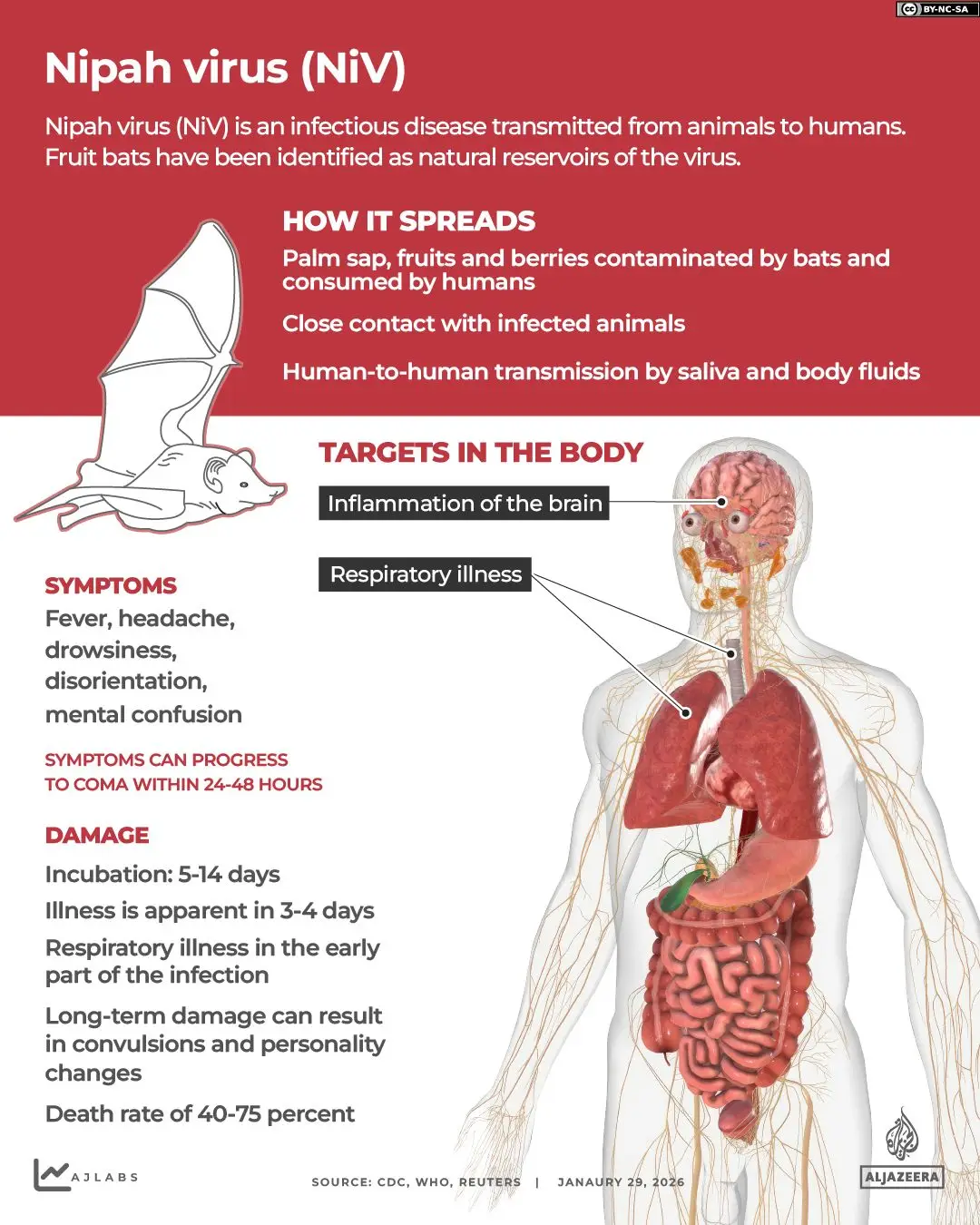
The Nipah virus (NiV) is a zoonotic virus – a disease transmitted from animals such as fruit bats and flying foxes to humans. It can also be transmitted to humans via contaminated food products or directly from person to person.

The virus can be deadly. It typically incubates in the human body for five to 14 days, with symptoms occurring within three to four days.

It causes severe respiratory and neurological disease in humans, progressing from fever and headache to acute encephalitis (brain inflammation) in severe cases, Kaja Abbas, associate professor of infectious disease epidemiology and dynamics at the London School of Hygiene & Tropical Medicine and Nagasaki University, said.

Symptoms can also include convulsions and mental confusion, and patients can fall into a coma within 24 to 48 hours in severe cases.

“The case fatality rate is high, between 40 percent and 75 percent, among people infected with the Nipah virus,” Abbas told Al Jazeera.

However, the virus’s basic reproduction number, which is the expected number of secondary infections stemming from a primary case, is “typically below one”, he said. This suggests the virus spreads in only a limited way via human-to-human transmission and there is a low likelihood of the virus becoming a widespread pandemic.

Where have outbreaks of the Nipah virus occurred before?

The first known outbreak of NiV was reported in 1998 when pig farmers and butchers in Malaysia and Singapore contracted it from infected pigs. At least 250 people were infected, with more than 100 deaths.

In 2014, NiV infections in the Philippines were associated with the slaughter of horses and consumption of infected horse meat.

Since 2001, there have been sporadic but recurring outbreaks in South Asia, particularly in Bangladesh and India.

According to the World Health Organization, outbreaks in Bangladesh have been linked to humans consuming contaminated raw palm sap, having close contact with other people’s secretions and excretions, and caring for infected patients.

According to the WHO, the first cases in India were recorded in West Bengal in 2007 but an earlier outbreak was retrospectively identified in the state’s Siliguri city in 2001. The 2001 Siliguri outbreak occurred in a healthcare setting where 75 percent of cases were of hospital staff or visitors, the WHO said.

Since 2018, dozens of deaths have been reported in India’s Kerala state, which is now regarded as the world’s highest-risk region for the virus.

The reasons for other outbreaks in Indian states are unclear. Some medical experts have suggested outbreaks may have been triggered by human consumption of fruit contaminated by bat saliva or urine, while the Indian Council of Medical Research has suggested that while the virus is primarily spread by physical contact, it may also be airborne.

According to Abbas, there is no clear evidence about the cause of the latest outbreak in West Bengal, which has occurred after decades without outbreaks.

Abbas said the fact that the two confirmed cases are both healthcare workers in the same hospital indicates a potential transmission from an infected but undiagnosed patient to the healthcare workers at the hospital.

Nipah
Field laboratory assistants catch a bat to collect specimens for Nipah virus research in the Shuvarampur area of Faridpur, Bangladesh, on September 14, 2021 [File: Mohammad Ponir Hossain/Reuters]

Is there a vaccine for the virus?

According to the WHO, there is currently no approved treatment or vaccine available for people infected by the virus or animals carrying the virus.

The University of Oxford has been conducting clinical trials in Bangladesh to test a Nipah virus vaccine and launched the second phase of trials in December 2025.

In the absence of approved vaccines, doctors have been treating patients with antivirals such as Ribavirin. According to the United States government’s Centers for Disease Prevention and Control (CDC), Ribavirin was used to treat a small number of patients in a 1999 Nipah outbreak in Malaysia, but its efficacy in treatment remains unclear.

The CDC has said that the drug Remdesivir could also help prevent Nipah “when given to exposed nonhuman primates”.

The Indian state of Kerala used Remdesivir during a 2023 outbreak which resulted in an improved case fatality rate.

Which countries have announced enhanced screening for Nipah virus?

Thailand, Indonesia, Nepal and Malaysia have all tightened international airport screening.

Thailand’s health ministry told journalists that it has assigned special parking bays for aircraft arriving from Nipah-affected countries, and passengers have been asked to complete health declaration forms before immigration.

Thermal scanners have also been installed at the Suvarnabhumi airport in Bangkok to screen people for fever and other symptoms of the virus.

Malyasia, Indonesia and Nepal have implemented similar measures at their international airports.

What is the best way to prevent the spread of this virus?

On Wednesday, Hong Kong daily The South China Morning Post reported that social media channels in China had been flooded with posts from people expressing concern over the outbreak of the virus in India.

“It’s so scary, especially with the Spring Festival coming up. I don’t want to experience another lockdown,” one social media user said.

“Can’t we temporarily shut the travel channel with India?” another user asked, according to the SCMP.

China’s state broadcaster, CCTV, reported that the country has not recorded any Nipah virus cases so far but warned that there could be risks of imported cases.

According to Abbas, however, the virus is not like the COVID-19 virus which resulted in yearlong lockdowns around the world from 2020.

He said severe cases of the Nipah virus could be managed “through intensive supportive care”.

He added that besides airport health screenings, countries should focus on promoting measures to prevent the virus, like good hygiene, proper ventilation, avoiding crowds, staying home when ill, seeking timely medical advice and maintaining a healthy lifestyle to support immunity.

The WHO has also provided guidelines for controlling the spread of the virus.

In particular, it stated in a 2018 report, “decreasing bat access to date palm sap and other fresh food products” is required.

“Keeping bats away from sap collection sites with protective coverings [such as bamboo sap skirts] may be helpful. Freshly collected date palm juice should be boiled, and fruits should be thoroughly washed and peeled before consumption. Fruits with sign of bat bites should be discarded,” the WHO reported.

It added that people should wear gloves and other protective clothing while handling sick animals or their tissues, and during slaughtering and culling procedures.

To control the spread of the virus in healthcare settings, WHO said, “contact and droplet precautions should be used in addition to standard precautions. In some cases, “airborne precautions” may also be required.