Gaza’s collapsing economy drives youth to create unconventional solutions

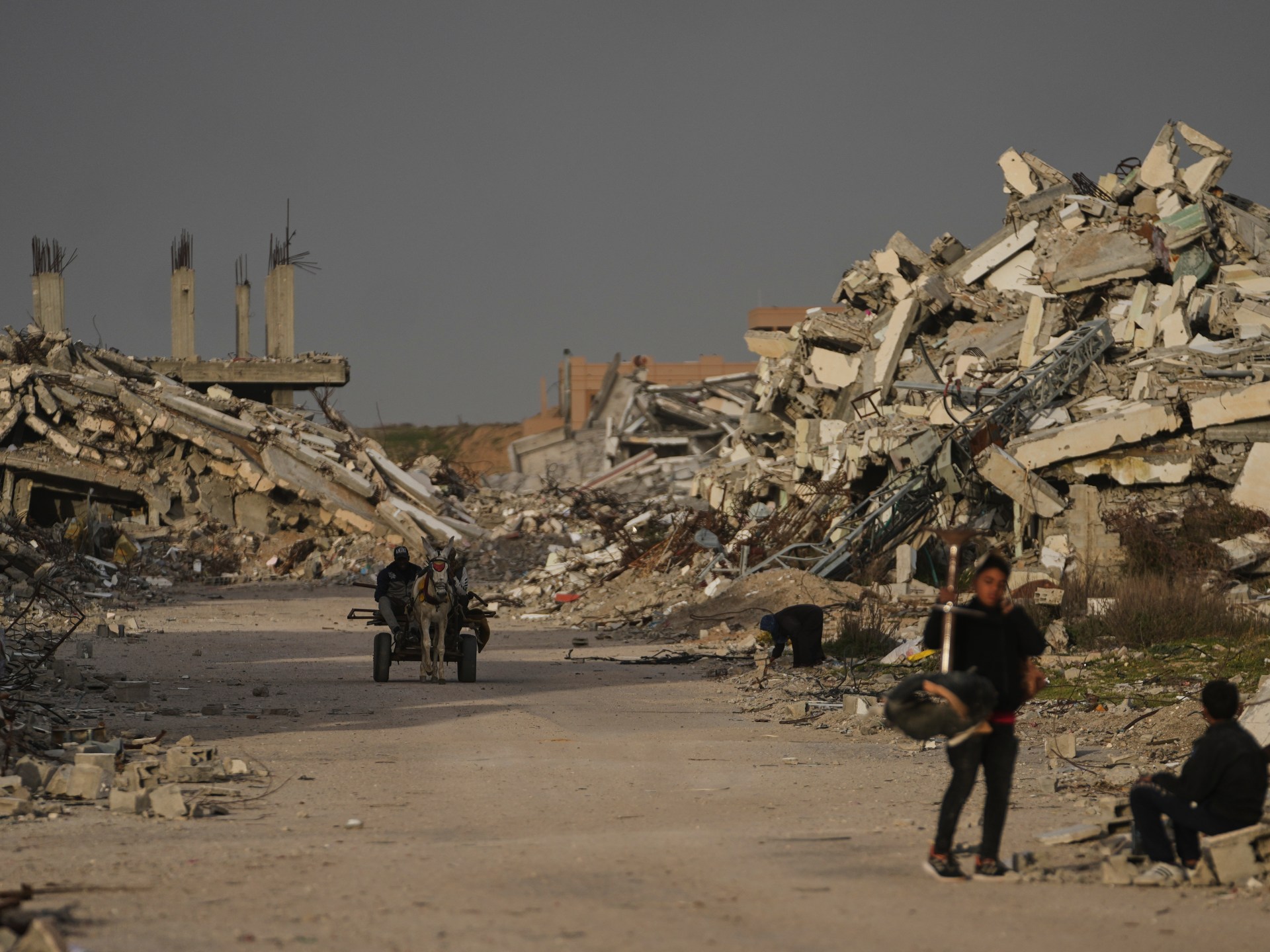
Gaza City – For many Palestinians in Gaza, earning a living has become a daily struggle amid Israel’s continuing blockade, repeated ceasefire violations, and the near-total collapse of the local economy.

With infrastructure destroyed and productive sectors paralysed as a result of Israel’s genocidal war on Gaza, traditional employment opportunities have all but disappeared, forcing residents to seek alternative, often precarious, ways to survive.

Recommended Stories

list of 3 itemsend of list

Hala Mohammed al-Maghrabi, 24, is one of many young professionals whose education no longer provides a path to stability. After graduating as a nurse in 2023, she spent two years volunteering in the healthcare sector, hoping the experience would eventually lead to paid employment. That opportunity never came.

“Volunteering doesn’t pay the bills,” al-Maghrabi said. “With prices constantly rising and no stable income, it became impossible to rely on this work to meet even my basic needs.”

With limited prospects in Gaza’s overstretched healthcare system, she made a difficult decision to leave her field entirely.

Al-Maghrabi instead shifted into social media marketing and e-commerce, working online to generate a modest income.

As al-Maghrabi recounted, she graduated as a nurse and began training in the hospital. During that training, she also took several design courses and tried to find work in that field, but she was unable to reach clients and earn an income. She then decided to take marketing courses instead of waiting for someone else to promote her work, allowing her to market herself effectively. After gaining experience in marketing, she began working in e-commerce and digital marketing.

“This isn’t what I studied or planned for,” she said. “But even though the income is limited, it helps me cover my daily expenses and survive under these conditions.”

Economic crisis

Al-Maghrabi’s experience reflects a broader phenomenon in Gaza, where years of compounded crises have pushed unemployment to unprecedented levels. According to the Palestinian Central Bureau of Statistics’ 2024 figures, the overall unemployment rate in Gaza is 69 percent, rising to approximately 80 percent among 15- to 29-year-olds.

The population under 30 accounts for approximately 70 percent of Gaza’s residents, meaning the majority of the community faces severe economic challenges, with a significant portion of young people holding university degrees but unable to find suitable employment.

Gaza’s GDP has also contracted by more than 82 percent due to Israel’s ongoing war and destruction of economic infrastructure, and around 80 percent of the population relies on international aid due to food insecurity and loss of income sources.

The economic collapse has not only affected employees, but business owners as well. Mohammed al-Hajj, who previously worked in general trade and food supplies, saw his entire business model unravel after the war.

“My warehouses and goods were destroyed, and I could no longer afford import costs or the required licences,” al-Hajj said. “Everything I had built over the years was suddenly gone.”

Faced with few options, al-Hajj searched for an alternative way to earn an income. Because his neighbourhood had not been heavily damaged, and he still had intermittent internet access, he converted part of his property into a small workspace equipped with an internet connection.

“I created this place after running out of options,” he said. “Students and engineers needed somewhere stable to take exams or work online, and this became a solution for them – and for me.”

Innovating to survive

As traditional employment structures collapse, innovation has become less a choice than a necessity. For some Palestinians in Gaza, finding unconventional solutions to personal crises has opened new paths not only for survival, but for rebuilding economic activity.

Ahmed Fares Abu Zayed, CEO of Abu Zayed General Trading, described how his company’s operations came to a halt when the war began.

“We started the company before the war as a very small electricity generation business with limited resources, aimed only at supplying specific energy needs,” said Abu Zayed. “But when the war broke out, our operations stopped immediately due to fuel shortages for the generators. The situation was extremely difficult.”

Rather than shutting down entirely, Abu Zayed began searching for alternatives. The result was an innovative approach to energy production that relied on available materials rather than scarce fuel.

“We thought about how to turn surrounding waste into energy,” he said. “That’s how we started producing electricity systems using plastic scraps as fuel. It was a difficult experience, but it was driven by creativity and necessity.”

His story illustrates how innovation in Gaza often emerges directly from crisis, as individuals attempt to solve immediate problems with limited resources.

Project manager and business management specialist Maram al-Qarra explained that such efforts play a critical role in Gaza’s labour market.

“The problem in Gaza isn’t a lack of talent, but the absence of an economic environment capable of absorbing it,” al-Qarra said. “Even small projects can stimulate the market by creating direct jobs and indirect service and production chains.”

She emphasised that innovation is now essential. “When traditional jobs are absent, innovation becomes a means to create opportunities instead of waiting for them,” she said.

On the broader labour market, al-Qarra concluded, “The blockade and the war destroyed traditional work structures, pushing many young people to seek alternatives outside conventional employment.”

Exploitation and opportunity

Across Gaza, many educated young people – doctors, engineers, nurses, and graduates – now sell bottled water, vegetables, or second-hand clothes on the streets. These efforts are not entrepreneurial ambitions, but survival strategies in a place where choice has all but disappeared.

As one young resident put it, “We don’t have the luxury of choice; all we can do is try to survive.”

While innovation has opened new paths for some, desperation has also created space for exploitation. Mahmoud, a young man from Gaza, described how the lack of jobs and social protection has pushed people towards shady or dangerous businesses.

“With no government support and no safety nets, securing a steady income has become almost impossible,” Mahmoud said. “Some people are turning to illegal or exploitative methods just to survive.”

He explained that money lending, currency trading, and exploitative financial transfers have become increasingly common.

“People are sometimes forced to receive their remittances in cash at a discount of more than 50 percent,” he said. “This is clear exploitation of people’s urgent needs, and it shows how desperation is being abused.”

Yet even amid these negative outcomes, examples of innovation that benefit the wider community persist. Abu Zayed noted that his electricity project did more than solve his own problem.

“The most important part is that it didn’t just provide energy,” he said. “It created jobs for dozens of young people in manufacturing, installation, and maintenance, and gave them skills they couldn’t gain in the traditional job market.”
Israeli forces kill 12 Palestinians across Gaza, attacks reported in Rafah

At least 12 Palestinians, half of them children, have been killed in the Gaza Strip since dawn, a day before the Rafah crossing is due to reopen.

An Israeli air strike on Saturday on a tent sheltering displaced people in the al-Mawasi area to the northwest of Khan Younis city killed at least seven Palestinians, including three children, medical sources told Al Jazeera.

Recommended Stories

list of 4 itemsend of list

Their bodies were taken to the Nasser Medical Complex in Khan Younis.

In Gaza City, emergency services reported that at least five Palestinians, including three children, were killed in an Israeli air strike on an apartment building in the Remal neighbourhood to the west of the city.

Eight Palestinians were also injured in an Israeli bombing of an apartment building in the Daraj neighbourhood of Gaza City.

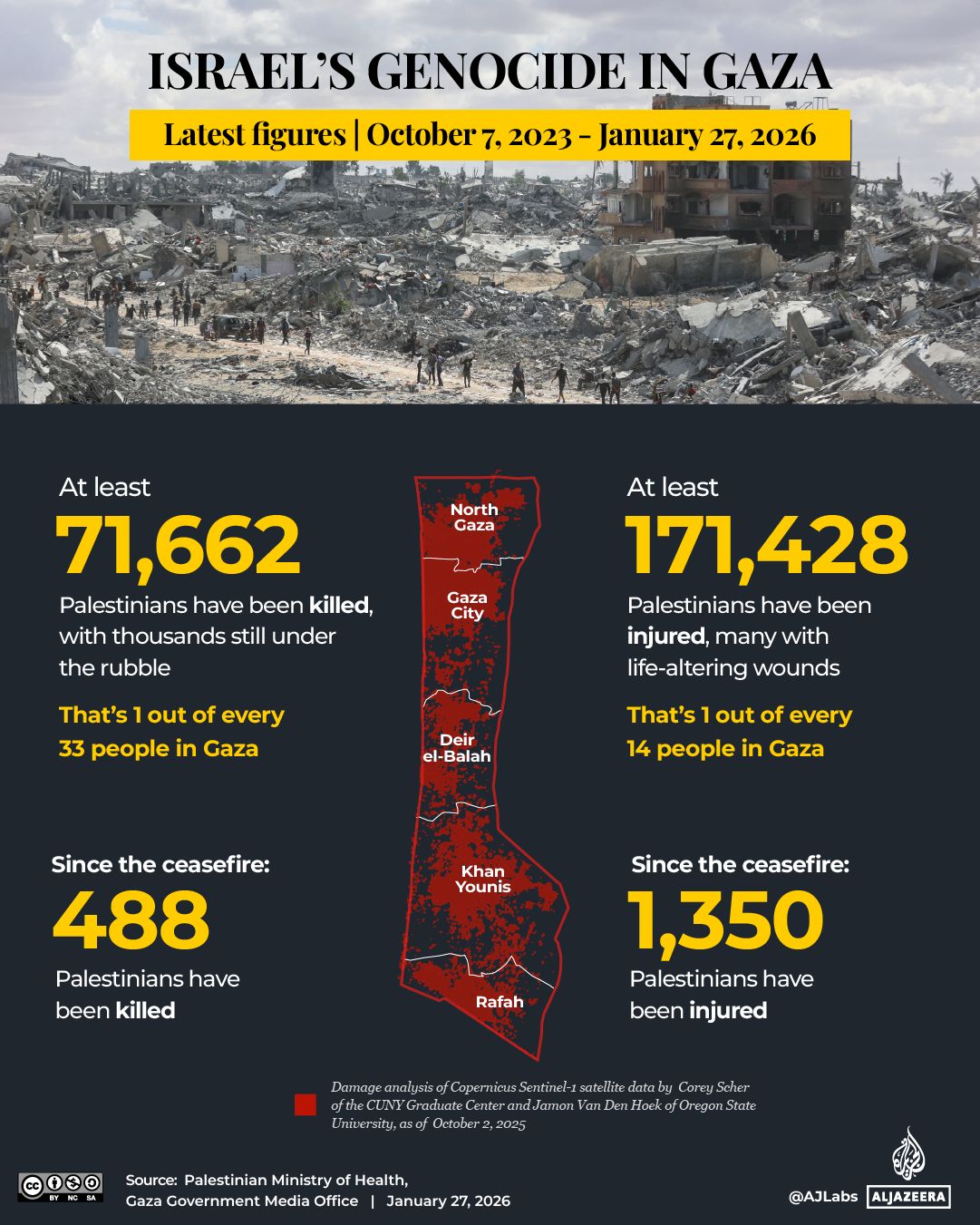
Gaza’s Government Media Office says at least 524 Palestinians have been killed by Israeli forces since a United States-brokered ceasefire in Gaza came into effect on October 10.

Rafah reopening

Residents in the border town of Rafah also reported several air attacks in areas under Israeli control. Israel is due to reopen the Rafah crossing, which links Gaza with Egypt, on Sunday for the first time since May 2024.

The opening of the key entry point is part of the ceasefire agreement with Hamas. It was meant to open during the first phase of the ceasefire, but Israel refused to do so until the body of its last remaining captive was found.

Israel on Saturday said it would only allow a “limited movement of people” who have received security clearance by Israel to enter and exit. No aid or humanitarian supplies will be allowed to enter.

“Only those who fled during the past two years are allowed to come back,” Al Jazeera’s Hani Mahmoud explained. “Those who are born outside the Gaza Strip are not going to be allowed to come back.”

Hamas responded to the Rafah announcement by calling for Israel to allow movement in and out of Gaza “without restrictions”, and urged it to adhere to all aspects of the ceasefire agreement.

Israel’s genocidal war on Gaza has killed more than 71,600 Palestinians since October 7, 2023.

Your Winter Olympics need-to-know guide in six charts

The 25th Winter Olympics is almost here – it’s back in Europe and will feature a record 116 medal events, three of which will be in the new sport of ski mountaineering.

It could be Britain’s most successful Winter Olympics

Great Britain have never won more than five medals – or more than one gold – at a single Winter Olympics, but that could change in 2026.

Medal ‘targets’ have become medal ‘ranges’ at recent Olympics, and for Milan-Cortina the funding body UK Sport is hoping GB athletes will win between four and eight medals, while Team GB chef de mission Eve Muirhead says there is an “opportunity to get the most we ever have”.

British athletes won nine medals at the most recent World Championships in Winter Olympic sports – across bobsleigh, curling, figure skating, freestyle skiing, skeleton and snowboard.

And that does not include the likes of snowboarder Mia Brookes and freestyle skier Kirsty Muir who have won World Cup events this season and are considered genuine medal hopes.

The most gender-equal Winter Olympics ever

The Winter Olympics have come a long way since their 1924 debut, which featured 11 female athletes – and roughly 25 times more men.

According to the International Olympic Committee (IOC), about 1,300 female athletes will be at Milan-Cortina. Of the 116 medal events, 50 will be in women’s competition (the most ever) and 12 will be mixed. The upshot is that women will compete in a Winter Games-record 53.4% of all medal events.

Twelve of the 16 disciplines will be fully gender-balanced in athlete numbers – another Games record. Among the new women’s events are luge doubles and the ski jumping individual large hill, while there is also a mixed skeleton relay.

There is another sign of the progress made with equality: these Games are the first to be overseen by new IOC president Kirsty Coventry, the first woman to be elected to the organisation’s most powerful position.

The NHL stars are back

Ice hockey is one of the biggest draws of the Winter Olympics, and the return of NHL stars after an absence of 12 years has only heightened the anticipation.

NHL-contracted players were denied a chance to compete at the 2018 Games while Covid put paid to their 2022 participation – and even 2026 has been touch and go after major issues with the readiness of the main rink and the condition of the ice.

The return of NHL players has also reignited the USA’s hopes of a first Olympic men’s ice hockey title since the 1980 ‘Miracle on Ice’ gold – further boosted by the fact that Russia are banned from competing.

Milan-Cortina 2026 will be very different from Cortina 1956

Cortina d’Ampezzo will become the fourth location to host the Winter Olympics twice, following St Moritz (1928 & 1948), Innsbruck (1964 & 1976) and Lake Placid (1932 & 1980).

The growth of the Winter Olympics from 1956 to 2026 – five times as many events and almost four times as many athletes – means it would be impossible today for a ski resort like Cortina to stage the Olympics single-handedly. The 2026 Games will be the most geographically widespread, with events in multiple regions and cities, including Milan, which is Italy’s second biggest city.

The IOC also prizes sustainability, and spreading events around – something president Kirsty Coventry says will be “the new normal” – meaning less new infrastructure is required.

Golden era of record-breaking athletes

Not since 2018 has there been a new name at the top of the list of most Winter Olympic golds, but 2026 could change that.

German lugers Tobias Wendl and Tobias Arlt are aiming to win their seventh and eighth golds in Milan-Cortina, which would move them level with the Norwegian trio of biathlete Ole Einar Bjorndalen and cross country skiers Bjorn Daehlie and Marit Bjorgen.

It would arguably be a greater achievement as biathlon and cross country skiing offer more medal opportunities than luge. Daehlie, Bjorgen and Bjorndalen won gold in 53%, 33% and 30% respectively of the Olympic events they competed in. The ‘Two Tobis’ have won all six of theirs (100%).

How will hosts Italy perform?

Hosting an Olympics usually results in a boost in medals – but it’s not always the case, as Italy discovered the last time they hosted the Winter Olympics in 2006.

They had won 13 medals in 2002 in Salt Lake City but only managed 11 in Turin – although they did win five golds as opposed to four in the USA four years previously.

The Italian Olympic Committee has set a minimum target of 19 medals, which is one short of their biggest haul of 20. That was achieved in 1994 – including a record seven golds – when their team included the likes of skiing greats Alberto Tomba, Deborah Compagnoni and Stefania Belmondo.

Italy’s 2026 hopes have already suffered a few setbacks, with flagbearer Federica Brignone and freestyle skier Flora Tabanelli both fighting fitness battles while another alpine hope, Marta Bassino, has already been ruled out.

But there are others with golden credentials, including speed skater Davide Ghiotto, snowboarder Maurizio Bormolini and curling pair Amos Mosaner and Stefania Constantini.

Related topics

  • Winter Sports

More on this story

    • 20 January
    Hazel Irvine, Clare Balding and Jeanette Kwakye
    • 4 days ago
    Shawna Pendry competing at the Biathlon World Cup
    • 3 days ago
    ICE agent in Minneapolis 24 Jan

GB’s Skupski wins Australian Open doubles title

Great Britain’s Neal Skupski and American partner Christian Harrison claimed the Australian Open men’s doubles title in their first Grand Slam together.

Skupski, 36, and Harrison, 31, defeated Australian wildcards Jason Kubler and Marc Polmans 7-6 (7-4) 6-4.

Skupski and Harrison competed together for the first time in Adelaide just before the Australian Open, getting to the semi-finals.

Liverpudlian Skupski played with fellow Briton Joe Salisbury throughout 2025, reaching finals at the French Open and US Open, before Salisbury took a break from tennis because of anxiety.

It is a second Grand Slam men’s doubles crown for Skupski, who won the Wimbledon title alongside Dutchman Wesley Koolhof in 2023.

It is also the third time in the past five Grand Slams that at least one British player has triumphed in the men’s doubles.

Related topics

  • Tennis

More on this story

    • 18 November 2025
    Joe Salisbury plays a forehand at Wimbledon

‘Heated Rivalry inspired me to come out as gay’

To play this video you need to enable JavaScript in your browser.

The American television drama Heated Rivalry – about two male professional ice hockey players in a secret relationship – has become the first viral show of 2026.

For most viewers, it is entertainment to be talked about at work or online. For Jesse Kortuem, it hit deeper.

Born, raised and still living in Minneapolis, he grew up with skates on his feet and loved ice hockey – but stepped away from the sport at 17 as he felt he would not be accepted because of his sexuality.

More than two decades later, watching Heated Rivalry inspired Kortuem to come out as gay, believing it shows attitudes within the sport have shifted for the better.

His Instagram post has since gone viral, leading to a “very surreal” start to the year.

“I’m just so grateful for where my life has ended up,” he tells BBC Sport. “To finally have that relief… to bring 110% of myself into the locker room. Something was speaking to me through the show – I had to let something out.

“Then that release was shared with the entire world. For the first couple of days, it was shocking, but now it is humbling – people have reached out to say it inspired them to have the conversation with their parents. I’m honestly speechless.”

Kortuem played ice hockey in local leagues in Minneapolis during his teenage years, and occasionally dipped back into the amateur game as an adult.

It was not until he joined Cutting Edges, an LGBT-inclusive team who play across North America, in 2017 that he re-engaged with the sport – and it was only this year that he felt comfortable to be open about his sexuality with the wider hockey community.

Now 40, Kortuem says he had to “edit” himself in hockey – and life – to fit in.

But seeing the show, in which two athletes enter a loving relationship, stirred repressed feelings.

“I had to hide, and looking back now it was tough,” he says. “It was still a place of comfort, but a place I had to edit myself.

‘The hockey is terrible, but they like the story’

Like many LGBTQ+ amateur athletes, Kortuem has a nagging feeling that having to repress a part of his personality stopped him being his best – and potentially cost him sporting opportunities.

But he says former team-mates getting in touch in recent weeks has helped.

“I didn’t know what would happen if I disrupted the brotherhood you have in the locker room,” he says. “Would I be a target?

“But I’m now at peace. I don’t know where hockey could have brought me, if I would have had a career, but to have that pride on the ice, it feels like home.”

Despite Heated Rivalry’s overtly queer themes, the show has been embraced by the wider hockey community.

It is, of course, escapism rather than a realistic portrayal of what life would be like for a homosexual player in the American top-tier National Hockey League (NHL).

But Kortuem thinks a popular show with a positive attitude towards gay athletes can only do good.

“It really hit me and a lot of gay athletes; our whole lives we were taught it was not OK to be gay,” he says.

“To see the positive reception – not only from gay people, but straight hockey fans – and watching them cheer on these queer hockey players really resonated, even if these are fictional characters who get this Cinderella story.

“Even ex-NHL players have embraced it – they say the hockey is terrible, but they like the story. It can resonate with people, and it means finally, for someone at my age, that it is a positive gay story.

‘I’d like the NHL to say they were wrong’

Jesse KortuemJesse Kortuem

There are currently no active NHL players who are out as gay, though the sport does have more elite LGBTQ+ representation than many others.

In 2021, Luke Prokop became the first player contracted to an NHL club to come out as gay. The following year, Zach Sullivan, who plays for Manchester Storm in the Elite League – the top tier of UK ice hockey – revealed he was bisexual.

Women’s ice hockey, meanwhile, has its own version of Heated Rivalry. Julie Chu and Caroline Ouellette were respective captains of the US and Canada Olympic teams. Since retiring, they have married and started a family.

The NHL, meanwhile, has been keen to capitalise on the popularity of the show, with commissioner Gary Bettman saying he binge-watched all six episodes in one night.

But Kortuem says “a lot of gay people” are “very hesitant” about what the NHL says.

During the 2022-23 season, the league eliminated Pride jerseys after some players refused to wear them. Bettman said shirts had become “more of a distraction” but Kortuem believes the message it sent to gay people was they were “not welcome”.

In an interview with The Athletic, Bettman said: “You know what our goals, our values and our intentions are across the league, whether it’s at the league level or at the club level. But we also have to respect individual choice. And part of being diverse and welcoming is understanding those differences.”

Later that season, the NHL banned players from using using stick tape to express support for social causes, before reversing that decision.

“Actions speak louder than words,” says Kortuem. “I would like to see the NHL say they were wrong.”

Heated Rivalry itself has come in for criticism, for creating an impression that there is a secret network of gay athletes in the NHL – and some have found the explicit scenes too much to handle.

“The sex part in the first two episodes might have been a bit much,” says Kortuem. “I had to tell my 77-year-old parents to stick with the whole show.

Related topics

  • Ice Hockey