A simple guide to playing cricket

The tenth edition of the ICC Men’s T20 World Cup will take place in India and Sri Lanka from February 7 to March 8, 2026.

Twenty teams will be competing in 55 matches for the chance to win cricket’s most prestigious T20 trophy.

But cricket is a game with a list of commonly used terms and phrases that might confuse those new to it.

In this illustrated guide, Al Jazeera breaks down cricket lingo and helps you understand the game beloved by nearly two billion people.

What is the aim of the game?

Cricket is a bat-and-ball sport played between two teams consisting of 11 players each.

The game is divided into two parts, known as innings.

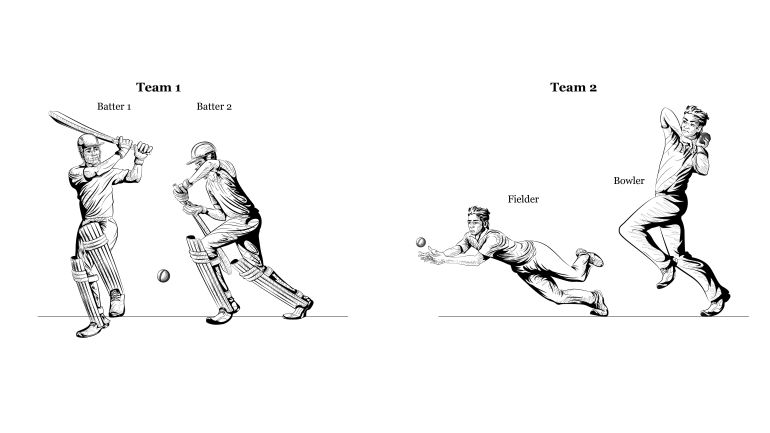
In the first innings, following a coin toss, the first team bats while the other team bowls and fields.

Interactive_Illustrated guide to cricket_8 teams

The batting team should try to score the highest number of runs in the allotted time, while the bowling team has to try to prevent them from scoring.

Interactive_Illustrated guide to cricket_8-Batting team

The bowling team has dedicated bowlers, while the remaining players, spread across the ground, try to prevent the batters from scoring runs as well as catch the ball to get the batters out.

Interactive_Illustrated guide to cricket_Bowling team

In the second innings, the bowling team now gets a turn to bat and try to score more runs than their opposition.

The team with the highest number of runs at the end of the day wins the game.

What does T20 mean?

There are three different formats in cricket, each with its own duration and rules.

Each format has its own defined set of “overs”.

An “over” consists of six deliveries by the bowler.

Interactive_Illustrated guide to cricket_OVER

In a T20 match, which usually lasts three to four hours, each team is given 20 overs (120 balls) to score the most number of runs. This format of the game is designed to be shorter and faster-paced, which provides more excitement for spectators.

Interactive_Illustrated guide to cricket_20OVERS

A One Day International (ODI) match typically lasts about seven to eight hours. Each team is given a total of 300 deliveries, which are divided into 50 overs, to score the most number of runs.

Interactive_Illustrated guide to cricket_50OVERS

A Test match is the longest and oldest format of the game, played over a maximum of five days. It is considered a test of endurance and skill. Each day has a minimum of 90 overs. Both teams have two innings each.

The cricket field and pitch

Cricket is played in a large, oval-shaped field, typically about 150 metres (164 yards) in diameter at its widest point and surrounded by a boundary rope.

Interactive_Illustrated guide to cricket_Cricket field and pitch

In the centre of the field is the pitch, a rectangular area about 20 metres long (22 yards) and 3 metres (3.3 yards) wide, where most of the action takes place.

At each end of the pitch are three wooden sticks known as wickets or stumps, with two bails atop them.

The batter stands in front of these wickets inside a specified area known as the batting crease. It is from there that he or she will strike the incoming ball from the bowler.

Interactive_Illustrated guide to cricket_PITCH_REVISED

During the match, the batting team will actually have two players on the field, one on either end of the pitch, to take turns in hitting the ball.

The bowling team, meanwhile, will have all 11 players scattered throughout the field to minimise the number of runs their opponents can score.

Some of the most common positions are shown below:

Interactive_Illustrated guide to cricket_FIELDING_REVISED

How are runs scored?

The aim for the batters is to score as many runs as possible by hitting the ball in the gaps between the fielders or over the boundary rope.

To score a run, the batter needs to hit the ball and then, together with their batting partner, run to the opposite side of the pitch before the fielder returns the ball; otherwise, they can be run out.

Interactive_Illustrated guide to cricket_run scoring

A single run is scored when both batters safely complete one run, a two-run when they complete two runs, and so on.

If a batter hits the ball along the ground and it reaches the boundary rope, then four runs are awarded.

To signal that four runs have been scored, the umpire moves his right hand from one side to the other, repeatedly waving it back and forth horizontally.

CRICKET-WIS-IND-2NDTEST
Umpire Paul Reiffel (R) signals four runs during a Test match between West Indies and India [Randy Brooks/AFP]

The maximum, six runs, is scored when the batter hits the ball directly over the boundary before it bounces. This shot is the most rewarding but also among the riskiest, due to the chances of getting bowled or caught.

To signal a six, the umpire will raise both hands above his head, which the fans will often imitate.

CRICKET-ODI-ZIM-IRL
Umpire Michael Gough (R) signals for six runs during a One Day International cricket match between Zimbabwe and Ireland [Jekesai Njikizana/AFP]

How does a player get ‘out’?

There are several ways to get a batter out, with each out referred to as “losing a wicket”.

Interactive_Illustrated guide to cricket_WAYS TO GET OUT_REVISED

Since cricket is played with pairs of batsmen, when 10 players from the batting team are dismissed, their innings concludes, and the sum of the runs they scored sets the target score for the bowling team.

The most common ways of getting a player out include:

Bowled: This happens if the batter misses the ball, and it goes on to hit the wicket.

Interactive_Illustrated guide to cricket_bowled

Caught: A batter is caught out when they hit the ball and a fielder catches it before it touches the ground.

Interactive_Illustrated guide to cricket_caught

Run-Out: A run-out happens when the fielding team throws the ball at the wicket while the batter is trying to score a run and before they can reach the opposite side of the pitch.

Interactive_Illustrated guide to cricket_run out

LBW (Leg Before Wicket): This decision depends on various factors, but in a nutshell, a batter can be given out LBW if the ball hits their legs while they are standing in front of the wicket, thus preventing the wicket from being hit.

Interactive_Illustrated guide to cricket_leg_before_wicket

To signal an “out”, the umpire who is standing in the middle of the field will raise his index finger to signify that a batter has been dismissed.

This gesture is often referred to as the umpire having “raised the finger” or “given the finger”.

Cricket - Ashes - Fifth Test - England v Australia - The Oval, London, Britain - July 28, 2023 The on field umpire gives out for Australia's Pat Cummins before the decision is overturned following a review Action Images via Reuters/Andrew Boyers
The on-field umpire signals an out for Australia’s Pat Cummins before the decision is overturned following a review [Andrew Boyers/Reuters]

How do you read the score?

To follow the score in cricket, you need to look at three numbers.

The first is the number of runs a team has scored – the higher the number, the better.

The second indicates the number of “outs” or “wickets”. Once 10 players are out, their batting innings come to an end.

The third is the number of overs that have been bowled.

Combined, a score may look like this: 109-5 (10 overs)

This means that 109 runs have been scored, 5 players are out, and 10 overs have been completed.

INTERACTIVE cricket-players-1770121180
(Al Jazeera)

Typically, teams make anywhere from 100 to 250 runs during a T20 match. A score of 100 is considered low to defend, while 250 runs is usually very strong.

The highest score in international T20 cricket was between Zimbabwe and The Gambia in 2024.

Zimbabwe batted first and scored a huge 344-4 in their 20 overs. In response, The Gambia only managed 54 runs before losing all 10 of their wickets.

A simple guide to playing cricket

The tenth edition of the ICC Men’s T20 World Cup will take place in India and Sri Lanka from February 7 to March 8, 2026.

Twenty teams will be competing in 55 matches for the chance to win cricket’s most prestigious T20 trophy.

But cricket is a game with a list of commonly used terms and phrases that might confuse those new to it.

In this illustrated guide, Al Jazeera breaks down cricket lingo and helps you understand the game beloved by nearly two billion people.

What is the aim of the game?

Cricket is a bat-and-ball sport played between two teams consisting of 11 players each.

The game is divided into two parts, known as innings.

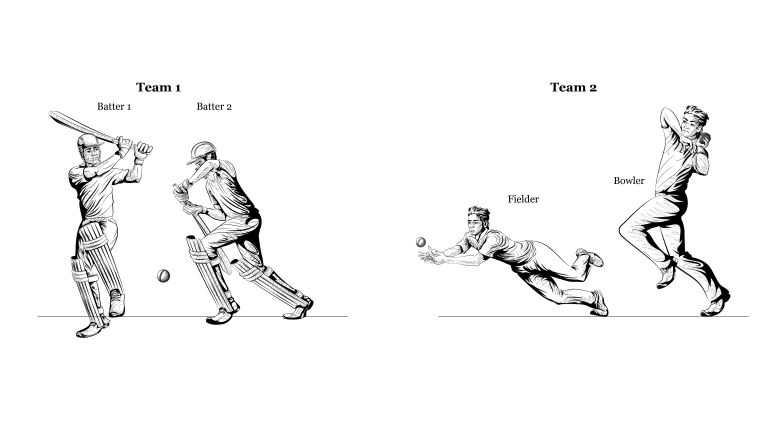
In the first innings, following a coin toss, the first team bats while the other team bowls and fields.

Interactive_Illustrated guide to cricket_8 teams

The batting team should try to score the highest number of runs in the allotted time, while the bowling team has to try to prevent them from scoring.

Interactive_Illustrated guide to cricket_8-Batting team

The bowling team has dedicated bowlers, while the remaining players, spread across the ground, try to prevent the batters from scoring runs as well as catch the ball to get the batters out.

Interactive_Illustrated guide to cricket_Bowling team

In the second innings, the bowling team now gets a turn to bat and try to score more runs than their opposition.

The team with the highest number of runs at the end of the day wins the game.

What does T20 mean?

There are three different formats in cricket, each with its own duration and rules.

Each format has its own defined set of “overs”.

An “over” consists of six deliveries by the bowler.

Interactive_Illustrated guide to cricket_OVER

In a T20 match, which usually lasts three to four hours, each team is given 20 overs (120 balls) to score the most number of runs. This format of the game is designed to be shorter and faster-paced, which provides more excitement for spectators.

Interactive_Illustrated guide to cricket_20OVERS

A One Day International (ODI) match typically lasts about seven to eight hours. Each team is given a total of 300 deliveries, which are divided into 50 overs, to score the most number of runs.

Interactive_Illustrated guide to cricket_50OVERS

A Test match is the longest and oldest format of the game, played over a maximum of five days. It is considered a test of endurance and skill. Each day has a minimum of 90 overs. Both teams have two innings each.

The cricket field and pitch

Cricket is played in a large, oval-shaped field, typically about 150 metres (164 yards) in diameter at its widest point and surrounded by a boundary rope.

Interactive_Illustrated guide to cricket_Cricket field and pitch

In the centre of the field is the pitch, a rectangular area about 20 metres long (22 yards) and 3 metres (3.3 yards) wide, where most of the action takes place.

At each end of the pitch are three wooden sticks known as wickets or stumps, with two bails atop them.

The batter stands in front of these wickets inside a specified area known as the batting crease. It is from there that he or she will strike the incoming ball from the bowler.

Interactive_Illustrated guide to cricket_PITCH_REVISED

During the match, the batting team will actually have two players on the field, one on either end of the pitch, to take turns in hitting the ball.

The bowling team, meanwhile, will have all 11 players scattered throughout the field to minimise the number of runs their opponents can score.

Some of the most common positions are shown below:

Interactive_Illustrated guide to cricket_FIELDING_REVISED

How are runs scored?

The aim for the batters is to score as many runs as possible by hitting the ball in the gaps between the fielders or over the boundary rope.

To score a run, the batter needs to hit the ball and then, together with their batting partner, run to the opposite side of the pitch before the fielder returns the ball; otherwise, they can be run out.

Interactive_Illustrated guide to cricket_run scoring

A single run is scored when both batters safely complete one run, a two-run when they complete two runs, and so on.

If a batter hits the ball along the ground and it reaches the boundary rope, then four runs are awarded.

To signal that four runs have been scored, the umpire moves his right hand from one side to the other, repeatedly waving it back and forth horizontally.

CRICKET-WIS-IND-2NDTEST
Umpire Paul Reiffel (R) signals four runs during a Test match between West Indies and India [Randy Brooks/AFP]

The maximum, six runs, is scored when the batter hits the ball directly over the boundary before it bounces. This shot is the most rewarding but also among the riskiest, due to the chances of getting bowled or caught.

To signal a six, the umpire will raise both hands above his head, which the fans will often imitate.

CRICKET-ODI-ZIM-IRL
Umpire Michael Gough (R) signals for six runs during a One Day International cricket match between Zimbabwe and Ireland [Jekesai Njikizana/AFP]

How does a player get ‘out’?

There are several ways to get a batter out, with each out referred to as “losing a wicket”.

Interactive_Illustrated guide to cricket_WAYS TO GET OUT_REVISED

Since cricket is played with pairs of batsmen, when 10 players from the batting team are dismissed, their innings concludes, and the sum of the runs they scored sets the target score for the bowling team.

The most common ways of getting a player out include:

Bowled: This happens if the batter misses the ball, and it goes on to hit the wicket.

Interactive_Illustrated guide to cricket_bowled

Caught: A batter is caught out when they hit the ball and a fielder catches it before it touches the ground.

Interactive_Illustrated guide to cricket_caught

Run-Out: A run-out happens when the fielding team throws the ball at the wicket while the batter is trying to score a run and before they can reach the opposite side of the pitch.

Interactive_Illustrated guide to cricket_run out

LBW (Leg Before Wicket): This decision depends on various factors, but in a nutshell, a batter can be given out LBW if the ball hits their legs while they are standing in front of the wicket, thus preventing the wicket from being hit.

Interactive_Illustrated guide to cricket_leg_before_wicket

To signal an “out”, the umpire who is standing in the middle of the field will raise his index finger to signify that a batter has been dismissed.

This gesture is often referred to as the umpire having “raised the finger” or “given the finger”.

Cricket - Ashes - Fifth Test - England v Australia - The Oval, London, Britain - July 28, 2023 The on field umpire gives out for Australia's Pat Cummins before the decision is overturned following a review Action Images via Reuters/Andrew Boyers
The on-field umpire signals an out for Australia’s Pat Cummins before the decision is overturned following a review [Andrew Boyers/Reuters]

How do you read the score?

To follow the score in cricket, you need to look at three numbers.

The first is the number of runs a team has scored – the higher the number, the better.

The second indicates the number of “outs” or “wickets”. Once 10 players are out, their batting innings come to an end.

The third is the number of overs that have been bowled.

Combined, a score may look like this: 109-5 (10 overs)

This means that 109 runs have been scored, 5 players are out, and 10 overs have been completed.

INTERACTIVE cricket-players-1770121180
(Al Jazeera)

Typically, teams make anywhere from 100 to 250 runs during a T20 match. A score of 100 is considered low to defend, while 250 runs is usually very strong.

The highest score in international T20 cricket was between Zimbabwe and The Gambia in 2024.

Zimbabwe batted first and scored a huge 344-4 in their 20 overs. In response, The Gambia only managed 54 runs before losing all 10 of their wickets.

Scotland’s rising star Brown poised for sliding doors moment

Tom English

BBC Scotland’s chief sports writer

We are inching towards a sliding doors moment in the life of Gregor Brown.

The day is surely fast approaching when Brown is no longer quizzed about being Blair Kinghorn’s cousin and when the Scotland full-back is instead asked what it is like being related to the Glasgow forward.

It is not exactly clear which position Brown is going to play for Scotland in the Six Nations, or indeed, if he starts or is on the bench, but there is one certainty – he is going to be pivotal to the team’s hopes.

The 24-year-old is only really 18 months into his time as a top-level player – a whirlwind of progress that he calls “insane” – but his impact has been enormous.

He has played Test matches with four, five, six and seven on his back. He has started against France at lock and against New Zealand and Argentina at blindside flanker.

He was Jonny Gray’s understudy in the Six Nations last season and by the summer had played some minutes for the British and Irish Lions in Australia.

“If I went back 18 months and you told me that I would have done all this, I would have laughed at you. Like, no way. It’s just been absolutely mental,” he told the Scotland Rugby Podcast.

True, but Brown is a pivotal figure now for Townsend, a guy who gives the coach some questions to answer.

Townsend’s natural inclination for their Six Nations Opener against Italy in Rome on Saturday might be a second row of Grant Gilchrist and Scott Cummings.

2026 Guinness Six Nations

Watch on iPlayerListen on Sounds

No matter how you slice it, Brown’s power, energy, footwork and all-round skill-set is indispensable. The only puzzler is how best to deploy it.

The man himself only sees the positives, no matter which way Townsend goes.

“Obviously, everyone wants to start, but I think a big growth in rugby over the past few years has been that it’s an 80-minute game and that the bench has such an important role to play,” he added.

“I have spoken about South Africa leading the way in that sense. When you’re a pack and it gets to 50, 60 minutes and you see six or seven fresh forwards come on, it’s like, ‘right, we’ve got to up it now’.

“Test match rugby is physical, it’s fast. When you get to those last 15, 20 minutes, it’s usually the crunch time. The game is usually still in the balance at that point and it will be the bench making that difference.”

Gregor BrownSNS

“I remember Franco talking about it. He was kind of joking but also being serious about how you have all your friends around to watch a rugby game and when it kicks off, people are getting a drink, snacks, going to the toilet,” said Brown.

“But in that last 15, 20 minutes, everybody is sat glued to the TV and that’s when the bench are on.

“This old-school mindset of secondary players coming on is just not what it is any more. Off the bench, you can bring more punch, more dynamism in the carries, tackles, things like that.

    • 20 hours ago
    • 1 day ago

The strength of Scotland’s bench is particularly relevant given how many times they have fallen away late in games, which was a bit of a theme in their camp last week.

Stacking the bench as much as he can makes sense. It will be fascinating to see what Townsend does when he names the team on Thursday to face Italy.

In Brown, he has a player who is growing up fast. His cameo with the Lions – the highlight of which was coming on for James Ryan in the battle against First Nations & Pasifika in Melbourne – has only helped the process.

It was brief, sure, but he made the most of it.

“I was only there for a few days but being in the same environment as some of the best players in the world was absolutely incredible,” he said.

“I’ve got my jersey and I still look at it. I’m just like, ‘wow!’

Gregor BrownSNS

Related topics

  • Scottish Rugby
  • Rugby Union

Related internet links

Scotland’s rising star poised for sliding doors moment

Tom English

BBC Scotland’s chief sports writer

We are inching towards a sliding doors moment in the life of Gregor Brown.

The day is surely fast approaching when Brown is no longer quizzed about being Blair Kinghorn’s cousin and when the Scotland full-back is instead asked what it is like being related to the Glasgow forward.

It is not exactly clear which position Brown is going to play for Scotland in the Six Nations, or indeed, if he starts or is on the bench, but there is one certainty – he is going to be pivotal to the team’s hopes.

The 24-year-old is only really 18 months into his time as a top-level player – a whirlwind of progress that he calls “insane” – but his impact has been enormous.

He has played Test matches with four, five, six and seven on his back. He has started against France at lock and against New Zealand and Argentina at blindside flanker.

He was Jonny Gray’s understudy in the Six Nations last season and by the summer had played some minutes for the British and Irish Lions in Australia.

“If I went back 18 months and you told me that I would have done all this, I would have laughed at you. Like, no way. It’s just been absolutely mental,” he told the Scotland Rugby Podcast.

True, but Brown is a pivotal figure now for Townsend, a guy who gives the coach some questions to answer.

Townsend’s natural inclination for their Six Nations Opener against Italy in Rome on Saturday might be a second row of Grant Gilchrist and Scott Cummings.

2026 Guinness Six Nations

Watch on iPlayerListen on Sounds

No matter how you slice it, Brown’s power, energy, footwork and all-round skill-set is indispensable. The only puzzler is how best to deploy it.

The man himself only sees the positives, no matter which way Townsend goes.

“Obviously, everyone wants to start, but I think a big growth in rugby over the past few years has been that it’s an 80-minute game and that the bench has such an important role to play,” he added.

“I have spoken about South Africa leading the way in that sense. When you’re a pack and it gets to 50, 60 minutes and you see six or seven fresh forwards come on, it’s like, ‘right, we’ve got to up it now’.

“Test match rugby is physical, it’s fast. When you get to those last 15, 20 minutes, it’s usually the crunch time. The game is usually still in the balance at that point and it will be the bench making that difference.”

Gregor BrownSNS

“I remember Franco talking about it. He was kind of joking but also being serious about how you have all your friends around to watch a rugby game and when it kicks off, people are getting a drink, snacks, going to the toilet,” said Brown.

“But in that last 15, 20 minutes, everybody is sat glued to the TV and that’s when the bench are on.

“This old-school mindset of secondary players coming on is just not what it is any more. Off the bench, you can bring more punch, more dynamism in the carries, tackles, things like that.

    • 21 hours ago
    • 1 day ago

The strength of Scotland’s bench is particularly relevant given how many times they have fallen away late in games, which was a bit of a theme in their camp last week.

Stacking the bench as much as he can makes sense. It will be fascinating to see what Townsend does when he names the team on Thursday to face Italy.

In Brown, he has a player who is growing up fast. His cameo with the Lions – the highlight of which was coming on for James Ryan in the battle against First Nations & Pasifika in Melbourne – has only helped the process.

It was brief, sure, but he made the most of it.

“I was only there for a few days but being in the same environment as some of the best players in the world was absolutely incredible,” he said.

“I’ve got my jersey and I still look at it. I’m just like, ‘wow!’

Gregor BrownSNS

Related topics

  • Scottish Rugby
  • Rugby Union

Related internet links

ICE agents have no operational police role in Winter Olympics: Italy

Agents from the divisive United States Immigration and Customs Enforcement (ICE) agency will have no operational role in the Winter Olympics, Italy’s interior minister has said days before the Milan-Cortina Games open.

ICE’s Homeland Security Investigations (HSI), which is a separate investigative arm of the Department of Homeland Security (DHS) from the department carrying out the US immigration crackdown, will operate within US diplomatic missions only and “are not operational agents” and “have no executive function”, Matteo Piantedosi told the Italian Parliament on Wednesday.

Recommended Stories

list of 3 itemsend of list

He said the outrage over the HSI presence, including the Milan mayor’s warning that they were not welcome in the city during the February 6-22 Winter Games, was “completely unfounded”.

“ICE does not and will never be able to carry out operational police activities on our national territory,” Piantedosi said.

The minister aimed to clarify the news of the contentious deployment of ICE agents, which prompted protests in the Italian metropolis.

“Security and public order are ensured exclusively by our police forces,” he said.

“During the Milan-Cortina Games, the members of this agency will be engaged solely in analysis and information exchange with the Italian authorities,” he added.

“The presence of personnel linked to the ICE agency is certainly not a sudden and unilateral initiative to undermine our national sovereignty, as some have portrayed, but rather compliance with a legally binding international agreement entered into by Italy.”

Last week, the US agency said it will support the “Department of State’s Diplomatic Security Service and host nation to vet and mitigate risks from transnational criminal organisations”.

Following the announcement, Milan Mayor Giuseppe Sala said ICE would not be welcome in his city.

“This is a militia that kills … It’s clear that they are not welcome in Milan. There’s no doubt about it. Can’t we just say no to [US President Donald] Trump for once?” he said in an interview with RTL 102.5 radio.

ICE said its operations in Italy are separate from the immigration crackdown ordered by Trump in the US.

The Italian interior minister confirmed that the agency’s role would be limited.

“We will not see anything on national territory that resembles what has been seen in the media in the United States,” Piantedosi said.