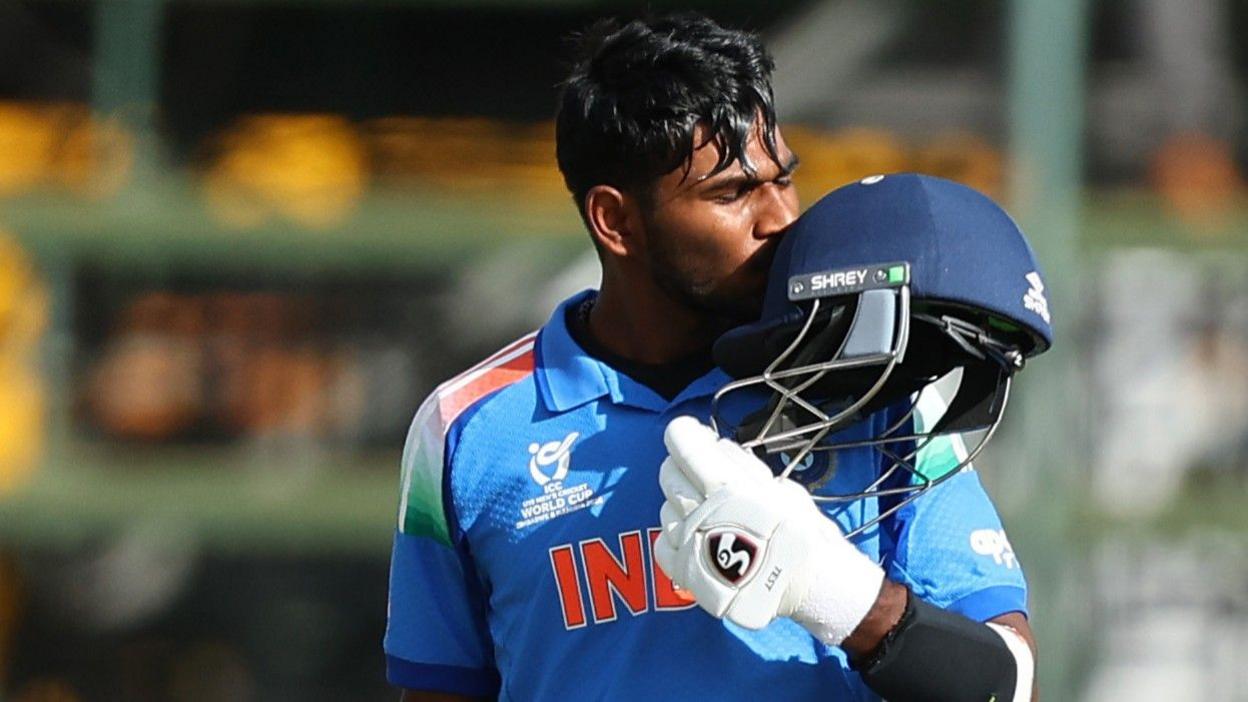
India 311-3 (41.1 overs): George 115 (104), Suryavanshi 68 (33); Nooristani 2-64
India won by seven wickets
India will play England in the final of the Under-19 World Cup after a record-breaking run-chase against Afghanistan in Harare.
The five-time winners chased down an Under-19 World Cup record target of 311 for the loss of just three wickets and with more than eight overs to spare in a blistering display.
Aaron George hit 115 after 14-year-old Vaibhav Suryavanshi, who already has a 35-ball IPL century to his name, smoked a scintillating 68 off just 33 balls after being dropped twice.
Captain Ayush Mhatre added a half-century of his own as India waltzed into their 10th final against an England side looking for their first win in the competition since 1998.
Faisal Khan Shinozada and Uzairullah Niazai both hit centuries for Afghanistan, who looked well set until the India batters took over.
“Our discussion was simple – just play our natural game,” said Mhatre. “The wicket was playing beautifully, a real flat wicket, so we knew if we played naturally, it would be a manageable total.
“Suryavanshi played a major role in the chase. Scoring 90 runs in the first 10 overs released all the pressure, making it much easier for the rest of us to build the innings.
“George is a classy, fabulous batsman. He anchored the innings perfectly.”
India 311-3 (41.1 overs): George 115 (104), Suryavanshi 68 (33); Nooristani 2-64
India won by seven wickets
India will play England in the final of the Under-19 World Cup after a record-breaking run-chase against Afghanistan in Harare.
The five-time winners chased down an Under-19 World Cup record target of 311 for the loss of just three wickets and with more than eight overs to spare in a blistering display.
Aaron George hit 115 after 14-year-old Vaibhav Suryavanshi, who already has a 35-ball IPL century to his name, smoked a scintillating 68 off just 33 balls after being dropped twice.
Captain Ayush Mhatre added a half-century of his own as India waltzed into their 10th final against an England side looking for their first win in the competition since 1998.
Faisal Khan Shinozada and Uzairullah Niazai both hit centuries for Afghanistan, who looked well set until the India batters took over.
“Our discussion was simple – just play our natural game,” said Mhatre. “The wicket was playing beautifully, a real flat wicket, so we knew if we played naturally, it would be a manageable total.
“Suryavanshi played a major role in the chase. Scoring 90 runs in the first 10 overs released all the pressure, making it much easier for the rest of us to build the innings.
“George is a classy, fabulous batsman. He anchored the innings perfectly.”
New Delhi, India – When US President Donald Trump announced a trade deal with India on Monday this week, he declared that New Delhi would pivot away from Russian energy as part of the agreement.
Indian Prime Minister Narendra Modi, Trump said, had promised to stop buying Russian oil, and instead buy crude from the United States and from Venezuela, whose president, Nicolas Maduro, was abducted by US special forces in early January. Since then, the US has effectively taken control of Venezuela’s mammoth oil industry.
In return, Trump dialled down trade tariffs on Indian goods from an overall 50 percent to just 18 percent. Half of that 50 percent tariff was levied last year as punishment for India buying Russian oil, which the White House maintains is financing Russian President Vladimir Putin’s war in Ukraine.
But since Monday, India has not publicly confirmed that it has committed to either ceasing its purchase of Russian oil or embracing Venezuelan crude, analysts note. Dmitry Peskov, a Kremlin spokesperson, told reporters on Tuesday that Russia had received no indication of this from India, either.
And switching from Russian to Venezuelan oil will be far from straightforward. A cocktail of other factors – shocks to the energy market, costs, geography, and the characteristics of different kinds of oil – will complicate New Delhi’s decisions about its sourcing of oil, they say.
So, can India really dump Russian oil? And can Venezuelan crude replace it?
US President Donald Trump speaks during a news conference on Saturday, January 3, 2026 at his Mar-a-Lago estate in Palm Beach, Florida, the US as Secretary of State Marco Rubio listens [Alex Brandon/AP]
What is Trump’s plan?
Trump has been pressuring India to stop buying Russian oil for months. After Russia invaded Ukraine in 2022, the US and European Union placed an oil price cap on Russian crude in a bid to limit Russia’s ability to finance the war.
As a result, other countries including India began buying large quantities of cheap Russian oil. India, which before the war sourced only 2.5 percent of its oil from Russia, became the second-largest consumer of Russian oil after China. It currently sources around 30 percent of its oil from Russia.
Last year, Trump doubled trade tariffs on Indian goods from 25 percent to 50 percent as punishment for this. Later in the year, Trump also imposed sanctions on Russia’s two biggest oil companies – and threatened secondary sanctions against countries and entities that trade with these firms.
Since the abduction of Maduro by US forces in early January, Trump has effectively taken over the Venezuelan oil sector, controlling sales cash flows.
Venezuela also has the largest proven oil reserves in the world, estimated at 303 billion barrels, more than five times larger than those of the US, the world’s largest oil producer.
But while getting India to buy Venezuelan oil makes sense from the US’s perspective, analysts say this could be operationally messy.
A man sits by railway tracks as a freight train transports petrol wagons in Ajmer, India, on August 27, 2025. US tariffs of 50 percent took effect on August 27 on many Indian products, doubling an existing duty as US President Donald Trump sought to punish New Delhi for buying Russian oil [File: Himanshu Sharma/AFP]
How much oil does India import from Russia?
India currently imports nearly 1.1 million barrels per day (bpd) of Russian crude, according to analytics company Kpler. Under Trump’s mounting pressure, that is lower than the average 1.21 million bpd in December 2025 and more than 2 million bpd in mid-2025.
One barrel is equivalent to 159 litres (42 gallons) of crude oil. Once refined, a barrel typically produces about 73 litres (19 gallons) of petrol for a car. Oil is also refined to produce a wide variety of products, from jet fuel to household items including plastics and even lotions.
Russian President Vladimir Putin, left, and Indian Prime Minister Narendra Modi greet each other before a meeting in New Delhi, India, on December 6, 2021 [File: Manish Swarup/AP]
Has India stopped Russian oil purchases?
India has reduced the amount of oil it buys from Russia over the past year, but it has not stopped buying it altogether.
Under increasing pressure from Trump, last August, Indian officials called out the “hypocrisy” of the US and EU pressuring New Delhi to back off from Russian crude.
“In fact, India began importing from Russia because traditional supplies were diverted to Europe after the outbreak of the conflict,” Randhir Jaiswal, India’s Foreign Ministry spokesperson, said then. He added that India’s decision to import Russian oil was “meant to ensure predictable and affordable energy costs to the Indian consumer”.
Despite this, Indian refiners, currently the second-largest group of buyers of Russian oil after China, are reportedly winding up their purchases after clearing current scheduled orders.
Major refiners like Hindustan Petroleum Corporation Ltd (HPCL), Mangalore Refinery and Petrochemicals Ltd (MRPL), and HPCL-Mittal Energy Ltd (HMEL) halted purchasing from Russia following the US sanctions against Russian oil producers last year.
Other players like Indian Oil Corporation (IOC), Bharat Petroleum Corporation, and Reliance Industries will soon stop their purchases.
A man pushes his cart as he walks past Bharat Petroleum’s storage tankers in Mumbai, India, December 8, 2022 [File: Punit Paranjpe/AFP]
What happens if India suddenly stops buying Russian oil?
Even if India wanted to stop importing Russian oil altogether, analysts argue it would be extremely costly to do so.
In September last year, India’s oil and petroleum minister, Hardeep Singh Puri, told reporters that it would also sharply push up energy prices and fuel inflation. “The world will face serious consequences if the supplies are disrupted. The world can’t afford to keep Russia off the oil market,” Puri said.
Analysts tend to agree. “A complete cessation of Indian purchases of Russian oil would be a major disruption. An immediate halt would spike global prices and threaten India’s economic growth,” said George Voloshin, an independent energy analyst based in Paris.
Russian oil would likely be diverted more heavily towards China and into “shadow” fleets of tankers that deliver sanctioned oil secretly by flying false flags and switching off location equipment, Voloshin told Al Jazeera. “Mainstream tanker demand would shift toward the Atlantic Basin, most likely increasing global freight rates as a result,” he noted.
Sumit Pokharna, vice president at Kotak Securities, noted that Indian refineries have reported robust margins in the last two years, majorly benefitting from the discounted Russian crude.
“If they move to higher-costing, like the US or Venezuela, then raw material cost would increase, and that would squeeze their margins,” he told Al Jazeera. “If it goes beyond control, they may have to pass the excess onto consumers.”
A pumpjack for oil is pictured at the Campo Elias neighbourhood in Cabimas, south of Lake Maracaibo, Zulia state, Venezuela, on January 31, 2026 [File: Maryorin Mendez/AFP]
Can India stop buying Russian oil altogether?
It may not be able to. One of India’s two private refiners, Nayara Energy, is majority-Russian-owned and under heavy Western sanctions. The Russian energy firm Rosneft holds a 49.13 percent stake in the company, which operates a 400,000-barrel-per-day refinery in India’s Gujarat, PM Modi’s home state.
Nayara is the second-largest importer of Russian crude, buying about 471,000 barrels per day in January this year, accounting for nearly 40 percent of Russian supplies to India.
Its plant has relied solely on Russian crude since European Union sanctions were imposed on the company last July.
Nayara is not planning to load Russian oil in April as it shuts its refinery for more than a month for maintenance from April 10, according to Reuters.
Pokharna said the future of Nayara hangs in the balance, with the US unlikely to grant India an overt exemption for the Russia-backed company to import crude.
Can India switch to Venezuelan oil?
India has been a major consumer of Venezuelan oil in the past. At its peak, in 2019, India imported $7.2bn of oil, accounting for just under 7 percent of total imports. That stopped after the US slapped sanctions on Venezuelan oil, but some officials of the government-owned Oil and Natural Gas Corporation are still stationed in the Latin American country.
Now, major Indian refiners have said they are open to receiving Venezuelan oil again, but only if it is a viable option.
For one thing, Venezuela is roughly twice as far from India as Russia and five times further than the Middle East, meaning much higher freight costs.
Venezuelan oil is more expensive as well. “Russian Urals [a medium-heavy crude blend] has been trading at a wide-ranging discount of about $10-20 per barrel to Brent, while Venezuelan Merey currently offers a smaller discount of around $5-8 per barrel,” Voloshin told Al Jazeera.
“Importing from Venezuela and forgoing the Russian discount would be a costly affair for India,” said Pokharna. “From transportation cost to forgoing discounts, it could cost India $6-8 more per barrel – and that is a huge increase in the importing bill.”
Overall, a complete pivot away from Russia could raise India’s import bill by $9bn to $11bn – an amount roughly equal to India’s federal health budget – per year, according to Kpler.
“Venezuelan crude must be discounted by at least $10 to $12 per barrel to be competitive,” argued Voloshin. “This deeper discount is necessary to offset the much higher freight costs, increased insurance premiums for the longer Atlantic voyage, and the somewhat higher operational expenses required to process Venezuela’s extra-heavy high-sulfur crude.”
Without deeper discounts, the longer journey and complex handling make Venezuelan oil more expensive on a delivered basis, he added.
Another major issue is that many Indian refiners simply do not have the facilities to process very heavy Venezuelan oil.
Venezuelan crude is a heavy, sour oil, thick and viscous like molasses, with a high sulphur content requiring complex, specialised refineries to process it into fuel. Only a small number of Indian refineries are equipped to handle it.
“[Venezuelan oil’s heaviness] makes it an option only for complex refineries, leaving out older and smaller refineries,” Pokharna told Al Jazeera. “The shift is operationally difficult and would require blending with more expensive light crudes.”
Then there is the question of availability. Today, Venezuela produces barely a million barrels per day when pushed to its limit. Even if all production was sent to India, it would not match the total Russian oil import.
Where else could India buy oil?
India’s Minister Puri has said that New Delhi is looking to diversify sourcing options from nearly 40 countries.
As India has reduced Russian imports, it has increased them from Middle Eastern nations and other countries in the Organization of the Petroleum Exporting Countries (OPEC). Now, while Russia accounts for nearly 27 percent share in India’s oil imports, OPEC nations, led by Iraq and Saudi Arabia, contribute 53 percent.
Reeling from Trump’s trade war, India has also increased purchases of US oil. American crude imports to India rose by 92 percent from April to November in 2025 to nearly 13 million tons, compared to 7.1 million in the same period in 2024.
However, India would be competing for these supplies with the European Union, which has pledged to spend $750bn by 2028 on US energy and nuclear products.
Meanwhile, for Venezuela to return to higher production, Caracas needs political stability, changes in foreign investment and oil laws, and to clear debts. That will take time, experts say.
Customers refuel their vehicles at a Nayara Energy Limited fuel station, the Russian oil major Rosneft’s majority-owned Indian refiner, in Bengaluru, India on December 12, 2025 [File: Idrees Mohammed/AFP]
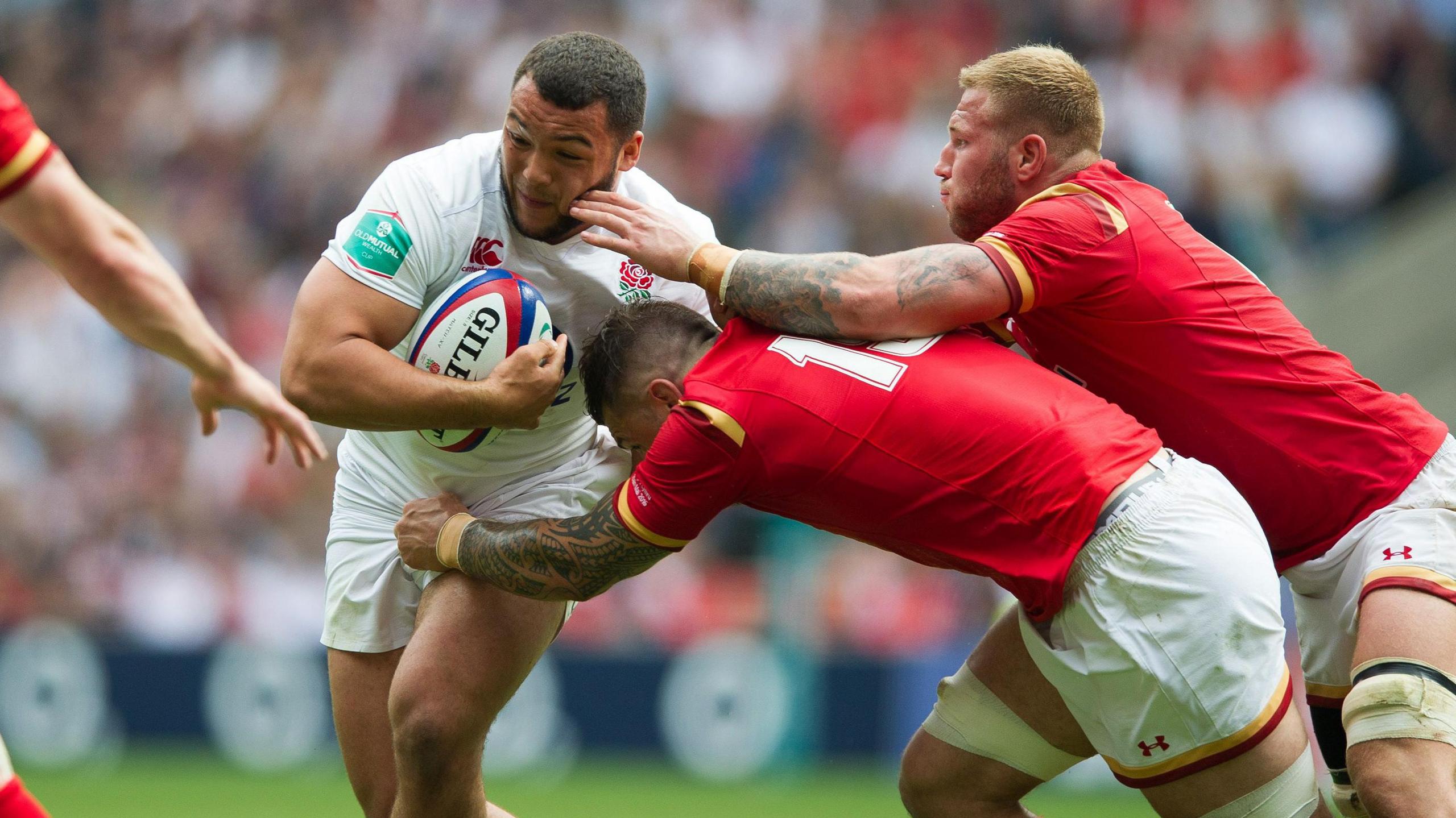
Prop Ellis Genge says he is braced for Wales to take out their frustrations on England when the sides meet in their Six Nations openers on Saturday.
Wales have lost 20 of 22 Tests since the 2023 Rugby World Cup while a controversial restructuring of their domestic game continues in the background.
1 day ago
2 days ago
Bookmakers have Wales as rank outsiders for the fixture with odds of 28-1 available on the visitors to Allianz Stadium.
“Sometimes when there is a lot of stuff behind the scenes it can bring you together and, for them, there is no better fixture than England v Wales,” Genge told Rugby Union Weekly.
“Although there has been a bit of turmoil over the last 12 months and a lot of tough discussions behind the scenes, everyone knows that a Wales team who are a bit damaged, coming to Twickenham, is not going to be an easy game by any means.”
New head coach Steve Tandy is coming into his first Six Nations with Wales, having previously overseen Scotland’s defence.
Genge believes a 73-0 thrashing by world champions South Africa at the end of his maiden autumn campaign has obscured some of the progress Wales have already made.
The fixture against the Springboks was staged outside World Rugby’s window for international matches, meaning a clutch of first-choice players were on club duty outside Wales and unavailable to Tandy.
Genge believes Wales’ performance against New Zealand the week before, when they were within three points of the All Blacks on 50 minutes before fading to a 52-26 defeat, is a more accurate indicator of their form.
“You have got to pay them their respect. With a full outfit they were brilliant against New Zealand for 50 or 60 minutes, so they have definitely got it,” he added.
‘England’s new prop stars young, but ready’
Getty Images
Genge starts at loose-head prop on Saturday, with Bevan Rodd backing him up on the replacements bench. However, injuries to fellow front-rowers Will Stuart, Asher Opoku-Fordjour and Fin Baxter have ushered some new faces into the wider England squad.
Bath’s Vilikesa ‘Billy’ Sela and Northampton’s Emmanuel Iyogun, both uncapped, have been called up for the Six Nations.
Twenty-year-old Sela’s rise has been especially rapid.
He was part of England’s under-20 world title win in July 2024, but with South Africa’s Thomas du Toit, Stuart and Wales’ Archie Griffin all tight-head options at Bath, senior action has been hard to come by.
Sela has made three league starts and another two in the Investec Champions Cup this season.
Genge, who made his debut as a 21-year-old against Wales in May 2016, says the new generation of front-row talent are better prepared for the Test game than he was.
“They are big lumps, not like when we were younger,” he said.
“Billy is bigger than me I think – size 15 feet. All the youngsters who come in, they are young, but they are ready.
“I wasn’t ready for Test match rugby until 23, 24, maybe a bit older if I am honest.
“Now the boys come in and they are huge, they are robust, their neck strength is there, they have played a lot of Prem rugby.
A recently released audio recording captures disgraced financier Jeffrey Epstein and former Israeli Prime Minister Ehud Barak discussing the “gigantic” sums paid to former UK Prime Minister Tony Blair for his consulting work, and questioning his financial arrangements.
In the recording, released by the United States Department of Justice as part of a massive new tranche of investigative files related to the disgraced financier, the men appear to be discussing strategies for former political figures to make money after leaving office.
Recommended Stories
list of 4 itemsend of list
Epstein, whom Blair has admitted meeting once in Downing Street during his time as prime minister, talks approvingly of the significant sums being paid to the former United Kingdom leader for his work, but speculates that the money is not all going to Blair, with payments of some funds being made to other parties.
The audio does not provide specific details about the other parties.
Blair, a divisive figure who led the UK from 1997 to 2007 and was an architect of the catastrophic Iraq war, provided consultancy services to clients, including governments, through his firm Tony Blair Associates after leaving office.
He reportedly closed the firm in 2016 to found the Tony Blair Institute for Global Change, which describes itself as a “not-for-profit, non-partisan organisation helping governments and leaders turn bold ideas into reality”.
Epstein died while awaiting trial for sex trafficking [File: New York State Sex Offender Registry via AP photo]
‘How do we make money?’
During the released conversation, Barak, Israel’s prime minister from 1999 to 2001, raises the question of a “business model”, asking Epstein “how do we make money out of” a contract with a government or governments.
He raises “something that I’ve heard from you … that Tony Blair, for example, is doing some probably $11m per year from the Kazakhstan government just to give them advice, to help them with lobbying in some NGO or UN organisation”.
UK newspaper The Guardian has reported that Tony Blair Associates signed a deal to advise Kazakhstan’s government in 2011, months after autocratic former President Nursultan Nazarbayev was controversially re-elected in a landslide and weeks before security forces shot dead 14 people during an antigovernment uprising.
Epstein, who was found dead in his New York City jail cell in 2019 while awaiting trial for sex trafficking, replies: “Tony has turned funny.”
“I don’t know what Tony’s doing for money. And I don’t know if the money that Tony is getting is actually to Tony or to somebody else.”
He continues: “I hear gigantic numbers given to Tony – $5m here, $10m here, $5m there. Tony’s not making $30m a year.”
Barak replied: “Yeah, but he’s become quite … I can judge from the style of his watches that he’s …”
“Yes, but he’s making $10m a year,” says Epstein.
Barak then responds: “Probably he [gets] the money and he leaves some of it to the others, probably some of the providers.”
Leaked emails suggest that Epstein served as a trusted financial adviser, fixer, concierge, sounding board and even friend to Barak during their long-running relationship, which continued for years after the disgraced financier became a convicted sex offender following a controversial plea deal in 2008.
The US Justice Department has not confirmed when the recorded conversation took place. Media reports suggest it took place in early 2013.
‘Rubbish,’ says Blair spokesperson
Asked for comment on the released conversation through his institute, a spokesperson for Blair said: “None of these people have any idea about what he did or didn’t earn, and the figures given are rubbish.”
The spokesperson said that Blair had met Epstein only once, as had been previously reported, and had never spoken to or seen him since.
“He has never discussed what he earned with either of the other two people mentioned,” they said.
The payment for work in Kazakhstan was “not paid to Blair but to his organisation, which hired a team of people for the purpose of that work, which was about reform in Kazakhstan and completely in line with what other international institutions were working on”.
“It was not related to communications or lobbying, which further demonstrates that none of the people concerned knew what they were talking about,” said the spokesperson.
A spokesperson for Blair previously said in October that he had met Epstein once “for less than 30 minutes” in Downing Street in 2002, where they discussed US and UK politics, noting the meeting took place long before his crimes were known of and his subsequent conviction.
Mandelson investigation
The acknowledgement came as the UK’s National Archives released details of the meeting under a freedom of information request, after UK political veteran Peter Mandelson, a close associate of Blair’s during his time in power, was fired as Britain’s ambassador to the US over his relationship with Epstein.
This week, UK police announced they had launched an investigation into allegations that Mandelson committed misconduct in public office in his dealings with Epstein.
The material includes emails from Mandelson to Epstein sharing sensitive government information, as well as bank documents suggesting Epstein transferred tens of thousands of dollars to accounts linked to Mandelson or his partner.
Blair has recently been back in the spotlight after US President Donald Trump named him one of the founding executive members on the so-called “Board of Peace“, tasked with oversight of the administration and reconstruction of Gaza under the US leader’s 20-point plan to end Israel’s genocidal war against Palestinians in Gaza.
More than 71,000 Palestinians have been killed and Gaza turned into rubble during Israel’s two years of nonstop bombardment. Rights groups and scholars have dubbed Israel’s actions in Gaza a genocide. Despite a “ceasefire” agreed upon in October, Israel has killed more than 500 Palestinians, including 21 on Wednesday, and has reneged on many of the terms of the deal.
Blair’s participation in Trump’s project has been a major source of contention, given his prominent role in the Iraq war, which resulted in the deaths of hundreds of thousands of Iraqis.