‘Boxing can be messed up’ – how to build a prospect

Kal Sajad

BBC Sport journalist

“I’d rather fight than do interviews.”

This short, sharp sentence tells you everything you need to know about Hassan Ishaq.

In an era of influencer boxing, where manufactured social media feuds can outshine the sport itself, the 22-year-old super-bantamweight from Slough has little interest in clout or cameras.

“I’m not used to the spotlight. I just love the sweet science of boxing,” he tells BBC Sport.

Mastering the art of self-promotion will come in time but, for now, Ishaq is backed by a team determined to ensure his talent does not go unnoticed.

Frank Warren, a promoter who has navigated the shark-infested waters of British boxing for 45 years, is guiding Ishaq’s first steps in the paid ranks. And in trainer Huzaifah Iqbal, he has a voice outside the ropes – a hype man, strategist and mentor rolled into one.

“Hassan’s going to be pound-for-pound one of the world’s best,” says a beaming Iqbal.

    • 4 days ago
    • 1 day ago

Talent, belief and dedication can take a fighter far but making smart decisions early on will determine the height of Ishaq’s ceiling.

Iqbal describes the transition from amateur to professional as a “delicate” stage, where careers are often made or broken.

“The first five or six fights are the real transition,” he says. “The work Hassan does in the gym now – and with the sparring partners we bring in – is more important than later.

“As you get older, your muscles become cemented. It’s harder to change.”

Crucially, Iqbal believes the trainer must be involved when it comes to match-making, making sure opponents aid development rather than simply pad a record.

“Boxing is a messed-up sport. Sometimes managers who have never boxed find opponents,” he says.

“But it should be the coach, because the coach knows the fighter’s strengths and weaknesses.”

Even the sport’s greats needed learning nights. Pacquiao’s first three bouts went to points. In his second pro fight, Floyd Mayweather went the four-round distance with awkward southpaw Reggie Sanders and had to deal with a cut in the third.

“We want opponents who make Hassan show what he can do. Who can test his grit and take his power. Hassan can box with both hands and we want someone who throws something back so he can slip, counter and whack.” Iqbal adds.

The ‘Shooter’ and the sweet science

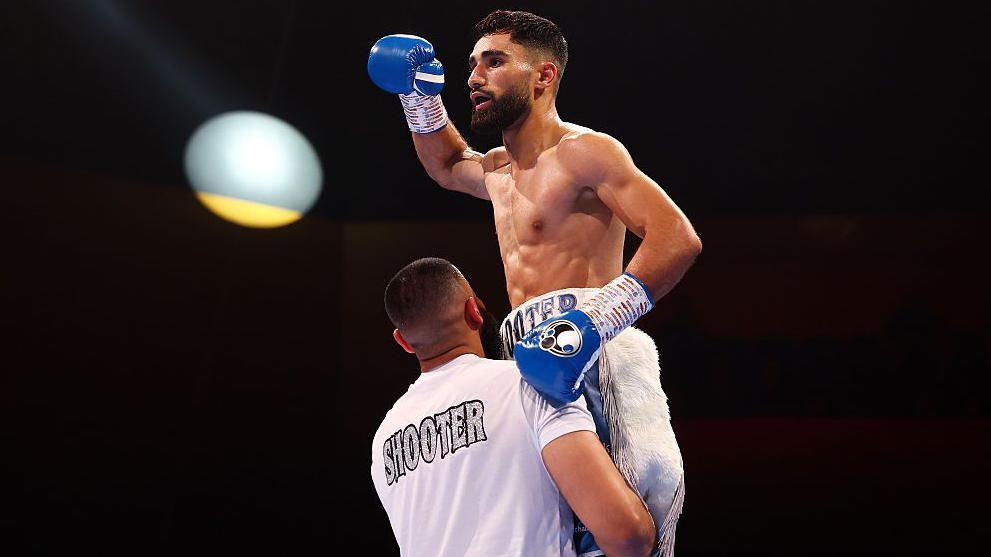
Hassan Ishaq lands a body punch on Jake PollardGetty Images

Ishaq will be searching for a third consecutive stoppage win on the undercard of featherweight Nick Ball’s world title defence against Brandon Figueroa in Liverpool on Saturday.

A three-time England national champion and gold medallist at the prestigious Haringey Box Cup, he boasts strong amateur pedigree.

Such is the buzz around him that the end of his amateur career was marked with a celebration event in London which included messages of encouragement from heavyweight titan Anthony Joshua and unbeaten middleweight star Hamzah Sheeraz.

Yet for all his amateur success, Ishaq never considered staying on to chase Olympic glory.

“I had about 50 fights and won about 40,” he says. “But I felt like in the amateurs, I used to get robbed a lot. Decisions never went my way and it disheartened me.”

That disillusionment led him to the professional ranks. Nicknamed ‘Shooter’, Ishaq describes himself as a “thinker” rather than a brawler.

What makes him so good?

Ishaq fights out of the New Era Gym in Surrey under Iqbal, one of the sport’s brightest young coaches.

A former professional himself, Iqbal won his lone bout in 2019 before serving a lengthy apprenticeship under the tutelage of world-class coach Adam Booth.

Welterweight world champion Lewis Crocker has recently joined Iqbal’s stable and the trainer says the IBF belt-holder is one of many “elite fighters who turn their necks when Hassan is sparring”.

Iqbal points to the ‘Philly Shell’ – the shoulder-roll defence popularised by Mayweather – as the foundation of Ishaq’s game.

Philly Shell is a high-IQ style built around making opponents miss by inches and punishing the mistake.

“A lot of Philly Shell fighters are purely counter-punchers and aren’t very aggressive,” Iqbal explains.

Related topics

  • Boxing
    • 18 hours ago
    Leigh Wood and Josh Warrington go head-to-head for a face-off
    • 28 April 2024
    Split image of Claressa Shields, Paddy Pimblett and Chris Eubank Jr

More boxing from the BBC

    • 16 August 2025
    BBC Sport microphone and phone

Gaza patients head to Rafah crossing as people return amid Israeli attacks

Twenty-five more Palestinians have returned to Gaza through the Rafah crossing following its long-awaited partial reopening, describing an exhausting journey through humiliating Israeli security measures, while patients in need of urgent medical treatment abroad are being transferred to the border.

This comes as the Wafa news agency reported a Palestinian man was killed by Israeli forces in Bani Suheila, east of Khan Younis, on Thursday, as Israeli attacks continue despite a “ceasefire” in the Gaza Strip.

Recommended Stories

list of 4 itemsend of list

The group of 25 – the third batch to return since the heavily restricted reopening of the crossing into Egypt – entered the Strip at 3am local time (01:00 GMT), with buses delivering them to Nasser Hospital in the southern city of Khan Younis more than 20 hours after they left the Egyptian city of El Arish.

Hours later, 13 Palestinian patients, accompanied by family members and World Health Organization (WHO) officials, were transferred from a hospital towards the crossing for medical treatment abroad.

Some of the returnees, visibly fatigued from their ordeal, told an Al Jazeera team in Gaza that they had been interrogated and insulted by Israeli forces as they passed through security controls.

Footage showed emotional scenes as returning Palestinians embraced loved ones from whom they had long been separated, and registered firsthand the scenes of devastation caused by the war in their homeland.

“The feeling is like being caught between happiness and sadness,” one returnee, Aicha Balaoui, told the Reuters news agency.

“I’m happy to be back and to see my family, my husband and my loved ones, thank God. But I also feel sad for my country after seeing the destruction. I never imagined the devastation would be this severe.”

She said while she had lived in comfort and safety abroad, “I wasn’t at peace because it wasn’t my place.

“My place is here. My place is Gaza,” she said.

The Rafah crossing with Egypt, the sole route in or out of Gaza for nearly all of the territory’s more than two million inhabitants, was closed by Israeli authorities for most of the war, but was partially reopened on Monday.

The reopening of the crossing – to allow the return of Palestinians who have left, and the evacuation of patients requiring medical treatment outside the Strip – is one of the terms of the US-brokered “ceasefire” agreement to end the war in Gaza.

Only Palestinians who left Gaza during the war are being permitted to return, and people travelling in both directions are being subjected to strict security vetting – a process which returnees have described as humiliating and abusive.

Palestinian women who returned earlier this week described to Al Jazeera having their hands bound and eyes covered, being interrogated and subjected to full body searches as part of the security screening.

The International Commission to Support Palestinian People’s Rights (ICSPR) has said the strict Israeli measures have turned the Rafah crossing “into a tool of control and domination rather than a humanitarian passage”.

Only 13 patients awaiting transfer

Reporting from Khan Younis, Al Jazeera’s Hani Mahmoud said 13 Palestinian patients had been taken by bus from a hospital in the Gazan city, due to cross to the Egyptian side of the Rafah crossing in order to receive medical treatment abroad.

Families of the patients had begun receiving phone calls late on Wednesday telling them to prepare for their transfer, he said. Israel had briefly suspended coordination over the medical transfers before resuming it hours later.

But the pace of the medical evacuations since the crossing’s partial reopening was slower than the numbers promised, and far short of what was required to meet the needs of the approximately 20,000 patients in need of medical treatment in other countries.

While the agreement had spoken of 50 patients being evacuated each day, each accompanied by two family members, only about 30 had been transferred so far this week.

“If we keep this pace each passing day, we’re looking at at least three years” to complete the required medical evacuations, Mahmoud said.

“This is a very long time for those in need of immediate medical care.”

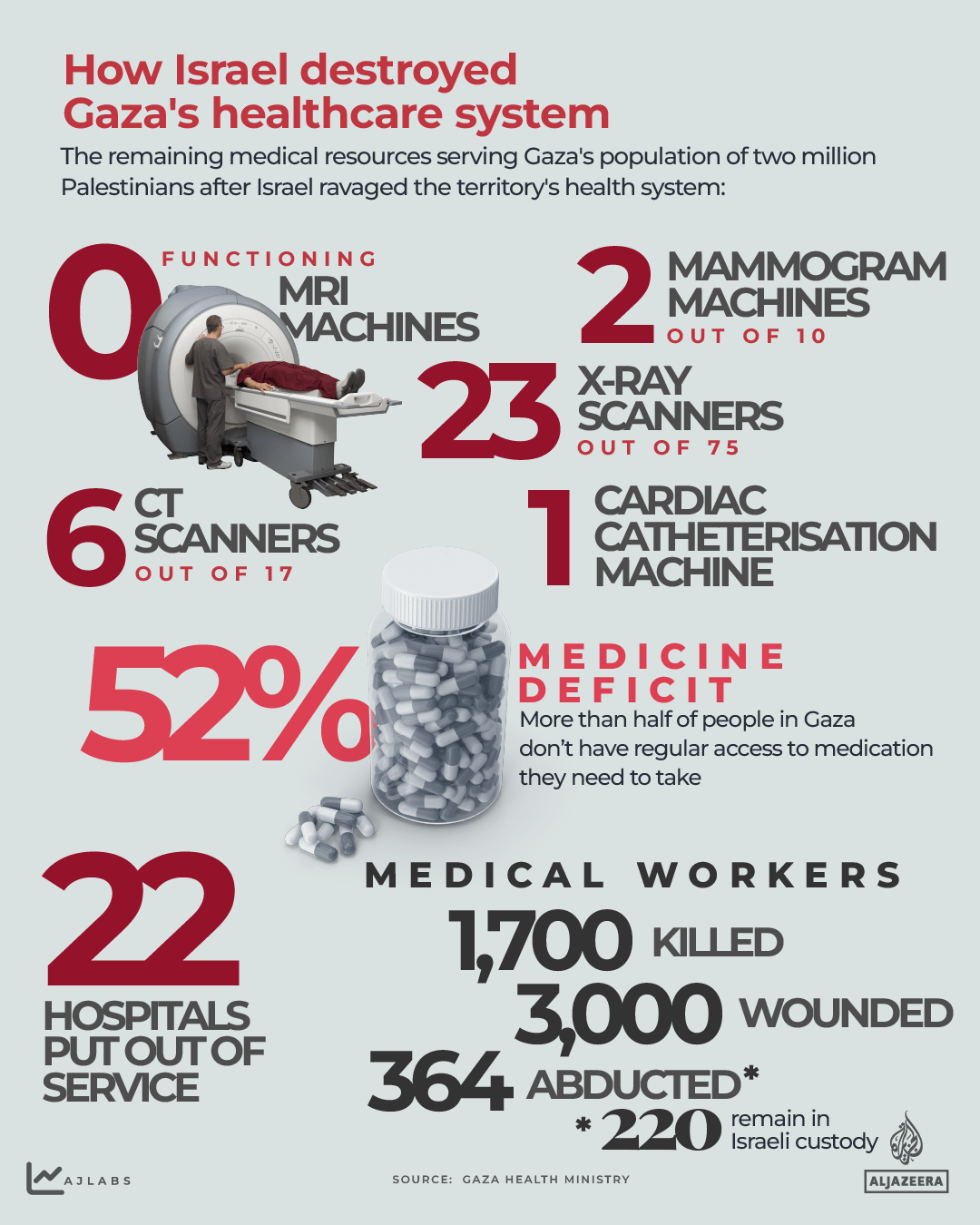
Gaza’s healthcare system has been devastated by Israel’s genocidal war on the enclave, with 22 hospitals put out of service and 1,700 medical workers killed, according to the Palestinian Ministry of Health.

Israeli attacks continue

Meanwhile, as the returns played out in southern Gaza, Israel continued to carry out attacks across the Strip, a day after 23 Palestinians were killed in one of the deadliest days since the October “ceasefire” began.

Israel carried out air strikes east of Deir el-Balah in central Gaza, and east of Khan Younis in the south, Al Jazeera teams reported.

Reporting from Khan Younis, Al Jazeera’s Mahmoud said there had also been Israeli air strikes, gunfire and heavy artillery shelling targeting Gaza City’s eastern Tuffah neighbourhood, which was next to the so-called “yellow line” demarcating territory under Israeli military control.

Same again please Bruno – FPL team of the week

Thomas Woods

BBC Sport senior journalist
  • 8 Comments

After a run of just 17 points in his past seven games, Erling Haaland is dropped from this FPL team of the week.

Just one goal in seven games, he only managed two shots last week and faces Liverpool away – it seems an easy choice.

It’s a much harder choice for FPL managers to decide what to do with the Norwegian in the long run and I’d still hold him – with a nice run of games after this one – unless you really need the money elsewhere.

The other priority for managers is to make sure you have a plan to get to three Arsenal players in time for next week, when they have a double gameweek along with Wolves.

The team of the week is selected based on current FPL prices to fit within a £100m budget, as if you were playing a Free Hit.

How did last week’s team do?

BBC Sport’s FPL team of the week for gameweek 25

BBC Sport FPL team of the weekBBC Sport

Keeper

To play this video you need to enable JavaScript in your browser.

David Raya, Arsenal, keeper, £5.9m – Sunderland (h)

Gabriel, Arsenal, defender, £7m – Sunderland (h)

Jurrien Timber, Arsenal, defender, £6.3m – Sunderland (h)

With Bukayo Saka having injury issues and Declan Rice failing to produce in recent matches, it is an Arsenal triple-up in defence this week against a Sunderland side with just six goals on the road this season.

Don’t expect more than six points from Raya, but he is a very steady choice while Gabriel and Timber have well-known attacking threat.

If this comes off, 20-plus points between the three of them is a possibility.

Marc Cucurella, Chelsea, £6m – Wolves (a)

The Spaniard got his first goal of the season against West Ham (he scored five in 2024-25). Will this be the start of more attacking production from him?

Midfielders

Bruno Fernandes (captain), Manchester United, £9.6m – Tottenham (h)

He produced last week and gets the armband again in a United team that you feel could score three in any game on current form – even if their defence is shaky.

There’s no point going through all his statistics over and over again but it is safe to say the Portugal midfielder is head and shoulders above everyone else in terms of creativity.

Only Fernandes (12) and Bayern Munich’s Michael Olise (14) have reached double figures for assists in Europe’s top five league this season.

Matheus Cunha, Manchester United, £8m – Tottenham (h)

Back-to-back nine-pointers for the Brazilian means he gets the nod ahead of Bryan Mbeumo (£8.4m) and Amad Diallo (£6.2m) as a second United attacking option.

Cunha has had the most shots per 90 minutes on the pitch (3.69) of any United midfielder – Mbeumo is next on 2.65. Cunha has had more shots (61) than any other midfielder in the league too.

And he feels like the least likely of the trio to get a rest if Benjamin Sesko is recalled to the starting line-up following his match-winning goal v Fulham.

Enzo Fernandez, Chelsea, £6.8m – Wolves (a)

Another great fixture for Chelsea and Fernandez just keeps producing, with returns in five of his past six games.

Still has the highest expected goals (xG) among midfielders with 8.91 and is still just a cracking all-round pick, especially at the price.

Yasin Ayari, Brighton, £4.8m – Crystal Palace (h)

The 22-year-old Swede has turned into an FPL bargain recently.

Ayari has returned in his past four games, including two double-digit hauls.

He’s also in and about getting defensive contribution points (defcon) in every game. In his past seven games, he’s earned defcon three times and twice come within one point of getting it.

All for £4.8m – wildcarders pay attention.

Elliot Anderson, Nottingham Forest, £5.3m – Leeds (a)

Another budget gem FPL managers should be looking at more closely.

Anderson has earned defcon points in his past eight games.

Strikers

Joao Pedro, Chelsea, £7.5m – Wolves (a)

The Brazilian has been on fire in his past three league games, with three goals, two assists and 30 points.

The main worry with Joao Pedro in the past 10 games has been whether he’ll start, as he has been benched four times, but after coming on at half-time to rescue Chelsea against West Ham last week you’d like to think he’ll be first choice again.

And with Wolves away, Leeds at home and then Burnley at home in the next three, fixture runs don’t come much better.

He’s a good captain choice this week too if you don’t have Fernandes.

Jarrod Bowen, West Ham, £7.6m – Burnley (a)

Bowen is another striker in hot form, with 20 points in his past two.

Likewise, West Ham have two wins in three, scoring seven goals in the process, and were unlucky not to take something in Saturday’s 3-2 loss at Chelsea.

Subs bench

Martin Dubravka, Burnley, keeper, £4m – West Ham (h)

Raul Jimenez, Fulham, striker, £6.2m – Everton (h)

James Tarkowski, Everton, defender, £5.8m – Fulham (a)

Joe Rodon, Leeds, defender, £3.9m – Nottingham Forest (h)

Related topics

  • Nottingham Forest
  • Manchester United
  • Fantasy Football
  • West Ham United
  • Chelsea
  • Brighton & Hove Albion
  • Premier League
  • Arsenal
  • Football
    • 17 October 2025
    A graphic of Premier League players from every team in the division in 2025-26 season, with the Premier League trophy in front of them.
  • Quiz logo

More on this story

Trump Attacks US Electoral System With Call To ‘Nationalize’ Voting

From calls for his Republican party to “nationalize” voting to his repeated false claims of a stolen election, President Donald Trump is ramping up attacks on the electoral system ahead of this year’s US midterms.

The latest idea from Trump — who still refuses to acknowledge his 2020 election defeat by Democrat Joe Biden — is to take responsibility for organizing elections away from some US states and hand it to the federal government instead.

“The Republicans should say, ‘We want to take over. We should take over the voting in at least — many, 15 places.’ The Republicans ought to nationalize the voting,” Trump told podcaster and former FBI deputy director Dan Bongino this week.

His extraordinary comments — which were condemned by Democrats — come as Republicans face losing control of Congress in the November 3 midterm elections. Polls show low approval ratings for second-term president Trump while Republicans have suffered a string of losses in local elections.

Trump has, however, doubled down on his long-standing but debunked claims of widespread voter fraud — and his insistence that he needs to tackle it.

“I don’t know why the federal government doesn’t do them anyway,” Trump told reporters in the Oval Office on Tuesday when asked about his comments about nationalizing elections.

Trump pressed the case in an interview with NBC News that aired Wednesday, alleging “there are some areas in our country that are extremely corrupt.”

He added that if elections “can’t be done properly and timely, then something else has to happen.”

READ ALSO: FIFA President Infantino Defends Giving Peace Prize To Trump

 ‘No debate’

Trump’s comments have sparked fears that he will — and not for the first time — go up against the US Constitution itself.

“The Constitution clearly says that states are the ones that do the running” of elections, Justin Levitt, a professor at Loyola Law School, told AFP. “There is no debate about this.”

Levitt, who worked in the administrations of presidents Barack Obama and Joe Biden, said this was partly because of the huge size of the United States but also a “separation of powers” and an “anti-corruption measure.”

But Trump, who has openly warned that he faces a third impeachment if Republicans lose in November, has been unrepentant in his quest to change the way America votes.

The 79-year-old remains convinced that the 2020 US presidential election was rigged against him, even though its legitimacy has been confirmed by the courts.

“It was a rigged election. Everybody now knows that,” Trump told world leaders at the Davos forum in January. “People will soon be prosecuted for what they did.”

Billionaire Trump, who has pushed presidential power to unprecedented limits since returning to office last year, is now using all the levers of power to right those perceived wrongs.

On January 28, the FBI seized hundreds of boxes of ballots and other materials in Georgia, as part of a controversial probe into his 2020 election loss in the southern state.

Unusually, the raid was carried out under the watchful eye of Tulsi Gabbard, Trump’s director of National Intelligence, whose role is meant to be focused on foreign threats.

 ‘Cast doubt’

U.S. President Donald Trump speaks to reporters on board Air Force One while flying in between Ireland and Washington as he returns from the World Economic Forum on January 22, 2026. Chip Somodevilla/Getty Images/AFP 

The US Justice Department has meanwhile filed lawsuits in some 20 states to try to recover voting records.

Trump’s administration has falsely claimed that undocumented migrants are illegally voting on a large scale.

Such actions were “part of a broader strategy to, at least, cast doubt on the validity of the upcoming elections,” Rick Hasen, a law professor at UCLA, told AFP.

“At worst, it suggests he may try to use the federal government to actually interfere in how states run elections in 2026,” he said, also calling for civil society groups to be on the lookout.

One of them, the NAACP, which has fought for years for the civil rights of Black people, accused Trump’s administration of “looking to exhaust our nation with these deplorable and unconstitutional antics in hopes that we will grow tired and concede.”

In a more extreme scenario, some of the US president’s critics fear he could use law enforcement or even the military to influence the upcoming election.

Some of Trump’s top supporters have suggested as much.

“We’re going to have ICE (Immigration and Customs Enforcement) surround the polls come November,” Steve Bannon, a first-term Trump aide and leading ideologue in his “Make America Great Again” movement, said on Tuesday.

“And you can whine and cry and throw your toys out of the pram all you want, but we will never again allow an election to be stolen.”

Epstein’s help sought in bid to meet Chuck Schumer, files reveal

An associate of the United States Virgin Islands’ sole representative in the US Congress asked Jeffrey Epstein for help to arrange a meeting between the politician and Senate Minority Leader Chuck Schumer, according to documents released by the US Justice Department.

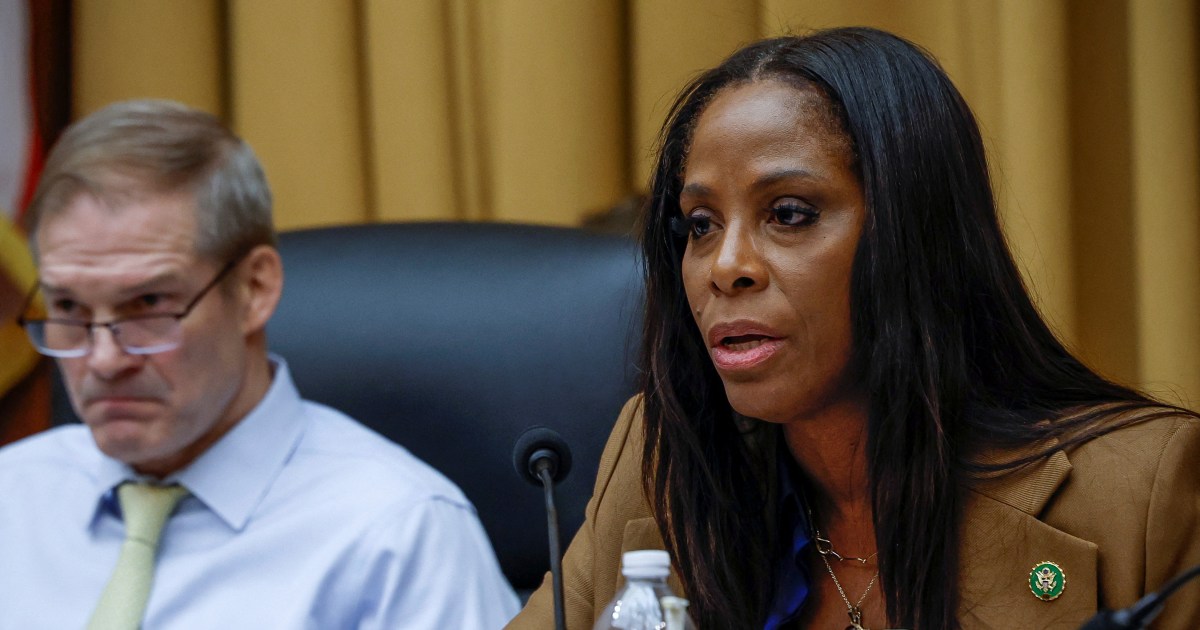
The outreach to Epstein was made on behalf of Stacey Plaskett, the islands’ delegate to the House of Representatives, as the politician sought to lobby Schumer for relief after two hurricanes ripped through the Caribbean in 2017, according to the documents.

Recommended Stories

list of 4 itemsend of list

“We have to help Stacey get a meeting with Schumer. Any thoughts?” Erika Kellerhals, a tax lawyer in the US Virgin Islands, wrote to Epstein in an email on January 24, 2018.

“[S]hould not be a problem need to know the reason and subject,” Epstein wrote back a few hours later.

“She has been unable to confirm a meeting with him. He is driving the disaster relief bill and has only been talking about Puerto Rico and not the [Virgin Islands]. She’s concerned we will be ignored,” Kellerhals told Epstein in response.

After his exchange with Kellerhals, Epstein sent an email to Kathy Ruemmler, a former chief counsel to US President Barack Obama, asking for help in setting up a meeting with Schumer.

“schumer is driving the puerto rico . virgin islands relief=bill. the VI congressional rep Stacey plaskett , h=s not been able to get a meeting. confirmed with him. ca= you help?” Epstein wrote to Ruemmler, who is now the chief lawyer to Goldman Sachs.

“I do not have any relations=ip with him, but let me see whether I can get to his COS,” Ruemmler said in response, referring to his chief of staff.

The emails are among some 3.5 million pages of files released last week that relate to US authorities’ investigations into Epstein, who died by suicide in 2019 while awaiting trial on sex trafficking charges.

It is not clear if a meeting between Schumer and Plaskett went ahead, though Congress ultimately approved emergency funds for the US Virgin Islands as part of a two-year budget package passed in February 2018.

There is no public record of Schumer meeting or directly communicating with Epstein.

Schumer, Plaskett and Kellerhals did not respond to requests for comment. Ruemmler could not be reached for comment.

The email exchange with Epstein, which has not been previously reported, is the latest among numerous examples of how the disgraced financier continued to exert influence at the highest levels of politics and business long after his 2008 conviction for soliciting prostitution with a minor.

Plaskett’s ties to Epstein have been a source of controversy for years.

Plaskett narrowly escaped censure by the House of Representatives last year over revelations that Epstein had coached her over text during a Congressional hearing in February 2019.

Shortly after Epstein was arrested for a second time in July 2019, Plaskett announced that she would donate a sum to charity equivalent to several campaign donations she had received from Epstein and his associates.

While Plaskett is a non-voting member of Congress, the Democrat participates in floor debates and sits on several influential committees, including the House Permanent Select Committee on Intelligence.

Here’s why Israel is allowing record murder rates in its Palestinian towns

While the international media has rightly focused on the genocide and enormous displacement in Gaza alongside the ethnic cleansing in the West Bank and occupied East Jerusalem, the 300 murders inside Israel in 2025, 252 of whom were Palestinian victims, garnered little to no media coverage outside Israel. Yet last year marked the deadliest year on record for murders among Palestinian citizens of Israel, who make up 21 percent of Israel’s population but sustain 80 percent of the murders. That is one murder every 36 hours.

The international media have also covered the rise in anti-Semitism across the world, even as there has been little to no media coverage of how Israel has been exaggerating and instrumentalising a Zionist notion of anti-Semitism to create moral panic among Jews everywhere. Indeed, when I speak to Jewish friends in Israel, they often ask how I, who live in London, cope with anti-Semitism. As consumers of Israeli news, they can be forgiven for thinking that Jews across the world are in imminent danger.

These two phenomena – the crime epidemic within Palestinian communities inside Israel and the weaponisation of anti-Semitism to amplify Jewish fear – might seem totally unconnected. Yet there is a clear thread linking them, and it is called demographic engineering.

The foundational acts

Demographic engineering has been at the heart of the Zionist project. During the 1948 war, about 750,000 Palestinians were displaced in what Fayez Sayegh called “racial elimination”. As part of this process, Palestinian cities were depopulated, and about 500 Palestinian villages were destroyed. By 1951, the Palestinians who had become refugees had been “replaced” by a similar number of Jewish immigrants, both Holocaust survivors from Europe and Mizrahi Jews from Arab countries, thus transforming the state’s racial composition without altering its overall population size.

In the wake of the war, Israel not only disregarded United Nations Resolution 194 affirming the right of Palestinians who had been made refugees in 1948 to return to their homes, but in 1950 it passed the Law of Return, bestowing “on Jews worldwide the right to enter Israel and obtain Israeli citizenship regardless of their countries of origin and whether or not they can show links to Israel-Palestine, while withholding any comparable right from Palestinians, including those with documented ancestral homes in the country”.

Over the past two years, a number of Israeli politicians and influencers have characterised what Israel has been doing in the territories it occupied in 1967 as completing the job left undone in 1948: “A second, real Nakba, to finish [former Israeli Prime Minister David] Ben-Gurion’s work,” one journalist quipped. Simultaneously, within Israel, a different kind of demographic strategy is unfolding, even as the overall objective remains the same.

Crime as an impetus to leave

Itamar Ben-Gvir is surely not the first minister of national security to have allowed criminal gangs to terrorise Palestinian communities. But on Ben Gvir’s watch, the murders have reached record levels. And 2026 seems to be following the trend, with 31 more Palestinians murdered during the first month.

On the one hand, Israel has used the soaring crime to portray Palestinian citizens as uncivilised and barbaric, extending the dehumanisation from stateless Palestinians in Gaza and the West Bank to its own citizens. On the other hand, it has enabled criminals to terrorise Palestinian towns.

Indeed, the police have solved only 15 percent of the murders within the Palestinian community while doing little, if anything, to stop criminals from collecting “protection fees” from businesses – fees that extract an estimated two billion shekels ($650m) a year from the community.

On January 22, Palestinians launched the largest demonstration since 2019, waving black flags while chanting slogans accusing the police of total abandonment. The following day, the organisers called a general strike, with one of the organisers, Mohammed Shlaata, making it clear that responsibility for the violence lies with the authorities: “We are in a state of emergency,” he said. “We have a clear finger of accusation – we blame the police.”

Talking to Palestinian friends, some tell me they fear for their children’s lives and want them to leave the country, while others have packed their bags and left. Admittedly, the number of those leaving is low, but Palestinian citizens are reaching a boiling point.

Anti-Semitism and negative migration

At the same time that the government does nothing to quell criminal activity and lawlessness within Palestinian communities in Israel, it exaggerates and instrumentalises a Zionist notion of anti-Semitism to continuously reassert Jewish victimhood.

While much has been written on the use of a false notion of anti-Semitism – that conflates criticism of Israel and Zionism with anathema towards Jews – to silence Palestinian and pro-Palestinian voices, much less has been said about the mobilisation of anti-Semitism to address Israel’s problem of negative migration.

Since 2023, more Jews have been leaving the country than entering. In 2024, the number of citizens leaving Israel was 26,000 higher than the number of immigrants entering it; in 2025, the gap was about 37,000 Israelis. In other words, negative migration has jumped by more than 42 percent, and Israeli officials are worried that this trend is taking root and even accelerating.

Accordingly, both the Israeli public and the Jewish diaspora are told again and again that anti-Semitism across the globe has gone rampant. Jews are told that the horrific Bondi massacre in Australia is an indication of a new global trend, that in the United Kingdom anti-Semitism has been normalised, and that in Europe Jews are afraid to wear kippahs.

Anti-Semitism has undoubtedly soared over the past two years, and there is obviously a kernel of truth in these articles. But in contrast to the very real panic among Palestinian citizens, which the state has ignored, in the case of anti-Semitism, the state dramatically exaggerates and instrumentalises the evidence to produce a moral panic. The message is clear: Jews across the world should fear for their lives, and therefore those who live in Israel should be wary of leaving, while the only way diasporic Jews can be safe is by migrating to Israel.

Supremacy as glue

The glue holding all of the demographic strategies Israel deploys together is the belief in Jewish exceptionalism and supremacy. The genocide in Gaza and ethnic cleansing in the West Bank are justified through the dehumanisation of Palestinians; the neglect of the murders and crime in Palestinian communities within Israel is informed by racial discrimination that has been ongoing since 1948; and Israel is weaponising racism against Jews to curb negative migration. The ultimate objective is to guarantee the racial-religious character of Israel as exclusively Jewish, while the dream is a pure Jewish state.