Understanding the value of gold: Prices, global reserves, and market trends

Interest in gold has skyrocketed in recent weeks, with the price of one ounce hitting an all time high of $5,600 on January 29 before settling back to just under $5,000 on Sunday.

As economic conditions fluctuate and geopolitical tensions rise, more individuals are seeking gold as a secure investment.

In this visual explainer, Al Jazeera breaks down how gold value is determined, the prices of gold coins in different markets, and the countries holding the largest reserves.

How is the value of gold measured?

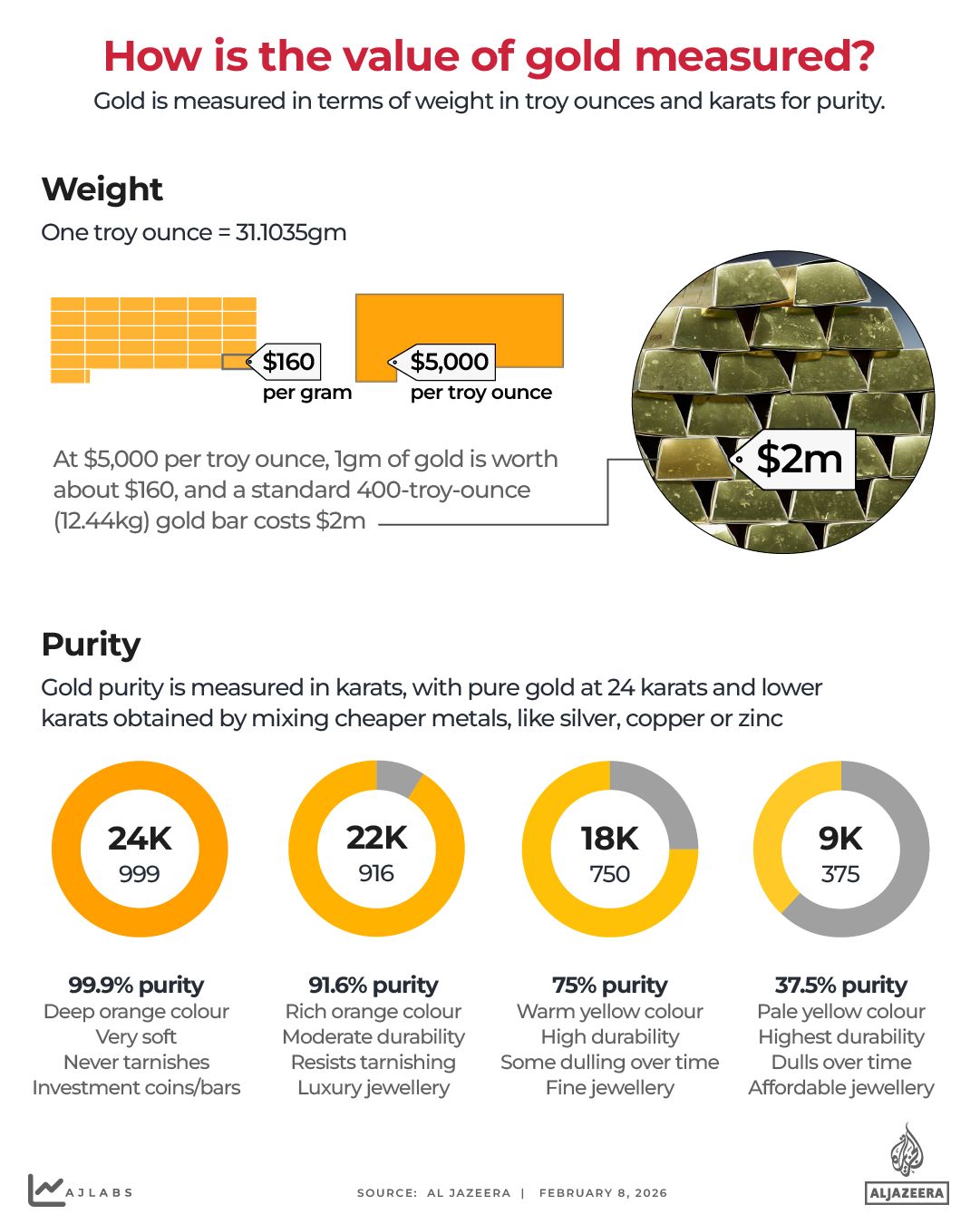
Understanding the value of a gold item requires knowing its weight in troy ounces alongside its purity in karats.

Weight (in troy ounces)

The weight of gold and other precious metals like silver and platinum is commonly measured in troy ounces (oz t). One troy ounce is equal to 31.1035 grammes.

At $5,000 per troy ounce, 1 gramme of gold is worth about $160, and a standard 400-troy-ounce (12.44kg) gold bar costs $2m.

Troy ounces are different from regular ounces, which weigh 28.35 grammes and are used to measure everyday items including foods.

Purity (in karats)

Karat or carat (abbreviated as “K” or “ct”) measures the purity of a gold item. Pure gold is 24 karats, while lower karats such as 22, 18, and 9 indicate that the gold is mixed with less expensive metals like silver, copper, or zinc.

To determine the purity of gold, jewellers are required to stamp a number onto the item, such as 24K or a numeric value like 999, which indicates it is 99.9 percent pure. For example, 18K gold will typically have a stamp of 750, signifying that it is 75 percent pure.

Some typical values include:

  • 24 karat – 99.9% purity – A deep orange colour, is very soft, never tarnishes and is most commonly used for investment coins or bars
  • 22 karat  – 91.6% purity – A rich orange colour, moderate durability, resists tarnishing and most often used for luxury jewellery
  • 18 karat – 75% purity – A warm yellow colour, high durability, will have some dulling over time and most often used in fine jewellery
  • 9 karat – 37.5% purity – A pale yellow colour, has the highest durability, dulls over time, used in affordable jewellery

Other karat amounts such as 14k (58.3% purity) and 10k (41.7% purity) are often sold in different markets around the world.

When you buy jewellery, the price usually depends on the day’s gold spot price, how much it costs to make, and any taxes.

If you know the item’s exact weight in grammes and the gold’s purity in karats, you can calculate the craftsmanship cost on top of that.

You typically cannot negotiate the spot gold price, but you can often haggle over the craftsmanship costs.

The price of gold has quadrupled over the past 10 years

Gold has been valued for thousands of years, serving various functions, from currency to jewellery. The precious metal is widely regarded as a safe haven asset, particularly in times of economic uncertainty or market volatility.

Up until 1971, the United States dollar was physically defined by a specific weight of gold. Under the classical gold standard, for nearly a century, from 1834 until 1933, you could walk into a bank and exchange $20 for an ounce of gold.

In 1933, amid the Great Depression, the price was raised to $35 per ounce to stimulate the economy.

In 1971, under President Richard Nixon, gold was decoupled from the dollar, and its price began to be determined by market forces.

Over the past 10 years, the price of gold has quadrupled from $1,250 in 2016 to around $5,000 today.

INTERACTIVE - Timeline of price of gold-1770547790
(Al Jazeera)

How is the price of gold determined in different countries?

Gold is priced globally based on the spot market, where one troy ounce is traded in US dollars on exchanges such as London and New York. Local prices vary as the dollar rate is converted into domestic currencies, and dealers add premiums for minting, distribution and demand.

Taxes and import duties further influence the final cost: India adds 3 percent GST, while the United Kingdom and United Arab Emirates impose none on gold investments.

Different countries produce unique gold bullion coins and bars, each with its own distinct features and cultural significance. Notable examples include the Gold Eagle from the US, the Gold Panda from China, and the Krugerrand from South Africa.

INTERACTIVE - The gold price in different countries-1770551461

Which countries have the most gold reserves?

The US leads global gold reserves with 8,133 tonnes, nearly equal to the combined total of the next three countries. Germany is in second place with 3,350 tonnes, and Italy comes in third with 2,451 tonnes.

The graphic below shows the top 10 countries with the largest gold reserves.

INTERACTIVE - Which countries have the most gold-1770549820
(Al Jazeera)

How reconstruction became Israel’s new weapon of ‘silent transfer’ in Gaza

At the World Economic Forum in Davos, Switzerland, last month, Jared Kushner, billionaire real estate scion and son-in-law to United States President Donald Trump, presented his vision of a “New Gaza”: glittering skyscrapers, waterfront tourism and a logistical corridor connecting a demilitarised enclave to the world.

But 3,000km (1,864 miles) away, on the bombed and dusty lands of the Gaza Strip, not a single brick has been laid as the distressing reality of the Palestinian territory is now measured not in new buildings but in tonnes of debris – specifically, 61 million tonnes of it.

After a fragile “ceasefire” was reached between Israel and Hamas in October, Israel’s air strikes may have let up, but the killings have not stopped, signalling a new, quieter war.

Meanwhile, there is no clarity on the potential entry of cement and steel rods – crucial construction materials whose entry Israel has blocked.

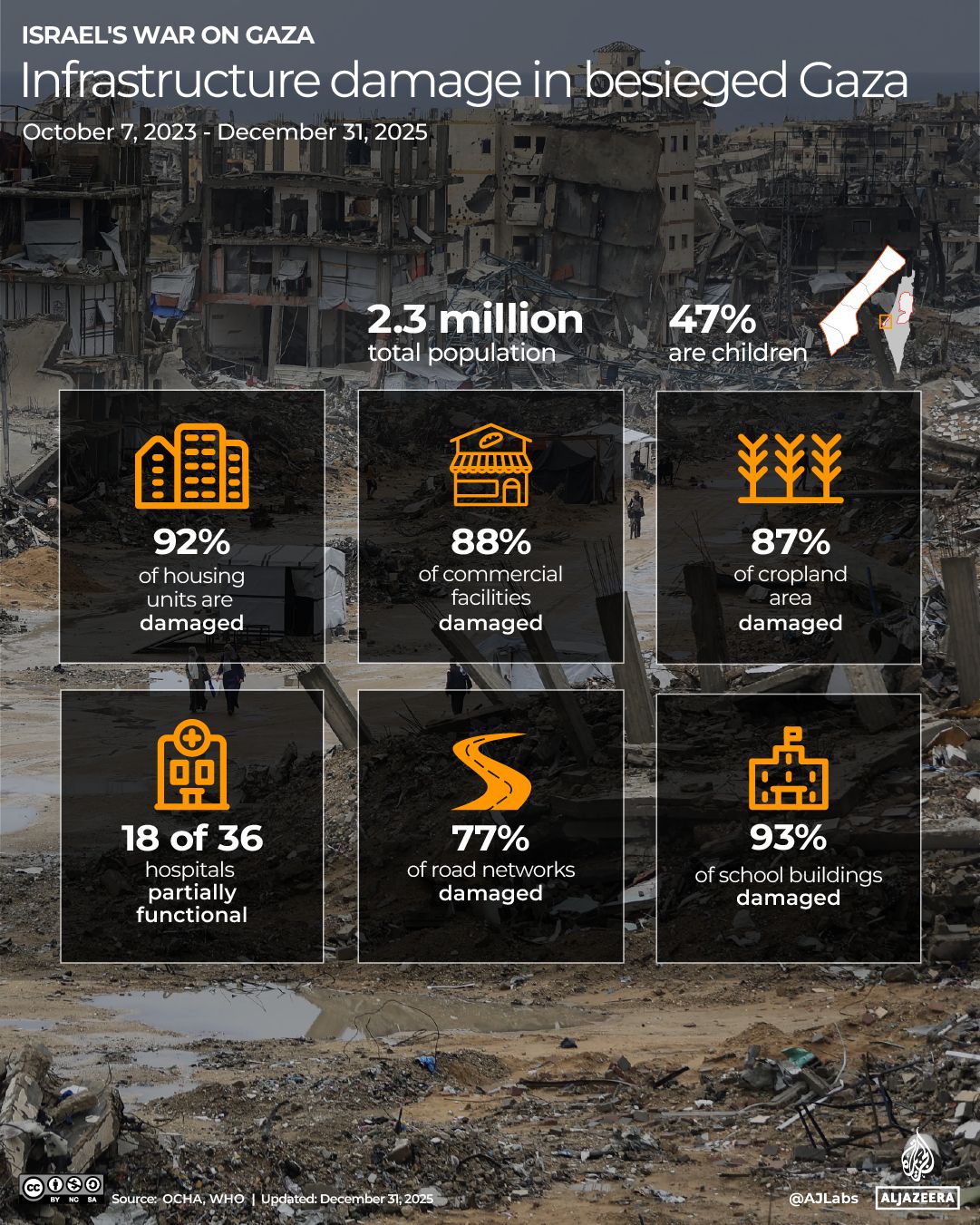
According to the United Nations, 92 percent of Gaza has been  destroyed during Israel’s more than two-year genocidal war, and the cost of its rebuilding is estimated at $70bn.

Yet analysts and urban planners warned that Gaza’s reconstruction is being designed not to restore Palestinian life but to “re-engineer” it – turning the basic human right of shelter into a tool of political extortion and alleged demographic change.

“Reconstruction is not the ‘day after’ the war; it is the continuation of war by bureaucratic and economic means,” Ihab Jabareen, a researcher specialising in Israeli affairs, told Al Jazeera.

‘Cement faucet’

Jabareen argued that for the Israeli security establishment, reconstruction is the ultimate bargaining chip, allowing Israel to move from a strategy of direct military occupation to one of “sovereignty by flow”.

“Whoever owns the oxygen of Gaza – the cement faucet – owns its political and security shape,” he said, adding that Israel aims to create a unique system of “control without responsibility” in which it holds veto power over how daily life in Gaza is conducted without the legal obligations of an occupier.

This system relies on turning the potential entry of construction materials and aid into a political decision through what Jabareen called three layers of extortion:

  • Security extortion: linking the flow of materials to “long-term surveillance”, creating a permanent dependency under which Gaza is rebuilt to a size that can be easily “switched off” at any moment.
  • Political extortion: using reconstruction to determine who governs. “Whoever distributes the cement, distributes the legitimacy,” Jabareen said, suggesting that Israel will allow reconstruction only under a “technocratic” proxy administration that fits its security needs.
  • Pacification extortion: turning the hope of basic survival – a roof over one’s head – into a “reward” for silence, rather than a right.

‘Phoenix Plan’

Before these political battles can even be fought, Gaza literally remains buried under the rubble of two years of Israeli bombardments. A United Nations Development Programme report released in November painted a grim picture: The debris generated by the war creates an “unprecedented obstacle” that could take seven years to clear – and that is only under “ideal conditions”.

“Gaza stands as one of the most devastated places on earth,” the report said.

Faced with this reality, Palestinian experts rejected the top-down models for reconstruction proposed in Davos. Abdel Rahman Kitana, professor of architecture at Birzeit University in the occupied West Bank, pointed to the “Phoenix Plan”, a framework developed by the Union of Gaza Strip Municipalities, as a viable local alternative.

“Reconstruction is not just about restoring what was destroyed. It is about reshaping life,” Kitana told Al Jazeera Arabic as he warned against disconnected solutions for Gaza. He instead advocated for an “integrated approach” rooted in the Phoenix Plan, under which rubble is not treated as waste but as a resource that could be recycled for land reclamation.

[embedded content]

Kitana insisted that any successful plan for Gaza’s reconstruction must be bottom-up. “We cannot succeed without the people themselves. … They know their needs and their dreams,” he said, warning that ignoring local agencies will lead to a “fragile, alienating environment”.

Israel’s ‘dual use’ rule

However, both the UN’s seven-year reconstruction timeline and the “Phoenix Plan” face a critical hurdle: Israel’s “dual use” list.

Historically, Israel has banned items such as fertilisers and steel pipes under the pretext that they could be used for military purposes. Today, that list has expanded to include more essential items, including oxygen cylinders, cancer medicines and water filters.

Jabareen says the blockade is no longer a pretext for security but a “philosophy of governance”.

“Israel has turned the ‘dual use’ excuse into a mechanism of indefinite delay,” he said.

By requiring project-by-project approval for every sack of cement, Israel ensures that reconstruction remains a perpetual “project” that keeps donor countries and agencies exhausted and the Palestinian administration in “a state of constant begging”, Jabareen said.

‘Silent demographic engineering’

While Israel blocks key materials on the ground, the Trump administration is creating a “political fantasy” abroad, experts said. Gaza’s Board of Peace, pushed by Trump, promises a $10bn gross domestic product boost to Gaza and a “New Rafah” with 100,000 housing units.

Jabareen viewed the plans, which include “waterfront properties” and “industrial zones”, as a form of “silent demographic engineering”.

“They are trying to shift the Palestinian cause from a national rights issue to a real estate problem,” he said. The goal, he argues, is to design a Gaza that is “economically useful” to the region but “nationally hollowed out”.

By focusing on “investments” and “tourism” while ignoring the rubble and the mass graves, the plan seeks to “legitimise a political fantasy”, Jabareen said. “If you can’t displace the Palestinian by force, you displace his idea of home by re-engineering his space.”

So who will eventually build this “New Gaza”? Jabareen warned of a “privatisation of occupation” even if Israeli companies do not enter Gaza directly.

“Reconstruction is a chain of indirect profits,” he noted, adding that the logistics of inspection, the security firms managing the crossings and the insurance companies covering the risks will all generate revenue for Israeli or allied firms.

The contracts for reconstruction themselves become a political filter. “This creates an international ‘market of obedience’,” Jabareen said. “The donor who objects is excluded, and the contractor who asks questions on sovereignty is replaced.”

‘Silent transfer’

Jabareen said the most dangerous aspect of such a policy is the “weaponisation of time itself”.

With UN assessments indicating that removing debris alone could last until 2032 and a full reconstruction of Gaza stretching to 2040, the “wait” becomes a policy of displacement.

“Time decomposes societies,” Jabareen said.

He said Israel is betting on “rational emigration” – after living for years in tents, Palestinians will leave, not because they were forced by tanks, but because they were exhausted by fears over their future.

“The long wait is not condemned by the international community. Israel realises that bombing brings condemnation, but bureaucratic delay brings only silence,” Jabareen said. “If the fighter jets failed to displace them, the waiting might succeed.”

US federal agent breaks pet dog’s rib in Tennessee

NewsFeed

‘This is not law enforcement, this is animal cruelty.’

A Tennessee woman says her dog suffered a broken rib after being kicked by a federal officer while agents arrested her boyfriend. The US Marshals Service said the kick was ‘unfortunate’ but done to ‘mitigate a dangerous situation’.

England deny Nepal in final-ball World Cup thriller

To play this video you need to enable JavaScript in your browser.

Matthew Henry

BBC Sport Journalist in Mumbai
  • 549 Comments

T20 World Cup, Group C, Mumbai

England 184-7 (20 overs): Bethell 55 (35), Brook 53 (32)

Nepal 180-6 (20 overs): Airee 44 (29), Lokesh 39* (20); Dawson 2-21

England won by four runs

England fought back from the brink to avoid a major shock and beat an inspired Nepal by four runs in their opening match of the T20 World Cup in Mumbai.

A month on from the conclusion of their Ashes defeat, England needed Sam Curran to defend 10 from the last over to deny Nepal the biggest win in their cricketing history and save his side from more misery.

The brilliant Lokesh Bam needed to hit the last ball for six to secure victory but only managed one.

Lokesh, who finished on 39 not out from 20 balls, dropped to his haunches at the finish as England’s players shook his hand to congratulate his efforts.

He had looked to be taking his side to victory when he struck two sixes to take Jofra Archer for 22 in the 18th over before swiping Luke Wood for another two fours in the 19th.

But England hung on – the recently-recalled Curran finding yorkers under pressure at the death.

It means head coach Brendon McCullum and captain Harry Brook, who scored 53 in England’s 184-7, begin their World Cup without the ignominy of overseeing one of the biggest upsets in World Cup history.

Relieved England survive

To play this video you need to enable JavaScript in your browser.

England’s relief was obvious at the end. There was no wild celebration. They had pulled it back from the brink.

Despite all that has happened this winter, they came into this World Cup among the favourites having won 10 of their past 11 T20s.

Had Curran not salvaged the victory, everything – McCullum’s future in particular – would have come under the microscope again.

That is pushed back for another day. England must also be praised for not wilting where other England sides have before.

How Curran rescued England

To play this video you need to enable JavaScript in your browser.

Curran already appeared to have swung the momentum once.

After Nepal reached 124-2, his slower ball stopped Dipendra Singh Airee on 44 as the right-hander was caught at deep over. Captain Rohit Paudel was dismissed by Dawson for 39 in the next over.

But England’s experienced bowlers of Archer and Adil Rashid, who conceded 42 from three overs, struggled, leaving Curran to bowl at the last.

He did not concede a boundary in the final over, mixing his pace and bowling predominately full.

Nepal a real threat at this World Cup

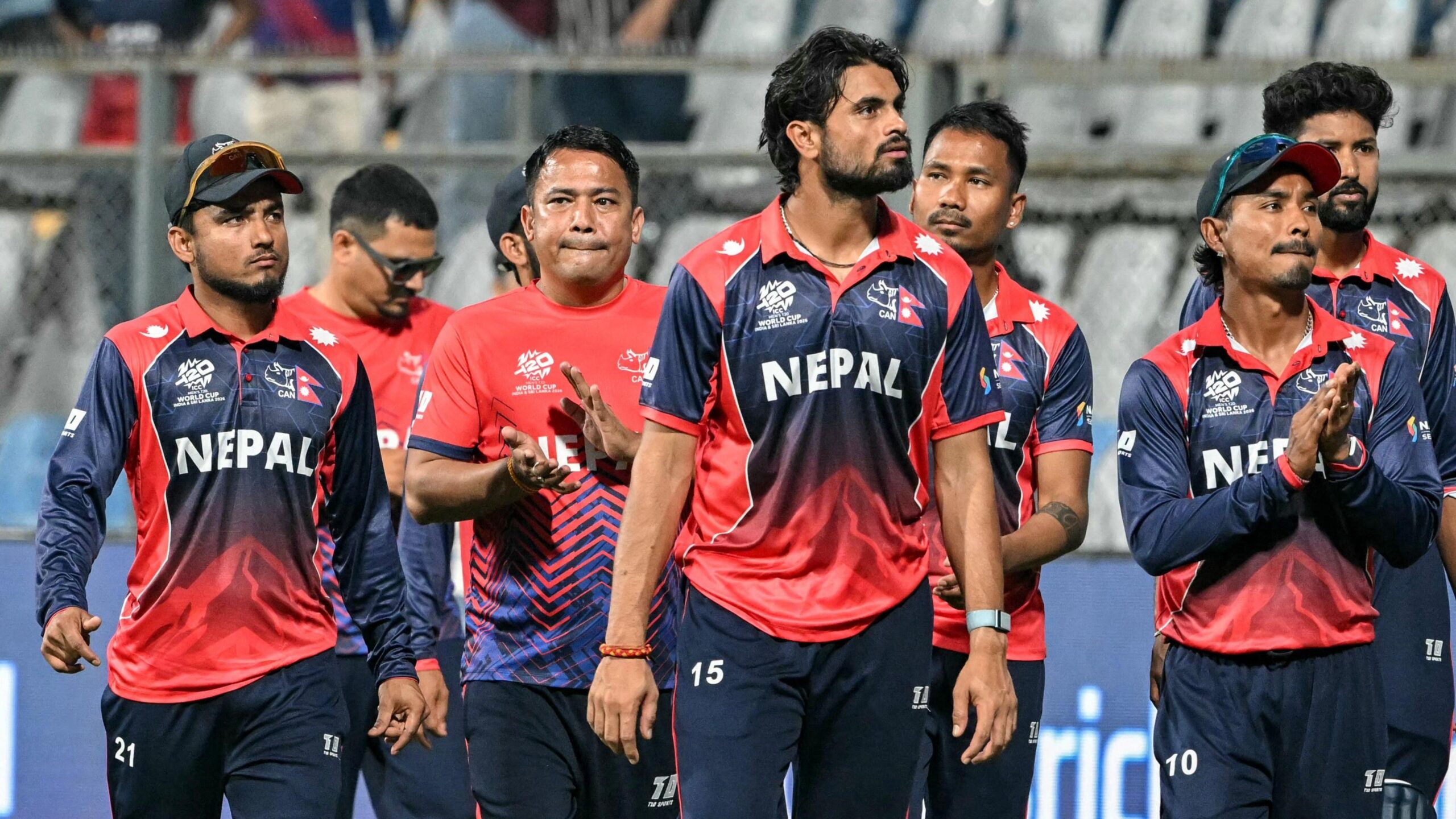
Nepal’s players completed a lap of honour in front of their deflated supporters at the end.

Though they have been tipped to cause problems at this World Cup, having beaten West Indies over three matches last year and taken South Africa to the final ball at the 2024 World Cup, they have never beaten a major nation on the world stage.

They were excellent with the ball too – leg-spinner Sandeep Lamichhane the pick with 1-25, including the wicket of Tom Banton lbw for two.

Off-spinner Sher Malla had Phil Salt caught off a top edge with his first ball in international cricket and Airee also took two wickets with his off-spin in a fine all-round performance.

Jacob Bethell made an entertaining 55 and Brook a well-placed 53 for England, but Nepal’s batting was on a par as they swept and scurried.

Related topics

  • England Men’s Cricket Team
  • Cricket

More on this story

  • Brook
    • 1 hour ago
    Nepal cricket team players stand beside T20 WC trophy

England survive scare to beat Nepal in World Cup thriller

Will Jacks’ late flurry of 39 runs off 18 balls proved to be key as England narrowly avoid a shocking upset against minnows Nepal, winning by four runs in their opening game of the ICC Men’s T20 World Cup.

MATCH REPORT: ICC Men’s T20 World Cup – England v Nepal