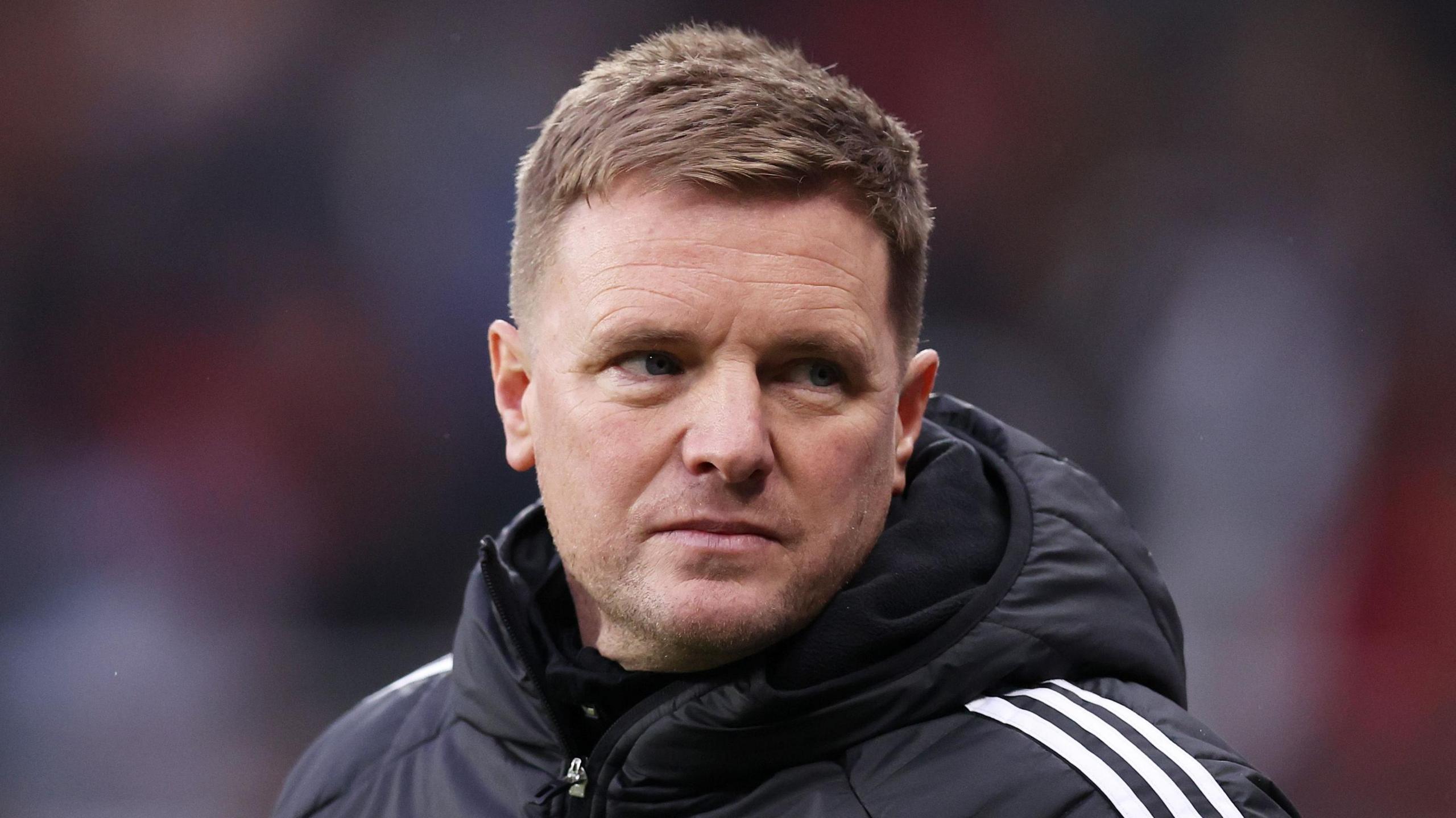
Head coach Eddie Howe says he would step aside if he did not think he was still the right man to lead Newcastle United.
Newcastle were booed off by their supporters following a damaging 3-2 defeat against Brentford at St James’ Park on Saturday.
Howe was crestfallen afterwards and said he was “not doing my job well enough at the moment” after his side slipped to 12th place in the Premier League table.
However two days later, Howe – who ended the club’s seven-decade wait for a major domestic trophy 11 months ago – said there was “no doubt in my mind” he was the right man for the job.
“That’s why I’m sitting here,” he said on the eve of Tuesday’s game at Tottenham Hotspur.
“If there was doubt, I wouldn’t be – because the club is the most important thing. I’ve never put myself before the club.
“If I didn’t think I was the correct man to take the team forward, and I couldn’t give the players what they need, then I would step aside and let someone else do it.”
Newcastle have won only one of their last eight games in all competitions, but Howe retains the backing of the club’s hierarchy.
He has had a transformational impact since his appointment in 2021, beating Liverpool in the Carabao Cup final last year and taking Newcastle into the Champions League twice.
Newcastle will be favourites to progress to the last 16 of the Champions League against Azerbaijan side Qarabag and have a FA Cup fourth-round tie against Aston Villa on Saturday.
The Newcastle head coach acknowledged he was going through one of the toughest periods of his reign but is drawing on the experiences of previous difficult periods to turn things round.
“Those experiences I have been through countless times before stand me in good stead for this moment,” he added.
“The collective spirit is what we’re after. We’re after the collective fight from all the players and if you have that resolve within the group, you can do amazing things again, so it can turn very quickly.
As Pakistan positions itself as a regional security provider, rising militancy and economic constraints continue to test the sustainability of that ambition.
From February 2 to 4, Libya’s eastern commander, renegade military commander Khalifa Haftar, visited Rawalpindi for talks at Pakistan’s army headquarters with the army chief, Asim Munir. The visit might have seemed routine, but it highlights Pakistan’s expanding defence diplomacy in the Middle East and North Africa (MENA).
Pakistan reportedly signed a $4bn defence deal with Haftar’s self-styled Libyan National Army (LNA), including 16 JF-17 fighters and 12 Super Mushak trainer aircraft, structured over roughly two and a half years. The acquisition of this 4.5-generation fighter grants the LNA a “game-changing” airpower advantage, potentially upending the military balance with its Tripoli-based rivals unless the latter secures a comparable capability in time.
Pakistan is also reportedly in the final stages of a $1.5bn package to supply the Sudanese Armed Forces (SAF) with 10 Karakoram-8 light attack aircraft, more than 200 drones and air defence systems to bolster its capabilities in the ongoing war against the paramilitary Rapid Support Forces (RSF).
In purely national-interest terms, Pakistan’s growing defence profile in MENA is not a problem automatically. A larger footprint can generate foreign exchange, expand diplomatic access, and increase Pakistan’s visibility in a region where security partnerships are being diversified. It can also strengthen longstanding military-to-military links in the Gulf and beyond.
Yet the same burst of activity raises a quieter question: is Pakistan’s foray into MENA largely transactional — focused on exporting weaponry — or part of a coherent strategy to provide security? In other words, Pakistan can export military services and equipment; the harder question is whether it can sustain a “security provider” posture when domestic militancy and border volatility keep pulling capacity inwards.
The Middle East is a useful recent example because it exposes a pattern of contingent, deal-driven activism: Pakistan can offer military cooperation and weapons, and it can gain diplomatic visibility, but the approach is being shaped less by a durable economic base and domestic security stability than by events and short-term openings.
The May 2025 India-Pakistan crisis helps explain why Pakistan’s defence industry suddenly looks more marketable in parts of MENA. Pakistan’s successful counter-air campaign against India, which reportedly included the downing of India’s premier Rafale fighter aircraft, has proved to be a windfall for the country, resulting in a surge in high-value defence partners and customers.
The crisis bolstered Pakistan’s airpower narrative, highlighting its superior training standards and operational integration when confronting a conventionally larger adversary — qualities that have increasingly drawn the interest of regional partners.
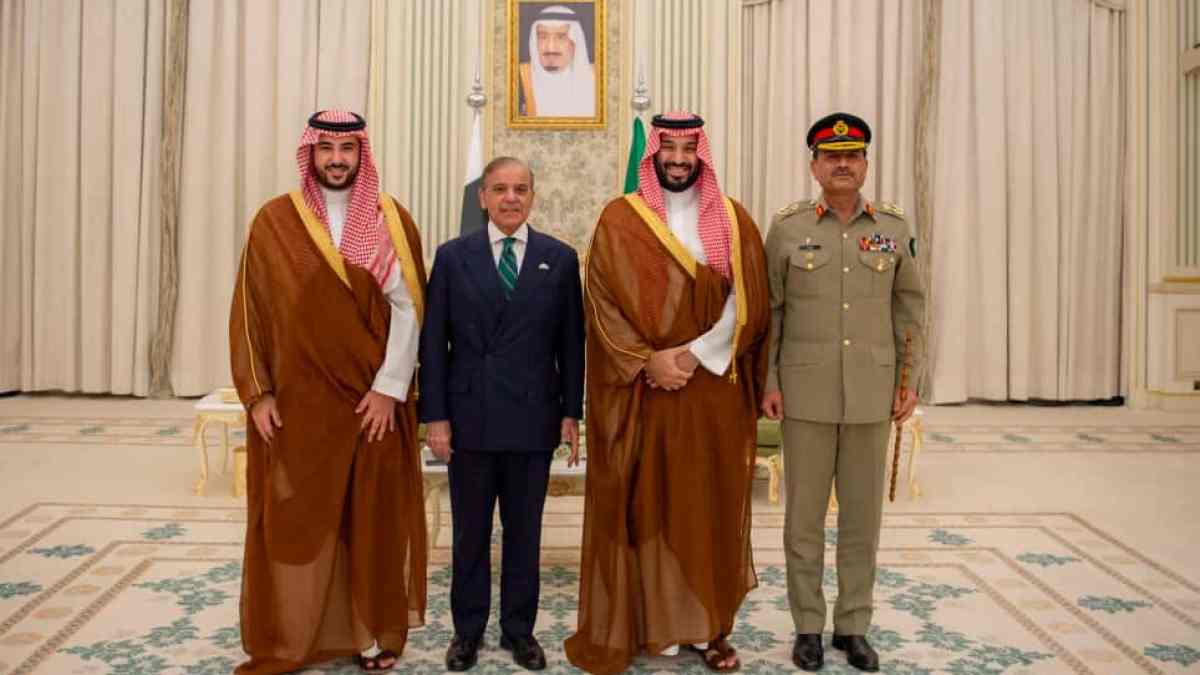
In September 2025, Saudi Arabia formalised a Strategic Mutual Defence Agreement with Pakistan, stating that an attack on one would be treated as an attack on both. The agreement is a significant diplomatic marker and reinforces Pakistan’s standing as a security partner at a time when Gulf states are diversifying their defence relationships.
But beyond airpower, training, and defence-industrial cooperation, Islamabad lacks the economic weight to anchor these relationships at scale.
In 2024-25, Pakistan’s net foreign direct investment from all countries was about $2.5bn, while its total trade with the Gulf Cooperation Council (GCC) nations was roughly $20bn. By contrast, India’s GCC-sourced investment alone was $4.7bn in 2024, and its GCC trade was about $179bn.
Moreover, Pakistan remains a net seeker of capital — relying on Gulf “rollover” loans and central bank deposits to stabilise its own economy — whereas India has transitioned into a strategic investor in Gulf infrastructure, energy, and technology. This “dependency gap” ensures that while Pakistan is a valued security guarantor, it is rarely a peer-level economic partner.
This imbalance matters because Gulf capitals increasingly treat defence cooperation as one strand within a much bigger partnership portfolio — energy, trade, investment, technology, and supply chains. India and the United Arab Emirates, for example, recently discussed deeper defence cooperation through a letter of intent to establish a strategic defence partnership, alongside a $3bn LNG supply deal and ambitious trade targets.
In that environment, Pakistan’s security value can open doors, but without comparable economic depth that fosters diverse interdependence, it is harder to convert access into durable influence.
The other constraint on the “net security provider” narrative is the condition of Pakistan’s own security environment.
Pakistan recently confronted one of its deadliest security flare-ups in years in Balochistan: a wave of simultaneous, province-wide attacks targeting administrative centres and security installations in Quetta and beyond. The resulting weeklong counteroffensive reportedly led to the death of 216 armed fighters, though at the steep cost of 22 security personnel and 36 civilian lives.
Whatever one’s preferred political explanation, the figures underline how much bandwidth the state is still expending to stabilise a key province.
Then came another signal from the Islamabad Capital Territory. On February 6, a suicide attacker struck a Shia mosque on the outskirts of the national capital during Friday prayers, killing more than 30 people and injuring about 170. A splinter faction linked to ISIL (ISIS) claimed responsibility. This was the second major attack in the capital in three months.
The western border with Afghanistan is another reminder that Pakistan’s security bandwidth is not infinite. Islamabad is now locked in a confrontation with a Taliban regime that refuses to curb cross-border militancy. This grinding conflict — which killed 1,034 people in 2025 alone — compels the state to divert critical military resources to the frontier, draining the very capacity needed for power projection abroad.
Indeed, the grim situation South Asia analyst Michael Kugelman portrays — of a Pakistan “sandwiched” between hardcore enemies — presents a strategic nightmare. He argues the Afghanistan-Pakistan situation is now more volatile than the India-Pakistan rivalry and could spur global terrorism.
None of these is to argue for retreat. Pakistan’s defence diplomacy in MENA can be good for the country, especially economically and diplomatically. But it does suggest a strategic tension: expanding security partnerships abroad is easier to sustain when internal stabilisation is more durable, and when foreign influence rests on a broader economic base as well as military capability. If Pakistan wants to be seen as exporting security, not just selling equipment, it will need a clearer doctrine, firmer internal stabilisation, and a wider economic foundation — so that events do not keep dictating its foreign policy priorities.
T20 World Cup debutants Italy have had a bruising introduction to cricket’s biggest stage as they suffered a crushing 73-run loss to Scotland in Kolkata, India.
Scotland posted a hefty 207-4 on Monday with opener George Munsey top-scoring with 84, and in reply, Italy were bowled out for 134 in 16.4 overs.
Recommended Stories
list of 4 itemsend of list
A nation better known for its football, Italy are cricket minnows and the lowest-ranked side in the 20-team tournament.
Chasing a mammoth 208 for victory, Italy suffered early blows before a valiant fourth-wicket partnership of 73 between brothers Ben and Harry Manenti kept them afloat at Eden Gardens.
But Harry departed for 37 and Ben got out after his 31-ball 52 as the Italian batting collapsed from 113-3.
Captain Wayne Madsen could not bat after he badly injured his shoulder while fielding.
Off-spinner Michael Leask took 4-17 for Scotland, adding to his batting cameo of an unbeaten 22 off five balls.
Scotland captain Richie Berrington said it was vital for his team to bounce back after losing their opening match of the tournament to the West Indies.
“Really pleased to get our first win. In the end, it was a comprehensive win, but we had to work hard for it,” he said.
“We knew they had good players in the lineup. Early wickets were key, and it put us on the front foot.”
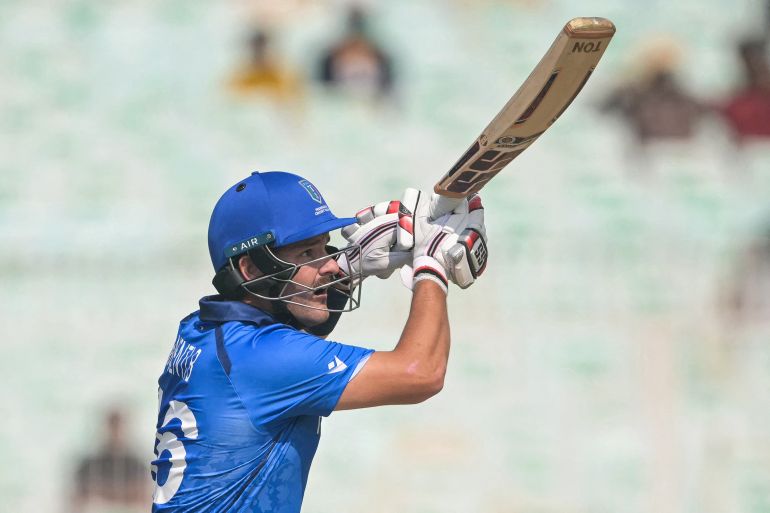
Ben Manenti top-scored for Italy with 52 runs, but it wasn’t nearly enough to forge a win on their T20 World Cup debut [Dibyangshu Sarkar/AFP]
Italy won the toss and bowled first in the Group C encounter, where there were a few Italian fans decked out in the country’s blue.
Scotland rode on a 126-run opening stand between Munsey and Michael Jones, who hit 37, to post the highest total in the tournament so far.
Brandon McMullen with an unbeaten 18-ball 41 and Leask, who hit two fours and two sixes in the last five balls, took Scotland to their best T20 World Cup total.
The left-handed Munsey started briskly with a flurry of fours to unsettle the Italy attack in the first six overs of the powerplay.
Italy suffered a blow when Madsen fell awkwardly while trying to stop a boundary in the fourth over and went off the field wincing in pain with what looked like a dislocated shoulder.
The captain still completed an unusual World Cup double on Monday – playing in two different sports for two separate countries.
He also played at the field hockey World Cup for his native South Africa but holds an Italian passport now through his ancestry.
Munsey, who was dropped on 40 by Anthony Mosca, reached his fifty in 30 balls with a six.
Munsey missed out on a hundred after he holed out to long-on off pace bowler Grant Stewart.
On February 12, Bangladesh will head to the polls to elect its next government, 18 months after Prime Minister Sheikh Hasina was ousted from office by a student-led movement.
Hasina, the daughter of Sheikh Mujibur Rahman, the leader of the country’s independence movement, ruled Bangladesh between 1996 and 2001 and again from 2009 until she had to flee from office in August 2024 – after ordering a brutal crackdown on protesters which killed an estimated 1,400 people – and seek exile in India.
An interim administration led by Nobel laureate Muhammad Yunus has since led the country.
Here is everything you need to know about the upcoming general election:
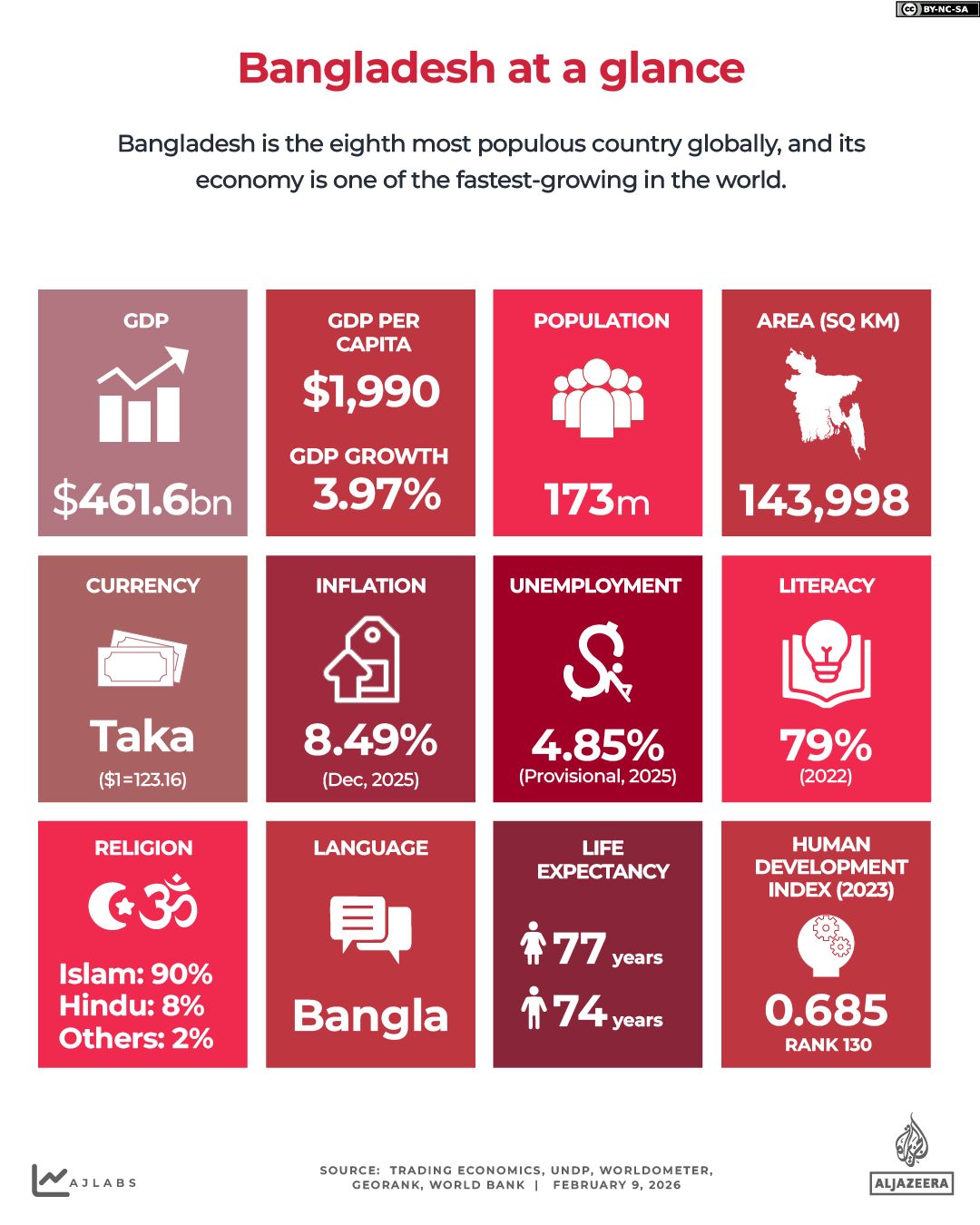
Bangladesh at a glance
The 2026 elections are among the most consequential in the country’s 55-year history, since gaining independence from Pakistan in 1971.
With more than 173 million citizens, Bangladesh is the eighth most populous country globally and, over the past 25 years, its economy has been one of the fastest-growing in the world – though growth has cooled in recent years.
Bangladesh is a predominantly Muslim country, with more than 90 percent of the population following Islam, 8 percent practising Hinduism and the rest following other faiths.
Economically, the country’s gross domestic product (GDP) stands at $461bn, with a per capita income of $1,990.
According to the Bangladesh Bank, GDP expanded by 3.97 percent in the fiscal year ending June 2025, easing from a 4.22 percent rise in the previous year.
Millions of first-time voters
Bangladesh has one of the world’s youngest populations, with a significant portion under the age of 30.
Among those above the voting age of 18, approximately 56 million, or 44 percent, are between the ages of 18 and 37, and nearly 5 million are first-time voters.
Bangladesh is one of the most densely populated countries in the world, with 1,366 people per square kilometre (3,538 people per square mile). This density is nearly three times that of India and four times that of Pakistan.
The country’s largest city is the capital, Dhaka, which has a population of more than 37 million people – more than the entire population of Malaysia, Saudi Arabia or Australia.
(Al Jazeera)
How is the government structured?
Bangladesh is a parliamentary republic, where executive power is exercised by an elected government, consisting of the prime minister and cabinet.
The president of Bangladesh is the ceremonial head of state and is indirectly elected by the parliament for a five-year term.
The prime minister is the leader of the majority party or coalition in parliament.
The prime minister appoints the cabinet, oversees government policy and directs civil service.
Legislative authority rests with the Jatiya Sangsad, Bangladesh’s parliament. It consists of 350 seats, including 300 directly elected seats and 50 seats reserved for women, which are allocated proportionally based on their share of votes. Members serve five-year terms.
Administratively, Bangladesh is divided into eight divisions, 64 districts and 495 upazilas (councils). Local governments manage municipal services, education and rural development, though they depend heavily on funding and authority from the central government.
Political parties
In this 2026 election cycle, there are 59 registered political parties in Bangladesh, excluding the Awami League, Sheikh Hasina’s party, which has had its registration suspended by the election commission, nullifying its ability to field candidates in the polls.
Of these, 51 parties are actively participating in elections by fielding candidates. In total, 1,981 candidates are contesting, including 249 independent candidates.
(Al Jazeera)
Bangladesh Nationalist Party (BNP) – Led by Tarique Rahman, the son of recently deceased former Prime Minister Khaleda Zia.
The BNP is one of Bangladesh’s two major traditional parties and positions itself as a nationalist and conservative alternative to the Awami League.
Jamaat-e-Islami – The Islamic party, led by Shafiqur Rahman, advocates for politics rooted in the religion’s principles and has formed an electoral alliance with the National Citizen Party (NCP) along with other Islamic parties.
National Citizen Party (NCP) – Formed by student leaders of the 2024 uprising, it is a centrist party focused on citizen-led governance and political reform. It has garnered attention from younger voters and civil society groups due to increasing dissatisfaction with established parties.
Jatiya Party (JP-Quader) – This centre-right faction of the Jatiya Party is led by Ghulam Muhammed Quader.
Jatiya Party (JP-Ershad) – Led by Anisul Islam Mahmud, this centre-right party has its roots in the military rule of former President Hussain Muhammad Ershad in the 1980s.
Left Democratic Alliance – A coalition of left-wing parties, including the Communist Party of Bangladesh and several socialist groups.
Amar Bangladesh Party (AB Party) – A centrist party that presents itself as a reform-oriented alternative to the established political blocs, appealing to voters seeking a break from traditional party politics.
Previous election results
Bangladesh’s electoral history over the past two decades has been predominantly shaped by the Awami League, which came to power in 2009 after a significant defeat of the Bangladesh Nationalist Party (BNP) which had ruled from 2001 to 2006.
(Al Jazeera)
In the 2001 election, the Awami League suffered a major defeat, winning just 62 seats, while the BNP secured a commanding majority with 193 seats. That election marked the last clear transfer of power between the two major parties.
The balance shifted decisively in 2008, when the Awami League-led Grand Alliance returned to power in a landslide. Since then, the party has consolidated its dominance.
In 2014, with the BNP absent from the contest, Hasina’s Awami League again won in a landslide.
The party further strengthened its grip in the 2018 election, securing 300 seats, while the BNP was reduced to just seven seats, its weakest performance on record. Thousands of BNP leaders were arrested in the lead-up to the elections. The Jamaat was banned in 2015, and so it couldn’t contest. International observers and opposition groups described the election as neither free nor fair.
In the most recent 2024 election, the Awami League won 272 seats, maintaining a parliamentary majority. The BNP again boycotted, amid deepening repression of opposition leaders. The Jamaat was still banned.
Political leaders throughout history
Since Bangladesh’s independence in 1971 from Pakistan, the country’s turbulent political evolution has been shaken by internal conflicts, military intervention and fragile democratic institutions.
(Al Jazeera)
Sheikh Mujibur Rahman served as the country’s first president – the leader of the independence movement – who soon banned other political parties and adopted increasingly repressive policies.
Rahman was assassinated in 1975 by army officers, who killed him and most of his family. Only two members of his immediate family survived: his daughters, Sheikh Hasina and Sheikh Rehana, who were in West Germany during the attack, and then lived in India in exile. This event triggered a period of coups and counter-coups that established the military as a dominant political force in the country.
A policeman walks past a banner with a picture of Bangladesh’s founder Sheikh Mujibur Rahman, in Dhaka, Bangladesh [File:Munir Uz Zaman/AFP]
Following the assassination, cabinet minister Khondaker Mostaq Ahmad took control of the government until he was deposed in a counter-coup just months later, which led to the appointment of Chief Justice Abu Sadat Mohammad Sayem as a figurehead president.
In 1977, Major General Ziaur Rahman assumed the presidency, and a year later, he founded the Bangladesh Nationalist Party (BNP). His leadership blurred the lines between military and civilian governance. Zia, as he was called, was also assassinated in a failed coup attempt in 1981.
From 1982 to 1990, Bangladesh was ruled under a military dictatorship led by Hussain Muhammad Ershad, during which democratic institutions were weakened, and the presidency functioned as an instrument of centralised rule.
By the late 1980s, Zia’s wife and successor as BNP leader, Khaleda Zia, and Mujibur Rahman’s daughter Sheikh Hasina, joined forces to take on military rule and demand a return to democracy.
In 1990, under mounting pressure, Ershad resigned, paving the way for elections in 1991 that Khaleda won – becoming the country’s first female prime minister.
By then, the brief unity between Khaleda and Hasina had broken down. Over the next two decades, Bangladesh experienced a turbulent swapping of power between the BNP and Hasina’s Awami League. Hasina became PM in 1996, then Khaleda returned to power in 2001, and then Hasina won office again in 2009.
Video from Brazil captured the moment a torrent of water and waste was sent washing down a street, after floods caused a wall to collapse at a recycling centre in Ribeirao Preto.