Russia warns Cuba fuel situation critical; Havana slams ‘cruel’ US tactics

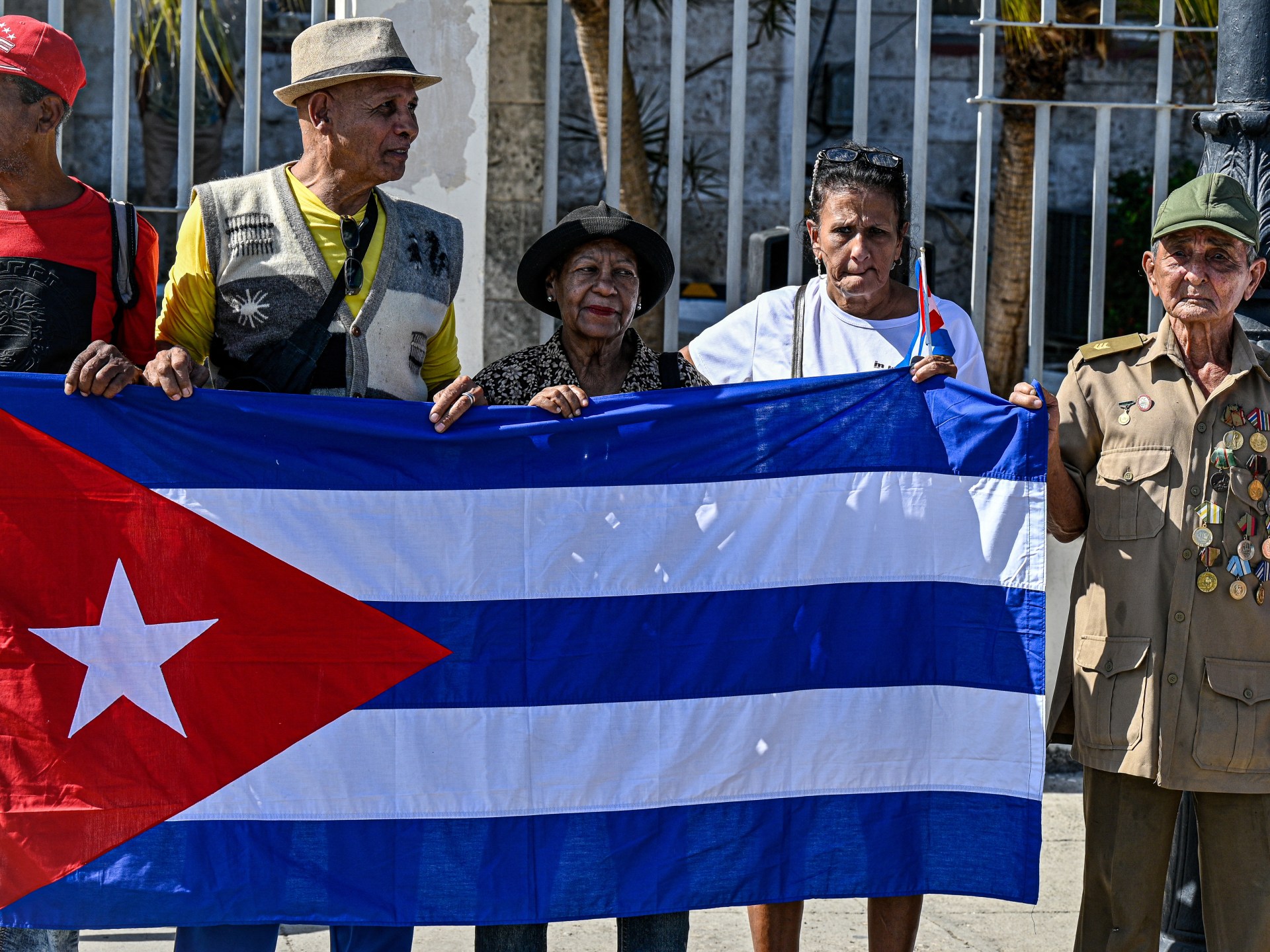
Russia has warned that Cuba’s energy crisis is becoming critical, as it accused the United States of using “suffocating measures” against the socialist island-state.

Kremlin spokesman Dmitry Peskov raised the alarm on Monday, saying Moscow is discussing “possible solutions” to provide Havana with “whatever assistance” it needs.

Recommended Stories

list of 3 itemsend of list

Cuba is reeling after US President Donald Trump cut off oil shipments from Venezuela, following the abduction of Venezuelan President Nicolas Maduro by US forces during a bloody night raid in early January.

Trump has also threatened to impose tariffs on other countries, including Mexico, if they continue to ship much-needed fuel to Cuba, which has already suffered under decades of punitive sanctions imposed by Washington.

“The situation is really critical in Cuba,” Peskov told reporters in Moscow.

“The suffocating measures imposed by the United States are causing many difficulties for the country,” he added.

In separate remarks, published on the Russian Foreign Ministry’s website, Minister of Foreign Affairs Sergey Lavrov renewed Moscow’s “solidarity with the people of Venezuela and Cuba”.

“We are convinced that only they can determine their own destiny,” Lavrov said.

Cuba’s crippling fuel shortage amid US attempts to strangle the economy has immobilised the nation, and power plants are struggling to keep the lights on.

The Cuban government has been forced to impose emergency measures, including a four-day work week for state-owned companies, limiting fuel sales, shuttering universities and reducing school hours.

Cuba has also warned international airlines that jet fuel would no longer be available on the island from Tuesday. On Monday, Air Canada announced it was suspending flights to Cuba due to the shortage of aviation fuel.

‘Breaking the political will of the Cuban people’

For weeks, Moscow has railed against Washington’s campaign against Havana.

Russia has called the US moves against Cuba “unacceptable” and warned of a possible humanitarian crisis in the country.

Moscow’s criticism of the US comes as Russia faces condemnation for its continued bombardment of Ukraine’s energy infrastructure as part of its war effort against its neighbour. Russian attacks have left more than a million people without power in freezing temperatures, according to Ukrainian officials.

United Nations Secretary-General Antonio Guterres had also warned of a humanitarian “collapse” in Cuba if the country’s energy needs go unmet.

On Monday, Cuban Foreign Minister Bruno Rodriguez denounced Washington’s “cruel aggression”, which he said was aimed at “breaking the political will of the Cuban people”.

“The situation is tough and will demand great sacrifice,” said Rodriguez, reiterating Cuba’s “willingness to engage in dialogue”, on its own terms.

Cuban President Miguel Diaz-Canel has said his country is willing to hold talks with the US, but not under pressure.

Trump and his secretary of state, Marco Rubio, the Miami-born son of Cuban immigrants, have made no secret of their desire to bring about regime change in Havana.

Defying Trump, Mexican President Claudia Sheinbaum said that sanctions that harm the people of Cuba were “not right”.

“We will continue supporting them and taking all necessary diplomatic actions to restore oil shipments” to Cuba, Sheinbaum told reporters on Monday.

“You cannot strangle a people like this. It’s very unfair, very unfair.”

Trump referred to Cuba in a recent executive order as “an unusual and extraordinary threat” to US national security, and warned countries that he would impose more tariffs on them if they supplied oil to Cuba.

Mexico was Cuba’s second-largest oil provider after Venezuela.
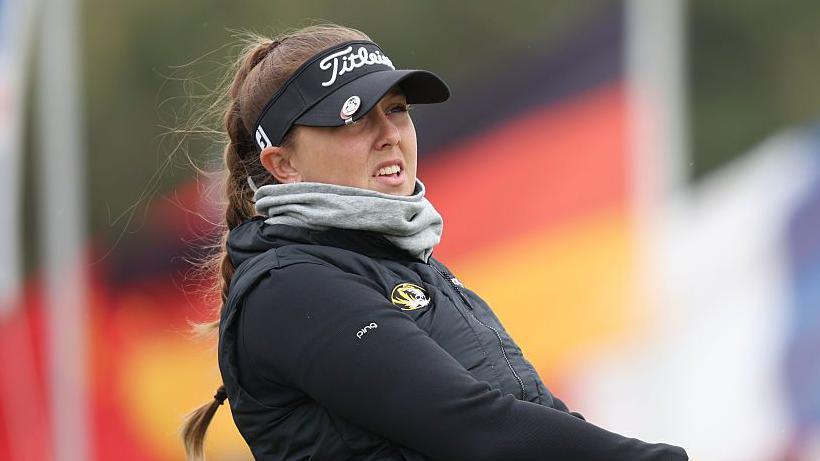
From turning down Mickey Mouse to becoming a pro golfer

Gareth Bailey

BBC Sport Wales

Ask any eight-year-old in the world and there is a high chance that they would bite your arm off to go and see Mickey Mouse at Walt Disney World.

Ask Ffion Tynan and the answer would be very different.

The Welsh golfer was on a family holiday in 2012 when she politely declined a visit to one of the parks in Orlando, instead opting for the kids’ holiday club activity of the day.

The activity? Golf.

It turned out she was actually pretty good at the sport, with a fire lit inside her that day.

“I have a younger sister, who’s two and a half years younger than me,” said Tynan.

“She wanted to go back to one of the Disney parks and I wasn’t having it. I was stubborn and I said to my friends I’m not going, so I ended up doing the kids camp for the day.

“The coach asked me to stay behind and I was like ‘Oh no, am I in trouble?’. They spoke to my parents and said I had a talent for it and to keep playing.

“My dad just laughed because I was the little girl in gymnastics in pretty flowery stuff and I was going to play this sport none of my family grew up in. From there my sister followed.”

Tynan laughs as she reflects fondly on the day.

“I don’t know what I was thinking,” she told BBC Sport Wales.

    • 1 December 2025
    • 23 December 2025

Ever since Tynan’s love of golf was realised, family holidays have revolved around the sport.

“Up until 2021, we didn’t go on a holiday that didn’t include golf,” Tynan explained.

“I was very fortunate that we’d tie stuff in. So for example there’s a small swing of events in Florida at Christmas time, so we’d go out there, do the Christmas bits, play the events and then go to Disney World one day or my favourite, Discovery Cove.

“We kind of had a family holiday within a golf competition, which was really nice.”

Her golfing passion saw her take her education to the United States too, first at the University of Arkansas and then the University of Missouri.

“I was always one of the youngest ones in the bigger tournaments,” said Tynan.

“I looked up to some of the older people and I saw some of them go over there [to America] and it sounded pretty cool.

“My mum’s a teacher so I was definitely getting a degree. To be able to do both [play golf and study] on a scholarship and coming back without student debt, that’s great.

“It was such a cool experience and I’d recommend it to anyone who wants to go.

Inspired by golfing hero Hull

Charley Hull laughs on the courseGetty Images

Tynan says she has been influenced in her career by tennis legend and seven-time singles Grand Slam winner Venus Williams.

Her golfing hero is Charley Hull, who was named the Ladies European Tour (LET) rookie of the year in 2013, shortly after Tynan’s love affair with the sport began.

“I used to run around on the course and watch her play and try to swing it like her and that kind of stuff,” Tynan added.

“I remember when I was a kid my coach would always say, ‘You’ve got to hold your finish like Charley’. I would try to do that when I was a kid.

“It’s pretty cool to see her still around after influencing me at a young age. That’s what I want, to be a person that can influence the next generation, and if I get some of the accolades she gets that’s incredible.

“I want to give back as well and show a little girl from a small town in Wales can do it as well.”

Asked whether she had got in contact with her hero, Tynan gave a smile.

“I feel like it’s that big line at the moment [between peer and hero],” Tynan said.

“Maybe I’ll get lucky enough and play in a major and play with her – that would be pretty awesome.

A young Ffion Tynan plays a shotFfion Tynan

The 2026 LET season begins in Saudi Arabia this week, but Tynan will not be in the field because her playing rights will only grant access to certain event.

As it stands, she is waiting to discover when exactly her tour debut will come.

Whenever the time comes to step on to the first tee, it will be the culmination of 14 years of graft.

“I was nine years old when I decided the path I was going to take, so a long time in the making,” said Tynan.

“I did four years in college and as soon as finishing that I went to Q-school knowing if I did well in that I was turning pro, so I’m really proud of myself for being able to accomplish that.

Related topics

  • Golf
  • Wales Sport

Russia-Ukraine war: List of key events, day 1,447

Here is where things stand on Tuesday, February 10:

Fighting

  • Ukraine’s Air Force said Russia launched 11 ballistic missiles and 149 drones against Ukraine overnight. Of the drones launched, 116 were shot down or neutralised, and some missiles were intercepted and did not reach their targets, the Air Force said.

Weapons

  • Ukraine and France have agreed to start “large-scale” joint weapons production, Ukrainian Defence Minister Mykhailo Fedorov announced on the Telegram messaging app, after hosting his French counterpart, Catherine Vautrin, in Kyiv.
  • Fedorov did not specify what arms would be produced with France or when manufacturing would be launched.

Politics and diplomacy

  • An agreement on ending Russia’s war on Ukraine must also take into consideration security guarantees for Russia, Russian Deputy Minister of Foreign Affairs Alexander Grushko told the Izvestia media outlet. These guarantees include the rejection of any deployment in Ukraine of troops from NATO states, he said.

Sanctions

  • The EU also proposed adding two Kyrgyz banks – Keremet and OJSC Capital Bank of Central Asia – to its sanctions list for providing crypto asset services to Russia, as well as banks in Laos and Tajikistan, while removing two Chinese lenders. If approved, the listed banks would be barred from transactions with EU individuals and companies.
  • The EU document proposes the inclusion in the sanctions list of 30 individuals and 64 companies, seeking a freeze on their assets and travel bans. These include Bashneft, a listed subsidiary of Russia’s oil behemoth Rosneft, as well as eight Russian refineries, among them two major Rosneft-controlled plants – Tuapse and Syzran. The proposal stops short of listing Rosneft or Lukoil, already hit by US sanctions.

Sport

  • Ukrainian Minister of Sports Matvii Bidnyi has decried actions by the IOC that Kyiv says indicate that the organisation may soon ease restrictions against Russian athletes, allowing them to once again represent their country in future Olympic Games.
  • Bidnyi told The Associated Press news agency that any change would be “irresponsible” and appear to condone Russia’s invasion, as the war’s fourth anniversary approaches.
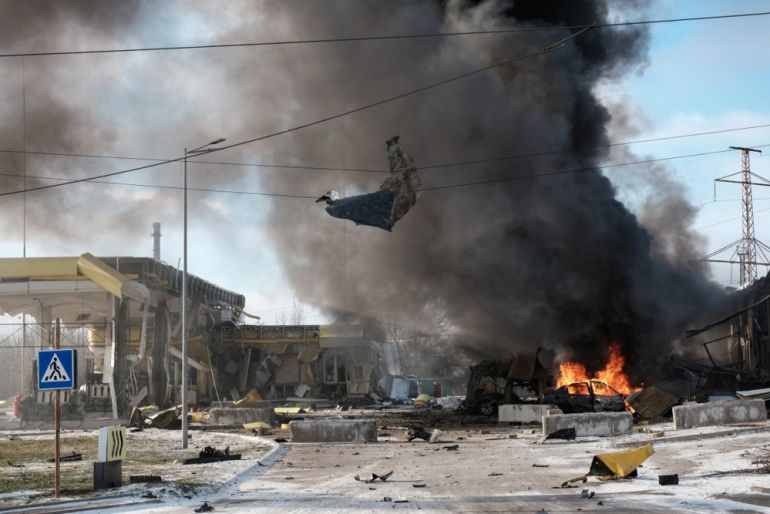
epa12720128 Smoke billows following a Russian double-tap Shahed drones attack against a petrol station in Kramatorsk, Donetsk, Ukraine, 09 February 2026. The city had already been heavily bombed the previous day with Russian troops only 15 kilometres away, and the intensity of the attacks increasing significantly. EPA/Maria Senovilla
Smoke billows following Russian double-tap Shahed drone attacks against a petrol station in Kramatorsk, in the Donetsk region, on Monday [Maria Senovilla/EPA]

Trump opposes Israeli annexation of occupied West Bank: White House

United States President Donald Trump opposes Israel’s annexation of the occupied West Bank, a White House official has said.

“A stable West Bank keeps Israel secure, and is in line with this administration’s goal to achieve peace in the region,” the official said on Monday, according to the Reuters news agency.

Recommended Stories

list of 4 itemsend of list

The comment from the White House comes amid international outrage after Israel’s far-right finance minister, Bezalel Smotrich, and defence minister, Israel Katz, announced new measures on Sunday extending Israeli control over occupied Palestinian territory.

The measures also make it easier for Israelis to acquire land for new settlements, which are illegal under international law.

Eight Muslim-majority countries denounced Israel’s move in a statement on Monday, saying that the “illegal Israeli decisions and measures” are “aimed at imposing unlawful Israeli sovereignty” over Palestinian territory.

Egypt, Indonesia, Jordan, Pakistan, Qatar, Saudi Arabia, Turkiye and the United Arab Emirates said the measures were an attempt at “entrenching settlement activity, and enforcing a new legal and administrative reality in the occupied West Bank, thereby accelerating attempts at its illegal annexation and the displacement of the Palestinian people”.

United Nations Secretary-General Antonio Guterres, the United Kingdom and Spain also joined the rising chorus of condemnation, with the UN chief saying Israel’s actions were “destabilising” and corrosive to the prospects for a two-state solution, according to his spokesman, Stephane Dujarric.

Al Jazeera’s Gabriel Elizondo asked Dujarric in a news conference at the UN headquarters in New York if Guterres considered Israel’s measures a “de facto annexation” of the occupied West Bank.

“These decisions are not moving us in the right direction. They are driving us further and further away from a two-state solution and from the ability of the Palestinian Authority and the Palestinian people to control their own destiny,” Dujarric said.

Elizondo also asked the spokesman what the UN chief could do to deter Israel.

“The secretary-general will continue to advocate for the respect of international law. He’ll continue to push for a two-state solution. But he can’t do it alone. We want others to do so as well,” Dujarric said.

The UK government called on Israel to reverse its decision in a statement on Monday.

“The UK strongly condemns the Israeli Security Cabinet’s decision yesterday to expand Israeli control over the West Bank,” the government said in a statement.

“Any unilateral attempt to alter the geographic or demographic makeup of Palestine is wholly unacceptable and would be inconsistent with international law. We call on Israel to reverse these decisions immediately,” it added.

The controversial Israeli measures include transferring authority over building permits in Hebron, the occupied West Bank’s largest city, from the Palestinian Authority to Israel.

The measures also strengthen Israeli control over two major religious sites in the southern part of the occupied West Bank: Rachel’s Tomb near Bethlehem and the Cave of the Patriarchs in Hebron.

Israeli minister Smotrich said on Sunday that the changes were aimed at “deepening our roots in all regions of the Land of Israel and burying the idea of a Palestinian state”.

In a statement late on Monday, Spain’s Ministry of Foreign Affairs condemned Israel’s decision, saying it is “contrary to international law” and threatens to trigger more violence in Gaza.

“These measures and any attempt at annexation are unacceptable and jeopardise current efforts to implement the Peace Plan and the ceasefire, increasing the risk of triggering a new wave of violence,” the Foreign Ministry said.

Ukraine skeleton racer claims war victim helmet banned by IOC

Jess Anderson

BBC Sport journalist in Cortina

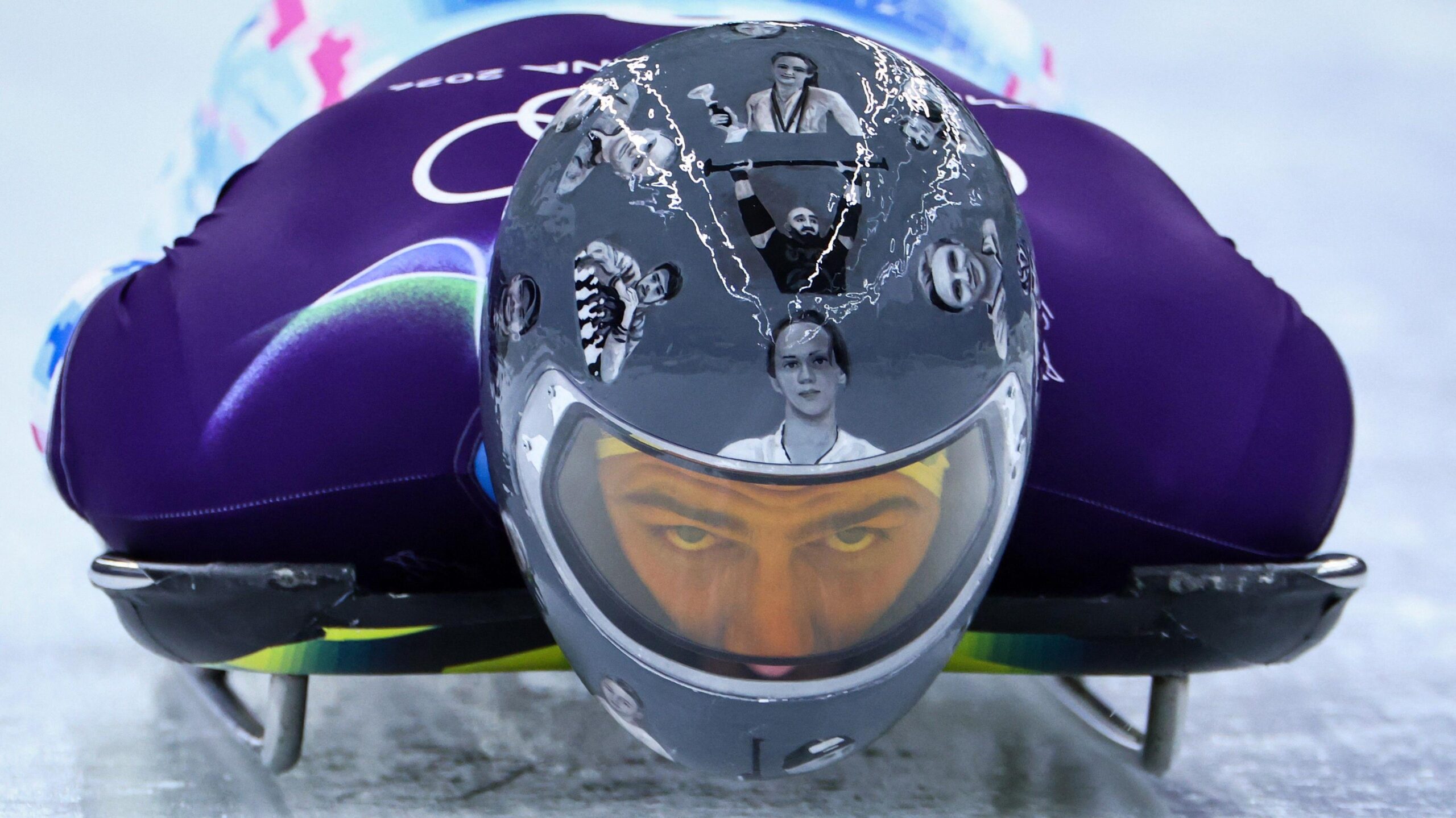
Ukranian skeleton racer Vladyslav Heraskevych claims the International Olympic Committee has banned his helmet featuring images of people killed in the war in his home country, in a decision that “breaks my heart”.

The 26-year-old wore the helmet during a Winter Olympics training session in Cortina, and had promised before the Games to use the event as a platform to keep attention on the conflict.

The IOC is yet to confirm publicly if it has banned the helmet.

“The IOC has banned the use of my helmet at official training sessions and competitions,” said Heraskevych, who was a Ukraine flagbearer in Friday’s opening ceremony, on Instagram.

“A decision that simply breaks my heart. The feeling that the IOC is betraying those athletes who were part of the Olympic movement, not allowing them to be honoured on the sports arena where these athletes will never be able to step again.

“Despite precedents in modern times and in the past when the IOC allowed such tributes, this time they decided to set special rules just for Ukraine.”

Heraskevych told Reuters that many of those pictured on his helmet were athletes including teenage weightlifter Alina Peregudova, boxer Pavlo Ishchenko and ice hockey player Oleksiy Loginov, and stated some of them were his friends.

Heraskevych said Toshio Tsurunaga, the IOC representative in charge of communications between athletes, national Olympic committees and the IOC, had been to the athletes’ village to tell him.

“He said it’s because of rule 50,” Heraskevych told Reuters.

Rule 50.2 of the Olympic Charter states that “no kind of demonstration or political, religious or racial propaganda is permitted in any Olympic sites, venues or other areas”.

He said earlier on Monday that the IOC had contacted Ukraine’s Olympic Committee over the helmet.

The IOC said it had not received any official request to use the helmet in competition, which starts on 12 February.

Meanwhile, Ukraine president Volodymyr Zelensky thanked Heraskevych “for reminding the world of the price of our struggle” in a post on X.

The post continued: “This truth cannot be inconvenient, inappropriate, or called a ‘political demonstration at a sporting event’. It is a reminder to the entire world of what modern Russia is.”

Heraskevych, Ukraine’s first skeleton athlete, held up a ‘No War in Ukraine’ sign at the 2022 Beijing Olympics, days before Russia’s 2022 invasion of the country.

Rule 50.2 of the Olympic Charter states: “No kind of demonstration or political, religious or racial propaganda is permitted in any Olympic sites, venues or other areas.”

Heraskevych had said he intended to respect Olympic rules which prohibit political demonstrations at venues while still raising awareness about the war in Ukraine at the Games.

Following Russia’s full-scale invasion of Ukraine in 2022 athletes from Russia and Belarus were largely banned from international sport, but there has since been a gradual return to competition.

The IOC cleared 13 athletes from Russia to compete as Individual Neutral Athletes (AINs) in Milan-Cortina.

    • 1 hour ago

Winter Olympics 2026

6-22 February

Watch on iPlayerListen on Sounds
Full coverage guide

Related topics

  • Winter Sports
  • Skeleton
  • Winter Olympics

Landmark cases on social media’s impact on children begin this week in US

Two lawsuits accusing the world’s largest social media companies of harming children begin this week, marking the first legal efforts to hold companies like Meta responsible for the effects their products have on young users.

Opening arguments began today in a case brought by New Mexico’s attorney general’s office, which alleges that Meta failed to protect children from sexually explicit material. A separate case in Los Angeles, which accuses Meta and the Google-owned YouTube of deliberately designing their platforms to be addictive for children, is set to begin later this week.

Recommended Stories

list of 4 itemsend of list

TikTok and Snap were also named in the original California lawsuit but later settled under undisclosed terms.

The New Mexico and California lawsuits are the first of a wave of 40 lawsuits filed by state attorneys general around the US against Meta, specifically, that allege that the social media giant is harming the mental health of young Americans.

New Mexico case

In the opening argument in the New Mexico case, which was first filed in 2023, prosecutors told jurors on Monday that Meta – Facebook and Instagram’s parent company – had failed to disclose its platforms’ harmful effects on kids.

“The theme throughout this trial is going to be that Meta put profits over safety,” said lawyer Donald Migliori, who is representing the state of New Mexico against Meta.

“Meta clearly knew that youth safety was not its corporate priority… that youth safety was less important than growth and engagement.”

Prosecutors say they will provide evidence and testimony that Meta’s algorithms and account features not only enticed young people and made them addicted to social media, but also fostered a “breeding ground” for predators who target children for sexual exploitation.

Late last month, in the process of discovery, the New Mexico attorney general’s office said the company did not put in safeguards to protect children from accessing sexualised chatbots on Facebook and Instagram.

In emails obtained by the court, some of Meta’s safety staff had expressed objections that the company was building chatbots geared for companionship, including sexual and romantic interactions with users, according to the Reuters news agency.

The artificial intelligence chatbots were released in early 2024. The documents cited in the state’s filing do not include messages or memos authored by Meta CEO Mark Zuckerberg. In October 2025, Meta added parental controls to the chatbots.

California case

The California case is more wide-reaching and alleges that Meta and YouTube, which is a unit of Alphabet-owned Google, used deliberate design choices that sought to make their platforms more addictive to children to boost profits.

The case centres around a 19-year-old identified only by the initials KGM. The case could determine how thousands of other, similar lawsuits against social media companies will play out.

KGM claims that her use of social media from an early age made her addicted to the technology and exacerbated her depression and suicidal thoughts.

“Borrowing heavily from the behavioral and neurobiological techniques used by slot machines and exploited by the cigarette industry, Defendants deliberately embedded in their products an array of design features aimed at maximizing youth engagement to drive advertising revenue,” the lawsuit says.

Executives, including Zuckerberg, are expected to testify at the trial, which will last six to eight weeks. It is unclear if they will attend the New Mexico case.

The tech companies dispute the claims that their products deliberately harm children, citing a bevvy of safeguards they have added over the years and arguing that they are not liable for content posted on their sites by third parties.

“Recently, a number of lawsuits have attempted to place the blame for teen mental health struggles squarely on social media companies,” Meta said in a recent blog post. “But this oversimplifies a serious issue. Clinicians and researchers find that mental health is a deeply complex and multifaceted issue, and trends regarding teens’ well-being aren’t clear-cut or universal.

Narrowing the challenges faced by teens to a single factor ignores the scientific research and the many stressors impacting young people today, like academic pressure, school safety, socio-economic challenges and substance abuse.”

A Meta spokesperson said in a recent statement that the company strongly disagrees with the allegations outlined in the lawsuit and that it is “confident the evidence will show our longstanding commitment to supporting young people”.

Jose Castaneda, a Google spokesperson, said the allegations against YouTube are “simply not true”.

“Providing young people with a safer, healthier experience has always been core to our work,” he said in a statement.

High stakes

The outcome of the cases could shape the future of social media.

“In my mind, an existential question for social media services is whether they’re liable for harm suffered by users from using the services. If so, the damages could be more money than the defendants have, Eric Goldman, a professor at the Santa Clara University School of Law, told Al Jazeera.

“We’re talking about massive financial stakes, and we’re also talking about the ability of the plaintiffs to veto or potentially override editorial decisions by the services about what’s in the best interests of their audiences,” he said.

“It’s essentially taking away power from the services to decide and handing it to plaintiffs’ lawyers. So, not only could there be existential damages, but there could also be a massive loss of editorial control over their services. The stakes could not be higher for social media services or the internet.”

Goldman said this was because the same argument could be used to shape claims against video game makers and generative AI, which refers to AI that can create original content, including text and video.

“If these theories work against social media, they might also work against video games, against generative AI, and who knows what else. That’s why I said the stakes are so high for the internet,” he added.

There are already lawsuits that claim that interactions with OpenAI’s ChatGPT led to instances of suicide and murder-suicide.