Kyiv, Ukraine – A heavy Russian Geran drone struck a fast-moving train in northern Ukraine on January 27, killing five, wounding two and starting a fire that disfigured the railway carriage.
Such an attack was impossible back in 2022, when Russia started dispatching roaring swarms of Shaheds, the Geran-2’s Iranian prototypes.
Recommended Stories
list of 4 itemsend of list
Ukrainian servicemen ridiculed them for their slow speed and low effectiveness – and shot them down with their assault rifles and machineguns.
But the Geran kamikaze drones have undergone countless modifications, becoming faster and deadlier – and some were equipped with Starlink satellite internet terminals.
The terminals made them immune to Ukrainian jamming and even allowed their Russian operators to navigate their movement in real time.
Western sanctions prohibit the import of the notebook-sized terminals operated by Elon Musk’s SpaceX company to Russia.
But Moscow has allegedly smuggled thousands of them via ex-Soviet republics and the Middle East, notably Dubai, using falsified documents and activation in nations where the use of Starlink is legal, according to Russian war correspondents and media reports.
Russian forces were able to counter the use of Starlink by Ukrainian forces as the terminals linked to SpaceX’s satellite armada orbiting the Earth allowed faster communication and data exchange, as well as greater precision.
In early February, SpaceX blocked the use of every Starlink geolocated on Ukrainian territory, including the ones used by Ukrainian forces.
Only after a verification and inclusion into “white lists” that are updated every 24 hours can they be back online.
But any terminal will be shut down if moving faster than 90km/h (56mph) to prevent drone attacks.
“Looks like the steps we took to stop the unauthorized use of Starlink by Russia have worked,” Musk wrote on X on February 1.
The step is ascribed to Ukraine’s new defence minister, Mykhailo Fedorov, a 35-year-old who had served as the minister of digital transformation. He introduced dozens of innovations that simplified bureaucracy and business, according to a four-star general.
“Fedorov managed to sort it out with Musk – somehow, because we couldn’t do it earlier,” Lieutenant General Ihor Romanenko, a former deputy head of Ukrainian armed forces, told Al Jazeera.
He said the shut-off “significantly lowered” the effectiveness of Russia’s drone attacks and disrupted the communication of small groups of Russian soldiers trying to infiltrate Ukrainian positions.
The effect was so devastating that it made Russian forces “howl” with despair, said Andriy Pronin, one of the pioneers of military drone use in Ukraine.
“They’re like blind kittens now,” he told Al Jazeera.
Russian servicemen in places like the contested eastern town of Kupiansk are now “deprived of any way of getting in touch with mainland”, one of them complained on Telegram on February 4.
Other servicemen and war correspondents decried the shortsightedness of Russian generals who built communications around Starlink and did not create an alternative based on Russian technologies and devices.
However, the shutdown affected Ukrainian users of Starlink that were not supplied to the Defence Ministry but were procured by civilians and charities.
“The communications were down for two days until we figured out the white list procedure,” Kyrylo, a serviceman in the northern Kharkiv region, told Al Jazeera. He withheld his last name in accordance with the wartime protocol.
The effect, however, is short-term and is unlikely to turn the tables in the conflict that is about to enter another year.
“It’s not a panacea, it’s not like we’re winning the war,” Pronin said. “It will be hard [for Russians], but they will restore their communications.”
The President of the Petroleum and Natural Gas Senior Staff Association of Nigeria (PENGASSAN), Festus Osifo, says the old Port Harcourt refinery has been rehabilitated to about 90 per cent and can be brought back into operation within one week, if the Nigerian National Petroleum Company Limited (NNPCL) so decides.
Osifo disclosed this on Tuesday while speaking as a guest on Channels Television’s The Morning Brief programme.
According to him, the refinery is technically ready for operation, but profitability considerations remain a major factor influencing NNPCL’s decision on when to restart the facility.
“As of today, you can start the old Port Harcourt refinery, and it will function. You can put it on today, and it will function. However, NNPCL as a company is there to make a profit. So, if they want to start it today, within the next one week, they can bring it back to life,” Osifo said.
READ ALSO: Restructure, Buy Port Harcourt Refinery, Otedola Tells DAPPMAN Amid Brawl With Dangote
He explained that although extensive rehabilitation work has been carried out, operational losses could arise due to the cost of crude oil relative to the value of refined products.
“It has been rehabilitated up to about 90 per cent. But the challenge is that if you feed crude oil worth, say, five million dollars into the old Port Harcourt refinery, what you are likely to get at the other end when you sell the petroleum products may be about 4.5 million dollars. So, you put in five million dollars as input and get 4.5 million dollars as output.”
Osifo, however, noted that the investment in the refinery was not wasted, stressing that major components of the facility had been replaced during the rehabilitation exercise.
“The money that was thrown into the Port Harcourt refinery is not a loss. If you look at the old Port Harcourt refinery, almost all the compressors were changed, the control rooms were changed, and the panels were all changed. The contractors did not take them away,” he said.
Old Port Harcourt Refinery
He added that the value of the refinery has significantly improved compared to its condition before rehabilitation.
“In fact, if you value the refinery today, it will be much more valuable than the state it was in before the rehabilitation,” Osifo said.
American ski athlete Lindsey Vonn said on Monday she had suffered a “complex tibia fracture” when she crashed in the Winter Olympics downhill and would need “multiple surgeries”.
“While yesterday did not end the way I had hoped, and despite the intense physical pain it caused, I have no regrets,” Vonn said on her social media, from the hospital in Italy where she is being treated.
Recommended Stories
list of 3 itemsend of list
Vonn, 41, insisted that the ruptured anterior cruciate ligament she suffered in a crash in a World Cup race before the Milan-Cortina Games “had nothing to do with my crash whatsoever”.
“I was simply 5 inches too tight on my line when my right arm hooked inside of the gate, twisting me and resulted in my crash,” she added.
“I sustained a complex tibia fracture that is currently stable but will require multiple surgeries to fix properly.”
In her first statement since the crash, Vonn said: “My Olympic dream did not finish the way I dreamt it would. It wasn’t a story book ending or a fairy tale, it was just life. I dared to dream and had worked so hard to achieve it.
“Because in Downhill ski racing the difference between a strategic line and a catastrophic injury can be as small as 5 inches.”
Vonn crashed heavily just 13 seconds after starting her run. She was winched off the piste by a rescue helicopter and is being treated in a hospital in Treviso.
She had resumed her career in late 2024 after nearly six years in retirement and was considered a strong favourite for the downhill at these Olympics after recording seven World Cup podium finishes, including two wins, before her pre-Olympics crash in Crans-Montana, Switzerland.
Vonn’s crash during the Olympic Women’s Downhill on Sunday is likely to be career-ending for the American Alpine ski athlete [Screengrab by IOC via Getty Images]
Even those who do not follow French football in its most granular detail will be aware of the plight that could have befallen Lyon this summer.
Spared from administrative relegation to Ligue 2 just five and a half weeks before the start of the season, the club’s future in the French top flight hinged on their capacity to fulfil financial promises.
A firesale of the side’s most valuable assets duly ensued, and with it, expectations of a third successive season of European football dwindled.
Constrained by their financial frailties, Les Gones, spearheaded by sporting director Matthieu Louis-Jean, had to work diligently, embarking on an agile recruitment drive.
Spotting talent from lesser-known European leagues became a central tenet of their philosophy.
“We worked on different markets,” outlined the former Nottingham Forest right-back in September.
Amid a flurry of moves, Pavel Sulc and Ruben Kluivert arrived on permanent deals from Viktoria Plzen and Casa Pia respectively, while Adam Karabec joined from Sparta Prague on loan.
Louis-Jean has cultivated a burgeoning reputation as a strategic operator, but his most innovative market manoeuvre would have to wait until the winter window.
Having deviated from their reactive tendencies of the past, Lyon were left without a central striker of note, preferring to secure the temporary services of Martin Satriano on loan.
“We took a decision on the final day of the transfer window to leave the position of a first-choice striker open,” said general director Michael Gerlinger.
Louis-Jean, and Lyon’s wider recruitment department, were convinced an opportunity would present itself in January. Their intuition soon morphed into prophecy.
Having amassed just 99 minutes of action for Real Madrid during the first half of the season, Brazil striker Endrick needed an escape. Lyon were more than happy to provide sanctuary for a player and talisman they desperately craved.
Getty Images
At a club where strikers are held in such reverence, his impact has been almost divine.
He scored 42 minutes into his debut against Lille in the last 32 of the French Cup. Another four goals have followed in five games.
Three of those came against Metz, making him the youngest player to score a Ligue 1 hat-trick for Lyon, surpassing the great Bernard Lacombe, who had held the record for 54 years.
Before Saturday’s match with Nantes, no Lyon player had been directly involved in more goals (six), had more shots on target (14), or completed more dribbles (19) than the Brazilian since his arrival.
Endrick’s signing perpetuates a long-held legacy of Brazilians representing the club.
Juninho Pernambucano, Cris and Sonny Anderson are just a few to have spent significant portions of their careers with Lyon, each contributing to the club’s unprecedented run of seven successive Ligue 1 crowns between 2002 and 2008.
“I know there are a lot [of Brazilians] that have played for the club, and many of them have had a fantastic career here,” said Endrick during his first interview with French newspaper L’Equipe.
Lucas Paqueta and Bruno Guimaraes, Brazil team-mates of Endrick, provided counsel prior to his move.
“Before coming, I spoke with Paqueta and Bruno,” he said. “They told me it was a place I could be really happy.”
Personal fulfillment, and a chance “to play football” with this summer’s World Cup looming, he says were driving factors in his decision to join.
If strikers are revered in Lyon, they are held in almost sacred status in Brazil.
“We don’t have that mobile number nine in the Brazil side,” says former Lyon captain Cris.
“We have Gabriel Jesus, Richarlison, but there’s a space there for him to help the side with his mobility and the way he sees the game.”
Ultimately, Brazil manager Carlo Ancelotti will be the man who decides if Endrick makes the plane.
“We had a wonderful conversation,” said Endrick when asked about whether the Italian had been in contact before his move.
“He gave me some advice that has stayed with me,” he added. “Now, I have to work in order to improve and become a better player.”
Lyon, and Ligue 1, provide the perfect platform for him to do just that.
“He’s very explosive, very quick, very good in one-on-one situations,” enthused Lyon manager Paulo Fonseca after his debut against Lille.
His contentious sending-off for two yellow cards against Nantes on Saturday, however, following a petulant kick out after some robust challenges against him, provides a timely reminder of the adjustments Endrick needs to make.
“When there are players of that calibre, we have to make sure to contain them,” said Nantes manager Ahmed Kantari in the aftermath.
Getty Images
That influence transcends the pitch, too – his signing representing a commercial coup as well as a sporting one.
“It’s obvious his notoriety will boost the club’s image,” Gerlinger said during the Brazilian’s presentation.
The results have been tangible. His arrival video, published on the club’s official Instagram account, is the club’s most-watched on the platform, while highlights of games against Metz, Lille, Brest and Stade Laval – in which Endrick featured – top their YouTube charts.
Lyon will hope his impending one-game suspension does not stymie his, or their, seamless progress of late.
Prior to Endrick’s arrival, Fonseca’s side had recorded a run of four wins in all competitions – subsequently extended to 12.
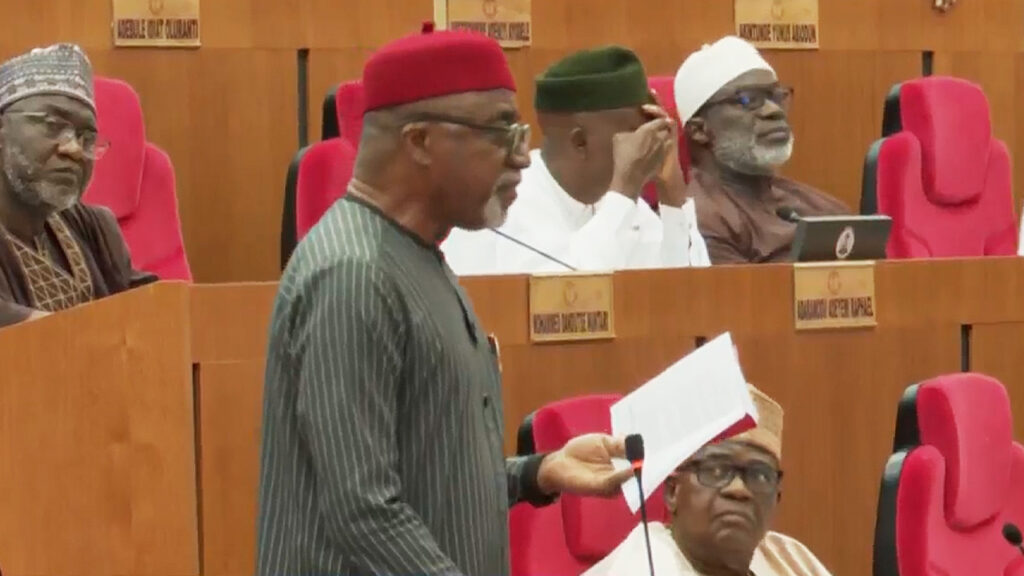
The Senate has held an emergency plenary session amid backlash over amendments to the Electoral Act, particularly provisions relating to the electronic transmission of election results.
Here were some of the key developments from the session, which started around 12:30 pm on Tuesday.
13: 34 pm: The Senate President has expanded the membership of the Senate Conference Committee to 12 and directed members to commence sittings immediately, as legislative work on the bill enters its final stage.
Addressing the committee, the Senate President urged members to expedite their deliberations, noting that the outcome would be transmitted promptly to the Presidency for assent within February.
He expressed optimism that President Bola Tinubu, in the next week, would sign the bill into law as an act of Parliament.
The number of lawmakers from the Senate was increased to 12 from a previous 9 to align with that of the House of Representatives. The total number of lawmakers from both chambers now stands at 24.
1:14 pm: The Senate President, Akpabio, continues with the votes and proceedings
1:10 pm: Abaribe withdraws his call for individual votes
1:02 pm: Sen. Abaribe calls for a vote on the matter, which is met with immediate uproar among lawmakers.
Senate President Akpabio
12:55 pm: The Senate President, Godswill Akpabio, has aligned with a motion sponsored by Senator Tahir Mungono calling for the electronic transmission of election results by presiding officers at polling units.
Under the proposal, electronic transmission would serve as the primary method of uploading results. However, in the event of technical challenges such as network failures, the motion provides for a fallback option allowing the manual transmission of results using Form EC8A, duly signed and stamped by the presiding officer.
The proposal, however, sparked concerns among lawmakers, particularly over the reliance on Form EC8A as the primary source of election results, where disputes arise.
The differing views led to sharp divisions on the floor of the Senate, prompting Senator Enyinnaya Abaribe to call for an individual vote on the matter to clearly determine the position of each lawmaker.
12:50 p.m.: The Senate now takes the motion by Senator Tahir Munguno that the decision on Clause 60 (3) be rescinded and recommitted to the committee of the whole.
Background
The emergency sitting was announced in a notice issued on Sunday by the Clerk of the Senate, Emmanuel Odo, following the directive of Senate President Godswill Akpabio.
“I am directed by His Excellency, the President of the Senate, Distinguished Senator Godswill Obot Akpabio, GCON, to inform all Distinguished Senators of the Federal Republic of Nigeria that an Emergency Sitting of the Senate has been scheduled to hold as follows: Date: Tuesday, 10th February, 2026. Time: 12:00 noon. Venue: Senate Chamber,” the notice read.
Although no official reason was given for the emergency sitting, the development comes amid widespread public debate and protests following the Senate’s passage of the Electoral Act 2022 (Repeal and Re-enactment) Amendment Bill 2026 through a third reading last week.
READ ALSO: Occupy National Assembly Protest Begins In Abuja Over E-Transmission Of Election Results
The controversy centres on Clause 60, Subsection 3, of the bill, which relates to the electronic transmission of election results.
The Senate declined to approve a proposed amendment that would have made real-time electronic transmission of results mandatory, instead retaining the existing provision in the 2022 Electoral Act.
The retained clause states that “the presiding officer shall transfer the results, including the total number of accredited voters and the results of the ballot, in a manner as prescribed by the Commission.”
The rejected amendment would have required presiding officers of the Independent National Electoral Commission (INEC) to electronically transmit polling unit results to the IREV portal in real time after the relevant result forms had been duly signed and stamped.
The Senate also rejected proposals seeking to introduce a 10-year ban on vote-buyers, opting instead to retain existing penalties of fines and jail terms.
Protest
Public discontent over the Senate’s decision spilled onto the streets on Monday, as members of civil society groups and opposition political parties converged on the entrance of the National Assembly in Abuja under the banner of the “Occupy National Assembly” protest.
The demonstration, which was directed against the Senate’s position on electronic transmission of results, attracted a heavy security presence, with personnel deployed from the Nigeria Police Force, the Nigerian Army and the Nigeria Security and Civil Defence Corps.
The entrance to the National Assembly was barricaded by security operatives, but some of the protesters told Channels Television that they did not intend to force entry into the National Assembly, noting that the demonstration was planned to take place solely at the gate.
The protesters marched from the Federal Secretariat towards the National Assembly complex.
Peter Obi at the Occupy National Assembly protest in Abuja
Meanwhile, the 2023 presidential candidate of the Labour Party, Peter Obi, who is now a member of the ADC, also joined the protest.
Obi said the Senate must act to prevent a recurrence of the technical failures reported by INEC during the 2023 general elections.
According to him, lawmakers should make real-time electronic transmission of election results mandatory to strengthen the credibility of the electoral process.
Clarification
In response to the backlash, Senate President Godswill Akpabio clarified that the Senate did not reject electronic transmission of election results but merely retained the provision as contained in the 2022 Electoral Act.
Speaking at a book launch over the weekend, Akpabio explained that the phrase “real time” was removed to avoid potential legal complications arising from network failures.
“All we said during the discussion was that we should remove the word ‘real-time’ because if you say real-time, then there is a network or grid failure, and the network is not working. When you go to court, somebody will say it ought to have been real-time. That was all we said,” he said.
A file photo of the Senate President Godswill Akpabio
Akpabio added that the decision was intended to give INEC the flexibility to determine the most appropriate method of transmitting results, taking into account technological and security challenges.
‘Allow INEC decide’
Former Senate President David Mark responded to Akpabio in on the issue, stating that the National Assembly should allow INEC to decide whether or not to transmit election results electronically.
Former Senate President, Senator David Mark (file)
Despite the criticism, some senators have defended the bill, insisting that it enjoyed overwhelming support in the Red Chamber.
“Over 85 per cent of senators agreed to electronic transmission. It was common ground. Even the ad hoc committee of the Senate agreed to it,” the Senator representing Anambra Central, Victor Umeh, told Channels Television.
Umeh said the only change agreed during the Senate’s executive session was the removal of the phrase “in real time”, attributing the decision to concerns about network coverage in some parts of the country.
“It was only ‘real time’ that was expunged because of network issues. Transmission itself was never in dispute,” he said.
According to him, confusion arose during plenary when a motion was reportedly introduced to replace the word “transmission” with “transfer” without debate.
“There was no debate on it. If debate had been allowed, it would have taken us back to the executive session where the issue had already been exhaustively discussed and resolved,” Umeh added.
You can watch the Senate proceedings today on all our platforms.
Ghislaine Maxwell, Jeffrey Epstein’s convicted associate and former girlfriend, invoked her Fifth Amendment right and refused to testify before a US congressional committee, with her lawyers saying she would only answer questions if granted clemency.