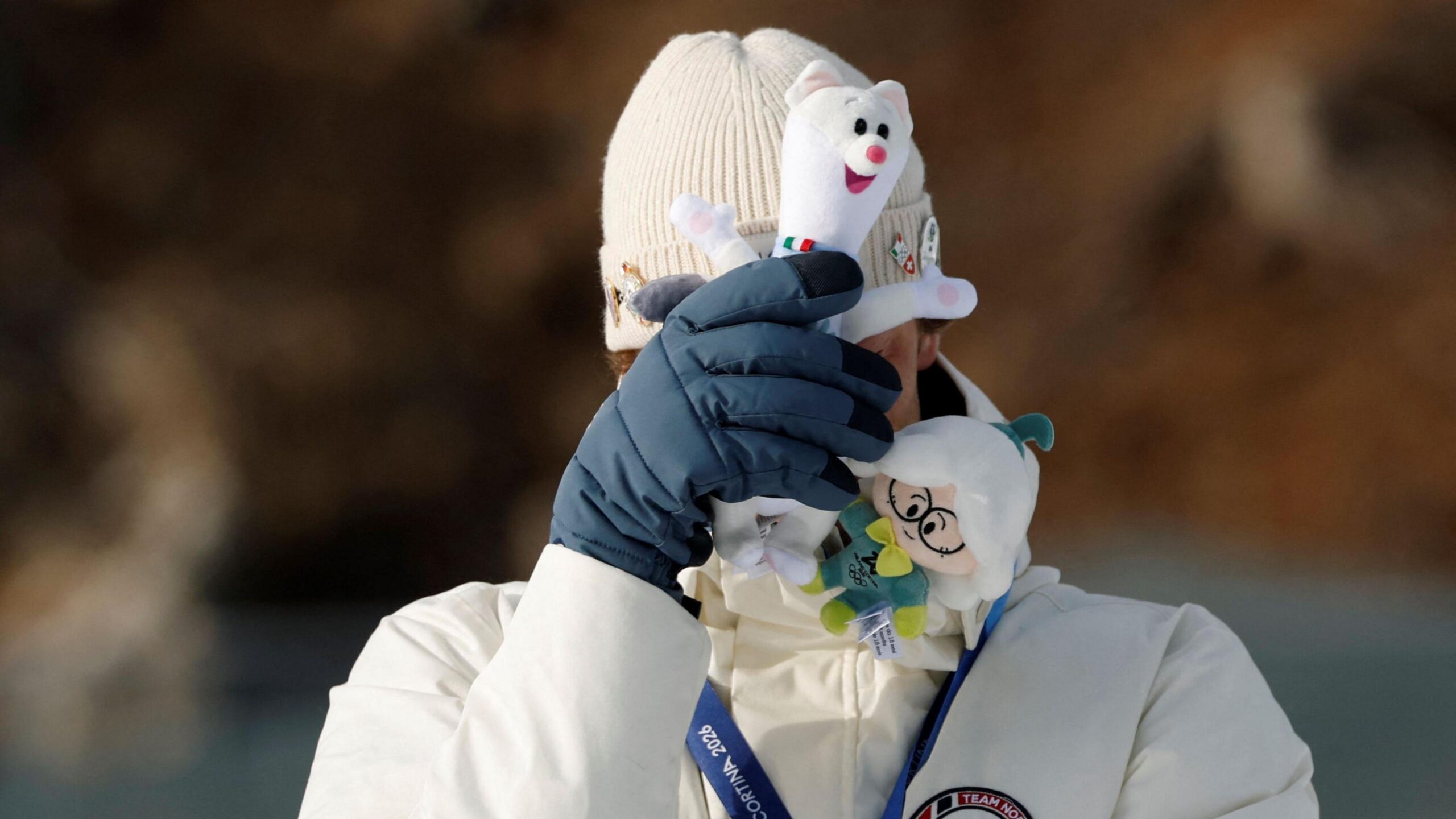
Norwegian biathlete Sturla Holm Laegreid confessed on live television to cheating on his girlfriend moments after winning bronze in the Winter Olympics.
The 28-year-old, who won his first individual Olympic medal in the 20km individual biathlon at Milan-Cortina, admitted he had an affair three months ago and called it “my biggest mistake”.
Laegreid said it had been “the worst week of my life” since he told his girlfriend of six months about the affair.
“There’s someone I wanted to share it with who might not be watching,” he told NRK, Norway’s state broadcaster.
“Six months ago I met the love of my life – the most beautiful and kindest person in the world. Three months ago I made my biggest mistake and cheated on her.
“I had the gold medal in life, and I am sure there are many people who will see things differently, but I only have eyes for her.
Getty Images
The seven-time world champion finished third in the biathlon – which combines cross-country skiing and rifle shooting – behind champion Johan-Olav Botn, a fellow Norwegian, and Eric Perrot of France.
It is a second Olympic medal for Laegreid, who won gold in the relay at the 2022 Games.
Asked about his admission in the news conference later, he added: “I don’t know if it was the right choice or not, but it was the choice I made.
“I made the choice to tell the world what I did so maybe there’s a chance she will see what she really means to me – maybe not, but I don’t want to think I didn’t try everything to get her back.
To play this video you need to enable JavaScript in your browser.
Adwaidh Rajan
BBC Sport journalist
82 Comments
Men’s T20 World Cup, Group A, Colombo
Pakistan 190-9 (20 overs): Farhan 73 (41); Van Schalkwyk 4-25
USA 158-8 (20 overs): Ranjane 51 (30); Tariq 3-27
Pakistan won by 32 runs
Pakistan geared up for the highly anticipated T20 World Cup showdown with India by securing a 32-run victory against the United States in their second group-stage fixture.
The USA pulled off a sensational win against Pakistan in a super over when the sides met in the 2024 edition, but there was no such drama this time around.
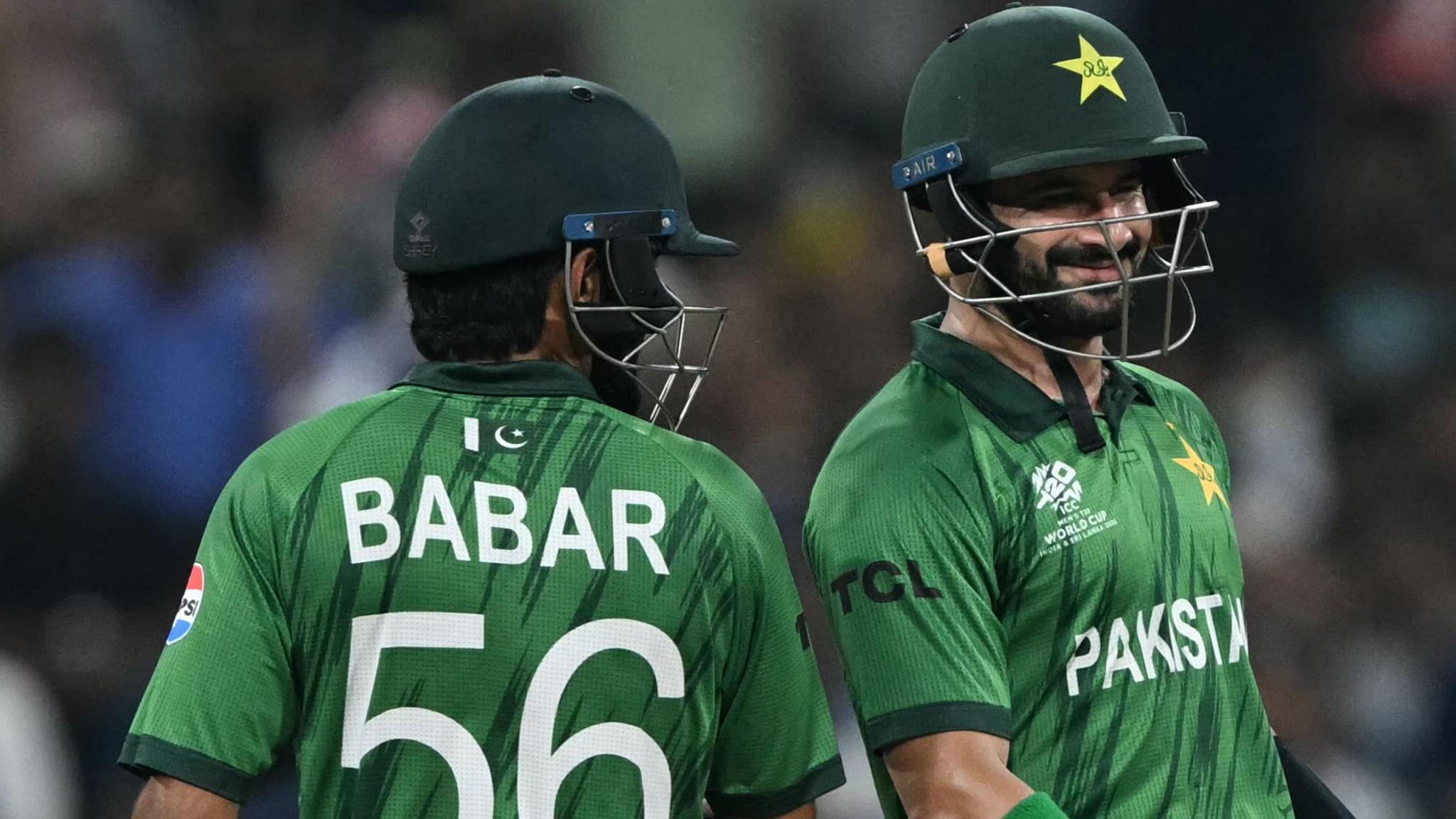
Sahibzada Farhan’s sparkling knock of 74 from 41 balls and Babar Azam’s 48 off 32 handed a target of 191 to the USA, who failed to keep pace during the chase as Pakistan made it two wins from two matches in the tournament.
It is a confidence‑boosting victory for Pakistan before Sunday’s high‑stakes match with arch‑rivals and defending champions India – a contest that was clouded by uncertainty until the country’s government reversed its order for a boycott.
Pakistan’s innings was shaped by Farhan’s ninth T20I half-century while Babar also added some much-needed runs to his account amid his recent struggles with form.
Farhan eventually fell to Harmeet Singh in the 16th over but not before leaving Pakistan well placed at 143‑4 heading into the death overs.
Shadab Khan then added a quickfire 30 from 12 balls but Pakistan lost five wickets in the final two overs to reach 190-9, with USA seamer Shadley van Schalkwyk finishing with figures of 4-25 for the second game running.
Opener Shayan Jahangir almost single-handedly guided the USA in the early stages of the chase but fell one short of a deserved half-century in the 11th over when they were already struggling to keep up with the asking rate.
Despite having wickets in hand, the USA managed just 29 runs in six overs after powerplay, meaning Shubham Ranjane’s 30-ball 51 proved too little and too late as mystery spinner Usman Tariq claimed three wickets.
13 hours ago
9 hours ago
New Zealand rout UAE for second win
To play this video you need to enable JavaScript in your browser.
Men’s T20 World Cup, Group D, Chennai
United Arab Emirates 173-6 (20 overs): Waseem 66* (45); Henry 2-37
New Zealand 175-0 (15.2 overs): Seifert 89* (42), Allen 84* (50)
New Zealand won by 10 wickets
Tim Seifert and Finn Allen put on a record-breaking opening partnership as New Zealand made it two wins from two matches with a 10-wicket defeat of the United Arab Emirates.
They guided New Zealand to victory with the highest partnership for any wicket in T20 World Cup history, breaking the previous mark of 170 held by England’s Jos Buttler and Alex Hales in a 10-wicket win over India in the 2022 semi-final.
Batting first in Chennai, half-centuries from captain Muhammad Waseem and Alishan Sharafu took the UAE to 173-6, a total they would have thought gave them a fighting chance against the 2021 finalists.
But any hope of a UAE challenge evaporated quickly as New Zealand openers Seifert and Allen produced a ruthless exhibition of hitting to help their side reach the target with 28 balls to spare.
Having hit a 42-ball 65 in Sunday’s win against Afghanistan, Seifert struck his second consecutive half-century in 23 balls and remained unbeaten on 89, while Allen hit a 50-ball 84, which included five sixes.
Earlier, a 107-run second-wicket stand between Waseem, who remained unbeaten on 66 from 45 balls, and Sharafu had given the UAE a solid platform to build on.
Sharafu, born in the Indian state of Kerala not too far away from Chennai, attacked the off-side freely for his 47-ball 55 and it took a brilliant relay catch involving Mark Chapman and Mitch Santner to dismiss the batter.
That wicket stalled UAE’s charge but Waseem and Mayank Kumar hit 27 runs off the 18th over from Glenn Phillips to wrest back some control. However, their highest total in a T20 World Cup game ultimately proved too little to trouble New Zealand.
4 days ago
6 hours ago
De Leede shines in Netherlands victory
To play this video you need to enable JavaScript in your browser.
Men’s T20 World Cup, Group A, Delhi
Namibia 156-8 (20 overs): Loftie-Eaton 42 (38); Van Beek 2-13
Netherlands 159-3 (18 overs): De Leede 72* (48); Scholtz 1-27
Netherlands won by seven wickets
In the first game of the day, Bas de Leede starred with both bat and ball as the Netherlands opened their account with a convincing seven-wicket win over Namibia.
The Netherlands ran Pakistan close but suffered a defeat in the tournament opener on Saturday but bounced back impressively in Delhi.
Chasing 157, all-rounder De Leede, who had already picked up two key Namibia wickets, crafted an unbeaten 72 from 48 balls to guide them home with authority.
It is their biggest win in the tournament’s history while De Leede became the first Netherlands cricketer to score a half-century and take two wickets in the same match of a T20 World Cup.
Sent to bat in their first game of the tournament, Namibia reached 60-1 in nine overs before Logan van Beek dismissed Jan Frylinck, who scored 30 off 26 balls.
Namibia’s momentum was further halted by De Leede, who sent back their captain Gerhard Erasmus and JJ Smit for 18 and 22 respectively, while Nicol Loftie-Eaton fell to Van Beek after a 38-ball 42 as they posted 156-8.
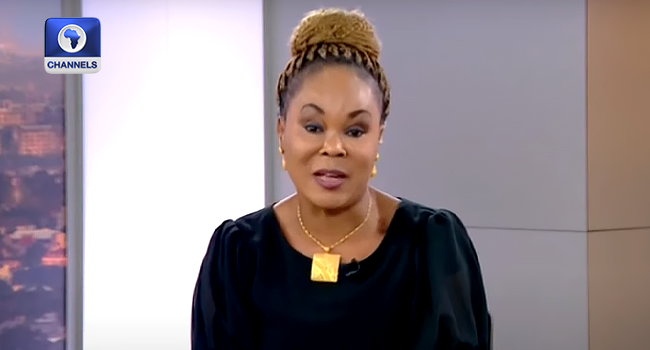
Former Minister of Women Affairs, Uju Kennedy-Ohanenye, has said she has no regrets over her removal from office, insisting that President Bola Tinubu could not have deliberately acted to hurt her.
Kennedy-Ohanenye made the remarks on Tuesday while speaking on Channels Television’s Political Paradigm, where she reflected on her time in office, her leadership style, and the circumstances surrounding her dismissal.
“I have no regrets to date. If I could go back in time, I think I didn’t do enough; I should have been harder. It is even difficult to rule Nigerians.
“The president is working, the governors are working, but what are Nigerians doing in between? If you want to work in this country, you must go offline and be very firm. If you don’t, you will end up achieving nothing,” she said.
She added that while she was not the President, she ensured that nothing improper occurred within the scope of her responsibilities.
“The particular office I was given, I did not allow anything anyhow to happen there,” she said.
Responding to criticism of her conduct while in office, Kennedy-Ohanenye defended her approach, saying she could not pretend or compromise her convictions in the name of diplomacy.
“There is no way I could have held that portfolio pretending. What you saw was who I am. I would not say I was erratic or undiplomatic. Being diplomatic does not mean agreeing to things that are destroying your country. I cannot agree to things I know are harmful,” she said.
According to her, she remains at peace with her actions and decisions while in office.
“That is why I am looking fresher. I am out now, and whatever they are doing there is none of my business. When I was there, I did what made me happy, and my conscience is clear,” she added.
‘Tinubu Proud Of Me’
When asked whether she felt President Tinubu was unfair in removing her despite her performance, the former minister said political decisions often involve factors beyond public knowledge.
“In politics, many things go on behind the scenes. All I can assure you is that the President cannot do anything purposely to hurt me. He is proud of me, he loved the way I worked. There must have been something beyond what he could manage at that time,” she said.
The ex-minister stressed that she does not consider her removal a mistake and maintained that she remains on good terms with the President.
“I wouldn’t call it a mistake. There must be more than what he could handle behind my removal. I am still on very good terms with him,” she said.
Kennedy-Ohanenye also disclosed that she is “not thinking” or actively “seeking another political appointment” but remains committed to her advocacy against gender-based violence.
Speaking further, the former minister criticised inefficiencies within the civil service, attributing a significant portion of Nigeria’s challenges to systemic issues.
She stated that “About 70 per cent of Nigeria’s problems come from the civil service,” while noting that the system itself enables such behaviour.
‘₦400m Personal Funds’
The former minister alleged that budgets approved for her ministry were done without her involvement and claimed that some funds were not released to her during her tenure.
“I carried out some cases with my own funds. I spent about ₦400 million of my personal money after seeing no evidence to show that the $100 million Nigerian women project was done. I did not feel good about it,” she said.
She claimed the Permanent Secretary of the Ministry of Women Affairs petitioned the Economic and Financial Crimes Commission (EFCC) against her over an alleged ₦138 million fraud.
“₦138 million, is that the kind of money they steal?” she queried, while insisting that the Federal Government still owes her reimbursement for funds she personally expended.
Tenure In Office
Kennedy-Ohanenye was appointed Minister of Women Affairs in August 2023 by President Tinubu. During her tenure, she actively focused on women’s economic empowerment and social inclusion.
On October 23, 2024, the President dismissed five ministers, including her, in a cabinet reshuffle. She was notably a female aspirant in the All Progressives Congress (APC) presidential primaries before stepping down for Tinubu.
In September 2023, she drew criticism after suggesting that schoolchildren should have Fridays free to engage in production activities, a proposal widely condemned as promoting child labour.
She also accused the United Nations of collecting funds on Nigeria’s behalf without proper accountability and threatened legal action if detailed financial records were not provided.
Another backlash followed her handling of a proposed mass wedding of 100 girls in Niger State. While she initially opposed the event, citing violations of the Child Rights Act, she later reversed her stance after stating that the girls were of legal age and not forced.
Kennedy-Ohanenye also faced criticism after a leaked phone conversation revealed her threatening female students who testified in a sexual harassment case involving a University of Calabar professor. She later apologised for the remarks.
In addition, she disrupted several events in Abuja, alleging they were organised without approval from her ministry, including one where she claimed the organiser was impersonating the Ministry of Women Affairs and had been taken into custody by security operatives.
Israeli Prime Minister Benjamin Netanyahu said he will present Donald Trump with “principles” for negotiating with Iran as he heads to Washington, DC, for his sixth official visit with the US president over the past year.
Netanyahu hailed the “unique closeness” between Israel and the United States and his own warm ties to Trump before leaving Tel Aviv on Tuesday.
Recommended Stories
list of 3 itemsend of list
“I will present Trump with principles for negotiations with Iran that are important not only to Israel but to everyone who wants peace and security,” Netanyahu told reporters, according to The Jerusalem Post newspaper.
“In my opinion, these are important principles for everyone who wants peace and security in the Middle East.”
His visit comes days after Washington and Tehran concluded a round of nuclear talks in Oman – the first negotiations since the June 2025 war that saw the US bomb Iran’s main nuclear facilities after waves of Israeli attacks.
Israel is not part of those talks, but Netanyahu has long sought to exert influence over US presidents to shape Washington’s policies in the region.
Netanyahu did not provide details about his “principles” for a potential Iran deal, but he has previously said Tehran should agree to full disarmament of heavy weapons, akin to Libya’s 2003 deal with the West.
Iran has ruled out negotiations over its missile programme, which it views as one of its most important deterrents against Israeli attacks.
When Israel launched its surprise assault against Iran in June of last year – killing several of the country’s top generals and nuclear scientists as well as hundreds of civilians – Tehran relied primarily on its missiles to respond after air defences were taken out.
Iran fired hundreds of missiles at Israel, dozens of which penetrated the country’s multilayered air defences, killing 28 people and causing significant damage.
Iran’s Foreign Minister Abbas Araghchi told Al Jazeera on Saturday that Iran’s missile programme is a defence issue that is “never negotiable”.
Israel and the US may also push Iran to end support to its network of allied non-state actors in the region – including the Houthis in Yemen, Hezbollah in Lebanon, Hamas in Palestine, and armed groups in Iraq.
But that alliance, known as the Axis of Resistance, has already been weakened by Israeli assaults over the past two years.
Another sticking issue in the talks is whether Iran would be allowed to enrich uranium domestically.
While Tehran has said it would agree to strict limits and monitoring of its nuclear activities, it has maintained that domestic enrichment is a sovereign national right.
Despite Washington’s talks with Tehran, US Ambassador Mike Huckabee – who is joining Netanyahu on his trip – has stressed Israel and the United States have the same red lines when it comes to Iran.
“I think there’s an extraordinary alignment between Israel and the United States. Everyone would love to see something that would resolve without a war, but it will be up to Iran,” he told reporters.
“If they insist on holding nuclear weaponry and enriched uranium, then I think the president made very clear that this is not acceptable.”
Washington, DC – No other world leader has visited the United States in an official capacity over the past year more than Israel’s Benjamin Netanyahu.
And the Israeli prime minister is set to break his own record when he embarks on yet another trip to the US this week – his sixth since President Donald Trump returned to the White House early in 2025.
Recommended Stories
list of 3 itemsend of list
The visit comes at a tense moment for the region.
Israel is tightening its illegal grip over the occupied West Bank; the bombardment and siege of Gaza are continuing despite a US-brokered “ceasefire”; and US and Iranian officials are holding indirect talks to stave off a war that appeared imminent a few weeks ago.
The Iran file is expected to top Netanyahu’s agenda in Washington, DC, as he pushes for a hardline US approach towards Tehran.
Here, we look back at Netanyahu’s previous visits to see Trump and their outcomes.
February 2025: Reaffirming alliance
Almost exactly a year ago, Netanyahu became the first foreign leader to visit Trump after the start of the US president’s second term in office.
The trip aimed to reaffirm the US-Israeli alliance and Netanyahu’s own strong ties to Trump, who had moved Washington’s policy further in favour of Israel during his first term.
“You are the greatest friend Israel has ever had in the White House,” Netanyahu told Trump at that time.
A Gaza truce that had begun in January 2025 was in effect.
But the US president revealed during that visit a proposal to ethnically cleanse Gaza and turn the Palestinian territory into the “Riviera of the Middle East”, sparking international condemnation.
With that Trump plan, which was vehemently opposed by Arab countries, the ceasefire collapsed, and Israel resumed its genocidal war in Gaza in full force weeks after Netanyahu’s trip to Washington, DC.
April: Signs of a rift?
It wasn’t long before Netanyahu returned to the White House, this time shortly after Trump had spiked US tariffs on goods from countries across the world, including Israel.
The Israeli prime minister had announced measures to boost trade with the US in a push to get a tariff exemption for his country.
But the move did not work. “Don’t forget, we help Israel a lot,” Trump said in the Oval Office next to Netanyahu when asked about tariff relief for Israel. “We give Israel $4bn a year. That’s a lot.”
The other top issue on Netanyahu’s agenda was Iran. The Israeli prime minister had been seeking escalation against Tehran.
But instead of a move towards war, Trump announced at the meeting with Netanyahu that the US and Iran would hold nuclear talks, reiterating his preference for a deal with Iran.
“We have a very big meeting, and we’ll see what can happen. And I think everybody agrees that doing a deal would be preferable to doing the obvious,” Trump said at that time.
Netanyahu responded by setting out maximalist conditions for US diplomacy with Iran – a complete disarmament of heavy weapons akin to the 2003 Libyan model.
“If it can be done diplomatically in a full way, the way it was done in Libya, I think that would be a good thing,” Netanyahu said. “But whatever happens, we have to make sure that Iran does not have nuclear weapons.”
Iran has repeatedly denied seeking nuclear weapons while Israel is widely believed to have an undeclared nuclear arsenal.
Despite signs of disagreement between Trump and Netanyahu over Iran and trade at that time, the US administration continued to support and fund Israel’s brutal assault on Gaza.
July: Victory lap
Although Trump and Netanyahu did not appear on the same page when it came to Iran weeks earlier, the US joined Israel in bombing Iran in June, hitting three of its key nuclear sites and fulfilling a wish that the Israeli prime minister had been seeking for years.
Netanyahu visited the White House a month later to hail the war and its outcomes, which Trump said “obliterated” Iran’s nuclear programme.
“I think the partnership between Israel and the United States, the partnership between President Trump and me, produced a historic victory. It’s an incredible victory, actually,” Netanyahu said.
“It brought the greatest capabilities of the United States – that are unmatched – with the great capabilities of Israel and the army of Israel, the pilots of Israel, the soldiers of Israel and the Mossad.”
Netanyahu met with Trump on two occasions during that visit as the US was pushing for a ceasefire in Gaza amid international outrage at Israel’s atrocities and a forced starvation campaign against Palestinians.
Some media reports had suggested at the time that Trump may pressure Netanyahu to stop the war, but the Israeli prime minister stressed that he and the US president were in “lockstep” over Gaza.
“President Trump wants a deal, but not at any price,” Netanyahu said. “I want a deal, but not at any price. Israel has security requirements and other requirements, and we’re working together to try to achieve it.”
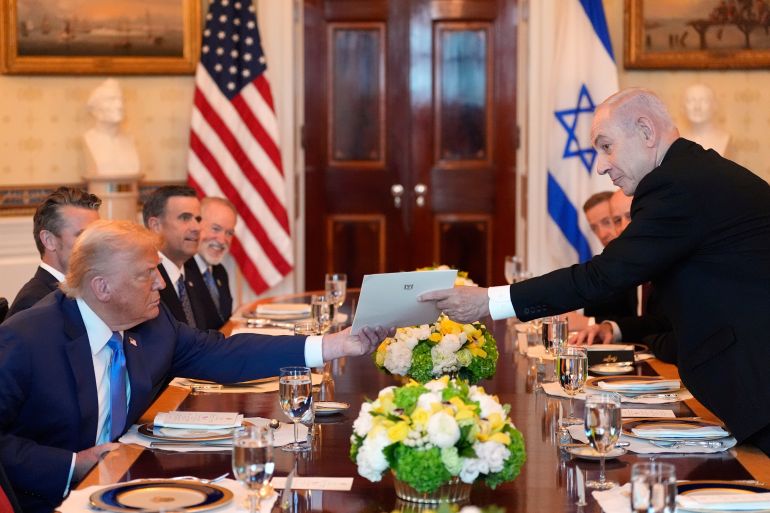
Israeli Prime Minister Benjamin Netanyahu, right, meets with US President Donald Trump at the White House on, July 7, 2025 [Alex Brandon/AP Photo]
September: The ‘ceasefire’
After a United Nations General Assembly that saw much of the world express outrage at the horrors unfolding in Gaza, Netanyahu travelled to Washington, DC, to meet with Trump for the fourth time in eight months.
Trump had put forward a 20-point plan that would become the basis for the current Gaza “ceasefire”.
With the visit, the US president sought buy-in from Netanyahu for his plan, which he hailed as a new dawn for the region and the world.
“This is a big, big day, a beautiful day, potentially one of the great days ever in civilisation,” Trump said during a news conference with Netanyahu.
“And I’m not just talking about Gaza. Gaza is one thing, but we’re talking about much beyond Gaza. The whole deal, everything getting solved. It’s called peace in the Middle East.”
While Netanyahu said he accepted the Trump proposal, he did so with caveats.
“Israel will retain security responsibility, including a security perimeter, for the foreseeable future,” Netanyahu said.
“Gaza will have a peaceful civilian administration that is run neither by Hamas nor by the Palestinian Authority but by those committed to a genuine peace with Israel.”
The truce would go into effect days later, but more than four months on, Israel has continued to bomb and kill Palestinians in Gaza while restricting the entry of medicine and material for temporary shelters into the territory.
December: Iran again
Netanyahu had proclaimed in July that the joint US-Israeli strikes against Iran set back the country’s nuclear and missile programmes, which he called “two tumours”. Still, the prime minister returned to the US at the end of the year to raise concerns about the same issues.
Even before the two leaders met at Trump’s Mar-a-Lago resort in Florida, Trump threatened Iran with more bombs.
“Now I hear that Iran is trying to build up again, and if they are, we’re going to have to knock them down,” Trump said. “We’ll knock them down. We’ll knock the hell out of them. But hopefully, that’s not happening.”
From there, Trump and Netanyahu heaped praise on one another, dismissing media reports that they were not seeing eye to eye on the future of Gaza and other regional issues.
Trump called Netanyahu a “hero”, arguing that Israel may not have existed without his leadership.
“We’re with you, and we’ll continue to be with you, and a lot of good things are happening in the Middle East,” Trump told Netanyahu.
For his part, the prime minister announced that his country would award Trump the Israel Prize, which is normally given to Israeli citizens.
“I have to say that this reflects the overwhelming sentiment of Israelis across the spectrum,” Netanyahu said.
Days after that meeting, antigovernment protests broke out in Iran, leading Trump to threaten to intervene militarily as he promised demonstrators who faced a security crackdown that “help is on the way”.
That threat never materialised.
With the protest movement in Iran all but faded and renewed US-Iranian diplomacy under way, the Israeli prime minister is likely to lobby for greater pressure on Tehran as he returns to Washington, DC, this week.
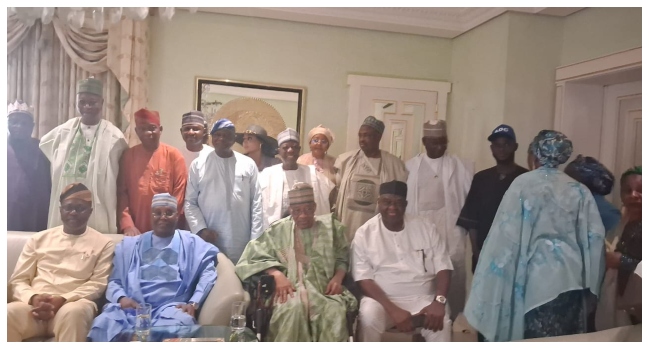
Former Vice President of Nigeria, Atiku Abubakar, and Oyo State Governor, Seyi Makinde, on Monday held a closed-door meeting with former Military President, General Ibrahim Badamasi Babangida (rtd.), at his hilltop residence in Minna, the Niger State capital.
Speaking to journalists after the meeting, Atiku said his visit to Niger State was aimed at strengthening the structures of the African Democratic Congress (ADC) in the state, stressing that the visit had nothing to do with contesting the 2027 presidential election.
According to him, the focus of his engagement was on the demand by Nigerians for real-time electronic transmission of election results, which he said would reduce confusion and electoral disputes.
“At this point, this is not about me contesting elections. It is about Nigerians who want electronic transmission of election results,” Atiku said.
He explained that electronic transmission of results would ensure transparency and reduce chaos during elections, adding that the controversial amendment to the Electoral Act was deliberately mixed with manual processes, thereby creating confusion.
“The preference of Nigerians is clear. They want real-time electronic transmission of results. What we have now is a mixture of electronic and manual uploading, which only causes confusion and chaos,” he stated.
Atiku called on all opposition political parties to unite and reject the decision of the Senate to opt solely for manual transmission of election results.
“We need all opposition political parties to pursue this issue. We should not allow it to rest the way they want it to rest at the Senate,” he said.
He disclosed that as a member of the ADC, the party is currently focused on grassroots mobilisation and strengthening its structures nationwide.
“I am a member of the ADC, and we are working to ensure our structures are firmly rooted from the ward level to local government, state, and national levels. We are mobilising and registering members across the country,” Atiku added.
Although Atiku did not disclose the specific reason for his visit to General Babangida, he noted that it was not his first visit to the elder statesman. On his part, Oyo State Governor Seyi Makinde declined to speak with journalists.
He reportedly remained in the inner chamber of Babangida’s residence after Atiku had left, and journalists were informed that the governor was on a private visit and would not grant any interview.
Reporters were subsequently asked to leave the premises, though some waited outside to observe his departure.
Atiku arrived in Minna at about 1:30 p.m. and proceeded directly from the Minna Airport to Babangida’s residence. Governor Makinde arrived later at about 2:10 p.m., approximately 30 minutes after Atiku had departed.
 Getty Images