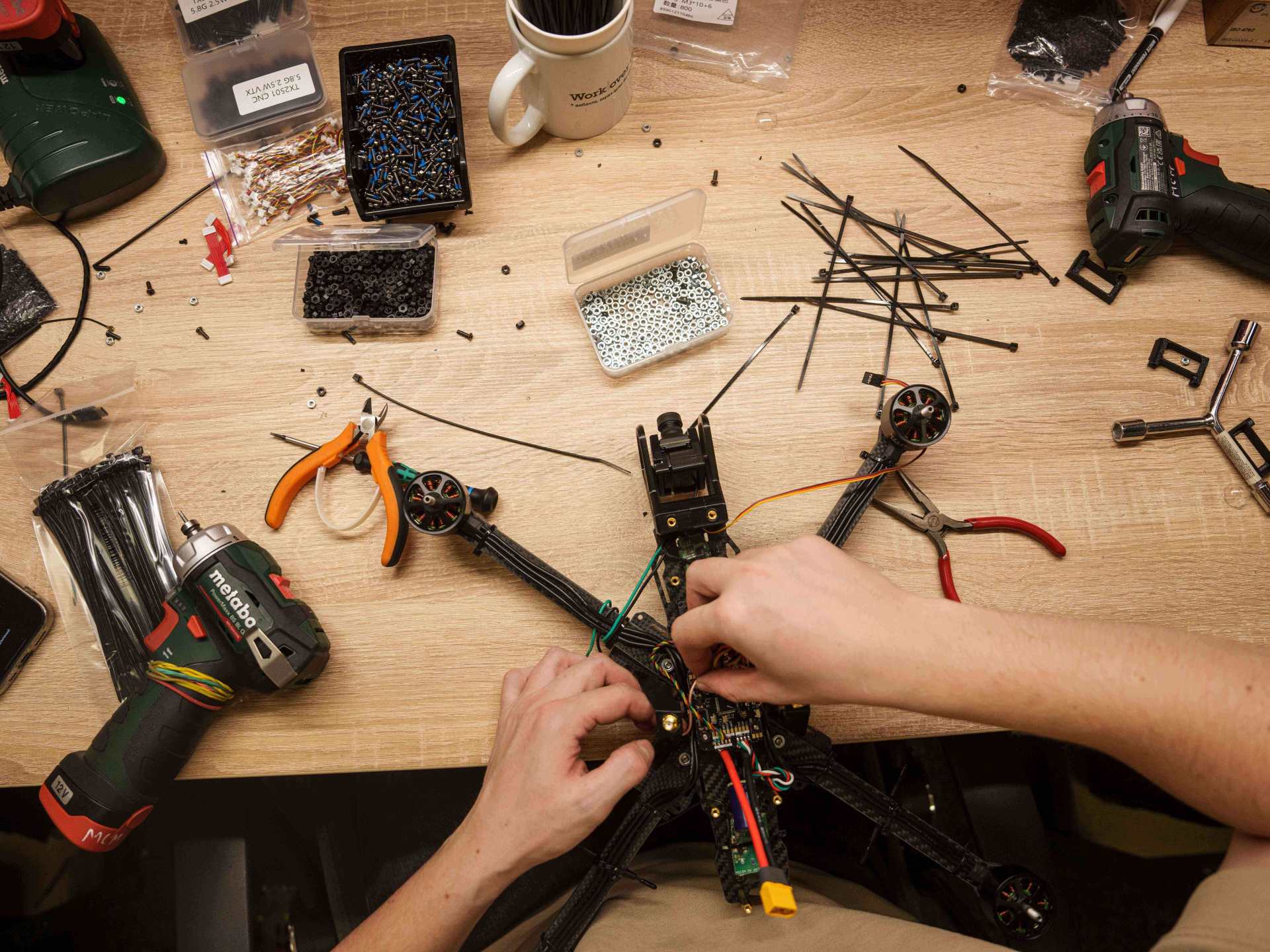
A drone appears on the grainy, gray-scaled image of the thermal camera. This is the type of drone used by groups such as Hezbollah, Hamas and the Yemeni Houthis. Suddenly, a blinding whiteness overtakes the image. Seconds later, the wing of the drone snaps off, sending it tumbling down, exploding when it hits the ground.
This is a video shared by the Israeli Ministry of Defence and arms producer Rafael, a hint towards the future of anti-drone warfare. In it, they are demonstrating one of their new weapons: a high-energy laser designed to take down aerial threats such as drones, but also rockets and even artillery shells. It’s called Iron Beam. Israel claims they have shot down several enemy drones with it already.
Recommended Stories
list of 4 itemsend of list
Laser weapons have been a dream for arms manufacturers and militaries since the invention of the laser in 1960. So far, they have remained a dream. But now they seem to be on the brink of a breakthrough. Technological advances have made lasers more robust. At the same time, the rise of drones increases the need for weapons that can shoot them down cheaply and efficiently.
“Lasers are the next step in air defence systems,” says Iain Boyd, director of the Center for National Security Initiatives at the University of Colorado Boulder, where he works on high-energy lasers in defence projects.
“When you are attacked by thousands of inexpensive drones, you cannot afford to defend yourself with expensive anti-air weapons, such as missiles. Lasers might be a solution.”
This promise is causing a gold rush among defence companies. Independent analyses on the market’s size are lacking, but a flurry of contracts and announcements have recently been made.
The Israeli Iron Beam contract is worth $500m for Rafael and Elbit Systems, another Israeli defence company. The US Navy has contracted Lockheed Martin to supply its ships with defensive high-energy lasers. UK defence firm MBDA was awarded a 316-million-pound ($430m) defence contract at the end of 2025 to deliver their DragonFire laser weapon system by 2027. MBDA is also cooperating with German defence giant Rheinmetall to develop a German system by 2029. France, in turn, took a similar approach, teaming up again with MBDA and a flurry of its own defence players to develop a laser system.
Star Wars
One of the companies benefitting from this gold rush is the Australian Electro-Optical Systems (EOS), led by the German CEO Andreas Schwer. In 2025, they secured a 71-million-euro ($84m) contract with the Netherlands for the development of a laser weapon. In December, another contract, worth $80m, was announced with South Korea.
Their laser technology is a descendant of the United States’s Strategic Defense Initiative programme, colloquially known as Star Wars. In the 1980s, US President Ronald Reagan created the programme to use lasers, fired from space, to shoot down Soviet ballistic missiles.
That grand vision failed. Billions were invested, but in the 1990s, most of the programmes ended. EOS was one of the participants. They used Star Wars’ insights to build lasers that track satellites. But now they are using them for a different goal: shooting down drones.
“Our high-energy laser is a derivative of our Star Wars technology,” says Schwer. “Initially, we developed lasers to track satellites. But when the Houthi rebels used drones to attack Saudi Arabia in 2018, we realised this technology was needed elsewhere.”
Today, they employ 500 people; by the end of next year, that should be 700. If EOS does any large acquisitions, that number might even be even higher, claims Schwer.
For their laser weapons, EOS is aiming to cooperate with local defence companies as a growth strategy. In Europe, for example, they are working together with players such as Helsing, OHB, MSI and KNDS. That way, they can grow without having to invest large amounts of capital. “We team up with local champions,” says Schwer.
Dependency and sovereignty
Particularly in Europe, the market for high-energy lasers is growing. The importance of drone warfare in Ukraine, but also recent cases of drone flights over critical infrastructure in Europe, and Russian drone incursions on the Eastern border of the EU, have caused a surge in demand for anything that can repel mass drone attacks.
“High-energy laser weapons have, supposedly, been just around the corner for a long time now. However, in the last few years we have seen the technology mature and systems actually being deployed,” says James Black, deputy director of the defence and security research group at RAND Europe.
The market is still fragmented, however, with many countries launching their own research projects. “You have different countries investing in sovereign R&D projects, testing and low-scale field tests,” says Black. “We don’t yet have a mass market rollout. We haven’t seen industrial consolidation yet.”
One of the reasons why lasers are so attractive is that they are not dependent on existing supply chains for air-defence weapons. “Countries want sovereign air defence solutions,” says Black. “They want to reduce their dependency on foreign suppliers. For different weapons, such as Patriot missiles, you’re, for example, dependent on the US.”
For many advanced anti-air weapons, the US is currently the dominant player. The companies that will dominate the market for laser weapons might come from a different part of the world, though. “For the US military, the main priority is deterring and defeating China,” says Black. “That affects which weapons US companies develop. China is more advanced than Russia or Iran. Also, the Indo-Pacific is a very large area, with mostly sea. Massed attacks by small drones are much less of a threat there than in Europe.”
Drone swarms
Lasers are becoming viable now, on the one hand, because the technology has simply matured. “Twenty years ago, we were using chemical lasers for these projects,” says Boyd. “They were the only ones that had enough power.”
A laser always has a medium through which the light passes and which amplifies it. Up until recently, for military lasers, the medium of choice was a cocktail of chemicals. These lasers generate a very powerful beam, but they also have downsides, including the volatile chemicals themselves.
In the past few years, however, solid-state lasers have become more powerful. In such lasers, the medium is a solid material, such as optical fibre. These lasers are more robust and easier to handle. “Solid-state lasers are used for all kinds of industrial processes,” says Boyd. “Civilian industries advanced them significantly. That accelerated their use in military applications.”
Technical issues still need to be resolved, however. One of those is collateral damage. A laser beam that misses its target just keeps going straight and could, for example, miss a drone and hit an airliner or satellite.
“Laser beams can also scatter off surfaces and blind people,” says Boyd. “That’s why good targeting systems are so important.”
This became clear this week when the airspace around El Paso, in the US, was closed down unexpectedly by the US Federal Aviation Administration (FAA), leading to chaos at the local airport. The shutdown seems to have been related to a non-scheduled test of an anti-drone laser weapon by the US Customs and Border Protection.
“The El Paso incident strongly illustrates the need for careful use of laser weapons,” says Boyd. “In cluttered civil environments, it is particularly important to have an effective process in place for de-confliction of the region into which a laser is being fired.”
Lasers are also sensitive to the weather; rain or fog reduces their effectiveness significantly. They also generate a lot of heat, which makes them prone to overheating and could make them an easy target on a battlefield. That is why initially, lasers might be used to defend critical infrastructure away from front lines, or be installed on ships.
“We’re not going to be shooting handheld lasers at each other anytime soon,” says Black. “Lasers aren’t a silver bullet. They don’t solve all problems. But they are making concrete advances, and countries are actually putting them in the field. They will, however, need to be integrated in wider anti-air systems, where they will serve beside other weapons.”

Leave a Reply