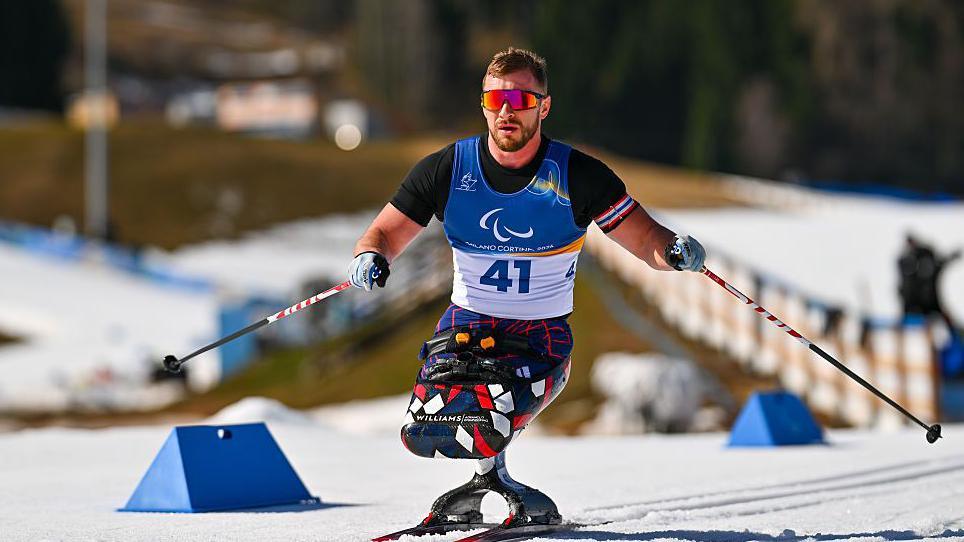
Athletes in T-shirts, fans applying suncream – have these been the Summer or Winter Paralympics?
If you were to listen to American Patrick Halgren, who called the conditions at the Milan-Cortina Games “tropical” and “like surfing”, you would think the former.
Until you were told he is a skier.
Since the 1992 Games, the Winter Paralympics have always been held in March, usually starting just shy of a fortnight after the conclusion of the Winter Olympics.
That means conditions during the Games have often been more spring-like than winter, with temperatures peaking at 26C four years ago in Beijing.
While such temperatures have not been felt in Cortina, it has been warm, and until a huge dump of snow fell the night before Sunday’s final day of competition, snow had only been seen on the groomed competition pistes.
A blazing sun on several days of competition, mixed with some rain, had caused snow on the courses to turn soft and slushy, which in turns sticks to athletes’ skis and snowboards.
Last weekend a third official training session for the Para-alpine skiing downhill events was cancelled in a bid to maintain the piste conditions.
While many athletes have praised the efforts of organisers to keep the tracks in as good a condition as possible, conditions on Friday during the men’s giant slalom events were far from ideal, with British visually impaired skier Fred Warburton describing it as a “bathtub of Slush Puppie”.
His guide, James Hannan, said: “The snow surface was changing every single gate, so we never knew how the ski was going to react.
“It was almost like survival of the fittest.”
It certainly proved that way during the sitting event, which followed the visually impaired and standing races: 18 athletes from a field of 37 failed to make it to the bottom of the course.
“The organisers need to look at scheduling with obvious changes of the climate that we’re experiencing,” said Warburton.
“Both the Olympics and Paralympics want to be top spectacles of skiing and allow athletes to put their best work down.
“We need to look at the schedule and move it forward in future. That’s way beyond my pay grade, but it seems pretty logical to me.”
Warburton’s words echoed those of retired American Paralympic snowboarder Amy Purdy, who this week said in a video on TikTok: “I don’t believe that the Paralympics should be happening right now.”
 Getty Images
So should – or could – the Winter Paralympics take place at a different time?
“Changing the winter sport calendar is easier said than done,” said International Paralympic Committee (IPC) chief brand and communications officer Craig Spence.
“If we were to move forward Olympic events then the Paralympics would follow, but the weeks prior are when the international federations are involved.
“We need to take into account the wishes of the International Olympic Committee (IOC), of the IPC, the winter sport federations, the media rights holders, because some of the major sporting events are coming to a climax during this moment.”
Regardless, changes will be needed in the future.
In 2023 the IOC said only 10 countries will be able to host snow sports by 2040 because of the impact of climate change.
Artificial snow has become the norm at recent Games, and at Milan-Cortina 2026, 1.8million cubic metres of artificial snow have been used across both the Olympics and Paralympics, though that is lower than the planning estimation of 2.4million thanks to heavy snowfall during the Olympics.
Speaking to BBC Sport last year, IPC president Andrew Parsons said climate change and the resulting lack of natural snow is a “permanent concern” for the future of the Winter Paralympics.
“What we are seeing for the future of winter Games is that we will have less hosts able to provide a good field of play, and we need to be prepared for that,” said Parsons.
In four years’ time, alpine skiing at the 2030 French Alps Paralympics will take place in Courchevel, a resort at a higher altitude than Cortina – as is Snowbasin, the Utah resort set to host the 2034 alpine skiing. This should, in theory, make for better conditions.
Yet it is not just about optimising the snow conditions for higher performance levels, but safety too.
“I’m here to represent the disability community on a snowboard, and I want to give the best show that I can,” said American three-time Paralympic gold medallist Brenna Huckaby.
Recent research conducted by Daniel Scott, a professor at the University of Waterloo (Canada), in co-operation with the IOC, has suggested that the Paralympics need to be moved to earlier in the year, perhaps by moving the Winter Olympics forward by two weeks so the Paralympics can take place in late February.
Similarly, his research also suggested the Paralympics should be scheduled to two years before or after the Olympics to use the more climate-reliable month of February.
“We want to take the Games to new places, new audiences, but at the same time we need to preserve the integrity of the competition in the sense that the field of play needs to be optimal so the athletes can perform,” said Parsons on the eve of the 2026 Games.
“That balance is important, that we have a lot of discussion between the IPC, the IOC, the international federations to find the best solution.
“The Winter Games should remain Winter Games, for snow and ice sports. That’s my particular position.
Related topics
- Winter Sports
- Disability Sport

Leave a Reply