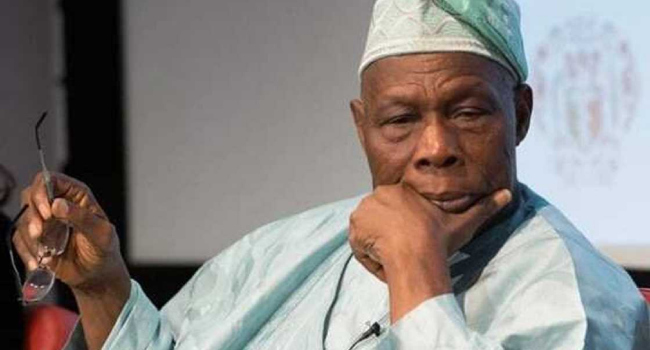
Former Nigerian President Olusegun Obasanjo has said Africa’s greatest challenge is not a lack of resources but a leadership deficit.
Obasanjo stated this on Thursday during his 89th birthday celebration in Abeokuta, Ogun State.
At the event, the former president recounted his decades in public service, stressing that Africa’s development challenges stem largely from poor leadership rather than a shortage of natural or human resources.
“I have seen across more than five decades of public life that Africa’s greatest deficit is not money, not land, not intellect. It is leadership. The bane of our development is leadership,” he said at the event attended by prominent figures, including Peter Obi, Rabiu Kwankwaso, former Ogun State governor Ibikunle Amosun, and the governor of Ogun State, Dapo Abiodun, among others.
Obasanjo warned that poorly prepared leaders often leave nations weakened and divided.
“I’ve seen what happens when leaders are poorly formed. Nations fracture. Resources are stolen. Children without education go to bed hungry. And young people with brilliant futures abandon hope and take great and dangerous risks in search of greener pastures,” he added.
READ ALSO: ‘Our Leaders Lack Basic Economics,’ Obasanjo Faults Africa’s Political Class
‘Africa Needs More Leaders’
However, the former military leader noted that the presence of capable and principled leaders can transform societies.
“I’ve also seen the opposite. I’ve seen what one well-formed leader can do. One leader with vision, with discipline, with integrity, with better service and incorruptibility, and with courage to serve rather than take.
“I’ve seen such a leader transform a community, rescue an institution, and redirect a nation. We have had them in Africa and outside Africa. OOLI (The Olusegun Obasanjo Leadership Institute) exists because Africa needs more of those leaders. Many more.
“They must be trained deliberately, rigorously, and unapologetically. They must be formed by internalising and being imbued with the necessary attributes and values,” the ex-president said.
Obasanjo, who served as Nigeria’s military head of state between 1976 and 1979 and later as civilian president from 1999 to 2007, has consistently criticised the quality of leadership across Africa.
In June 2025, while speaking at the Afreximbank Annual Meetings in Abuja, the former leader criticised Africa’s political elite for lacking basic economic knowledge, warning that the gap contributes to corruption, wasteful borrowing, and continued dependence on foreign aid.
“How many of our leaders even understand basic economics to be able to run the affairs of their country?” he asked.
The former president also condemned the misuse of public funds, saying, “Waste and corruption… are strange bedfellows of development.”
Obasanjo argued that Western-style democracy has not always worked effectively in Africa, calling for governance systems that better reflect African political traditions.
According to him, Africa’s traditional governance structures, built on consensus, communal responsibility, and dialogue, often provided more inclusive approaches to leadership.
The elder statesman also lamented Africa’s continued reliance on foreign aid, urging the continent to focus on strengthening leadership and domestic economic capacity.
“We have lived too long on aid. Is that how Africa should be expecting to survive? I don’t believe so.
“We run to Japan; we run to China. But for how much? China will give $20 billion, which a single African country can generate if it is well governed,” he said.
Obasanjo has also recently expressed concerns about governance in Nigeria. In November 2024, while speaking at the Chinua Achebe Leadership Forum at Yale University in the United States, he criticised the administration of President Bola Ahmed Tinubu, warning that Nigeria risks becoming a “failing state”.
“The failing state status of Nigeria is confirmed and glaringly indicated for all to see,” he said.
The former president attributed the situation to corruption, weak governance, and insecurity, adding that “state capture” by powerful interests has undermined public institutions.

Leave a Reply