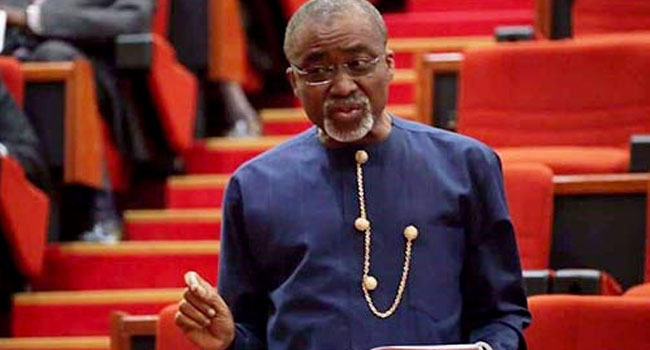
Senator Enyinnaya Abaribe has insisted that the Senate approved the electronic transmission of election results in real time, dismissing media reports suggesting otherwise and saying his integrity is at stake over the issue.
Speaking at a media briefing at the National Assembly on Thursday, accompanied by 13 serving senators, Abaribe asserted that the Senate did not pass the “transfer” of results as contained in the 2022 Electoral Act, but rather approved the electronic transmission of results, stressing that the distinction is deliberate and important.
“I am concerned about reports in the media, and that is why we decided to make this clarification. What we passed is electronic transmission of results. I need to make this very clear,” he said.
Abaribe explained that the Senate’s decision followed an extensive legislative process involving consultations with the Independent National Electoral Commission (INEC) and civil society organisations (CSOs).
According to him, a joint committee of the National Assembly held several retreats with the stakeholders, after which there was a consensus that electronic transmission of results should be adopted by both the House of Representatives and the Senate.
He added that the Senate subsequently set up an ad hoc committee to review the electoral reform report.
“That report was considered during a closed-door session. I can assure you, on my honour, that during the executive session we all agreed on electronic transmission of results in real time. At plenary yesterday, we also passed it,” he said.
Abaribe said the controversy arose during the plenary session, despite confirmation by the Senate President on the floor that electronic transmission of results had been approved.
READ ALSO: Electoral Act Amendment Bill Passes Third Reading, Senate Retains Existing Provision On Result Transmission
He noted that although the Senate adjourned after plenary, it has not yet adopted the Votes and Proceedings, which he described as a necessary procedural step before the conference committee can meet to harmonise the Senate and House versions of the bill.
“There is still one more step left for the Senate to take. Until the Votes and Proceedings are adopted, the conference committee cannot take place. Either the House or the Senate version has to be adopted. A huge number of senators across party lines are with us,” he said.
Also speaking at the briefing, Senator Aliyu Ningi said the process began as far back as 2024 and involved extensive deliberations.
“We had about 27 different sessions as a committee. Some of us find this very painful, that public opinion is being pushed in a negative direction despite the work that has been done,” Ningi said.
Both senators emphasised that the legislative process has not ended and that harmonisation cannot occur until the outstanding procedural steps are completed.
Clarifying the terminology, Abaribe said the Senate deliberately chose the word “transmission” rather than “transfer” to avoid ambiguity.
“What is in the 2022 Act is ‘transfer’. We do not want a law that is vague or ambiguous. What we passed is electronic ‘transmission’ of results,” he said.
However, during the clause-by-clause consideration, the Senate expunged the word “transmission” from the amendment and replaced it with the word “transfer,” as contained in the existing Act.
The proposal by the Senate Chief Whip was swiftly seconded by the Deputy Senate President and immediately adopted.
In what appeared contradictory during the debate the Senate Chief Whip, Senator Tahir Mongunu, pointed to the exact wording of the law and urged the chamber to retain the term “transfer” as provided in the 2022 Electoral Act.

Leave a Reply