- 6 Comments
So here we are.
Twenty-nine days since Sydney and the final ball of the Ashes – barely enough time for some of England’s players to return home.
Controversy has made no attempt to return to its box over the weeks that have passed. One positive for England is they are not alone in struggling to keep it in check.
The cricket, which begins on Saturday with Scotland and India among those in action, will be entertaining over the next four weeks, make no mistake.
Watching this sport in India, especially when the home team are involved, is one of the game’s thrills.
Sri Lanka will offer plenty as co-hosts too and the expansion to 20 teams, which this time allows Italy to make their major tournament bow, was one of the triumphs of the 2024 edition in the Caribbean.
But this tournament begins under the darkest of clouds.
Bangladesh have decided not to be there. Unless there is a late change of heart, Pakistan are not going to play India in Sri Lanka under instruction from their government.
Eight months ago, South Africa’s Heinrich Klaasen and West Indies’ Nicholas Pooran, two of the best and most sought-after batters in the T20 game, called time on their international careers.
Aged 33 and 29 respectively, they opted for the franchise world.
Would that happen so close to a major tournament if the draw of a World Cup was as strong as it once was?
A factor in these issues is, in part at least, the oversaturation of cricket’s major events.
Add in the 50-over World Cup in 2023, last year’s Champions Trophy and four women’s World Cups, there have been 10 such tournaments in little over four years.
But the wider mess, one absorbing an increasing amount of the subcontinent and which will threaten the future stability of the sport if not resolved, is a result of years of weak management.
Political posturing has not crept into cricket slowly over the past three months.
It has stamped all over it for a decade, all while the International Cricket Council stood and watched.
India played the Champions Trophy in Dubai rather than Pakistan as scheduled – an issue predictable from the moment the hosts were selected.
Bangladesh bowler Mustafizur Rahman was then removed from the Indian Premier League without explanation at the start of the year, kicking off this latest crisis.
- 1 day ago
- 1 day ago
- 1 day ago
England’s issues may not run so deep, but they are no less pressing.
The talk of the past four weeks has been of nights out, clockings and identifying who was in a New Zealand nightclub and who was not.
What happened in Wellington is English cricket’s latest drama.
The controversies also overshadowed an impressive two-week tour of the Indian Ocean.
By beating Sri Lanka in a one-day international series, England ended the hosts’ run of seven unbeaten series at home in the format.
They were asked to be smarter after the Ashes and clinched the subsequent T20 series by winning on a road, before sealing a 3-0 whitewash on a slow turner – all in conditions in which they will play their entire Super 8 phase, should they progress through the initial stage of this World Cup.
Yet the narrative has remained focused on Brook.
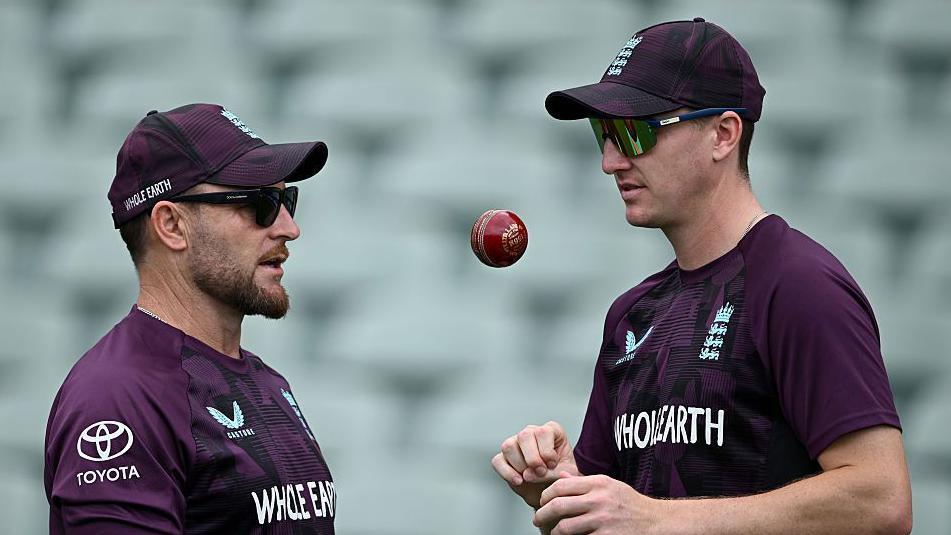
McCullum said this week his captain’s escapades in New Zealand have been spoken about too much. Some supporters may agree.
But by lying in his apology and those untruths not being immediately corrected afterwards, Brook and England only ensured the spotlight returned to their off-field activities.
The tight turnaround between the Ashes and World Cup was always one obvious stumbling block for those who would have already sacked Brook and McCullum.
There was no time for another coach to be found, but after this there are three months before England’s men play again – plenty of time for replacement feet to get under the table if results are poor again.
Of course, there is a scenario where McCullum simply sees the break as the time to walk away – though he maintained his desire to stay on earlier this week.
The New Zealander’s takeaway from his only previous white-ball tournament in charge of England – when his side exited the Champions Trophy without winning a match – was that the players cared too much.
“If anything they are too harsh on themselves,” he said. “They need to be able to give themselves a break and be able to let go a little bit so all of that talent can come out.”
Navigating that, given the scrutiny around a perceived relaxed, care-free environment and his bosses’ wish for change, appears a difficult challenge.
For McCullum and Brook, reaching the semi-finals in the first week of March is the minimum requirement. Having won 10 of their past 11 completed T20s, they should be capable.
Doing so in 2024 was not enough to save the job of McCullum’s predecessor as white-ball coach, Australian Matthew Mott, so much will also be about how England play.
Will they, unlike in the Caribbean, truly challenge the best?
They have been billed as serious contenders once this winter and failed miserably.
Men’s ICC T20 World Cup 2026
Related topics
- England Men’s Cricket Team
- Pakistan
- India
- Sri Lanka
- Cricket

Leave a Reply