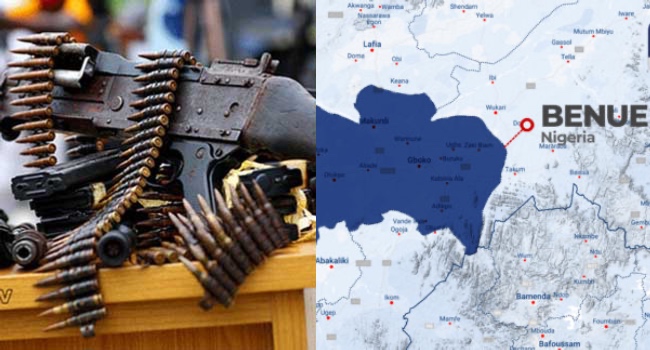
A police officer and four others have been killed in an assault by non-state actors in Abande Community, Kwande Local Government Area of Benue State.
The spokesman of the Benue State Police Command, Udeme Edet, said the attack happened on Tuesday.
While some reports claimed that about 16 people were killed during the incident, Udeme said, “An Assistant Superintendent of Police (ASP) attached to 13 Police Mobile Force (PMF), Makurdi, who was on special duty at Abande Community, was fatally injured during the attack.
“The Divisional Police Officer, Jato-Aka, received a distress call that suspected armed herder bandits, in large numbers, had attacked police personnel stationed at Abande Community as well as members of the community.
“Regrettably, four members of the community also lost their lives as a result of the attack by the bandits,” the spokesman said in a statement issued on Wednesday.
[READ ALSO] Yelwata Killings: Court Orders Remand Of Nine Suspects In Kuje Correctional Centre
According to him, a combined team of police operatives and other security agencies has been mobilised to the area to secure the community, conduct a thorough search, and forestall further breakdown of law and order.
He noted that the bodies of the victims have been recovered and deposited at the mortuary.
According to the spokesman, the Benue State Commissioner of Police, Ifeanyi Emenari, has dispatched the Deputy Commissioner of Police (operations) to the affected area.
Emenari also commiserated with the families of the deceased and the Abande community but assured them that measures are being taken to bring the perpetrators to justice and restore peace to the area.
The attack comes at a time when the Federal Government is prosecuting nine suspected terrorists linked to the deadly attack on the Yelwata community in Benue State, where about 150 persons were killed.
On Monday, the Federal Government filed 57 amended charges against the nine suspected terrorists.
The Minister of Justice/Attorney General of the Federation, Lateef Fagbemi, who is leading the prosecution, presented the amended charge before Justice Joyce Abdulmalik of the Federal High Court in Abuja.
Jack Draper says he has had to overcome “lots of dark moments” during his injury lay-off as he prepares to make his long-awaited return in Great Britain’s Davis Cup qualifier against Norway in Oslo.
The 24-year-old’s 2025 season was derailed by an injury to his upper left arm which first flared up during the clay-court season in the spring. He has played just one singles match since his second round exit at Wimbledon.
Draper, the British number one, had previously been enjoying a breakout season, reaching the fourth round at the Australian Open and French Open, winning his maiden Masters 1000 title in Indian Wells, and climbing to a career-high ranking of four in June.
Although he attempted a comeback at the US Open, partnering Jessica Pegula in the mixed doubles and winning his first round singles match, he later pulled out of the tournament due to injury.
He subsequently withdrew from the Ultimate Tennis Showdown in December and did not travel to Melbourne for the Australian Open.
“[It’s] been a long time since I’ve been able to compete. I’ve stayed in a good place, although it’s been tricky [with] a lot of dark moments and a lot of tough times, but that’s the sport I signed up for,” Draper told the LTA website.
“I’m happy to be back playing again. I miss the buzz of competing. I’ve missed the thrill of playing in front of people, against great players, and that winning feeling you can’t replicate in training.
13 September 2025
Draper, who has dropped down to number 13 in the rankings, hopes last year’s positive start can serve as motivation as he attempts to return to the top.
“Last year started off amazingly well. The second half was extremely challenging,” Draper said.
“I took a lot of belief and confidence from the first half of the year and what I achieved. I kept in mind that I want to be competing right at the top of the game.
‘We’re ready to fight for every point’
Ten-time Davis Cup champions Great Britain have only lifted the trophy once since the 1930s – an Andy Murray-led triumph in 2015 – and fell to Japan at the first hurdle last year.
Great Britain beat Poland 3-1 in September to retain their place in the top tier.
They head to Oslo, where their first-round qualifier will be held from on February 6 and February 7, as the favourites to advance. The squad features two singles players ranked inside the top 30 in Draper and Cameron Norrie, British number three Jacob Fearnley, and a Grand Slam-winning doubles pairing in Lloyd Glasspool and Julian Cash.
Hosts Norway are yet to confirm the availability of world number 12 Casper Ruud after he became a father last week.
Draper says Great Britain have to be prepared to “fight for every point” against an “amazing” Norway team.
“They’ve got a young player in [Nicolai Budkov] Kjaer, who was number one in the world juniors and playing great tennis on the tour. He’ll be tough to beat – a young guy who’s got a lot to prove,” Draper said.
“We all know Casper Ruud has been a top-10 banker player for a long time.
“It’s going to be a great challenge for us all but I think we’re ready to embrace it and fight for every point.”
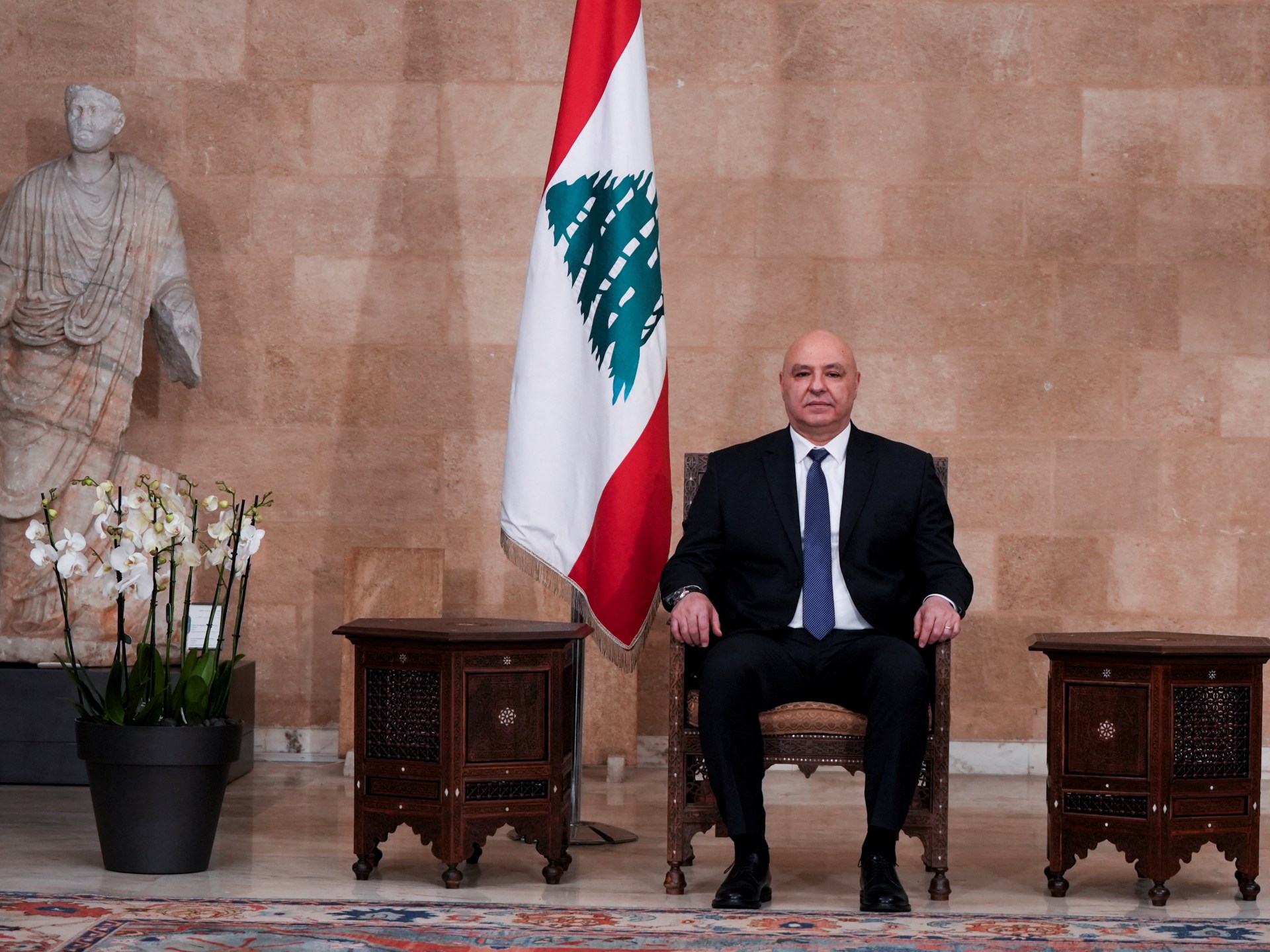
Lebanon’s President Joseph Aoun has accused Israel of committing an environmental crime after Israeli forces sprayed an unknown substance over southern Lebanese towns, which Beirut described as toxic.
Aoun condemned the Israeli move on Wednesday, saying he ordered government agencies to take all diplomatic and legal measures to “respond to this aggression”, which he said represents a “blatant violation” of Lebanon’s sovereignty.
Recommended Stories
list of 3 itemsend of list
“This is an environmental and health crime against Lebanese citizens and their land,” Aoun was quoted as saying by Lebanon’s National News Agency.
He added that the incident is a “continuation of repeated Israeli attacks on Lebanon and its people”.
Since Hezbollah and Israel reached a ceasefire agreement in November 2024, Israel has been attacking Lebanon almost daily in breach of the deal.
“These dangerous practices that target agricultural lands and the livelihoods of citizens and threaten their health and environment require the international community and relevant United Nations organisations to assume their responsibilities to stop these attacks,” Aoun said.
UN peacekeepers in south Lebanon, known as UNIFIL, had said they were informed on Monday by the Israeli military that it would spray a “non-toxic chemical substance” from the air over areas near the border.
“The [Israeli military] said that peacekeepers should stay away and remain under cover, forcing them to cancel over a dozen activities,” UNIFIL said.
Stephane Dujarric, spokesperson for UN Secretary-General Antonio Guterres, said on Tuesday that UNIFIL suspended its operations for nine hours due to the attack, and the force later worked with the Lebanese army to collect samples of the sprayed substance to be tested for toxicity.
The exact nature of the chemical remains unclear.
“Any activity that may put peacekeepers and civilians at risk is of serious concern,” Dujarric had said on Monday. “We reiterate our call on all parties to fully comply with their obligations under resolution 1701.”
UN Security Council Resolution 1701, which ended a war between Israel and Hezbollah in 2006, remains the basis of the ceasefire in south Lebanon.
Israel continues to occupy five points within Lebanese territory as it blocks the reconstruction of several border villages that it levelled to the ground, preventing tens of thousands of displaced people from returning to their homes.
The Lebanese government has been pushing to stem Israeli violations through diplomacy to no avail.
In January, Lebanon’s Ministry of Foreign Affairs submitted a complaint to the UN, documenting 2,036 Israeli breaches of the ceasefire in the final three months of 2025.
At the same time, last year, Beirut issued a decree to disarm Hezbollah, which the Iran-allied group has called a “grave” mistake.
The Lebanese party argues that its armed wing is necessary to stop Israel’s expansionism.
Still, Hezbollah, which has been weakened by the 2024 Israeli assault that killed the group’s top leaders, has not responded militarily to the repeated Israeli attacks.
While refusing to give up its weapons, Hezbollah has tacitly agreed to disarmament south of the Litani River by the Israeli border in accordance with UN Resolution 1701. Last month, the Lebanese government said it completed removing Hezbollah’s weapons in that area.
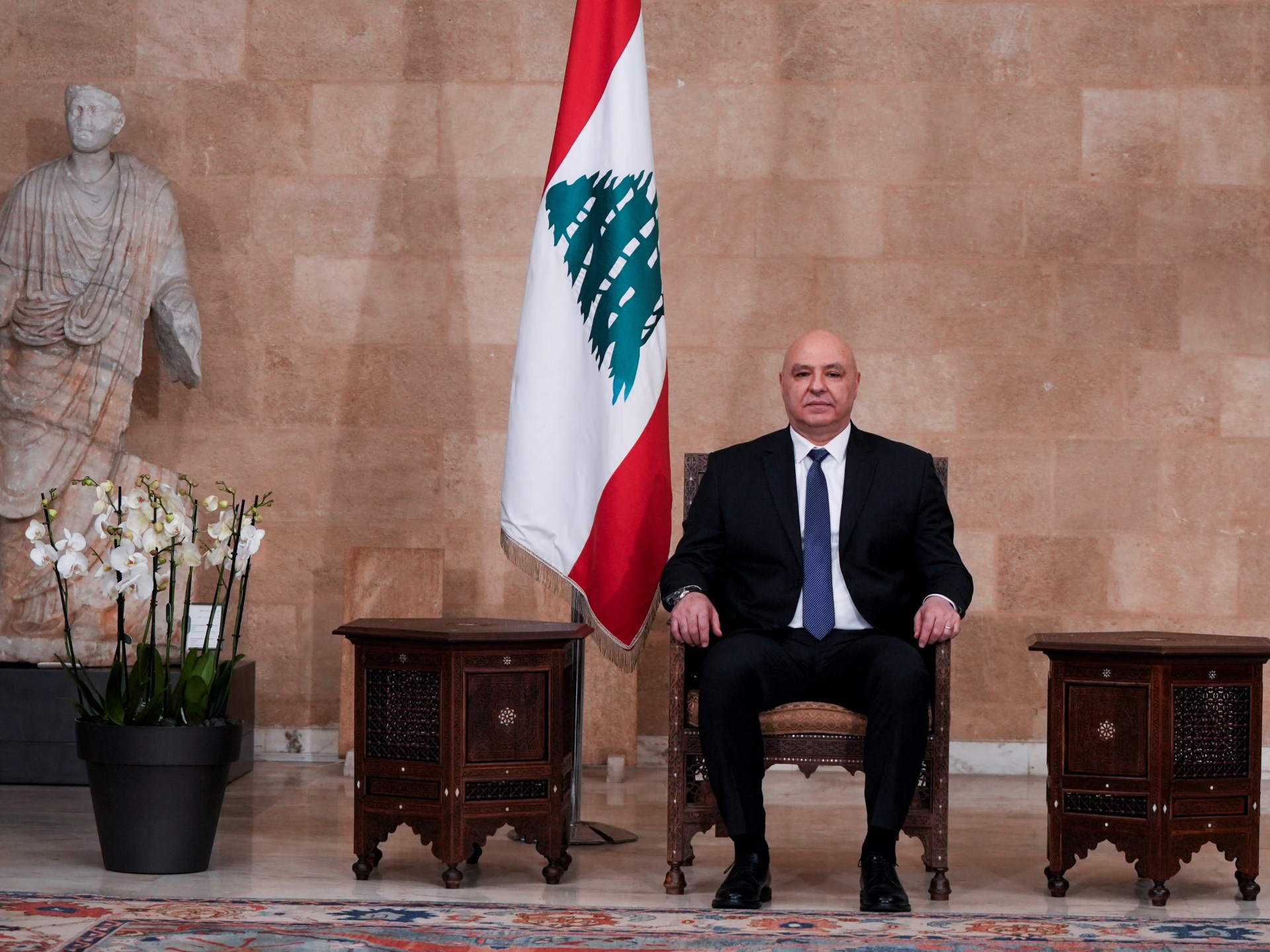
Lebanon’s President Joseph Aoun has accused Israel of committing an environmental crime after Israeli forces sprayed an unknown substance over southern Lebanese towns, which Beirut described as toxic.
Aoun condemned the Israeli move on Wednesday, saying he ordered government agencies to take all diplomatic and legal measures to “respond to this aggression”, which he said represents a “blatant violation” of Lebanon’s sovereignty.
Recommended Stories
list of 3 itemsend of list
“This is an environmental and health crime against Lebanese citizens and their land,” Aoun was quoted as saying by Lebanon’s National News Agency.
He added that the incident is a “continuation of repeated Israeli attacks on Lebanon and its people”.
Since Hezbollah and Israel reached a ceasefire agreement in November 2024, Israel has been attacking Lebanon almost daily in breach of the deal.
“These dangerous practices that target agricultural lands and the livelihoods of citizens and threaten their health and environment require the international community and relevant United Nations organisations to assume their responsibilities to stop these attacks,” Aoun said.
UN peacekeepers in south Lebanon, known as UNIFIL, had said they were informed on Monday by the Israeli military that it would spray a “non-toxic chemical substance” from the air over areas near the border.
“The [Israeli military] said that peacekeepers should stay away and remain under cover, forcing them to cancel over a dozen activities,” UNIFIL said.
Stephane Dujarric, spokesperson for UN Secretary-General Antonio Guterres, said on Tuesday that UNIFIL suspended its operations for nine hours due to the attack, and the force later worked with the Lebanese army to collect samples of the sprayed substance to be tested for toxicity.
The exact nature of the chemical remains unclear.
“Any activity that may put peacekeepers and civilians at risk is of serious concern,” Dujarric had said on Monday. “We reiterate our call on all parties to fully comply with their obligations under resolution 1701.”
UN Security Council Resolution 1701, which ended a war between Israel and Hezbollah in 2006, remains the basis of the ceasefire in south Lebanon.
Israel continues to occupy five points within Lebanese territory as it blocks the reconstruction of several border villages that it levelled to the ground, preventing tens of thousands of displaced people from returning to their homes.
The Lebanese government has been pushing to stem Israeli violations through diplomacy to no avail.
In January, Lebanon’s Ministry of Foreign Affairs submitted a complaint to the UN, documenting 2,036 Israeli breaches of the ceasefire in the final three months of 2025.
At the same time, last year, Beirut issued a decree to disarm Hezbollah, which the Iran-allied group has called a “grave” mistake.
The Lebanese party argues that its armed wing is necessary to stop Israel’s expansionism.
Still, Hezbollah, which has been weakened by the 2024 Israeli assault that killed the group’s top leaders, has not responded militarily to the repeated Israeli attacks.
While refusing to give up its weapons, Hezbollah has tacitly agreed to disarmament south of the Litani River by the Israeli border in accordance with UN Resolution 1701. Last month, the Lebanese government said it completed removing Hezbollah’s weapons in that area.
The tenth edition of the ICC Men’s T20 World Cup will take place in India and Sri Lanka from February 7 to March 8, 2026.
Twenty teams will be competing in 55 matches for the chance to win cricket’s most prestigious T20 trophy.
But cricket is a game with a list of commonly used terms and phrases that might confuse those new to it.
In this illustrated guide, Al Jazeera breaks down cricket lingo and helps you understand the game beloved by nearly two billion people.
What is the aim of the game?
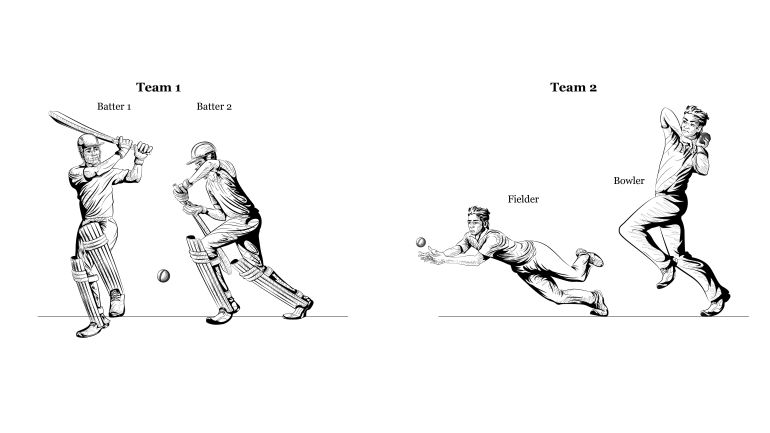
Cricket is a bat-and-ball sport played between two teams consisting of 11 players each.
The game is divided into two parts, known as innings.
In the first innings, following a coin toss, the first team bats while the other team bowls and fields.
The batting team should try to score the highest number of runs in the allotted time, while the bowling team has to try to prevent them from scoring.
The bowling team has dedicated bowlers, while the remaining players, spread across the ground, try to prevent the batters from scoring runs as well as catch the ball to get the batters out.
In the second innings, the bowling team now gets a turn to bat and try to score more runs than their opposition.
The team with the highest number of runs at the end of the day wins the game.
What does T20 mean?
There are three different formats in cricket, each with its own duration and rules.
Each format has its own defined set of “overs”.
An “over” consists of six deliveries by the bowler.
In a T20 match, which usually lasts three to four hours, each team is given 20 overs (120 balls) to score the most number of runs. This format of the game is designed to be shorter and faster-paced, which provides more excitement for spectators.
A One Day International (ODI) match typically lasts about seven to eight hours. Each team is given a total of 300 deliveries, which are divided into 50 overs, to score the most number of runs.
A Test match is the longest and oldest format of the game, played over a maximum of five days. It is considered a test of endurance and skill. Each day has a minimum of 90 overs. Both teams have two innings each.
The cricket field and pitch
Cricket is played in a large, oval-shaped field, typically about 150 metres (164 yards) in diameter at its widest point and surrounded by a boundary rope.
In the centre of the field is the pitch, a rectangular area about 20 metres long (22 yards) and 3 metres (3.3 yards) wide, where most of the action takes place.
At each end of the pitch are three wooden sticks known as wickets or stumps, with two bails atop them.
The batter stands in front of these wickets inside a specified area known as the batting crease. It is from there that he or she will strike the incoming ball from the bowler.
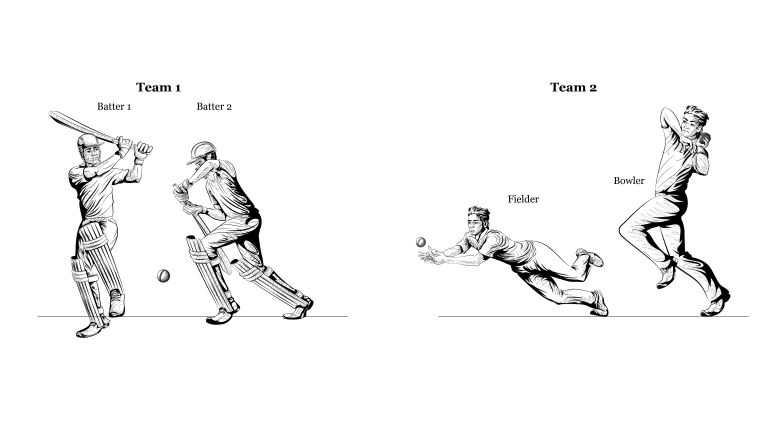
During the match, the batting team will actually have two players on the field, one on either end of the pitch, to take turns in hitting the ball.
The bowling team, meanwhile, will have all 11 players scattered throughout the field to minimise the number of runs their opponents can score.
Some of the most common positions are shown below:
How are runs scored?
The aim for the batters is to score as many runs as possible by hitting the ball in the gaps between the fielders or over the boundary rope.
To score a run, the batter needs to hit the ball and then, together with their batting partner, run to the opposite side of the pitch before the fielder returns the ball; otherwise, they can be run out.
A single run is scored when both batters safely complete one run, a two-run when they complete two runs, and so on.
If a batter hits the ball along the ground and it reaches the boundary rope, then four runs are awarded.
To signal that four runs have been scored, the umpire moves his right hand from one side to the other, repeatedly waving it back and forth horizontally.
Umpire Paul Reiffel (R) signals four runs during a Test match between West Indies and India [Randy Brooks/AFP]
The maximum, six runs, is scored when the batter hits the ball directly over the boundary before it bounces. This shot is the most rewarding but also among the riskiest, due to the chances of getting bowled or caught.
To signal a six, the umpire will raise both hands above his head, which the fans will often imitate.
Umpire Michael Gough (R) signals for six runs during a One Day International cricket match between Zimbabwe and Ireland [Jekesai Njikizana/AFP]
How does a player get ‘out’?
There are several ways to get a batter out, with each out referred to as “losing a wicket”.
Since cricket is played with pairs of batsmen, when 10 players from the batting team are dismissed, their innings concludes, and the sum of the runs they scored sets the target score for the bowling team.
The most common ways of getting a player out include:
Bowled: This happens if the batter misses the ball, and it goes on to hit the wicket.
Caught: A batter is caught out when they hit the ball and a fielder catches it before it touches the ground.
Run-Out: A run-out happens when the fielding team throws the ball at the wicket while the batter is trying to score a run and before they can reach the opposite side of the pitch.
LBW (Leg Before Wicket): This decision depends on various factors, but in a nutshell, a batter can be given out LBW if the ball hits their legs while they are standing in front of the wicket, thus preventing the wicket from being hit.
To signal an “out”, the umpire who is standing in the middle of the field will raise his index finger to signify that a batter has been dismissed.
This gesture is often referred to as the umpire having “raised the finger” or “given the finger”.
The on-field umpire signals an out for Australia’s Pat Cummins before the decision is overturned following a review [Andrew Boyers/Reuters]
How do you read the score?
To follow the score in cricket, you need to look at three numbers.
The first is the number of runs a team has scored – the higher the number, the better.
The second indicates the number of “outs” or “wickets”. Once 10 players are out, their batting innings come to an end.
The third is the number of overs that have been bowled.
Combined, a score may look like this: 109-5 (10 overs)
This means that 109 runs have been scored, 5 players are out, and 10 overs have been completed.
(Al Jazeera)
Typically, teams make anywhere from 100 to 250 runs during a T20 match. A score of 100 is considered low to defend, while 250 runs is usually very strong.
The highest score in international T20 cricket was between Zimbabwe and The Gambia in 2024.
Zimbabwe batted first and scored a huge 344-4 in their 20 overs. In response, The Gambia only managed 54 runs before losing all 10 of their wickets.
The tenth edition of the ICC Men’s T20 World Cup will take place in India and Sri Lanka from February 7 to March 8, 2026.
Twenty teams will be competing in 55 matches for the chance to win cricket’s most prestigious T20 trophy.
But cricket is a game with a list of commonly used terms and phrases that might confuse those new to it.
In this illustrated guide, Al Jazeera breaks down cricket lingo and helps you understand the game beloved by nearly two billion people.
What is the aim of the game?
Cricket is a bat-and-ball sport played between two teams consisting of 11 players each.
The game is divided into two parts, known as innings.
In the first innings, following a coin toss, the first team bats while the other team bowls and fields.
The batting team should try to score the highest number of runs in the allotted time, while the bowling team has to try to prevent them from scoring.
The bowling team has dedicated bowlers, while the remaining players, spread across the ground, try to prevent the batters from scoring runs as well as catch the ball to get the batters out.
In the second innings, the bowling team now gets a turn to bat and try to score more runs than their opposition.
The team with the highest number of runs at the end of the day wins the game.
What does T20 mean?
There are three different formats in cricket, each with its own duration and rules.
Each format has its own defined set of “overs”.
An “over” consists of six deliveries by the bowler.
In a T20 match, which usually lasts three to four hours, each team is given 20 overs (120 balls) to score the most number of runs. This format of the game is designed to be shorter and faster-paced, which provides more excitement for spectators.
A One Day International (ODI) match typically lasts about seven to eight hours. Each team is given a total of 300 deliveries, which are divided into 50 overs, to score the most number of runs.
A Test match is the longest and oldest format of the game, played over a maximum of five days. It is considered a test of endurance and skill. Each day has a minimum of 90 overs. Both teams have two innings each.
The cricket field and pitch
Cricket is played in a large, oval-shaped field, typically about 150 metres (164 yards) in diameter at its widest point and surrounded by a boundary rope.
In the centre of the field is the pitch, a rectangular area about 20 metres long (22 yards) and 3 metres (3.3 yards) wide, where most of the action takes place.
At each end of the pitch are three wooden sticks known as wickets or stumps, with two bails atop them.
The batter stands in front of these wickets inside a specified area known as the batting crease. It is from there that he or she will strike the incoming ball from the bowler.
During the match, the batting team will actually have two players on the field, one on either end of the pitch, to take turns in hitting the ball.
The bowling team, meanwhile, will have all 11 players scattered throughout the field to minimise the number of runs their opponents can score.
Some of the most common positions are shown below:
How are runs scored?
The aim for the batters is to score as many runs as possible by hitting the ball in the gaps between the fielders or over the boundary rope.
To score a run, the batter needs to hit the ball and then, together with their batting partner, run to the opposite side of the pitch before the fielder returns the ball; otherwise, they can be run out.
A single run is scored when both batters safely complete one run, a two-run when they complete two runs, and so on.
If a batter hits the ball along the ground and it reaches the boundary rope, then four runs are awarded.
To signal that four runs have been scored, the umpire moves his right hand from one side to the other, repeatedly waving it back and forth horizontally.
Umpire Paul Reiffel (R) signals four runs during a Test match between West Indies and India [Randy Brooks/AFP]
The maximum, six runs, is scored when the batter hits the ball directly over the boundary before it bounces. This shot is the most rewarding but also among the riskiest, due to the chances of getting bowled or caught.
To signal a six, the umpire will raise both hands above his head, which the fans will often imitate.
Umpire Michael Gough (R) signals for six runs during a One Day International cricket match between Zimbabwe and Ireland [Jekesai Njikizana/AFP]
How does a player get ‘out’?
There are several ways to get a batter out, with each out referred to as “losing a wicket”.
Since cricket is played with pairs of batsmen, when 10 players from the batting team are dismissed, their innings concludes, and the sum of the runs they scored sets the target score for the bowling team.
The most common ways of getting a player out include:
Bowled: This happens if the batter misses the ball, and it goes on to hit the wicket.
Caught: A batter is caught out when they hit the ball and a fielder catches it before it touches the ground.
Run-Out: A run-out happens when the fielding team throws the ball at the wicket while the batter is trying to score a run and before they can reach the opposite side of the pitch.
LBW (Leg Before Wicket): This decision depends on various factors, but in a nutshell, a batter can be given out LBW if the ball hits their legs while they are standing in front of the wicket, thus preventing the wicket from being hit.
To signal an “out”, the umpire who is standing in the middle of the field will raise his index finger to signify that a batter has been dismissed.
This gesture is often referred to as the umpire having “raised the finger” or “given the finger”.
The on-field umpire signals an out for Australia’s Pat Cummins before the decision is overturned following a review [Andrew Boyers/Reuters]
How do you read the score?
To follow the score in cricket, you need to look at three numbers.
The first is the number of runs a team has scored – the higher the number, the better.
The second indicates the number of “outs” or “wickets”. Once 10 players are out, their batting innings come to an end.
The third is the number of overs that have been bowled.
Combined, a score may look like this: 109-5 (10 overs)
This means that 109 runs have been scored, 5 players are out, and 10 overs have been completed.
(Al Jazeera)
Typically, teams make anywhere from 100 to 250 runs during a T20 match. A score of 100 is considered low to defend, while 250 runs is usually very strong.
The highest score in international T20 cricket was between Zimbabwe and The Gambia in 2024.
Zimbabwe batted first and scored a huge 344-4 in their 20 overs. In response, The Gambia only managed 54 runs before losing all 10 of their wickets.