To play this video you need to enable JavaScript in your browser.
Steve Sutcliffe
BBC Sport journalist
66 Comments
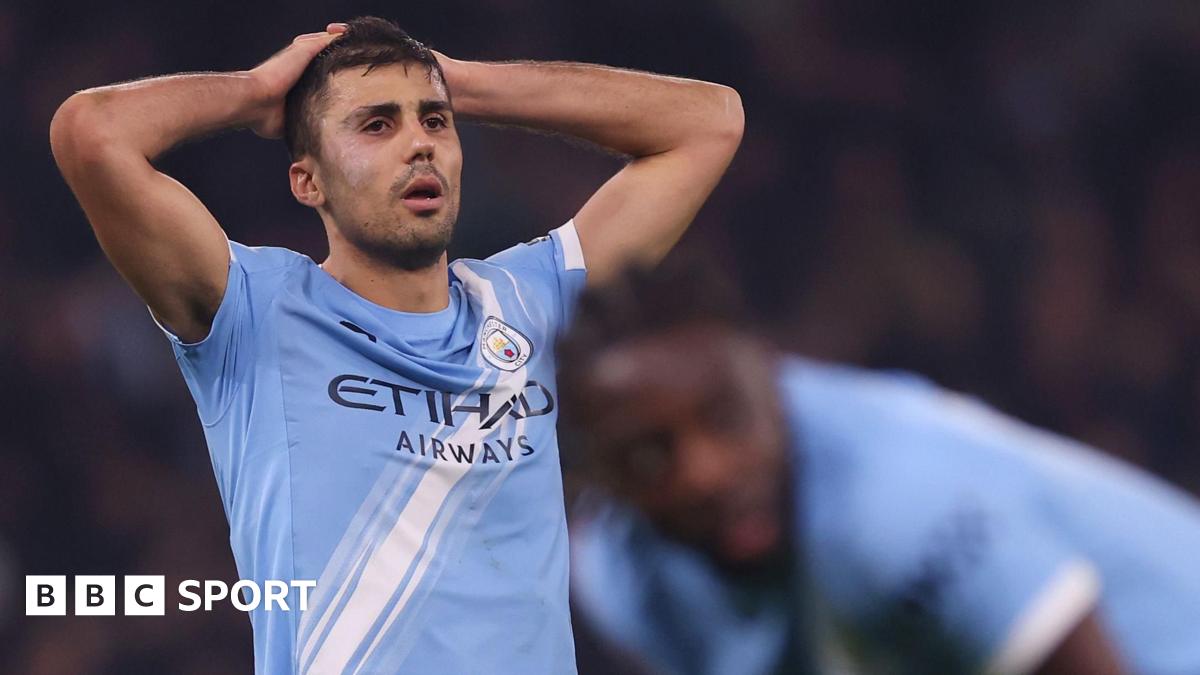
Dissent was in the air with Manchester City in total control at half-time at Tottenham Hotspur Stadium.
The hosts were two goals down and the deficit could and perhaps should have been more.
Yet on a day when campaign group Change for Tottenham called for an open revolt in the stands over the club’s perceived lack of ambition in the transfer market and high ticket prices, Thomas Frank’s side staged a superb fightback to draw 2-2.
By the time Dominic Solanke registered his second goal of the game with a wonderfully improvised scorpion kick, any possibility of a mass walkout had been averted.
Instead of concluding to half-empty stands, “Oh when the Spurs go marching in” reverberated around the ground at full-time in complete contrast to the chorus of boos only 60 minutes earlier.
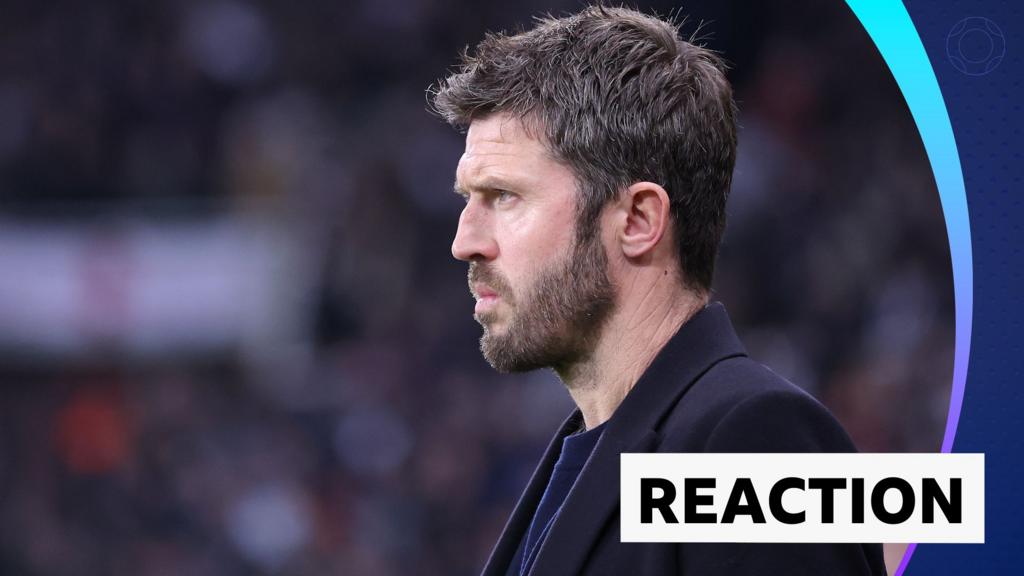
“We can create something magic together – the players and the fans – when we are united like we were, especially second half but also the Dortmund game,” Frank told BBC Sport.
“That atmosphere, intensity – that’s what pushed the players and they really needed it.
“What I like and what I think is truly important is when your back is against the wall as a team and a group you need to fight. You can never give up.
To play this video you need to enable JavaScript in your browser.
While Tottenham sit 14th in the Premier League, they are now unbeaten in four matches in all competitions and have advanced to the last 16 of the Champions League.
The fit-again Solanke’s return of four goals in four starts following his recovery from a recurring ankle issue has also eased the pressure on Frank, whose position at the club has been under significant scrutiny.
“I prefer it going more smooth, I think that is fair to say, but this is football,” said Frank.
“In this spell I think we have done more good things than bad things, but not enough performances have turned into results. Now I am happy we have four decent performances and are unbeaten.
“It was a big point with that second-half performance. The players’ mentality has been good throughout.
“It is quite evident that Dom has been a big miss for us. We’ve been without him for six months and now we have him back.
Gaza City – With what remains of her wounded forearms, Nebal al-Hessi scrolls on her phone to follow news updates on the reopening of the Rafah land crossing from her family’s tent in an-Nazla, Jabalia in the northern Gaza Strip.
Nebal’s hands were amputated in an Israeli artillery attack on the home where she had taken shelter with her husband and her daughter in the Bureij refugee camp in central Gaza, on October 7, 2024.
Recommended Stories
list of 3 itemsend of list
More than a year later, the 25-year-old mother is one of thousands of wounded people placing their hopes on the reopening of the Rafah crossing between Gaza and Egypt as they seek access to adequate medical treatment outside the besieged Palestinian territory.
“It’s been a year and five months since I got injured … Every day, I think about tomorrow, that I might travel, but I don’t know,” Nebal tells Al Jazeera in a quiet voice.
Recalling the attack, Nebal says she was sitting on her bed holding her baby daughter Rita, trying to communicate with her family in northern Gaza, when the shell hit suddenly.
“I was trying to catch an internet signal to call my family … my daughter was in my lap… suddenly the shell hit. Then there was dust; I don’t remember anything else,” Nebal says.
“It was the shell fragments that amputated my hands,” she recounts.
‘Life is completely paralysed’
Nebal was taken to the hospital with severe injuries, including complete amputation of both upper limbs up to the elbows, internal bleeding, and a leg injury. She underwent two abdominal surgeries.
She spent about 40 days in the hospital before beginning a new stage of suffering in displacement tents, without the most basic long-term care.
Today, Nebal, an English translation graduate and mother to two-year-old Rita, relies almost entirely on her family for the simplest daily tasks.
“I can’t eat or drink on my own … even getting dressed, my mother, sister, and sister-in-law mainly help me,” she says sorrowfully.
“Even going to the bathroom requires help. I need things in front of me because I cannot bring them myself.”
Nebal talks about the pain of motherhood left suspended, as her daughter grows up before her eyes without her being able to hold her or care for her.
“My little daughter wants me to change her, feed her, give her milk, hold her in my arms like other mothers… she asks me, and I can’t,” Nebal says with sorrow.
“My life is completely paralysed.”
Doctors tell Nebal that she urgently needs to travel to continue treatment and have prosthetic limbs fitted, emphasising that she needs advanced prosthetics to regain a degree of independence, not just cosmetic appearance.
“Doctors tell me that I need a state or an institution to adopt my case so I can gradually return to living my normal life,” she adds.
Nebal with her two-year-old daughter, Rita [Abdelhakim Abu Riash/Al Jazeera]
With Palestinian authorities announcing arrangements to open the Rafah crossing today for batches of wounded people and medical patients, Nebal, like many others, lives in a state of anticipation mixed with fear.
According to Gaza’s Ministry of Health, thousands of wounded still require specialised treatment unavailable inside the Strip, while the scheduling of names depends on medical lists and complex approvals, amid the absence of a clear timetable or publicly announced priority criteria.
Nebal says she received repeated calls over the past months from medical organisations informing her that she would be among the first on the travel lists.
“They contacted me more than once, told me to prepare… they gave me hope,” she adds. “But this time, no one has contacted me yet.”
Today, Nebal fears her case might be overlooked again, or that the crossing’s opening could be merely a formality, disregarding the urgent needs of patients like her.
“I die a little every day because of my current situation … not figuratively. I’ve been like this for a year and four months, and my daughter is growing up in front of me while I am helpless,” she says.
Nebal with her two-year-old daughter, Rita [Abdelhakim Abu Riash/Al Jazeera]
Uncertain future
Nada Arhouma, a 16-year-old girl whose life has been completely altered by a single injury, is also hoping the crossing opens as soon as possible.
Nada, who was displaced with her family from Jabalia refugee camp in northern Gaza amid Israel’s two-year genocidal war on Gaza, was hit in the face by shrapnel while inside a displacement tent in Sheikh Radwan, Gaza City.
The incident caused the complete loss of one eye, in addition to fractures in her facial bones, orbital damage, and severe tissue tearing.
Her father, Abdul Rahman Arhouma, 49, says that her health deteriorated over time despite treatment attempts in Gaza.
“She entered the ICU at al-Shifa Hospital, then was transferred to Nasser Hospital. She stayed there for about two and a half months. They tried multiple times to graft her eye, but each operation failed, and the disfigurement worsened,” he says.
According to her father, Nada underwent three surgical attempts using tissue from her hand and other facial areas, but all failed, further complicating her medical and psychological condition.
“My daughter bleeds from her eye every day, and she has pus and discharge,” he says. “I am standing helpless, unable to do anything.”
Today, Nada needs constant assistance to walk and suffers from persistent dizziness and balance weakness. Her vision in the healthy eye is also affected.
“Even going to the bathroom, my sisters help me. I can’t walk alone,” Nada tells Al Jazeera in a soft voice.
A photo showing Nada’s condition before and after the injury [Courtesy of Abdul Rahman Arhouma]
Nada has an official medical referral and urgently needs to travel for reconstructive surgery and the implantation of a prosthetic eye. But her ability to get the treatments remains uncertain pending the reopening of Rafah – as is the case for other patients and wounded individuals.
“Since I’ve been in the hospital, I hear every week: next week the crossing will open. Honestly, I feel they are lying. I’m not optimistic,” Nada says.
Her father told Al Jazeera that the continuing wait for the Rafah crossing to reopen was “disappointing”.
“Unfortunately, we didn’t understand anything. All the reports came from Israeli sources, and it seemed Rafah looked like a gate for prisoners, not for travel,” he says.
“Our situation is difficult, and it’s clear we face a long wait to secure my daughter’s right to treatment.”
Pilot reopening
Sunday was the first pilot reopening day at Rafah, amid ambiguity and a lack of clarity about the mechanism, particularly regarding the number of patients and wounded who would be allowed to travel.
According to Gaza’s Ministry of Health, thousands of patients and wounded people require urgent medical transfers outside the Strip, amid the collapse of the healthcare system and lack of resources.
The World Health Organization has repeatedly confirmed that Gaza’s health system is “on the brink of collapse”, and that delays in travelling for critical cases threaten their lives.
Meanwhile, Israel has said it will only allow those whose names it has approved in advance to cross, without any clear announcement on daily numbers or approved criteria, leaving families of patients in constant anticipation and frustration.
For Nada’s family, this “experimental opening” means little so far.
“We can’t plan, neither to stay nor to leave,” her father says. “The decision is not in our hands. One lives in a whirlpool, unable to decide what happens. Even the Ministry of Health has not disclosed anything.”
‘Devastating’ struggle to access treatment
Raed Hamad, 52 and a father of four, is also desperate to leave Gaza in order to seek treatments and medication that are not available in the war-ravaged territory.
Hamad was undergoing kidney cancer treatment a year before the war started. He underwent kidney removal after tumour detection to prevent its spread. But the outbreak of the war in October 2023 halted his treatment protocol, significantly affecting his health.
Hamad lives in the remains of his destroyed home in Khan Younis, amid the devastation left by the war, under deteriorating humanitarian conditions.
He describes his current struggle to access treatment during the war, alongside other cancer patients he meets in the hospital’s oncology department, as “devastating.”
“The war has made it almost impossible to obtain medicines and medical supplies. Cancer treatments and known treatment protocols are unavailable,” he says.
“Food, its nature, and the harsh crises we’ve endured during the war—all of this has greatly affected my health.”
Raed’s weight dropped from 92kg (203lb) to 65kg (143lb) due to complications from the disease, lack of treatment, and malnutrition.
“I continue my treatment whenever I can at my own expense,” he says. “Every time I go to the hospital, I cannot find my treatment and see that capabilities in Gaza are extremely limited. My immunity is low, and every day I face new hardships.
Brighterdaysahead got the better of Lossiemouth in their Leopardstown rematch to win the Irish Champion Hurdle on Sunday.
It was a reverse from their meeting in the December Hurdle at the Dublin venue as Gordon Elliott’s mare (11-4) produced a strong finish to finish three and a quarter lengths clear of Willie Mullins’ pre-race favourite (4-6).
The five-strong field was led for most of the way by El Fabiolo with Jack Kennedy on Brighterdaysahead in pursuit.
As the race entered the final turn, the leader dropped back with Brighterdaysahead taking charge and although Paul Townend on Lossiemouth did mount a challenge, there was no closing the gap on the Champion Hurdle joint favourite.
Poniros (33-1) finished in third.
“We knew she had improved from the last day, whether she was good enough to beat Lossiemouth we weren’t sure,” Elliott told RTE Sport after the race.
“Jack had a plan that if nobody was going to make it we were going to make it. She’s very very tough and she stays.
“It’s great to be involved in these races and to win them is extra special. I was so nervous coming to the last, just thinking ‘I hope she jumps it’.
“Lossiemouth is a superstar and our one is a superstar as well. We’re lucky to have her.”
Majborough (2-1) took the Grade One Dublin Chase with an assured performance despite some previous jumping issues.
Last year’s Irish Arkle winner was in great form with a 19-length victory, racing clear on the home stretch from favourite Marine Nationale (5-4) and third-place Found A Fifty (10-1).
Eighty worshippers who escaped abduction during a bandit attack at Kurmin Wali community in Kajuru Local Government Area of Kaduna State have returned to their homes.
However, dozens of others remain in captivity, as security operatives intensify efforts to rescue the victims.
This is according to the village head, Ishaku Danazumi, who said the eighty returnees fled when armed men stormed the community during a church service on January 18th, 2026, abducting several people and forcing others to escape for safety.
He said that the returnees were hale and hearty upon their return, nearly two weeks after the incident
Danazumi disclosed that although 80 worshippers escaped from being abducted by the bandits, 86 other worshippers are still in the custody of the kidnappers.
Security sources attribute the return of the displaced residents to intensified military operations targeting bandit hideouts across Kajuru and nearby forest corridors.
The spokesman of the Kaduna State Police Command, Mansir Hassan, said that the Divisional Police Officer of Kajuru had visited the community where he saw the victims, after which they were profiled and debriefed.
READ ALSO: Gov Sani Visits Kajuru After Abduction, Promises Speedy Return Of Victims
Last month, over 100 people were abducted when gunmen attacked three churches.
Initially, authorities denied the incident after the Christian Association of Nigeria (CAN) in the state first disclosed the incident.
But the Nigeria Police Force spokesman, Benjamin Hundeyin, days after, said the incident “did happen”.
Governor Uba Sani visited the community following the incident, assuring residents of the safe return of the abductees.
“The people of Kurmin Wali, just like other communities in Kaduna State, have absolute trust and belief in our government. Because they know we are running an inclusive government.
“We protect the lives of everyone, irrespective of religious or ethnic affiliation. We are one in Kaduna State. And I’m happy the people of Kurmin Wali have understood that clearly.
“That is the reason why when we came in here, you can see how they received us warmly, even those that are mourning, even those that are grieving, they are with the government.”
Great Britain women’s and men’s team sprint squads both took silver on Sunday’s opening day of the UEC Track Elite European Championships in Turkey.
The women’s team of Lauren Bell, Rhianna Parris-Smith and Lowri Thomas looked strong in qualifying and easily saw off Czech Republic in round one.
Olympic champion Sophie Capewell came in for Bell for the final against Germany and although the GB trio led after two of the three laps in Konya, they were overhauled late on.
The Germans clocked 45.710 seconds with the British trio 0.003secs back.
Harry Radford, Joe Truman and Matt Richardson guided the GB men to top spot in qualifying and a comprehensive first-round win over Belgium.
Olympic silver medallist Hamish Turnbull replaced Radford for the final against France and despite a huge drive from Richardson to close the gap, the French crossed the line 0.006secs ahead.