Archive January 30, 2026

How do Liverpool fix their struggles against low blocks?

  • 65 Comments

If you have listened to any of Arne Slot’s news conferences this season, you will have heard the Liverpool manager refer to ‘low blocks’.

The term essentially refers to a team’s defensive shape – blocking space close to their own goal. The closer to their goal, the lower the block.

Slot’s side – who cruised to the Premier League title last season in his first year in charge – have struggled for fluidity and consistency this term.

And one of the reasons for that, according to the Reds boss, has been their inability to break down sides who defend deep against them.

But Slot’s mentions of low blocks have become so frequent that frustration has started to grow among fans.

Liverpool legend Steven Gerrard said: “He needs to stop mentioning low blocks. Low blocks have been happening against Liverpool since I was playing. That’s just the way it is.”

A graphic showing how much time teams have spent building up against low blocks in the Premier League this seasonOpta

In fact, the space Slot’s side thrived in last year only seems to present itself against European sides in the Champions League, with Liverpool having scored nine goals – and conceded none – in their past two games in Europe.

Sort out set-pieces

On 1 January, Slot highlighted a number of ways teams can break down low blocks.

“One [way] is a set-piece,” Slot said.

Using set-pieces to unlock stubborn defences is a pattern numerous top teams are leaning on.

This is partly because set-pieces are a part of the game that still favour the attacking side, with teams able to choreograph routines throughout the week.

Image of numerous players in the six-yard box crowding Man Utd keeper Senne Lammens from an Arsenal attacking corner

Only Nottingham Forest (4.97) have generated less xG than Liverpool’s 5.03 from set-pieces.

The loss of reliable corner takers from the starting XI in Trent Alexander-Arnold, Andy Robertson and Kostas Tsimikas has undoubtedly had an impact.

Dominik Szoboszlai has taken the responsibility for most corners this season, but the right-footer’s deliveries from the right have all been out-swingers.

That goes against the general league trend, which has seen teams sending in-swinging corners into crowded six-yard boxes.

Pass map showing Liverpool's crosses from the right and their end locations this seasonOpta

In recent weeks, Slot has put the left-footed Salah on corners from the right in an attempt to improve this area.

Screengrab showing Salah's in-swinging cross assist for Ekitike's header against Brighton this season

Why loss of Frimpong is a blow

“Another [way to break down low blocks] is with something like we saw last week against Wolves, when Jeremie Frimpong had his moment of magic with a quick one-v-one,” Slot continued.

“To create chances against a low block, you need pace and individual special moments to create an overload.”

In the simplest terms, an overload is when one team has more players than the opposition in a particular area.

Against a low block, the centre of the pitch is often crowded with the defence looking to block any direct route to goal – so wide areas are key.

In one-v-one situations, Frimpong can use his pace to burst past his opponent, resulting in a Liverpool overload on the flank.

This has another knock-on effect – teams react by dropping their defensive line closer to their goal.

This can open up space in front of the defence, often towards the edge of the box, allowing more time to shoot under minimal pressure.

Screengrab from Liverpool vs Wolves indicating Frimpong's assist for Gravenberch's opener

In comparison to the flying Frimpong, Liverpool’s wingers – most often Salah and Cody Gakpo this season – have struggled to open up low blocks.

Screengrab showing Gakpo cutting inside and shooting, with Kerkez overlapping

Liverpool’s long-shot problem

Slot’s comments around breaking down low blocks failed to mention long shots, but this can be a viable option.

And Liverpool appear to have leaned into it – whether intentionally or not.

In theory, the threat of long shots can draw defenders out to the ball, opening up space closer to goal.

But players can also opt to pull the trigger themselves if they are not pressed.

Szoboszlai’s thumping strike against Barnsley in the FA Cup showcased his ball-striking quality.

Screengrab showing Szoboszlai's long range goal against Barnsley in the FA Cup this season

To make long shots work as a tactic, Liverpool need to push defences back through off-the-ball runs or dribbles, to provide more time and space for the player looking to shoot.

The sale of Luis Diaz – who had 4.2 dribbles per 90 minutes last season, the most of any Reds player – and the injury to Frimpong make this harder to achieve.

Can Liverpool skip low blocks altogether?

Slot’s quote finished with him saying “another way is from a counter-attack or winning the ball back high up the pitch”.

Going through Liverpool’s goals this season, it is not uncommon to see Slot’s side burst through the centre of the pitch following an opposition error that leaves their defensive shape disorganised.

The difficulty with this as a solution is Premier League teams often minimise Liverpool’s chance to apply pressure in the first place.

Their opponents have played the highest percentage of long passes against them, the most long passes overall, the fewest sequences of 10-plus passes in open play and fewest successful passes overall.

In essence, teams are playing long and defending deep.

How will rest of season play out?

At the start of the season, Liverpool committed plenty of players to attack but struggled to contain their opponents’ counter-attacks.

Then as their form slumped, Slot tweaked his system to prioritise control and defensive security.

In recent months, Liverpool have stopped leaking goals but are not as potent going forward.

In opting for defensive solidity, there is the possibility Liverpool have become too risk averse in the build-up.

Without Alexander-Arnold’s long passes from deep, the Reds are playing more slowly – and seem to be pressing less intensely – which gives them less space to attack.

More has to be expected from a squad possessing so much quality.

Slot appears to have given Florian Wirtz the freedom to float towards the ball in the final third – and putting players in close proximity to one another means Liverpool are able to create overloads, albeit with less space to play in.

This tactic requires time as it depends on an understanding and chemistry that does not develop immediately.

But there has been some promising interplay between Wirtz and Ekitike in recent weeks which could offer Liverpool another method of breaking down low blocks.

Screengrab showing Ekitike's back-heel assist for Wirtz against Barnsley

In September of last year, Slot said: “I prefer to play against a low block as you have the ball a lot and the other team are far from your goal.”

Related topics

  • Liverpool
  • Premier League
  • Football

Edo Gov Okpebholo Reshuffles Cabinet

image

Governor of Edo State, Monday Okpebholo, has approved minor changes to his cabinet, aimed at strengthening governance and efficiency in the state administration.

A statement from the Secretary to the State Government, Umar Ikhilor,  announcing the changes disclosed that the reshuffle involved three key appointments.

Vincent Osas Uwadiae has been redeployed from the Ministry of Oil and Gas Resources to the Ministry of Lands and Housing as Commissioner.

READ ALSO: Alleged Terrorism: Victims’ Complaints Against Tukur Mamu Corroborate DSS Investigations — Witness

Yakubu Oshiorenua Musa, previously Commissioner for Lands and Housing, is now Chief of Staff to the Governor.

Also, Gani Audu, former Chief of Staff, has been nominated as Commissioner for Oil and Gas Resources, pending confirmation by the Edo State House of Assembly.

The changes take effect from January 30, 2026.

UNRWA staff cuts deepen in Gaza as Israel restricts critical aid access

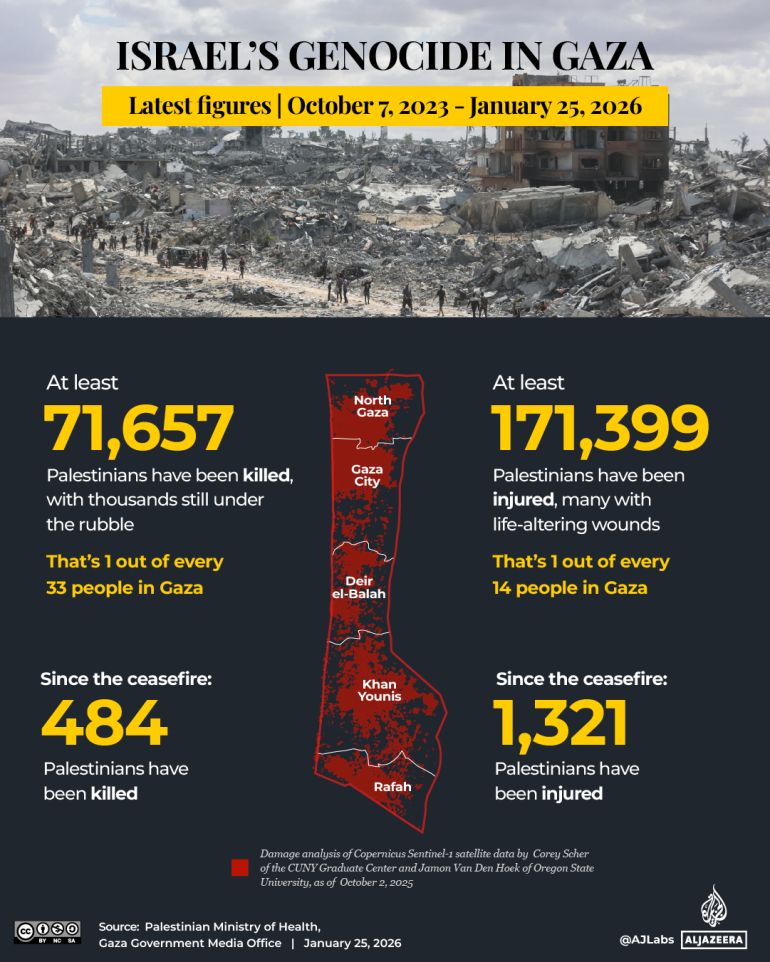
Gaza City — After 18 years as a teacher with an UNRWA-run school, Maryam Shaaban (name changed for safety reasons) fainted upon learning she was among 600 employees dismissed from their posts, the latest in a barrage of devastating blows borne out of Israel’s genocidal war on the besieged enclave.

Earlier in January, the United Nations agency for Palestinian refugees (UNRWA) announced a series of harsh austerity measures, including a 20 percent salary cut for local staff in Gaza, reduced working hours, and the termination of contracts for employees based outside Gaza who had been previously placed on “exceptional leave”.

Recommended Stories

list of 3 itemsend of list

According to a letter sent to affected staff by UNRWA Commissioner-General Philippe Lazzarini, the agency said it was forced to take steps due to a severe financial shortfall in its 2026 budget of some $220m.

The deficit threatens the agency’s ability to meet core operational obligations, including staff salaries and the continuation of essential humanitarian programmes.

Shaaban, 52, who is currently displaced in Egypt with her injured husband, began working with the UN agency in 2007 as a teacher at one of the agency’s schools in Jabalia, northern Gaza.

Like most residents of Gaza, she suffered a heavy price during Israel’s genocidal war.

She was displaced with her family from Jabalia to Nuseirat, in central Gaza, where they took refuge in her brother’s home. In December 2023, they were hit by a direct Israeli air attack that killed 15 people and injured dozens.

Among the victims were Maryam’s 22-year-old daughter, her brother, and his entire family.

INTERACTIVE-GAZA CEASEFIRE-jan 25, 2026_Death toll tracker-1765554400

Israeli targeting of UNRWA

Sustained Israeli campaigns to decimate and denigrate the agency have escalated to unprecedented levels.

Israel has repeatedly accused the agency of being lenient or complicit with Palestinian armed groups, without providing verifiable evidence. These are allegations UNRWA has vehemently denied, stressing that it takes disciplinary action against any employee proven to be involved in wrongdoing.

In 2025, the Israeli Knesset passed legislation effectively banning the agency’s operations in areas it considers part of “Israeli sovereignty”, including occupied East Jerusalem, claiming the agency poses a security threat.

The agency rejected the law as illegal and said it places it in direct confrontation with Israeli authorities.

As of this month, the UN agency has recorded deaths in Israeli attacks of more than 380 of its staff members in Gaza since October 2023.

Earlier this month, Israel sent in bulldozers, partially destroying UNRWA’s headquarters in East Jerusalem. Israeli lawmakers and members of the far-right government were also present, according to Lazzarini, who said the attack came “in the wake of other steps taken by Israeli authorities to erase the Palestine Refugee identity”.

As a UN agency, it enjoys international legal status. UN Secretary-General Antonio Guterres warned Prime Minister Benjamin Netanyahu earlier in January that he could take Israel to the International Court of Justice (ICJ) if it does not repeal laws targeting UNRWA and return its seized assets and property.

‘By what law does this happen?’

Maryam herself sustained minor injuries in the Israeli attack, while five of her children also suffered injuries. Her husband was critically wounded in the neck.

In April 2024, she left Gaza as a medical companion to her spouse, who was referred for treatment at an Egyptian hospital. She was forced to leave behind the rest of her children in Gaza, including those who were wounded.

“It feels like leaving for treatment and escaping death has become a crime we are being punished for,” Maryam told Al Jazeera by phone, her voice breaking with tears.

“Wasn’t it enough that I spent all this time grieving for my injured children, being away from them and constantly worried about them while accompanying my husband in treatment? They added to our wounds by dismissing us from our jobs. By what law does this happen?”

For Maryam and many others who were displaced outside Gaza during the war, the blow was especially severe, as it followed a February 2025 decision to place them on “exceptional leave” despite the fact that many of them continued teaching remotely.

“All my children are injured and have metal plates in their limbs. They suffered immensely after my salary stopped,” said the mother of eight.

In the past two weeks, the crisis has extended to employees who remain in the Strip, after the agency decided to cut their salaries by 20 percent, a move that has further deepened their humanitarian suffering amid Gaza’s catastrophic conditions.

The financial shortfall comes amid a decline in international donations, which had long formed the backbone of UNRWA’s budget, particularly after several donor states froze their contributions following Israeli allegations against some of its employees.

UNRWA provides essential services to millions of Palestinian refugees, who make up about 70 percent of the Gaza population, including education, healthcare, and social assistance, playing a central role in maintaining a minimum level of stability amid repeated Israeli wars and restrictions on crossings.

Dr Mustafa Al-Ghoul, a dentist with UNRWA for 29 years, who heads the UNRWA staff union
Dr Mustafa al-Ghoul, a dentist with UNRWA for 29 years, who heads the agency’s staff union, is currently leading protests against its recent decisions [Abdelhakim Abu Riash/Al Jazeera]

Why Gaza first?

There has been widespread anger and protests among UNRWA staff in Gaza, both inside and outside the Strip, who argue that the measures disproportionately target Gaza compared with the agency’s other five areas of operation: the occupied West Bank, Jerusalem, Jordan, Lebanon, and Syria.

Mustafa al-Ghoul, head of the UNRWA staff union in Gaza and a dentist who has worked with the agency for 29 years, questioned why Gaza — the most devastated and afflicted area — was chosen as the first sacrifice.

“All the measures started in Gaza, as if Gaza is not already overwhelmed by death, destruction, and hunger,” he told Al Jazeera, standing in front of their partially destroyed headquarters in Gaza City.

Of some of the 600 dismissed Palestinian employees who were outside Gaza, the cutting off of their salaries and savings without prior notice, al-Ghoul said, “Some are sick. Some have cancer. Some were on official leave. Some lost their entire families. Some left to treat a grandchild, and then they are punished with dismissal and deprivation of their rights.”

“Gaza needs someone to heal its wounds. Gaza is dying. You see tents, death, and destruction everywhere. Gaza needs compassion, not dismissals and the drying up of its lifelines,” al-Ghoul appealed to UNRWA’s leadership.

UNRWA Gaza aid access
Jihan al-Harazin with her husband and their three children in their tent west of Gaza City, where they were displaced after their home was destroyed [Abdelhakim Abu Riash/Al Jazeera]

‘UNRWA was the backbone of our survival’

Union warnings about the consequences of UNRWA cuts are already visible in the scarred daily lives of displaced Palestinians in Gaza, particularly in education, healthcare and food security.

This decline is reflected in the testimony of Jihan al-Harazin, 28, a mother of three, displaced in Gaza City, whose family relied almost entirely on the agency’s services.

“UNRWA was the backbone of our survival,  in health, education, and food. It provided everything,” she told Al Jazeera.

That reality, however, has changed dramatically since the war began.

“Now, there is nothing,” Jihan said, referring to the food aid that UNRWA has not been able to distribute for months.

Since October 2023, all humanitarian agencies, particularly the UN egency, have faced persistent obstacles in delivering aid to Gaza.

On multiple occasions, Lazzarini accused Israel of using humanitarian aid as a political tool. He said Israel is using aid to Gaza “as a weapon” to deepen civilian suffering.

‘A war waged on humanitarian work’ in Gaza

Amjad Shawa, director of the Palestinian NGOs Network (PNGO) in Gaza, told Al Jazeera that UNRWA represents “the backbone of humanitarian work in the Palestinian territory”, stressing that its role extends beyond services to the political core of the refugee issue as one of the last pillars of humanitarian and social stability in Gaza.

“UNRWA carries a central cause for our people, the refugee cause itself. It was established by a UN General Assembly resolution and has operated for decades,” he said.

Al-Shawa said the agency is facing “continuous Israeli incitement” alongside Israeli bans on its operations in the occupied Palestinian territory, particularly Gaza, and the obstruction of humanitarian aid.

He warned that weakening UNRWA serves Israel’s agenda to erase the Palestinians’ right of return and compensation. That has been a key goal of the successive Israeli governments.

Linking the agency’s cuts to a broader campaign against humanitarian work in Gaza, al-Shawa noted Israel has faced global condemnation after a ban on dozens of international aid organisations working to provide life-saving assistance to Palestinians in the war-ravaged Gaza Strip came into effect.

Cages, crushes and stabbings – is European away safety getting worse?

Football fans across the country dream of following their club in Europe, seeing them take on the cream of the continent’s crop alongside friends and family.

But European away trips aren’t all sunshine, sangria and singalongs – in recent years, there have been a number of significant security incidents in which fans’ safety has been put at risk.

The 2022 Champions League final became a “near mass fatality catastrophe” due to poor organisation by Uefa and French authorities, while in the years since, fans of Manchester City, Manchester United and Newcastle have strongly criticised policing and security measures at matches in Istanbul, Lyon and Marseille respectively.

Earlier this season, fans were even barred from attending some away matches in the Champions League amid “extremely worrying” security trends which some believe are worsening, stripping fans of dignity and in some cases leading to dangerous situations.

Common issues fans report include:

‘Lives are being put at risk’

“There are definitely countries where the situation is deteriorating, like Germany, Belgium and the Netherlands,” said Ronan Evain, executive director of Football Supporters Europe (FSE), which invites travelling fans to fill in a survey about their experience after each round of European fixtures.

“There are also repeat offenders – countries and clubs where things are not improving and they have demonstrated that they are not capable of hosting games in acceptable conditions.

“France, Spain, Portugal and Italy are major tourist destinations that are very used to hosting people from all over the world, but clearly treat football fans completely
differently – like a threat or second-tier citizen.”

Security arrangements and policing strategies for European matches are developed via a combination of host clubs, national governments, local authorities and regional police forces, with input from Uefa, who run the competitions.

The way fans are treated can vary drastically based on the place they are visiting, the policies of those running the country and/or city, the behaviour of home fans, and the context of the game. Plus, not every fan will have the same experience as others on the same trip.

“There are some things that are small humiliations – being forced to enter a stadium four hours before kick off, put on a bus for hours with no toilet, having lip balm taken off you,” Evain said.

“These things are rarely necessary, and are either a way for the police to exert a form of social control, or just completely outdated.

“Then we see things like pushing thousands of fans through gates no bigger than an apartment door – there are clearly policing strategies and infrastructural failures that are
putting people’s lives at risk.

How do European away trips play out?

BBC Sport asked fans who are experienced European away travellers to document how English clubs’ trips unfolded during the last two Champions League and Europa League matchweeks, choosing a range of games in different places with varied approaches to policing and security measures.

Gemma Manns, 44, Chelsea fan in Naples, Italy: “We avoided arriving in Naples until the afternoon of the game, based on Napoli fans’ reputation for hostility.

“Hearing about the two young guys who were stabbed was horrible but not surprising.

“In the end we didn’t see any trouble around the ground once we got to Naples, and the checks were all efficient.

“We were kept behind for over an hour after the game, and big groups of ultras stayed in their stand to try to intimidate us, so we felt at risk.

“Once we headed towards the designated buses after leaving the ground, the police completely disappeared, and we were packed on.

“The doors were open doors and we had no protection when it felt like we might need it – that was really sketchy.”

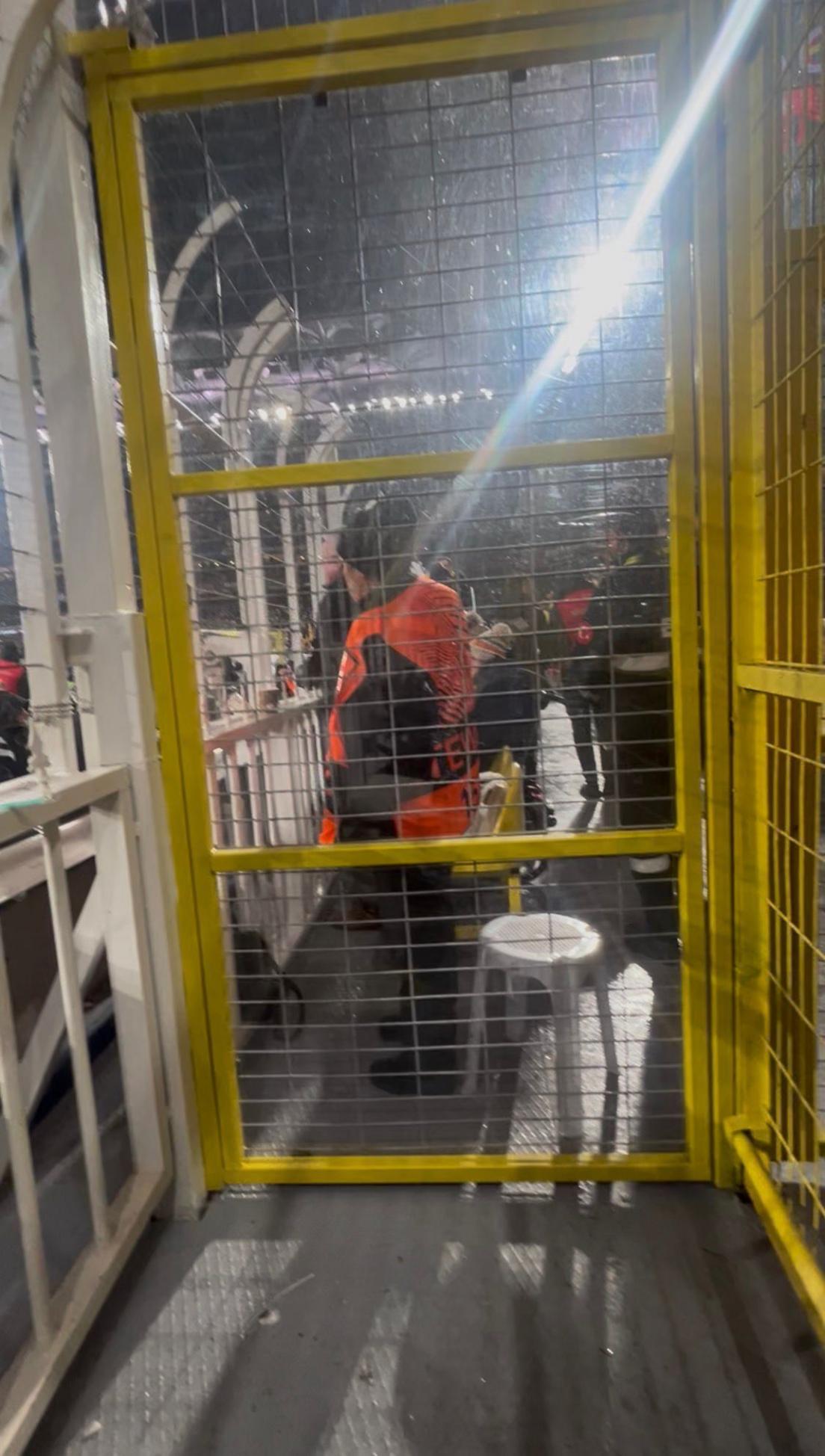
Jude Aston, 21, Aston Villa fan in Istanbul, Turkey: “I am a wheelchair user, and although we were warned by Villa about what conditions would be like, it was still worse than I expected.

“The cage was locked for most of the match, and I was the furthest one along – I couldn’t get out to use the toilet until half time and I don’t know what I would have done if there was a fire or something. I felt quite claustrophobic. It was unsettling.

“My personal assistant was separated from me, outside the cage, and I was worried about my phone dying in an emergency because I wasn’t allowed to take a power bank in.

“I know in theory the cage is for our safety from home fans, getting to and from the stadium was efficient, and the police and stewards were very friendly, but it’s 2026 – there has to be a better way than this.”

Jane Boland, 61, Liverpool fan in Marseille, France: “The riot police made entering and exiting the stadium really hard work. After being told to arrive at a designated meeting point more than four hours before kick off, we were held in overcrowded areas and made to wait for ages, sometimes with difficult or no toilet access.

“Leaving the stadium took over two hours after full time – by far the longest I’ve ever experienced. We were stood packed on stairwells for what felt like forever, and I had awful back pain afterwards. I understand that someone passed out and needed medical attention, and in retrospect I’m surprised it was only one.

“After two days of everything being great and nothing but friendly interaction between the two sets of fans, we were treated like cattle.

“I probably spent about £1000 on the trip, most of that in Marseille itself, so it smarts to be treated so badly as a ‘customer’.”

Sue Fox, 68, Spurs fan in Frankfurt, Germany: “Transport was pretty efficient, overall. The meeting point was well organised and the police gave clear instructions.

“Then we took a train and they marched us through a very dark, muddy forest for about half an hour. When we arrived at the ground the gates were locked so we had to queue for an hour, and we were all packed very close together. It was uncomfortable and inappropriate.

“The men were able to go to the toilet in the bushes, but what were we supposed to do? It was nearly two hours without being able to go.

CRS police officers watch on during a Marseille match in the Uefa Champions LeagueGetty Images

Dylan White, 21, Arsenal fan in Milan, Italy: “On the way to the stadium we had to wait in big, tight queues for the designated metro for a long time, and then got packed on like sardines.

“Outside the ground, some extremely thorough ticket checks meant we were in very tight queues again, which got tighter and tighter because the entry gates were locked until 20 minutes before kick off.

“Finally they let us through and we had to walk up the enormous spirals to enter the ground, just about making it in time for kick off.

“We were out of the San Siro within about half an hour of full time, which we’d have definitely taken, and then people had to go and collect their portable chargers which had been confiscated on the way in.

“The police were brilliant with us but the way of getting fans to and then into the ground could do with a lot of work.”

Luke Stanley, 22, Man City fan in Bodo, Norway: “The whole experience in and around the stadium was very straightforward and everyone was very friendly – entry was as easy as it could have possibly been.

“We hardly saw any police officers and the ones we did were helpful guiding us.

To play this video you need to enable JavaScript in your browser.

‘It’s an attack on dignity’

A number of negatives experienced by fans – including inadequate facilities for fans with disabilities, restricted access to toilets, and travel bans – break Uefa’s own rules and guidelines.

Supporters with disabilities can face particularly grim scenarios.

“It is absolute fury and frustration [seeing the cages for wheelchairs users],” says Owain Davies, chief executive of Level Playing Field, which campaigns on behalf of sports fans with disabilities.

“This is not an isolated incident. We’ve had stories of disabled fans being carried into stadiums, or changing on urine-soaked floors. In one of our surveys, 79% of fans said they had been made to sit in home sections on European trips, potentially opening them up to abuse.

“It really is heart-breaking to see this inequality in a huge tournament run by Uefa. It is an attack on dignity.

Aston Villa players celebrate in front of the away end after beating Fenerbahce 1-0 in the Uefa Europa League in IstanbulGetty Images

‘Games should be moved or teams thrown out’

The practice of regional police forces banning away fans from even attending some matches has become more common in recent years, particularly in France, Italy and the Netherlands.

Last autumn Maccabi Tel-Aviv supporters were banned by West Midlands Police from attending their club’s fixture against Aston Villa, a rare instance of a travel ban in England.

In some cases where fans are allowed to travel, they are banned from visiting the centre of the host city. This happened to Marseille fans in Bruges and Juventus fans in Nice for their trip to Monaco earlier this week, with the announcements made only days before the matches took place.

“Away travel bans are a good example of a country saying,
‘sorry, we can’t organise this game in an acceptable way’,” Evain said.

Napoli and Frankfurt players compete for the ball during their Champions League matchGetty Images

What does Uefa have to say?

BBC Sport put questions about the issues raised by fans to Uefa.

Uefa said: “We have, in recent years, considerably strengthened our partnerships with key European stakeholders responsible for safety and security.

“For the first time in the past decade, Uefa has recorded a measurable decline in the proportion of matches affected by incidents, which is an encouraging indicator of progress.

“[Since 2022] we have implemented stronger integrated operational planning and increased safety and security deployment at finals.

“The competent local authorities retain their legal powers and the final decision-making authority for safety and security measures at matches taking place on their territory.”

On disability access, they said: “Uefa is fully committed to ensuring a barrier‑free and inclusive matchday experience for disabled supporters.

“While we recognise that challenges persist and that improvements are needed in some contexts, accessibility remains an integral part of our commitment to safe, inclusive and welcoming football environments.”

Regarding travel bans, they said: “Although things cannot change overnight, all stakeholders have expressed a strong commitment to close cooperation in the search for sustainable solutions.”

‘Deeply concerned by lack of reforms’

Supporters commonly told the BBC that issues with organisation and the authorities occurred more often than risks posed by rival fans.

So why is a downward spiral in standards seemingly happening?

“The political atmosphere at the moment in Europe
doesn’t really help when it comes to police accountability,” Evain says.

“We see a number of governments wanting to show muscle, and football fans are an easy target.

“The British clubs are often in a better position compared to fans from other countries
because there are very good UK police delegations who travel with fans to away matches, and the clubs are well organised with pre-match security visits and bring a high number of their own staff.”

The final report into the 2022 fiasco, commissioned by Uefa and compiled by a panel of independent experts, found Uefa primarily at fault and made a series of recommendations to improve fan safety at matches, including Uefa taking more responsibility for security in their role as the event organiser.

“I am deeply concerned by the lack of tangible reforms since our report,” says Clifford Stott, professor of social psychology at Keele University and one of the authors of the report.

“Uefa’s response to our findings was limited to formal statements, with no substantive follow-ups or evidence of implemented changes.

Related topics

  • Liverpool
  • European Football
  • Europa League
  • Chelsea
  • Aston Villa
  • Manchester City
  • Tottenham Hotspur
  • Arsenal
  • UEFA Champions League
  • Football

The small ex-Wales U20s captain proving to be a big URC hit

  • 4 Comments

Former Wales Under-20s captain Harry Beddall is punching above his weight for Dragons after impressively making the step up to the United Rugby Championship (URC).

The open-side flanker arrived at Rodney Parade last summer from Leicester and the initial plan was to bed him in gently in Super Rygbi Cymru with Ebbw Vale.

However, the 21-year-old from Cardiff has made seven senior outings, five of them starts, and produced a remarkable defensive display at Munster last weekend.

The official URC stats recorded 33 tackles by Beddall in the 22-20 loss in Cork, as Dragons came agonisingly close to a huge upset.

The 5ft 10in (1.78m), 14st 11lb (93.9kg) flanker is ranked 15th in the league tackle chart on 99 despite only featuring in six of 10 rounds.

“He started to make it so hard not to pick him. He is phenomenal and a great talent with a great attitude,” said Dragons defence coach Dale MacLeod.

    • 16 hours ago
    • 1 day ago

Beddall’s appetite for defence comes as no surprise after his efforts when captaining Wales in the 2025 Under-20 Six Nations.

He topped the tournament tackle chart with 109 in five fixtures, including 34 in the backs-to-the-wall win against Ireland in the Rodney Parade rain.

Beddall arrived at Dragons with limited senior experience after a solitary Premiership Cup appearance for Leicester and some outings for Hartpury University RFC in the English Championship.

The flanker is proving to be cut from the same cloth as Rodney Parade cult hero Nic Cudd, another 5ft 10in (1.78m) open-side that mixed it with the heavy hitters.

“We talked about ‘Bedds’ at the start of the season and how we would give him a little bit of a taste because he is only a young man,” said MacLeod.

“He got an opportunity because of some injuries and then went out and made something like 20 tackles.Then he went out and made 29.

Wales Under-20s captain Harry Beddall makes a tackle against EnglandHuw Evans Picture Agency

Dragons, who take on Ospreys in Bridgend on Saturday (19:45 GMT) have also picked Thomas Young, Harri Keddie and Shane Lewis-Hughes in the seven jersey this season.

Beddall, the club’s lightest forward, has profited from learning from the senior back-row forwards – and now has them sweating on their starting spots.

“He is very coachable with a want to get better,” said MacLeod. “He takes nothing for granted, he keeps working on his action plan and is really clear about how he is going to get there.

Related topics

  • Dragons
  • Welsh Rugby
  • Wales Sport
  • Rugby Union

Can Bangladesh’s Awami League survive election ban, ex-PM Hasina’s exile?

Dhaka, Bangladesh – As boatman Ripon Mridha washed his feet early in the morning after a night of fishing in Bangladesh’s mighty Padma River, his eyes scanned the walls and shutters of the shops in the neighbourhood market.

Until recently, the neighbourhood in central Bangladesh’s Rajbari district was plastered with large posters and banners, with the faces of local politicians belonging to former Prime Minister Sheikh Hasina’s Awami League party looming large.

Recommended Stories

list of 4 itemsend of list

Today, those signs are gone, leaving little traces of a party that ruled over Bangladesh for 15 years before a student-led uprising in 2024 toppled Hasina’s iron-fisted government and forced her into exile in India, her close ally.

After the uprising, Hasina’s Awami League was banned from all political activities, while a special tribunal, ironically founded by Hasina herself in 2010 to try political opponents, sentenced her to death in absentia for her role in the killing of more than 1,400 people during the protests.

On February 12, the country of 170 million people is scheduled to vote in its first parliamentary election since Hasina’s ouster.

Mridha, a lifelong Awami League voter, said he feels little enthusiasm over the election after the party he supported had been banned. He might still vote, but faces a dilemma over whom to support since the Awami League’s boat symbol will not appear on the ballot.

The boatman, about 50 years of age, said that his family fears that if they don’t vote, they might be identified as Awami League supporters in a country where Hasina and her party today draw widespread anger for the decades of killings, forced disappearances, torture and political crackdowns that they oversaw.

Under Hasina’s rule, the Jamaat-e-Islami party and Bangladesh Nationalist Party (BNP) – the Awami League’s two biggest opponents – were systematically persecuted. The Jamaat was banned, some of its leaders were executed, and many others were imprisoned. Thousands of BNP leaders were arrested, including former Prime Minister Khaleda Zia, who died in December. Her son and current BNP leader Tarique Rahman lived in exile in London for 17 years before returning to Bangladesh in December.

Widespread political violence continues to trouble Bangladesh’s preparations for the elections, with leaders from the BNP, Jamaat and other parties killed in recent weeks. But now, like their counterparts from other parties, common supporters of the Awami League no longer enjoy immunity either from the anger the actions of their leaders have triggered.

“If we don’t vote, we risk being singled out,” Mridha told Al Jazeera. “So our family will go to the polling centre.”

Conversations with longtime Awami League voters in areas where the party once dominated reveal a divided mood.

While many say they will still go to polling centres, others say they may not vote at all.

Like Solaiman Mia, a rickshaw puller in Gopalganj, the Hasina family’s bastion and the hometown of her father and Bangladesh’s founder, Sheikh Mujibur Rahman, whose grave lies in the district south of Dhaka as an enduring symbol of the Awami League’s powerful grip on the region. Hasina won huge victories in Gopalganj in every election since 1991.

Mia is unequivocal that he and his family would not vote this year. “An election without the boat on the ballot is not an election,” he told Al Jazeera, a sentiment shared by many residents of Gopalganj.

‘Awami League will return’

In central Dhaka’s Gulistan area lies the Awami League’s head office – now abandoned after it was vandalised and set on fire during the uprising. Since then, the building has been used as a shelter by homeless people and sections of it as a public toilet.

Outside the office, street vendor Abdul Hamid says he has not seen Awami League activists anywhere near the area for months.

“You won’t find any Awami League supporters here,” he said. “Even if someone is a supporter, they would never admit it. The Awami League has faced crises before, but it has never almost disappeared like this.”

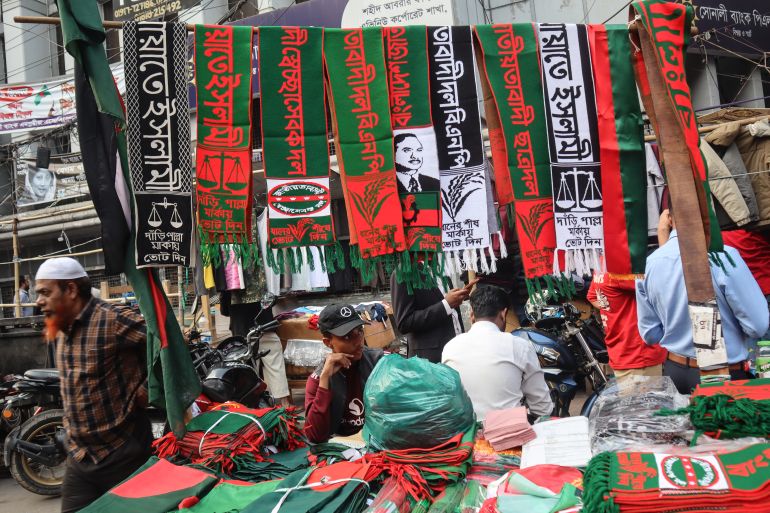
Nearby, another street vendor, Sagor, is selling woollen scarves draped in the symbols of the BNP and its former ally and now rival, the Jamaat-e-Islami party.

“The scarves belonging to the parties are selling well,” he said as pedestrians surrounded him.

Bangladesh Election
A vendor selling scarves with BNP and Jamaat party symbols in Dhaka [Masum Billah/Al Jazeera]

Still, some Awami League supporters are optimistic about the party’s resurgence.

Arman, a former leader of Bangladesh Chhatra League, the student wing of the Awami League, said the party may be maintaining a strategic silence, but is far too entrenched to disappear from Bangladesh’s politics.

“The Awami League will return,” he told Al Jazeera. “And when it does, it will return with Sheikh Hasina.”

But Rezaul Karim Rony, a Dhaka-based political analyst and editor of Joban magazine, is not so sure. He thinks surviving the February election will be difficult for the Awami League.

“If an election takes place without the Awami League, its voters will gradually go through a form of reconciliation at the local level,” Rony told Al Jazeera. “They will be absorbed locally – aligning themselves with whichever influential forces or parties dominate their areas – and begin rebuilding their everyday lives that way.”

As a result, Rony said, it will be difficult for the Awami League to recover its support base once the election is over. He said while a section of the party’s supporters still sees no future for the party without Hasina, a sizeable group within it is frustrated by her authoritarian rule when she was in power.

“With supporters divided, with or without Hasina, returning to its previous political position is extremely difficult – almost impossible – for the Awami League,” Rony said.

‘Feels like a political wipeout’

Other analysts argue that a recent surge in support for Jamaat-e-Islami could, paradoxically, offer a reference point for a possible future revival of the Awami League. The Jamaat supported Pakistan during Bangladesh’s war of independence in 1971, a role that its critics – including Hasina – have repeatedly used to challenge its credibility.

The party was banned twice, and its top leaders were hanged and jailed during Hasina’s rule. Still, it survived, and is now – according to polls – on the cusp of its best ever performance in the February elections.

“Jamaat’s current level of activism, influence and assertiveness – what might even be described as a show of dominance – can paradoxically be seen as a kind of blessing for the Awami League,” Anu Muhammad, a retired economics professor at Jahangirnagar University, told Al Jazeera.

Muhammad said the appeal of the Awami League extends far beyond its formal political structure, making its total political erasure unlikely. “The Awami League is not just its leadership,” he said. “It is connected to cultural, social and other forces.”

Bangladesh Election
A vandalised and deserted Awami League office in Rajbari, Bangladesh [Golam Mohiuddin Shohan/Al Jazeera]

A pre-election survey by the International Republican Institute, a United States think tank focused on democratic governance, suggested the Awami League still retains a support base of about 11 percent.

Yet, the party does not feature in the ongoing election campaign, and its leaders have instead been seen organising events from India, including a controversial address by Hasina – her first since ouster – at a “Save democracy in Bangladesh” event at New Delhi’s Foreign Correspondents Club.

“To overthrow the foreign-serving puppet regime of this national enemy at any cost, the brave sons and daughters of Bangladesh must defend and restore the Constitution written in the blood of martyrs, reclaim our independence, safeguard our sovereignty, and revive our democracy,” Hasina said in a prerecorded audio message.

A furious Dhaka said it was “surprised and shocked” that Indian authorities allowed such an event to take place.

Back home, however, Hasina’s party is struggling to assert political relevance, raising questions about its survival.

Michael Kugelman, senior fellow for South Asia at the Atlantic Council, argued that, by strict democratic standards, an election in Bangladesh without the Awami League cannot be considered fully credible, calling the vote “an election with an asterisk”.

At the same time, he argued, the Awami League had – in the eyes of many Bangladeshis – forfeited its rights to be treated as a legitimate party because of the repression that Hasina had overseen and its earlier efforts to tilt the electoral playing field. The 2014, 2018 and 2024 elections – which Hasina won with a landslide – were all widely seen as manipulated, with opposition boycotts and crackdowns on rivals.

Still, Kugelman said the nature of dynastic political parties in South Asia is such that they rarely die.

“Even though the Awami League is in a bad place, it is essentially out of the political picture indefinitely in Bangladesh; one certainly should not rule out a potential future comeback. Political circumstances can change very quickly,” he told Al Jazeera.

Kugelman compared the party’s current crisis with what its bitter rival, the BNP, suffered during Hasina’s regime when the main opposition party struggled to mount a meaningful political or electoral challenge – only to re-emerge now as the most likely contender for power.

He said the Awami League is likely to adopt a “waiting strategy”. As long as Hasina remains politically active, she is likely to “want to stay in the game” and might also announce her US-based son Sajeeb Wazed as her dynastic successor.

“It could take time,” Kugelman said. “Given how politics play out in this region, they can be quite volatile. If an opening emerges down the road and the Awami League is in a better position to operate as a viable political force, it could well come back. But for now, it is essentially dead in the water.”

That is not a happy portent for Mridha, the boatman in Rajbari, for whom the uncertainty over his party’s future is deeply unsettling.

“My father used to talk about how the Awami League struggled after Bangabandhu [as Hasina’s father is fondly called] was assassinated,” he said, referring to Rahman’s assassination during a coup by the army in 1975, which pushed the Awami League into its first major crisis.