Archive January 30, 2026

Can Trump’s ‘madman theory’ reshape Iran and the Middle East?

In June 2025, the United States had just struck Iranian nuclear sites, but rather than signal that the bombings were the opening salvo of a war between the US and Iran, President Donald Trump was quick to try to draw a line under the attack.

“Now is the time for peace,” was Trump’s message at the time.

Recommended Stories

list of 3 itemsend of list

Fast forward to the present day, and Trump is threatening an even bigger attack, and backing up the threat with a large-scale movement of US military assets, including an aircraft carrier, towards Iranian waters.

Trump says that these threats are his way of convincing the Iranians to agree to a deal – reported to include demands to effectively end Iran’s nuclear programme, limit its ballistic missile programme, and stop support for allies across the Middle East.

This is the Trump school of foreign policy: heavy on threats, and willingness to carry out calibrated and – at least initially – confined military action, designed to avoid US military entrenchment. At the same time, Trump says that he is not necessarily a supporter of regime change, but leaves the door open for it.

Trump actively cultivates an image that may – in a more disparaging way – be called the “madman theory” of foreign policy. Said to have originally been coined by former US President Richard Nixon in the late 1960s, the idea is for the enemy to question just how far you are willing to go, even if it seems irrational.

The US assassination of Iranian General Qassem Soleimani in 2020 was one of the major examples of Trump acting this way during his first term. The unexpected killing of a senior state official of another country risked direct war and went against the opinions of many foreign policy experts. And yet Trump saw it as an act of deterrence and strength, and felt vindicated once it became clear the Iranians would not respond in kind.

In his second term, Trump has doubled down on this style of foreign policy, most notably in the abduction of Venezuelan President Nicolas Maduro. It now serves to give added heft to his current threats towards Iran.

The tactic serves two separate instincts within Trump and those around him – a desire to appear to be different from the neoconservatives who took the US into the 2003 war and subsequent disastrous occupation of Iraq, while simultaneously weakening any force in the region deemed to be a threat to the US or its chief Middle Eastern ally, Israel.

In essence, Trump wants to use the threat of force – and the occasional attack – to get short-term “wins” that make US enemies weaker, while steering clear of any protracted engagements.

Can Trump be successful?

How long that can work for depends on the size of the goal. When limited concessions are acceptable to both the US and the adversary, Trump’s threats can potentially lead to results in his favour.

The US president’s current threat to “no longer help” Iraq if the pro-Iranian politician Nouri al-Maliki becomes prime minister is a case in point.

Trump may be imposing his will on Iraq, but it is a threat backed not by war, but by potential economic consequences, therefore reducing the sense that Iraqi sovereignty is under attack. It also leaves the door open to other politicians the US deems acceptable to be prime minister, including the man currently in the job, Mohammed Shia al-Sudani.

Al-Sudani is within the same wider Shia political alliance as al-Maliki, but is considered not to be as close to Iran and does not have the latter’s baggage. Keeping al-Sudani in power instead of al-Maliki, if that does indeed happen, is a relatively easy deal to make in return for avoiding any US economic wrath – and allows Trump to secure another “win”.

In Syria, US policy appears to be more focused on gradual withdrawal, because Trump feels like he has a partner in the group that he can work with in President Ahmed al-Sharaa. US policy in Syria is fixated on two goals: ensuring that ISIL (ISIS) does not strengthen, and guaranteeing no threat towards Israel from Syria.

At the same time, Trump has no qualms in abandoning the Kurdish-led Syrian Democratic Forces, a US ally now deemed surplus to requirements.

Instead, Gulf powers, led by Saudi Arabia, have said that they can vouch for the Syrian government and al-Sharaa, and for Trump, this is a way to largely wash his hands of at least one problem in a region he has long maintained is prone to endless wars.

Increasing complications

In Lebanon and Gaza, Trump has attempted to use the threat of military force to achieve two goals: an end to all-out war and for anti-US and anti-Israel forces to agree to disarm.

Trump’s policy goals in Lebanon and Gaza are less maximalist than in Iran, but achieving them will be more complex than the relatively moderate concessions demanded of Iraq.

In both Lebanon and Gaza, the US has stepped in after devastating Israeli wars and positioned itself as a peacemaker, despite backing Israel in both of the conflicts.

And yet peace is conditional on armed groups – Hezbollah in Lebanon and Hamas in Gaza – disarming completely. During the gradual negotiations in both instances, the US has presented itself as a restraining force on Israel, preventing a return to all-out war, but allowed Israel to carry out regular small-scale attacks that serve as reminders of what Israel and the US could carry out if their demands are not met.

But full disarmament is a bitter pill to swallow for both Hezbollah and Hamas.

In Syria, Hezbollah and its supporters would see this as accepting defeat in the fight against the US and Israel – a catastrophic blow for an organisation that sees itself as a resistance movement to those two powers.

Trump’s “Board of Peace“, the body established to oversee the administration of Gaza, is more palatable to Hamas to a point, but similarly, the full disarmament being demanded of the group will take away one of the central elements of its self-identity, even as Israel’s occupation of Palestinian land continues with no end in sight.

It is therefore likely that both Hezbollah and Hamas believe that agreeing to the demand to fully disarm is an existential matter, opening the door to a future breakdown of negotiations.

Long-term consequences

Iran’s past experience with Trump and perception of its own existential threat may test the limits of Trump’s approach to foreign policy.

Trump insists that he wants a deal, but the Iranian government is signalling that it simply does not believe him, based on what it believes to be his duplicitous previous attacks during negotiations, and his willingness to abduct foreign leaders as a means of projecting US power.

The Iranians appear to see few off-ramps, and based on their experience in the past year, now regard concessions as merely inviting further pressure.

The Islamic Republic – or at least elements within it – sees that its own survival is at stake. So now, for the US and Trump, it is the other side that may have nothing to lose. In these circumstances, can the “madman” foreign policy approach work?

England through to U19 World Cup semi-finals

Under-19 World Cup, Super Six Group 2, Bulawayo

England 234-7 (50.0 overs): Mayes 53 (70); Reddy 2-28

New Zealand 169 (38.5 overs): Reddy 47 (65); Lumsden 5-17

England won by 65 runs

Manny Lumsden took five wickets as England booked their spot in the semi-finals of the men’s Under-19 World Cup with a 65-run over New Zealand.

Hampshire seamer Lumsden bowled superbly on a slow pitch at the Queens Sports Club in Bulawayo to finish with impressive figures of 5-17 as the Kiwis were bowled out for 169 in pursuit of 235.

England will play either Australia or Afghanistan in the semi-finals on 3 or 4 February depending on how India perform in their final group game of the Super Six stage against Pakistan.

India are currently in second spot with six points but have a superior net run-rate (+3.337) compared to England’s (+1.757), with the group winners facing Afghanistan and the runners-up playing the Aussies.

“It’s nice to win and know we are through. We are looking forward to the semi-finals now,” said England captain Thomas Rew.

“Manny has been good all tournament. He’s bowled quick and been aggressive, having firepower like that is a great asset.”

England compiled a patient 234-7 after being asked to bat first by the Kiwis on a tricky deck.

Ben Dawkins made 42 as he and fellow opener Joseph Moores put on 48 for the first wicket to give England a solid platform.

Dawkins then shared a stand for the same amount with tournament leading runscorer Ben Mayes, who top scored for England with 53 off 70 balls.

Caleb Falconer (47) and Farhan Ahmed (29) provided some late impetus as Snehith Reddy took 2-28 for the Black Caps.

Lumsden did the early damage for England with the ball when he removed the dangerous Hugo Bogue and Kiwi captain Tom Jones in the eighth over.

Reddy provided some resistance with a stoic 47 off 65 balls, while Jaskaran Sandhu chipped in with 26 before he became Lumsden’s third wicket.

Lumsden then returned to wrap up the victory when he bowled Harry Burns and Hunter Shore in consecutive deliveries.

“It’s a great result and I’m really proud of how we stuck at it with the bat. We knew 230 or 240 would be a good score,” Rew added.

Related topics

  • England U19
  • Cricket

More on this story

    • 16 August 2025
    BBC Sport microphone and phone

Why has Burkina Faso banned political parties, and what’s next?

After several years of suspension, political parties in Burkina Faso have been formally dissolved by the military government, which has also seized all their assets in a move analysts say is a major blow for democracy in the West African nation.

In a decree issued on Thursday, the government, led by Captain Ibrahim Traore, scrapped all laws which established and regulated political parties, accusing them of failing to comply with guidelines.

Recommended Stories

list of 4 itemsend of list

The troubled West African nation is struggling with violence from armed groups linked to ISIL (ISIS) and al-Qaeda. It is one of a growing number of West and Central African nations to have undergone coups in recent years.

Traore seized power in September 2022, eight months after an earlier military coup had already overthrown the democratically elected President Roch Marc Kabore.

Despite strong criticism by rights groups and opposition politicians of his authoritarian approach, 37-year-old Traore has successfully built up an online cult-like following among pan-Africanists, with many likening him to the late Burkinabe revolutionary leader, Thomas Sankara.

Traore’s anti-colonial and anti-imperial pronouncements are often shown in high-definition, AI-generated videos that have gained him widespread admiration across the internet.

But the decision to ban political parties does not sit well for democracy, Dakar-based analyst Beverly Ochieng of the Control Risks intelligence firm, told Al Jazeera.

“The military government will [remain] highly influential, especially after a recent decree appointing Traore in a supervisory capacity in the judiciary,” Ochieng said, referring to a December 2023 constitutional change which placed courts directly under government control.

Going forward, “there will be very limited division of powers or autonomy across the civic and political space,” Ochieng said, adding that the military government will likely keep extending its stay in power.

Ouaga
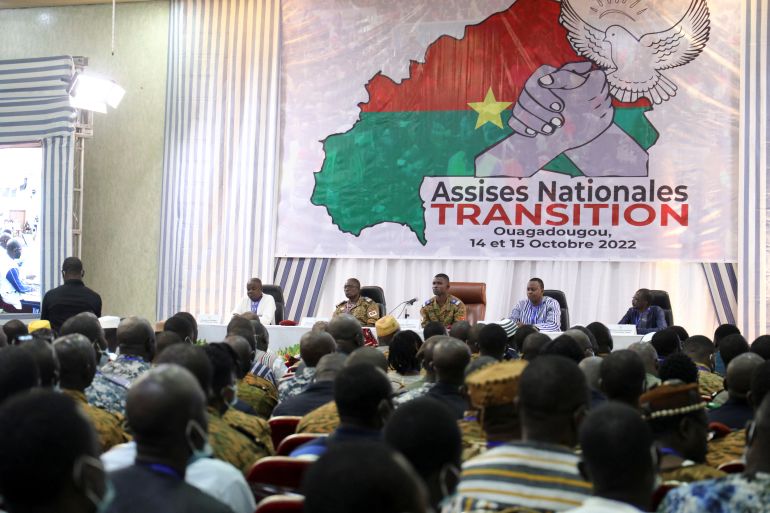
People attend the beginning of two days of national talks to adopt a transitional charter and designate an interim president to lead the country after September’s coup in Ouagadougou, Burkina Faso, on October 14, 2022 [Vincent Bado/Reuters]

Why have political parties been banned?

The Burkinabe government claims the existing political parties were not following the codes which established them.

In a televised statement following a Council of Ministers meeting on Thursday, when the new decree was approved, Interior Minister Emile Zerbo said the decision was part of a broader effort to “rebuild the state” after alleged widespread abuses and dysfunction in the country’s multiparty system.

A government review, he said, had found that the multiplication of political parties had fuelled divisions and weakened social cohesion in the country.

“The government believes that the proliferation of political parties has led to excesses, fostering division among citizens and weakening the social fabric,” Zerbo said.

He did not give details of the political parties’ alleged excesses.

How did political parties operate in the past?

Before the 2022 coup, which brought the current military leadership to power, Burkina Faso had more than 100 registered political parties, with 15 represented in parliament after the 2020 general elections.

The largest was the ruling People’s Movement for Progress (MPP), which had 56 of 127 seats in parliament. It was followed by the Congress for Democracy and Progress, with 20 seats, and the New Era for Democracy with 13 seats.

But the civilian government faced months of protests as thousands took to the streets to demonstrate against growing insecurity from armed groups in large parts of the country.

In 2022, Traore took power, promising to put an end to violence by armed groups. He also promised the regional Economic Community of West African States (ECOWAS) bloc that his government would hold elections by 2024.

But political parties were banned from holding rallies after the 2022 coup and, a month before the 2024 deadline, Traore’s government postponed elections to 2029 after holding a national conference, which was boycotted by several political parties.

Burkina Faso, along with Mali and Niger, withdrew from ECOWAS to form the Alliance of Sahel States, a new economic and military alliance in January last year. They also withdrew from the International Criminal Court (ICC).

In July 2025, Traore’s government dissolved the Independent National Electoral Commission, saying the agency was too expensive.

Traore
Burkina Faso’s President Captain Ibrahim Traore, second left, walks alongside Mali’s President General Assimi Goita during the Alliance of Sahel States (AES) second summit on security and development in Bamako, Mali, on December 23, 2025 [Mali Government Information Center via AP]

Has insecurity worsened under Traore?

Landlocked Burkina Faso is currently grappling with several armed groups which have seized control of land in the country’s north, south and west, amounting to about 60 percent of the country, according to the Africa Center for Strategic Studies (ACSS).

The most active groups are the al-Qaeda-backed Jama’at Nusrat al-Islam wal-Muslimin (JNIM) and Islamic State Sahel Province (ISSP), which also operate in neighbouring Mali and Niger.

The groups want to rule over territory according to strict Islamic laws and are opposed to secularism.

Supporters of Capt. Ibrahim Traore parade wave a Russian flag in the streets of Ouagadougou, Burkina Faso, Oct. 2, 2022.
Supporters of Captain Ibrahim Traore parade with a Russian flag in the streets of Ouagadougou, Burkina Faso, on October 2, 2022 [File: Sophie Garcia/AP]

By December 2024, all three Alliance of Sahel States countries had cut ties with former colonial power France and instead turned to Russian fighters for security support after accusing Paris of overly meddling in their countries.

Between them, they expelled more than 5,000 French soldiers who had previously provided support in the fight against armed groups. A smaller contingent of about 2,000 Russian security personnel is now stationed across the three countries.

But violence in Burkina Faso and the larger Sahel region has worsened.

Fatalities have tripled in the three years since Traore took power to reach 17,775 – mostly civilians – by last May, compared with the three years prior, when combined recorded deaths were 6,630, the ACSS recorded.

In September, Human Rights Watch accused JNIM and ISSP of massacring civilians in northern Djibo, Gorom Gorom and other towns, and of causing the displacement of tens of thousands since 2016.

HRW has also similarly accused the Burkinabe military and an allied militia group, Volunteers for the Defense of the Homeland, of atrocities against civilians suspected of cooperating with armed groups. In attacks on northern Nondin and Soro villages in early 2024, the military killed 223 civilians, including 56 babies and children, HRW said in an April 2024 report.

Mali and Niger have similarly recorded attacks by the armed groups. Malian capital Bamako has been sealed off from fuel supplies by JNIM fighters for months.

On Wednesday night, the Nigerien military held off heavy attacks on the airport in the capital city, Niamey. No armed group has yet claimed responsibility.

Is the civic space shrinking in Burkina Faso?

Since it took power, the government in Ouagadougou has been accused by rights groups of cracking down on dissent and restricting press and civic freedoms.

All political activities were first suspended immediately after the coup.

In April 2024, the government also took aim at the media, ordering internet service providers to suspend access to the websites and other digital platforms of the BBC, Voice of America and HRW.

Meanwhile, authorities have forced dozens of government critics into military service and sent them to fight against armed groups. Several prominent journalists and judges have been arrested after speaking out against increasingly restrictive rules on press and judiciary freedom.

Abdoul Gafarou Nacro, a deputy prosecutor at the country’s High Court, was one of at least five senior members of the judiciary to be forcibly conscripted and sent to fight armed groups in August 2024 after speaking out against the military government. Nacro’s whereabouts are currently unknown.

In April 2025, three abducted journalists resurfaced in a social media video 10 days after they went missing, in one example. All three – Guezouma Sanogo, Boukari Ouoba, and Luc Pagbelguem – were wearing military fatigues in an apparent forced conscription. They have all since been released.

Djokovic beats Sinner as history and Alcaraz await in Australian Open final

Novak ‍Djokovic ‍channelled his halcyon days in a five-set classic to dethrone Jannik Sinner and become ⁠the oldest man to reach ​the Australian Open final ‍in the professional era at a rocking Rod Laver Arena.

Four months before his ‍39th ⁠birthday, Djokovic showed he remains unbeatable on his day as he sent the double defending champion packing with a 3-6 6-3 4-6 6-4 ​6-4 win in a 1:32am finish early on Saturday in Melbourne (14:32 GMT on Friday).

Recommended Stories

list of 4 itemsend of list

“It feels surreal to be honest playing over four hours,” Djokovic said on ​court.

“I was reminiscing in 2012 when I played Rafa (Nadal) in the final, that was six ‍hours almost.

“The level of intensity and quality was high (against Sinner) and that was the only way to have a chance to win.

“He won the last five matches against me, he had my mobile number, so I had to change my ‍number tonight.

“Jokes aside I ⁠said at the net: ‘Thanks for allowing me at least one’. Tremendous respect, an incredible player. He pushed me to the limit, so he deserves applause for his performance.”

Novak Djokovic of Serbia in the Men's Singles Semifinal against Jannik Sinner of Italy
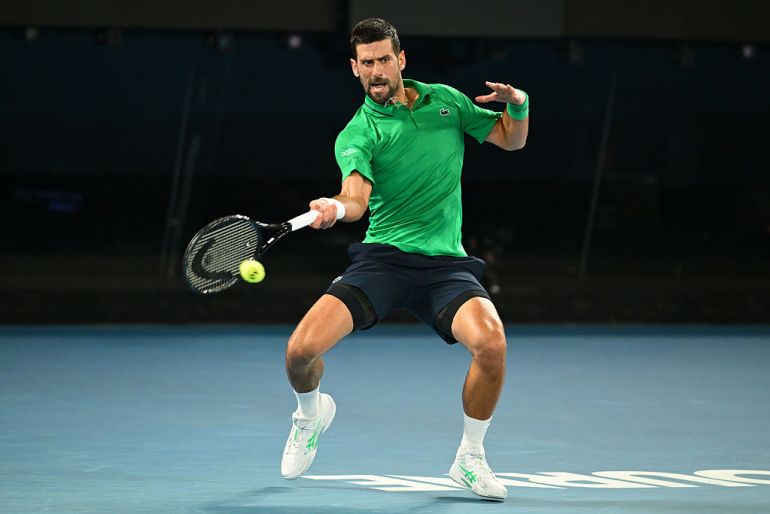
Novak Djokovic of Serbia plays a forehand against Jannik Sinner of Italy [Quinn Rooney/Getty Images]

Djokovic will meet world number one Carlos Alcaraz in Sunday’s decider, the Spaniard having fought off Alexander Zverev in the longest Australian Open semi-final.

Eighteen years after his first Melbourne crown, Djokovic will strive for a record-extending 11th against Alcaraz and the unprecedented 25th Grand Slam title that has eluded him.

Djokovic needed incredible ​fortune to reach the semi-finals, with his quarter-final opponent Lorenzo Musetti retiring injured ‌after taking the first two sets.

The Serb enjoyed a walkover in the fourth round as well, when Jakub Mensik pulled out.

But it was hard work and mental toughness that got Djokovic over the line against Sinner, a player who had beaten him in ‌their previous five matches.

Jannik Sinner in defeat to Novak Djokovic at the Australian Open tennis
Jannik Sinner of Italy plays a forehand in the Men’s Singles semifinal at Melbourne Park[Phil Walter/Getty Images]

Victory came grudgingly.

He had to save a slew of break points in the decisive set before finally getting a look at Sinner’s ‌serve at 3-3.

Flooring the Italian in three punishing rallies, the Serb ⁠broke him to lead 4-3, raised one fist and threw an icy stare at his player’s box.

Djokovic had to save another three break points in the next service game but sent Serbian fans into delirium when he survived them all and held with an ‌ace.

Serving for the match at 5-4, Djokovic summoned the grit and champion spirit of 20 years at the top, setting up two match points with a forehand winner down the line.

Mateta ‘not in right place’ to play against Forest

Crystal Palace striker Jean-Philippe Mateta is “not in the right place” to play against Nottingham Forest as he continues to be linked with a move away, says Oliver Glasner.

AC Milan have accelerated their interest in the France international, having initially enquired in January, but Palace want a fee of £40m after previously rejecting a bid of £35m from Forest.

At Friday’s news conference, Glasner confirmed Mateta will not feature when Palace travel to the City Ground for Sunday’s 14:00 kick-off.

“It is nothing to do right now with the transfers. He is not in the [right] place,” Glasner said.

“To play makes no sense. We have to protect the team and I have to protect him.

Mateta, 28, is Palace’s top scorer this season with eight Premier League goals but told the club he wanted to leave earlier in January.

“Again, there is so much noise, so much speculation, so many things going on,” added Glasner.

“We need every single player at their best and JP [Mateta] isn’t at his best right now with all the noise that happens.

“It can be football noise, but if someone has private issues where they can’t focus on football, then it makes no sense to play.

“He can’t help the team and perform at his top level. We decided it is better not to play him.”

Palace sit 15th in the Premier League and have already sold captain Marc Guehi to Manchester City during the winter window.

They are yet to find a replacement for the England international but Glasner, who said earlier this month that he will be leaving at the end of the season, is confident the club are working to bolster the squad before Monday’s deadline.

“The club is working almost 24 hours a day right now,” Glasner said.

“Marc [Guehi] left two weeks ago and nobody is in. You can imagine it is not so easy – every team wants to play a successful season, so it is not so easy that you can get the players at the end of January.

“I see the club working hard to get players in to replace Marc and, of course, we have to prepare if something happens with JP [Mateta].”

Glasner said the club is preparing for different scenarios and Wolves striker Jorgen Strand Larsen remains a target.

“To be clear, it can be that Mateta stays, and he is a Palace player on 2 February, and it can be that Mateta has left the club and a new striker is in,” said Glasner.

“These are the two situations we are talking about and discussing right now.”

Palace were ready to offer £50m for Norway striker Strand Larsen, but that deal is now in the balance after the Eagles communicated their intention to walk away.

Related topics

  • Premier League
  • Crystal Palace
  • Football
  • Wolverhampton Wanderers

More on this story

  • Selhurst Park
  • Ask Me Anything logo

Carrick not ruling out Man Utd deadline day moves

Michael Carrick has not ruled out Manchester United adding to their squad before Monday’s transfer deadline.

Former United head coach Ruben Amorim said last month he expected to bring someone in during the window.

However, the club’s refusal to divert the £65m they had been willing to spend on long-term target Antoine Semenyo – who opted to join Manchester City from Bournemouth – was a source of frustration for the Portuguese.

United have been linked with a number of central midfield players, including former Wolves skipper Ruben Neves who now plays in Saudi Arabia for Al-Hilal.

After Carrick confirmed left-sided utility man Patrick Dorgu would be out for “a number of weeks” through injury, there have been suggestions the club might look to cover the Denmark international’s absence.

Interim head coach Carrick was coy when asked specifically about the club’s position as he spoke in a news conference to preview Sunday’s Premier League encounter with Fulham.

But he did leave the door open for business being done.

“Never say never,” Carrick said. “A lot can happen and situations can be thrown up.

“Sometimes it is in our control, sometimes not. I am pretty calm. We have shown what we are capable of as a team.”

Joshua Zirkzee remains at the centre of interest as it remains to be seen if he returns to Italy, with Juventus considering whether to make a move for the former Bologna forward who cost United £36.5m 18 months ago.

Zirkzee has recovered from a minor injury and is available for the Fulham game.

“Josh has just been trying to work to get fit,” said Carrick. “It was great to have him training with the group the first time and I am just looking forward to working with him.”

Carrick accepts the issue of Bruno Fernandes’ future is “on the agenda a little bit”, with the United captain due to assess his plans at the end of the season.

    • 1 day ago
    • 4 days ago

Don’t underestimate Fulham – Carrick

Carrick has started his 17-match stint in charge until the end of the season in the best manner possible.

Victories against the Premier League’s top two, Arsenal and Manchester City, have catapulted United into the top four for the first time this season.

However, sceptics argue they have beaten title contenders before and it is against the top flight’s lesser lights that they tend to struggle.

Since late November, United have failed to beat Everton, West Ham, Bournemouth and Wolves at Old Trafford in league games. Three of those sides are in the bottom eight, while Everton had a man sent off after 13 minutes.

Marco Silva’s in-form Fulham had the better of a 1-1 draw against United at Craven Cottage in August.

Fulham have also taken 17 points from their past eight games, only one of which has ended in defeat, and they would close to just one point back from United if they were to win this weekend.

Little wonder Carrick is taking nothing for granted.

“Marco has made Fulham into a really good team,” he said.

Related topics

  • Manchester United
  • Football

More on this story

  • Manchester United bench
  • Ask Me Anything logo